Quick answer Mercury, Yamaha, and Honda all make reliable modern four-stroke outboards. None has a clear mechanical defect rate that rules it out. For Ontario boaters, the practical difference often comes from local dealer access, parts availability and repair capacity.
Quick answer
Mercury, Yamaha, and Honda all make reliable modern four-stroke outboards. None has a clear mechanical defect rate that rules it out. For Ontario boaters, the practical difference often comes from local dealer access, parts availability and repair capacity. Mercury is well represented in our region. Full disclosure: we have sold Mercury exclusively since 1965. Build a live CAD quote at mercuryrepower.ca.
Three-brand quick comparison (2026, Ontario lens)
| Factor |
Mercury |
Yamaha |
Honda |
| Mechanical reliability (2026) |
Strong |
Strong |
Strong |
| Useful life (properly maintained) |
15 to 25 years |
15 to 25 years |
15 to 25 years |
| Ontario dealer density (Kawarthas + GTA) |
High |
Moderate |
Lower |
| Freshwater reputation |
Excellent |
Excellent |
Excellent |
| Extended service contract |
Mercury Product Protection (Gold / Platinum) |
Yamaha YES |
Honda Protection Plan |
| SmartCraft / digital integration |
Yes (current/full lineup) |
Yes (proprietary) |
Yes (proprietary) |
| Software upgrade options |
Mercury Boost on select engines, mostly 175 HP and up |
Not compared here |
Not compared here |
| Parts shelf availability (Ontario) |
Strong |
Strong |
Moderate |
| Rigging cost if switching brand |
n/a (already on brand) |
$2,000 to $3,000 CAD |
$2,000 to $3,000 CAD |
| Resale in Ontario |
Strong |
Strong |
Strong, smaller buyer pool |
Prices here are planning figures as of October 2026. For live Mercury motor pricing, see the Mercury pricing reference.
Conflict-of-interest reminder: HBW is a Mercury Premier dealer. We don't sell Yamaha or Honda and we don't service them. This table reflects our honest read of the Ontario market, but the Mercury column is the brand we know best by a wide margin.
Let us be honest about who is writing this
We are a Mercury dealer. We have been since 1965. We do not sell Yamaha or Honda. For engine repairs, we only service Mercury and MerCruiser. When a customer with a Yamaha or Honda asks about service, we send them to a brand-specific dealer.
This is a conflict of interest. We are declaring it upfront, not burying it, because we think you are better served by a dealer who is straight about their bias than one who pretends to be neutral.
The short answer on mechanical reliability
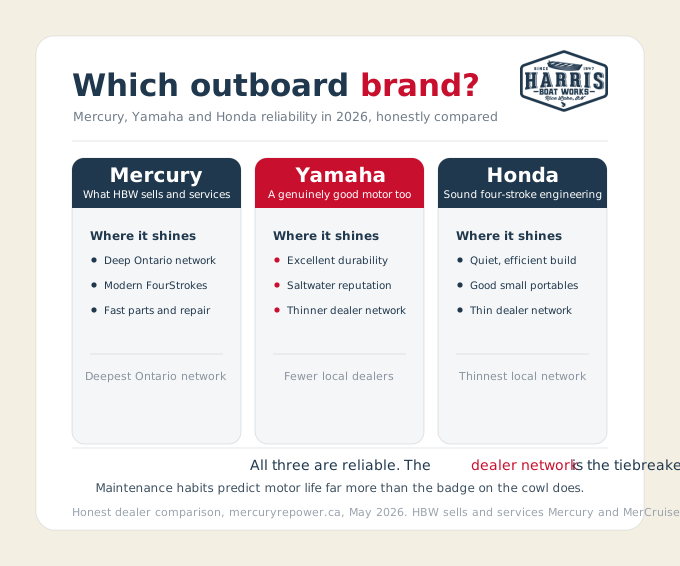
All three brands make mechanically reliable four-stroke outboards in 2026. We are not aware of a meaningful defect rate in any of the three that should rule it out for Ontario freshwater use.
No brand has an honest universal service-life promise. Engine family, installation, load, cooling water, corrosion exposure, storage, and maintenance history all matter. Follow the exact manual, respond early to warnings, and use the model-specific storage procedure. Brand matters less than condition and care.
The factor that actually moves the reliability answer: dealer network
A motor is reliable if it starts when you turn the key, runs through the season without unexpected failures, and gets fixed quickly when something does go wrong. That last part is the one that varies most by brand and region.
Mercury has a broad Ontario dealer network. Around Rice Lake, Ontario and the Kawarthas, that can provide more options for certified service and common parts. Exact inventory and appointment timing still need to be confirmed with the dealer.
Yamaha makes excellent motors. Legendary saltwater durability, well-respected in the offshore community. In Ontario cottage country, Yamaha dealers are present but thinner on the ground than Mercury. Parts that are common in a coastal Yamaha dealer warehouse can take weeks to source inland.
Honda makes mechanically sound motors. Honda outboard dealer network in Ontario is smaller than either Mercury or Yamaha. Honda also has fewer high-HP options at the upper end of the lineup.
The point is not that Yamaha or Honda fail more. The point is that when any motor needs service, Mercury regional dealer depth in Ontario means faster resolution.
Where each brand has had issues (honest version)
Mercury
Strengths: Broad Canadian dealer coverage. Modern Mercury FourStrokes (post-2010) have a strong track record. The 9.9 ProKicker is a common kicker choice on Canadian fishing boats.
Where to be careful: Older generation Pro XS motors had some early production issues that were worked out in subsequent model years. Current-generation Mercury is a mature product.
Our honest take: This is what we sell and what we service. We service what we sell, year after year.
Yamaha
Strengths: A genuinely well-earned reputation for durability, especially in saltwater applications. The Yamaha 4.2L V6 engine family is widely respected in the offshore fishing community.
Where to be careful: Ontario dealer density is lower than Mercury. Repowering from Mercury to Yamaha, or Yamaha to Mercury, requires replacing the full control system: $2,000 to $3,000 CAD in rigging on top of the motor cost.
Our honest take: In saltwater on the coast, Yamaha is a legitimate competitor to Mercury. In our part of Ontario, Mercury often offers more nearby dealer-support options.
Honda
Strengths: Reliable four-stroke engineering. Quiet operation, fuel-efficient at cruise, well-built mechanically. Strong reputation in the small-HP portable class.
Where to be careful: Honda outboard dealer network in Ontario is smaller than either Mercury or Yamaha. Honda also has fewer options at the higher end of the HP range.
Our honest take: Nothing wrong with the motor itself. The practical reliability disadvantage comes from the thinner dealer network in Ontario, not from the engineering.
Brand decision
Switch brands, or stay where you are?
All three brands are mechanically reliable in 2026. The deciding factor is who services it when something goes wrong.
Service network matters most
- ✓You boat in Ontario and want parts in hand same week
- ✓You travel the Trent-Severn or run between lakes
- ✓You do not have a current dealer relationship
- ✓You want resale support when you eventually sell
Mercury often offers more nearby Ontario dealer options
You already have a relationship that works
- ✓Your current Yamaha or Honda dealer treats you well
- ✓Parts and service have not been a problem
- ✓The motor is under 10 years old with reasonable hours
- ✓Switching brands adds $1,500 to $3,000 in rigging
Stay with what works. Reliability follows the relationship.
When in doubt:If service access is the problem, compare the actual dealer route, written parts lead time, and complete brand-swap cost before switching.
What reliability actually requires (regardless of brand)
Maintenance habits are more predictive of motor longevity than brand choice. What kills outboards:
- Missed oil changes
- Impeller neglect (most common failure point)
- Improper winter storage
- Running flat-out on a cold motor
- Prop damage ignored
A well-maintained Yamaha or Honda will outlast a neglected Mercury. We see this in the service bay.
Five questions that determine the right brand for you
- Where do you live and launch? Dealer density in your specific area matters more than national market share.
- What does your current boat already have? A boat that came factory-rigged for Mercury is most cost-effective to keep Mercury during a repower.
- How are your service habits? If you are meticulous, any of the three brands works long-term.
- What is your boating plan? Freshwater recreational, saltwater, racing, commercial.
- Are you planning to sell the boat in five to ten years? Compare local resale demand for the exact brand, horsepower and boat package.
When it makes sense to switch brands
Stay with your current brand when:
- The motor is running well and you have good dealer access
- Your boat came factory-rigged for that brand
- The cost of switching does not justify the change
Switch to Mercury when:
- You are doing a full repower anyway and the rigging investment is already committed
- The dealer network for your current brand has thinned out in your area
- The motor has aged out and the brand current lineup does not have the right HP class for your hull
For most Ontario boaters switching to Mercury, the timing is a full repower, when the old motor is going anyway and the rigging is getting replaced regardless.
What we see at HBW
After three generations of running this shop, we've seen every major outboard brand come through the yard. Mercury is what we sell new because the platform, the rigging compatibility, and the parts pipeline beat the competition. But honestly, late-model Yamaha and Honda are reliable motors -- the difference at the powerhead level is small.
The bigger reliability swing is who installed and rigged the motor, and whether the owner kept up with the 100-hour service. A botched install kills a perfect motor faster than the brand badge ever does.
For the Mercury vs Suzuki comparison specifically, see our Mercury vs Suzuki Outboard Reliability 2026 post.
