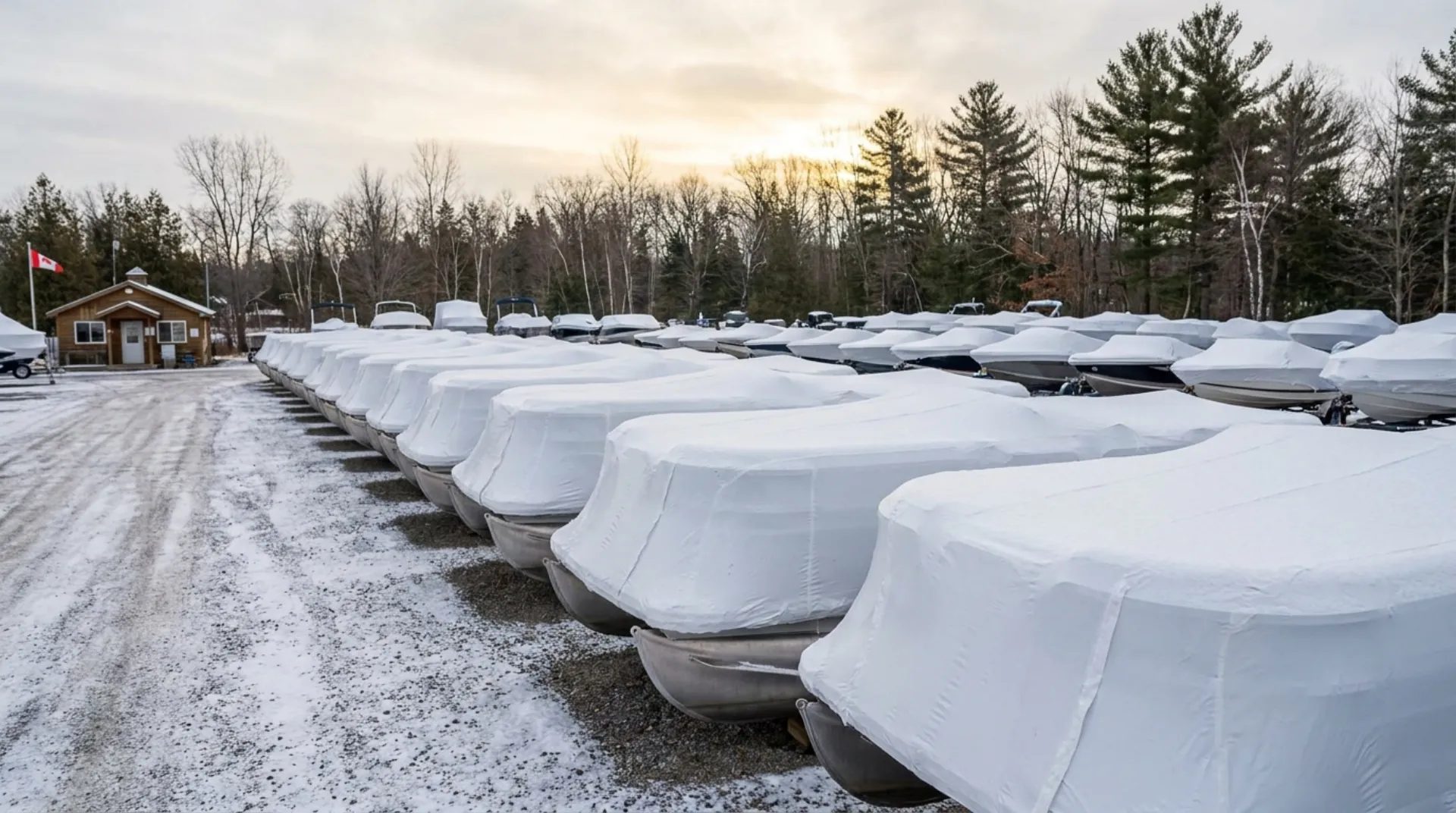
Quick Answer Harris Boat Works offers outdoor storage with professional shrink wrap, outdoor uncovered storage, and shrink-wrap-only service. We do not offer indoor or heated boat storage. We also do not offer climate-controlled or year-round storage. We can generally arrange...
Quick Answer
Harris Boat Works offers outdoor storage with professional shrink wrap, outdoor uncovered storage, and shrink-wrap-only service. We do not offer indoor or heated boat storage. We also do not offer climate-controlled or year-round storage. We can generally arrange boat pickup. Ask us about availability for your boat and location. HBW does not deliver boats, ship motors, offer mobile, dockside, or on-site service, recommend transport providers, or quote third-party transport. You can also complete hbwservice.ca, then drop off anytime, including after hours.
The physical marina is closed December 1 through April 1. There is no service, installation, inspection, or customer access during that period. Planning and approvals can continue remotely, and physical spring work begins after the marina reopens.
See the current HBW 2026–27 rate card, then request the boat-specific storage scope at hbwservice.ca.
Compare the storage plan, not a price multiplier
| Question |
Outdoor storage with shrinkwrap |
Indoor heated storage |
| Where is the boat stored? |
Outdoors under the agreed cover and support plan |
Inside a building with the stated temperature controls |
| What needs confirmation? |
Covering, ventilation, support, winterization and access |
Building conditions, winterization requirements and access |
| How should costs be compared? |
Use the written quote and included services |
Use a written quote with the same scope |
Choose the plan for your boat and equipment. Confirm the storage location and services with the provider; no fixed indoor-to-outdoor price ratio applies to every boat.
What HBW Actually Offers
The words storage, shrinkwrap, winterization, and spring commissioning describe different jobs. A useful quote should say which ones are included.
| Work item |
What it covers |
HBW operating rule |
| Outdoor storage |
The boat is stored outdoors on HBW property for the contracted period |
Outdoor only; no indoor, heated, climate-controlled, or year-round storage |
| Shrinkwrap |
A fitted seasonal cover and the agreed supporting/venting scope |
Confirm the exact cover scope in the written quote |
| Winterization |
Engine and onboard-system preparation for storage |
The procedure must match the exact engine, serial number, and installed systems |
| Spring commissioning |
The approved return-to-service checks after reopening |
Included for HBW winter-storage customers; $99 for non-storage customers as of September 2026 |
Storage does not automatically include every service item. The work order is the source of truth.
Outdoor Shrinkwrap or Indoor Storage?
HBW offers outdoor storage with professional shrink wrap, outdoor uncovered storage, and shrink-wrap-only service. We do not offer indoor or heated boat storage.
Outdoor storage may fit when the boat can be prepared correctly for freezing temperatures, the cover scope is appropriate, and the owner does not need winter access. Indoor or heated storage may fit a different boat or owner, but HBW does not provide those options and does not promise a referral.
Compare quotes using the same questions:
- Is the space outdoor, indoor unheated, or heated?
- Is shrinkwrap or another cover included?
- Is engine winterization included?
- Are livewells, freshwater systems, heads, or other onboard systems included?
- What is the battery plan?
- Is spring commissioning included?
- What are the access dates and pickup rules?
- What work requires separate written approval?
Do not compare two storage prices until the scopes match.
From the Shop: The Fall Drop-Off
Complete hbwservice.ca, then drop off anytime, including after hours. Or ask about boat pickup.
Bring or submit:
- Boat make, model, year, and length
- Motor model and serial number
- Current engine hours
- Trailer details and any known trailer issue
- A list of installed water systems
- The last known service and winterization history
- Any alarm, leak, running problem, or damage that needs separate assessment
- The services you want quoted
Remove personal items, documents, loose electronics, food, valuables, and anything you may need before April 1. Once the marina closes, customers cannot access stored boats.
The boat and trailer must be safe to move. If HBW cannot safely accept or position the boat, the storage arrangement must be corrected before drop-off.
Winterization Is Not the Shrinkwrap
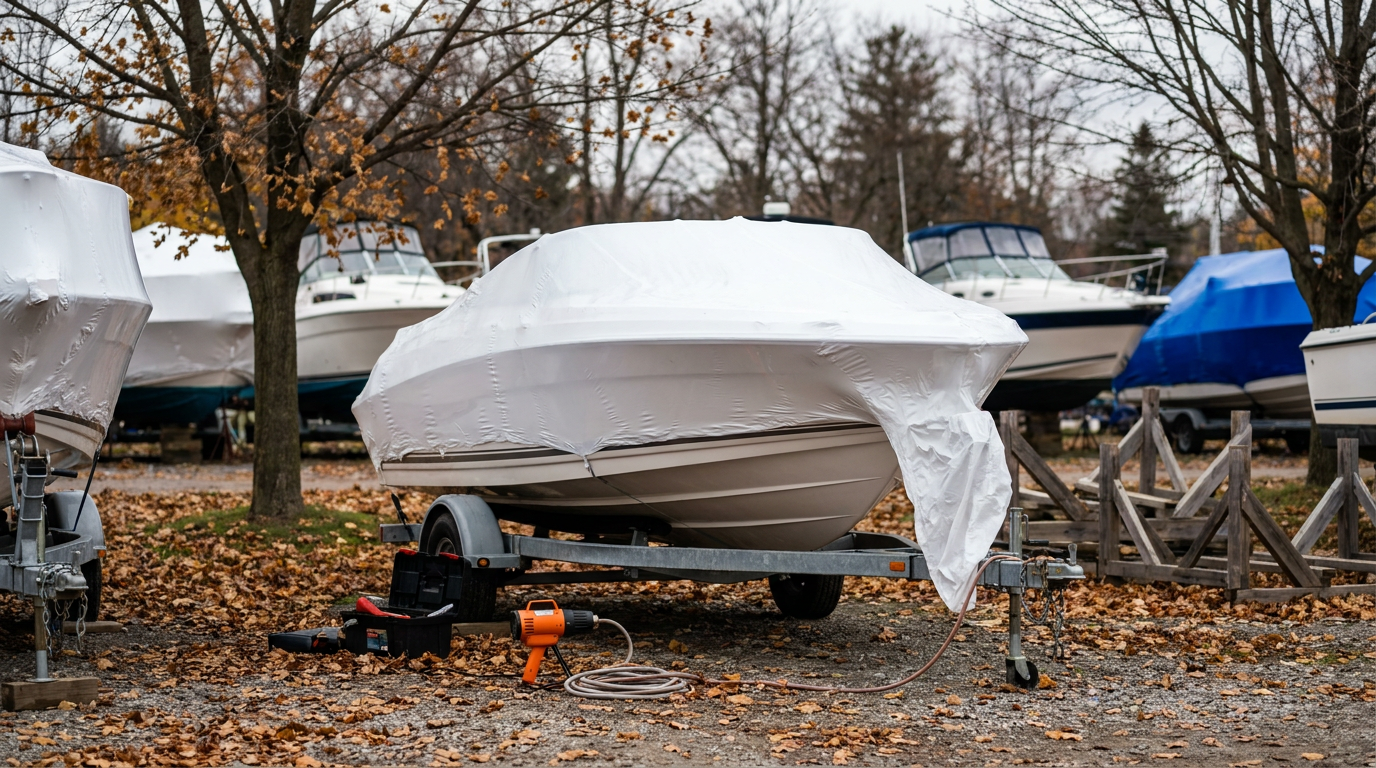
Shrinkwrap protects the boat from weather. It does not prepare an engine, gearcase, fuel system, livewell, freshwater system, or head for freezing conditions.
The exact winterization procedure depends on the engine family, serial number, installed equipment, prior maintenance, and storage position. HBW repairs Mercury outboards and MerCruiser products; the current service request form states that engine-repair boundary. Winterization is different: we winterize all brands of outboards, sterndrives, inboards and PWCs.
Avoid universal shortcuts:
- Do not assume every engine uses the same fuel treatment
- Do not assume every engine needs the same internal-protection procedure
- Do not turn an annual interval into a rule for every model and serial number
- Do not assume the battery must be removed
A healthy battery may remain aboard only if fully charged, disconnected, secured, and permitted by the approved storage plan. The model/serial manual and approved storage plan control. The written work order should state what HBW will do.
For engine-specific requirements, use the owner’s manual for the exact serial number and the approved work order.
What Happens During the Winter Closure
The physical marina is closed from December 1 through April 1.
During that period:
- No service, repower, installation, inspection, or spring commissioning happens on site
- Customers cannot access stored boats
- A stored boat is not available for mid-winter pickup or item retrieval
- Remote planning, quoting, and approvals can continue
Take anything you may need out of the boat before the closure. Do not rely on a promise of winter access or winter shop work.
Spring Commissioning and Pickup
Physical spring commissioning begins after the marina reopens.
Spring commissioning is included for HBW winter-storage customers. As of September 2026, the current price for a non-storage customer is $99. The exact checks and any additional repair still depend on the approved scope.
If a spring check finds a fault, leak, damaged component, failed battery, or other condition outside the approved scope, HBW contacts the customer before additional work.
HBW confirms when the boat is ready and provides the pickup window. Customers who dropped off their own boat return to Gores Landing for pickup; inbound boat pickup availability is confirmed separately for the boat and location.
What to Compare in Any Storage Quote
Storage quotes are only comparable when the scopes match.
| Question |
Why it matters |
| Outdoor, indoor unheated, or heated? |
These are different products. HBW offers outdoor storage with professional shrink wrap, outdoor uncovered storage, and shrink-wrap-only service. We do not offer indoor or heated boat storage. |
| Is shrinkwrap included? |
A storage space and a fitted seasonal cover are separate scopes. |
| Is engine winterization included? |
Shrinkwrap does not prepare an engine or onboard system for freezing temperatures. |
| Which onboard systems are included? |
Livewells, freshwater systems, heads, and other installed systems need boat-specific review. |
| What is the battery plan? |
A healthy battery may remain aboard only if fully charged, disconnected, secured, and permitted by the approved storage plan. The model/serial manual and approved storage plan control. |
| Is spring commissioning included? |
It is included for HBW winter-storage customers; as of September 2026 it is $99 for non-storage customers. |
| What are the access dates? |
HBW has no customer access during the December 1 to April 1 closure. |
| What needs separate approval? |
Repairs and conditions outside the approved scope require customer authorization. |
Do not budget from an old planning range or an assumed bundle discount. Use the current written quote.
Pricing: Use the Current Written Quote
HBW does not publish a timeless per-foot storage, shrinkwrap, winterization, or transport price in this guide.
The current quote can depend on:
- Boat and trailer dimensions
- Hull and engine configuration
- Cover and support requirements
- Installed water systems
- Winterization scope
- Approved repairs
- Spring commissioning scope
- HST and stated exclusions
Submit the boat details at hbwservice.ca. Do not budget from an old article range or an assumed package discount.
Sources and Scope
- HBW service request, current drop-off workflow and Mercury/MerCruiser repair boundary
- HBW operating rules reviewed August 26, 2026: offers outdoor storage with professional shrink wrap, outdoor uncovered storage, and shrink-wrap-only service. We do not offer indoor or heated boat storage. We can generally arrange boat pickup. Ask us about availability for your boat and location. HBW does not deliver boats, ship motors, offer mobile, dockside, or on-site service, recommend transport providers, or quote third-party transport.
- HBW seasonal closure reviewed July 24, 2026: physical marina closed December 1 through April 1
- HBW spring commissioning price reviewed July 2026: included for winter-storage customers; $99 for non-storage customers
- Mercury owner resources, engine-specific manuals and maintenance scope
Ready to Request Storage?
Submit the boat, motor, trailer, and requested work at hbwservice.ca.
Phone: 905-342-2153
Drop-off and pickup: 5369 Harris Boat Works Rd, Gores Landing, ON K0K 2E0
Ready to price a Mercury repower? Build a live CAD quote at the Mercury Repower Centre.