Last reviewed: 2026-06-06 > Quick answer: A repower at Harris Boat Works runs eight steps: building an installed-price quote at mercuryrepower.ca, booking the job, drop-off and full assessment, old motor removal, rigging and installation to Mercury spec, a pre-water rigging...
Last reviewed: 2026-06-06
Quick answer: A repower at Harris Boat Works runs eight steps: building an installed-price quote at mercuryrepower.ca, booking the job, drop-off and full assessment, old motor removal, rigging and installation to Mercury spec, a pre-water rigging check, an on-water test on Rice Lake, and pickup with a break-in walk-through.
Most people don't know what they're agreeing to until it's done. Here's the whole process.
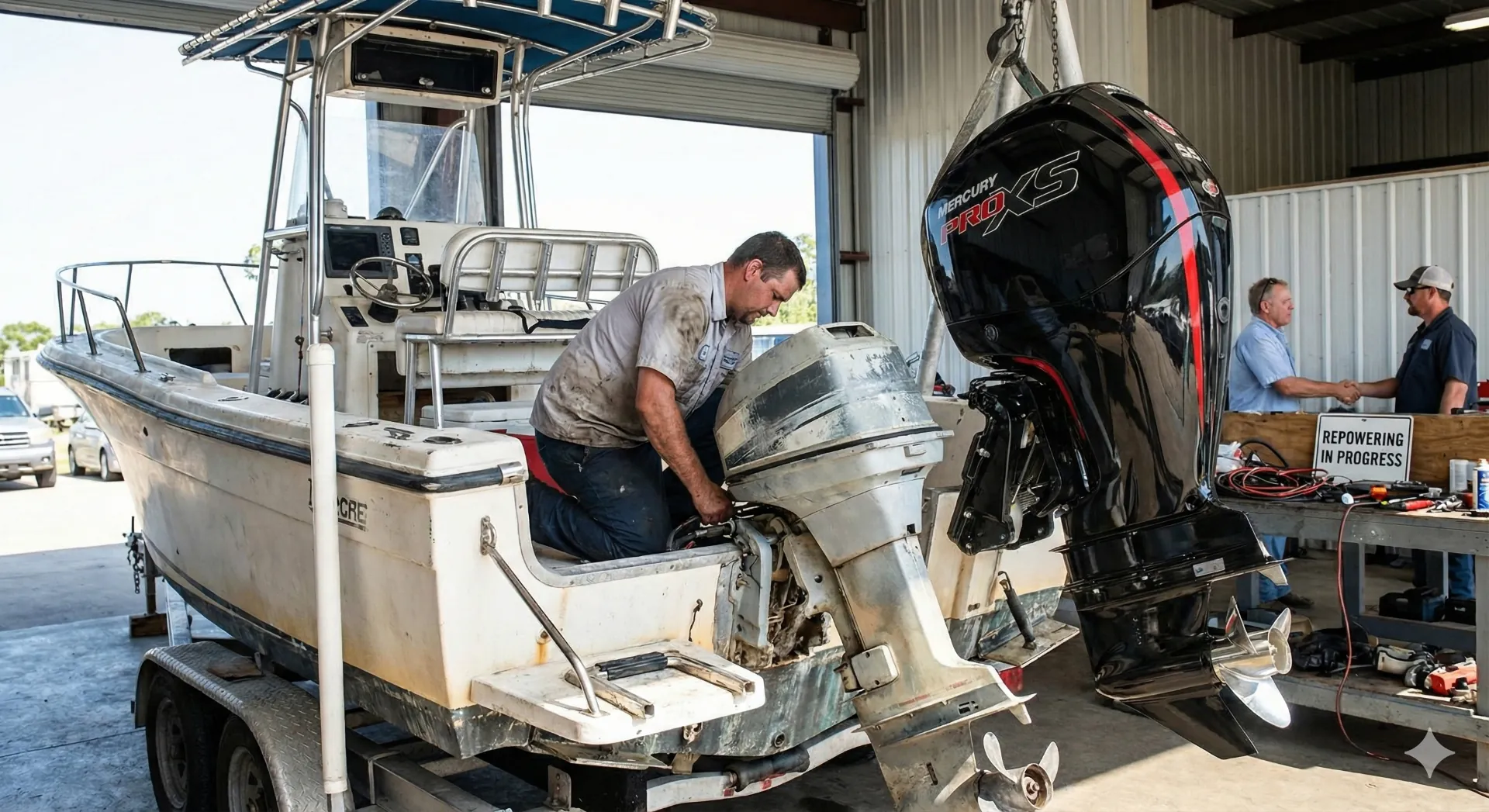
A repower is not complicated, but it's not just unbolting one motor and bolting on another. If you've never done one, the process is worth understanding before you hand over your boat. This is what actually happens at Harris Boat Works from the moment you decide to move forward.
Step 1: The quote
Everything starts at mercuryrepower.ca. You build the quote online, select your motor, your rigging preferences, and whether you have a trade-in. You get an installed price. Not an "engine only" price, not a "starting from" price. The installed number.
If you have questions the configurator doesn't answer, call us at 905-342-2153. We'd rather spend five minutes on the phone getting it right than have a surprise conversation after the boat is in the shop.
Step 2: Booking the job
Once you've confirmed the quote and motor availability, we schedule the drop-off. Motor lead times vary by model and time of year. Spring is busy. If you're planning a spring launch, the time to book is not the week before ice-out.
Most standard repowers take 3 to 5 business days once the motor is on-site. Spring compresses the calendar, so the earlier you book, the better your slot.
Step 3: Drop-off and assessment
When you bring the boat in, we start with an inspection before we touch anything. This includes:
- Transom condition check: structural integrity, any soft spots, signs of delamination or rot
- Existing controls and rigging assessment: what needs replacing vs. what can be retained
- Fuel system check: condition of primer bulb, fuel line, and tank connection
- Steering inspection: is the current steering system compatible with the new motor and safe to reuse?
If the inspection turns up something that changes the job scope, we call you before we proceed. No surprises added after the fact.
Step 4: Motor removal
The old motor comes off. If you have a trade-in, it's assessed at this point (or before drop-off if you've brought it in separately). Motors that aren't trade-able get set aside for disposal.
Step 5: Rigging and installation
This is the bulk of the work, and it's where "just swap the motor" gets complicated on older boats:
- New motor mounted and torqued to manufacturer spec
- Throttle and shift cables run and connected
- Steering connected and adjusted
- Fuel line connected to new motor
- Control box connected (new or existing, per the quote)
- Battery cables verified or replaced
- SmartCraft harness and gauges installed (if quoted)
- Lower unit oil and gear ratio verified
Everything is installed to Mercury's rigging standards. We're family-owned since 1947 and a Mercury dealer since 1965, now at Mercury's Platinum tier. This is the work we do every season.
Step 6: Rigging check and pre-water inspection
Before the boat goes in the water, the full installation gets a bench check. Controls are operated through their full range of motion. The motor starts and idles. Gauges verify correctly. Any adjustments happen here.
Step 7: On-water test on Rice Lake
Every repower gets an on-water test on Rice Lake before pickup. No exceptions.
The boat goes in the water. We run it through throttle range, check for rigging issues, verify the trim, confirm the prop is performing as expected, and run it until the motor reaches operating temperature. This is not a formality, it's the only way to know the job is actually done.
If anything surfaces during the test, it gets fixed before the boat comes out. You pick up a boat that has already been proven on the water, not one that's been proven on the hoist.
Step 8: Pickup and walk-through
When you pick up the boat, we walk you through the new motor, break-in procedure, throttle management during the first few hours, oil check intervals, and what to expect from a new FourStroke before it's fully run in. This usually takes about 15 minutes and it's worth the time.
Ready to book your repower?
Start with a quote at mercuryrepower.ca, then request service at hbw.wiki/service. Questions first? Call 905-342-2153.
Related guides