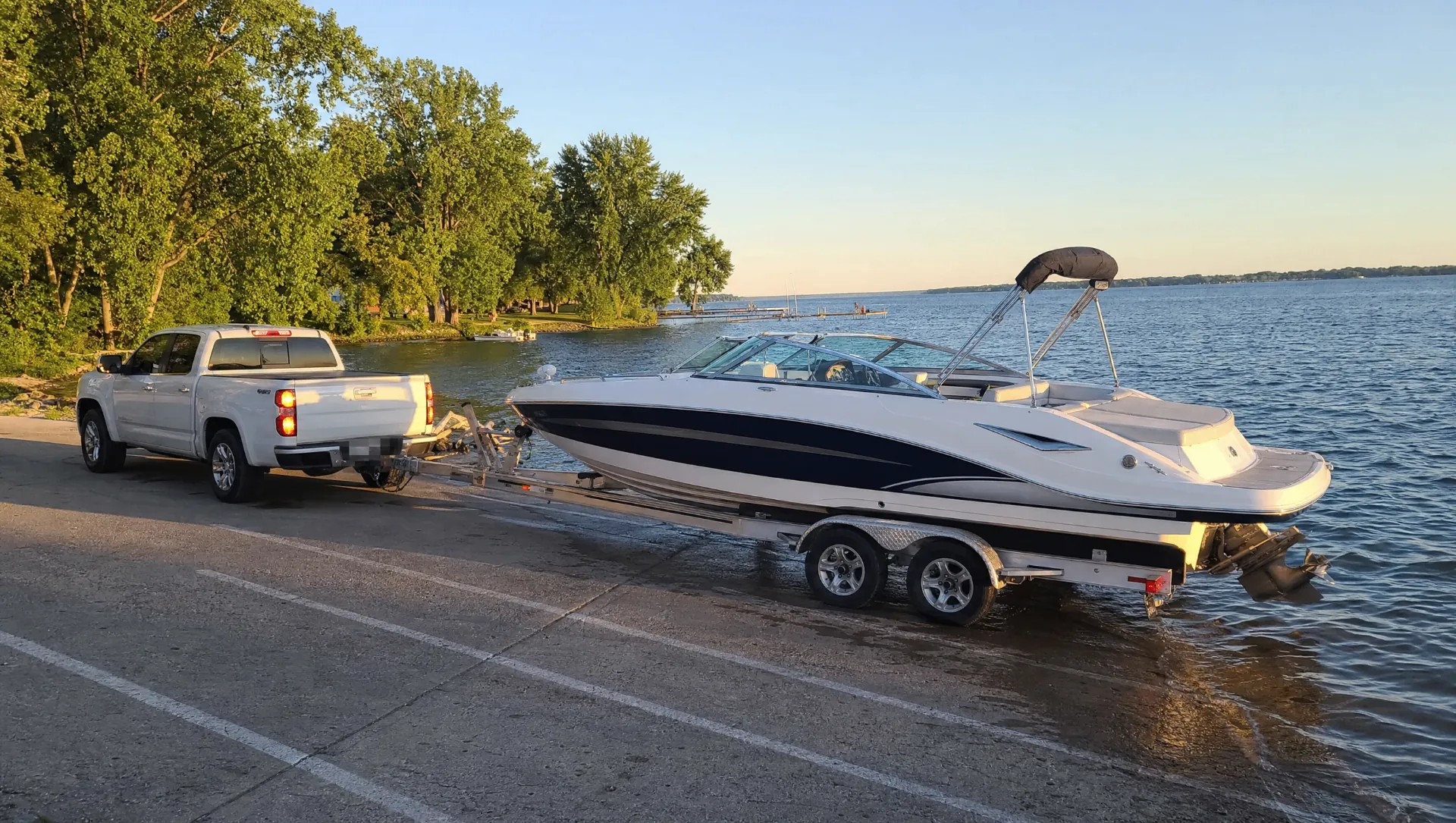
There's a lot happening at a public boat ramp on a Saturday morning. Someone's arguing with their winch. Someone else is blocking the lane to dig through the cab for a strap they "definitely packed." And somewhere in the background, a guy is already knee-deep in the water...
Quick answer: Most boat-trailer damage happens to the boat owner, not in transit. The worst Ontario trailering mistakes we see: improper tongue weight, loose strap-downs, missing safety chains, bald or under-inflated trailer tires, skipped wheel-bearing lubrication, ramp-launching with the plug out, and not knowing your tow vehicle's weight rating. Most cost time. The expensive ones cost time and money.
There's a lot happening at a public boat ramp on a Saturday morning. Someone's arguing with their winch. Someone else is blocking the lane to dig through the cab for a strap they "definitely packed." And somewhere in the background, a guy is already knee-deep in the water realizing he forgot the drain plug.
We've been on Rice Lake in the Kawarthas (Ontario) since 1947. We've seen most of these, sometimes twice before 9 a.m. This post covers the ten trailering mistakes that reliably ruin Ontario weekends, with enough detail to actually fix them.
If you're headed to the Kawarthas, the Trent-Severn, or Rice Lake this season, read this before you hook up.
The 10 Mistakes
1. Wrong Tongue Weight
Tongue weight, the downward force the trailer puts on the hitch ball, should sit at 10-15% of your total loaded trailer weight. Outside that window, things go wrong in both directions.
Too light: the trailer rear lifts and you get sway at highway speed. Once a loaded boat trailer starts swaying, most tow vehicles have a hard time correcting it.
Too heavy: the rear of the tow vehicle sags, the front wheels get light, steering suffers, and the hitch and rear axle are overloaded over the long haul north.
Keep heavier gear forward in the boat. A dedicated tongue-weight scale will tell you where you stand. A bathroom scale only works on lighter trailers or with a lever setup.
2. Underrating Your Tow Vehicle
Your truck's tow rating assumes a mostly empty vehicle. By the time you add passengers, fuel, ice, gear, and the full boat-plus-trailer load, you're well past the number on the sticker.
The real calculation: trailer weight (dry) + boat weight (dry) + outboard + full fuel tank + gear. Compare that against your truck's GCVWR, not just the tow rating.
This matters more when you're climbing Highway 7 toward Peterborough or heading up to Haliburton. Ontario highways have a way of reminding you what's behind you.
3. Skipping the Wheel Bearing Check
Trailer wheel bearings get abused in a way that vehicle bearings don't: they heat up on the highway, then plunge into cold water at the ramp. That thermal cycling drives water past seals.
Bearing Buddy-style protectors help, but they need to be checked at the start of each season, pull the cap, look at the grease quality, check for rust-coloured contamination. A wheel bearing failure on the 401 doesn't give much warning. One moment fine, next moment watching a trailer wheel pass you in the mirror.
Twenty minutes at the start of the season. It's worth it.
4. Old, Dry-Rotted Trailer Tires
The most common roadside breakdown for Ontario boaters. Trailer tires often look fine, low tread wear, because they don't log enough highway kilometers to wear down. They age out instead.
UV exposure and ozone oxidize the rubber compound even when the tire's sitting in a driveway all winter. Replace trailer tires every 5-6 years regardless of tread, and check sidewalls for cracking every spring.
If your tires are from 2018 and you're heading from the GTA to Rice Lake on the 115, you're rolling the dice. New trailer tires are cheap. A highway blowout is not.
5. Loose Tie-Downs or No Bow Safety Chain
The winch strap holds your boat to the trailer. The bow safety chain is the backup if the strap or hook fails. Without it, a failed winch strap on the highway means your boat slides into traffic.
Check both every time: strap tight, hook fully engaged, chain secured, not just looped through the bracket. Add stern tie-downs if your trailer has rails. Lateral movement causes hull stress and strips gelcoat over the course of a season.
Two minutes at the ramp. Every time.
Roadside diagnosis
Trailer acting up? Work the symptoms in this order
Most highway trailer failures trace back to one of these five checks. Pull over at the first sign and run the list before you continue.
Hot wheel hubs
?Can you hold your hand on the hub for 5 seconds after a 30-minute run?
💡A hub too hot to touch means bearing failure is minutes away. Stop, let it cool, and limp to the nearest service. Do not continue at highway speed.
Tire pressure and condition
?Are both trailer tires at the sidewall PSI, with no sidewall cracking?
💡Under-inflated tires build heat fast and blow out. Trailer tires age out at 5 to 7 years even with good tread. Check the date code.
Tongue weight
?Does the tongue sit level on the ball, not nose-up or nose-down?
💡10 to 15 percent of trailer weight should be on the tongue. Too light causes sway; too heavy overloads the rear axle. Re-balance load forward or back.
Load distribution
?Is the bow of the boat snug against the bow stop, with the transom strapped?
💡A boat that shifts on the trailer changes tongue weight at speed. Tighten the bow strap and re-check both transom tie-downs before continuing.
Lights and connection
?Do brake lights, turn signals, and running lights all work with the truck engine running?
💡A bad ground at the trailer plug is the most common cause. Clean the contacts, wiggle the plug, and confirm before merging back on the highway.
🔧Bearings or tires need attention?
We service trailer bearings and tires alongside motor work at HBW. Call (905) 342-2153 before you head home if you noticed any of the above on the way in.
6. Not Securing the Motor
An outboard hanging freely on a transom isn't built to absorb highway vibration. Without a transom saver, the motor's weight swings on the tilt/trim system and steering cable over every bump on every Ontario back road north of the city.
Over one season, that wears steering arms, transom brackets, and trim ram seals. On a Mercury FourStroke in the 60-200 hp range, those repairs add up fast.
Transom savers cost next to nothing. They attach between the trailer roller and the motor cavitation plate and distribute the load off the lower unit. Use one every time the motor goes on the road.
7. Failed or Unplugged Trailer Lights
Ontario police ticket trailer lighting violations, and they're not shy about it. Working brake lights, turn signals, and tail lights are required, not optional.
Common problems: corrosion at the 7-pin connector, a water-damaged socket, or a plug left on the hitch ball since last fall. Test before every trip: plug in, turn on hazards, hit the brakes, walk around. A wiring harness replacement takes an afternoon. A roadside stop on Highway 28 costs more, in time, money, and whatever was left of a good mood.
8. Backing In Too Fast or Too Far at the Ramp
Speed at the ramp is confidence cosplay. Everyone's seen the result: a truck with the transmission submerged past the bell housing, or trailer brakes that stopped working properly because the drums flooded.
Trailer wheel bearings and surge brakes aren't meant to be dunked, especially hot from a highway drive. Back in slowly until the bunks are just below surface and the boat floats. That's it. The hubs and brakes should stay above the waterline.
And if there's a lineup behind you, ignore it. Go slow.
9. Forgetting the Drain Plug
The classic. Never not funny, until it's yours.
The fix is a habit: the drain plug goes in before the boat comes off the trailer. Not at the ramp. Not while floating. Before. Some people put it in their cup holder the night before. Others have a rule that it goes in when the boat comes out of storage.
Whatever your system, have one. Because forgetting the plug has ended more Ontario weekends than anything else on this list.
(Said with genuine affection. We've heard this story many times.)
10. Trailering with the Boat Cover On at Highway Speed
A canvas boat cover at 100 km/h is experiencing forces it wasn't designed for. It's not a question of whether it'll fail, it's how fast. Covers billow, snap at attachment points, tear, and sometimes leave the boat entirely, becoming a hazard for whoever's behind you.
The stress also damages snap hardware and canvas attachment points, so even a cover that makes it to the lake may have failed snaps and delaminated corners by the time you arrive.
Use a proper trailering cover with tie-down straps, or remove the cover and store it inside the boat. Arriving with an intact cover beats the alternative every time.
Pre-Trip Checklist
Save or print this. Four minutes at the driveway beats an hour on the shoulder of the 115.
- Drain plug, installed, hand-tight, confirmed
- Trailer lights, plugged in, tested (brake lights, signals, tails)
- Wheel bearings. Bearing Buddy caps full, no discolouration
- Trailer tires, inflated to spec, sidewalls clean, age under 6 years
- Bow winch strap, tight, hook fully engaged
- Bow safety chain, attached and secured
- Stern tie-downs, both sides secured, no lateral play
- Transom saver, motor supported, not hanging free
- Boat cover, removed or trailering-specific cover secured
- Hitch and safety chains, pin locked, chains crossed and connected
What Ontario Law Says About Your Trailer
A quick reference. Regulations change, verify current requirements with the MTO Driver's Handbook or ServiceOntario before relying on this summary.
Trailer plate requirements: All trailers on Ontario public roads must be registered and plated separately from the tow vehicle. Ontario treats trailers as separate vehicles. Registration is a one-time fee (around $72 for original plate and permit). See ontario.ca/page/register-trailer for the full document list.
Lights and reflectors: All trailers require working brake lights, tail lights, turn signals, and rear reflectors. Larger trailers may require side marker lights. Equipment violations are actively ticketed.
Brakes: Ontario's Highway Traffic Act requires brakes on trailers with a gross weight of 1,360 kg (approximately 3,000 lb) or more. Confirm with MTO whether a breakaway system is required for your exact trailer and brake type rather than treating breakaway as universal. Most loaded boat trailers with mid-size or larger boats hit the brake threshold. If you're unsure, weigh it loaded. Verify the current threshold with MTO; regs do change.
Speed limits: Ontario doesn't set a separate lower limit for towing, the posted limit applies. On most 400-series highways, that's 100 km/h (some stretches are posted at 110 km/h for passenger vehicles, but check signage as limits change). Towing at the posted limit requires proper setup: rated hitch, correct tongue weight, functioning trailer brakes if required, and tires you'd actually trust.
More from the Blog
If you're doing spring prep and want the full mechanical rundown, the spring outboard commissioning checklist covers fuel, gearcase, cooling-system, and battery checks.
For walleye opener timing and what to have ready before May, the walleye opener boat prep guide is worth a read.
Making the drive from the GTA for the first time? The Toronto to Rice Lake trailering guide covers the route, ramp access, and what to expect when you get there.
Trailer Issues Fried Your Motor?
It happens. Submerged connectors, corrosion, water intrusion, trailer problems become motor problems faster than most people expect.
We do Mercury repowers and full electrical service at Harris Boat Works. If your outboard came back from the season worse than it went in, book service at hbwservice.ca and we'll take a look.
Harris Boat Works, est. 1947. Gores Landing, ON. Mercury Marine Premier Dealer.
905-342-2153 | mercuryrepower.ca