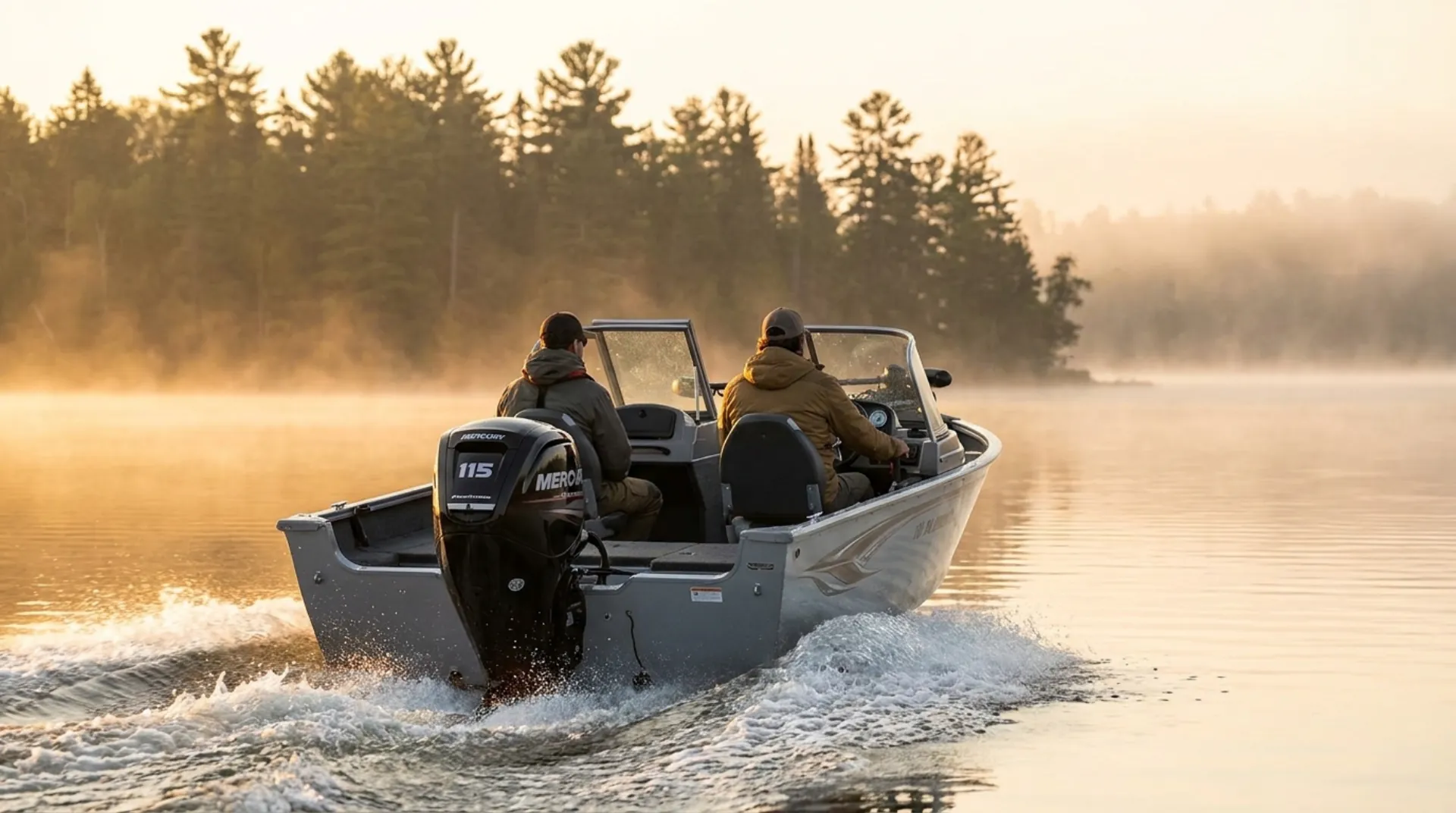
A guy tested 19, 20 and 21-pitch props on the same Mercury 115 Pro XS. The 20 was fastest. The 21 was slower than both of the others. That one test tells you more about buying a 115 than most spec sheets do. The motor matters, but the finished setup matters just as much. A...
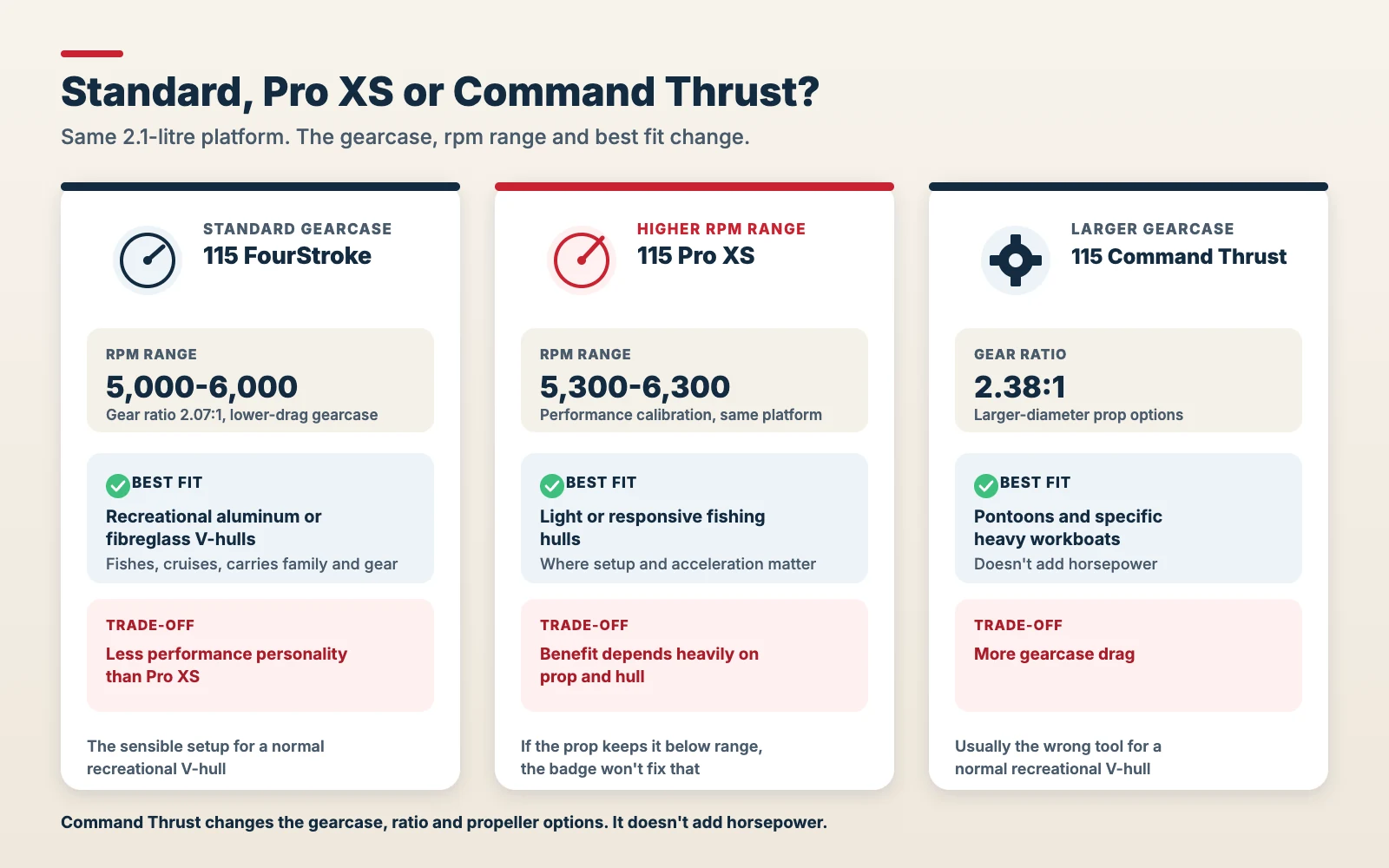
Quick answer: Mercury's current 115 HP FourStroke is a quiet, relatively light 2.1-litre inline-four that works very well when the boat, gearcase and propeller match. Choose the standard gearcase for a recreational V-hull, Command Thrust for a pontoon or specific heavy workboat, and Pro XS when the hull and owner can use its higher operating range.
A guy tested 19, 20 and 21-pitch props on the same Mercury 115 Pro XS.
The 20 was fastest. The 21 was slower than both of the others.
That one test tells you more about buying a 115 than most spec sheets do. The motor matters, but the finished setup matters just as much. A well-matched 115 feels quiet, eager and easy to live with. Put the wrong gearcase or prop behind it and the same motor can feel lazy, lose grip in turns or miss its proper operating range.
This review covers the current 2.1-litre Mercury 115 FourStroke, the 115 Pro XS and the Command Thrust versions. It uses current-family specifications, documented freshwater tests, independent boat reviews and owner prop testing. No brochure fantasy and no universal speed promise.
The Current 2.1-Litre Mercury 115
Mercury has built the current 2.1-litre 75 through 115 horsepower EFI FourStroke family since 2014 (Mercury tiller announcement). The 115 Pro XS joined it in 2016.
That is useful, not disappointing. This is a mature engine family, not a first-year design that Ontario buyers are being asked to test for Mercury.
The current standard 115 FourStroke uses:
- a 2.1-litre inline-four powerhead
- an 8-valve single-overhead-cam design
- electronic fuel injection
- a 5,000 to 6,000 rpm wide-open-throttle range
- a 2.07:1 standard gear ratio
- a listed dry weight of roughly 163 kg (360 lb) for the lightest 20-inch configurations, depending on market specification
- mechanical controls with SmartCraft compatibility
Command Thrust changes the gearcase, ratio and propeller options. It doesn't add horsepower. Current specifications put the lightest 20-inch CT configurations at about 165 kg (364 lb) with a 2.38:1 ratio.
The 115 Pro XS uses the same 2.1-litre platform but raises the operating range to 5,300 to 6,300 rpm and adds performance-oriented calibration. It is available with either the standard gearcase or Command Thrust in the current Canadian lineup.
What It Actually Feels Like on the Water
The first thing many owners notice is the lack of noise at idle. In one Boating Magazine test, the reviewers said they could not hear the 115 Pro XS on a Ranger aluminum fishing boat over their conversation at idle. A few owner reports make the same point in less scientific language: check the tach before reaching for the key because the motor may already be running.
Acceleration is strong when the boat is propped correctly. In Mercury's freshwater records, a Crestliner 189XF reached 20 mph in 3.81 seconds, while a Crestliner 1750 Super Hawk did it in 4.94 seconds. Those are separate boat-specific results. A Canadian test of a 21 ft 6 in Princecraft pontoon with a 115 Pro XS Command Thrust reported planing in 3.6 seconds.
Those numbers describe those boats, not every 115 installation. A loaded 22 ft pontoon and a light 17 ft fishing boat can carry the same horsepower and feel like completely different machines.
Fuel use follows the boat too. In Mercury's freshwater 189XF test, the 115 Pro XS used about 9.8 L/h (2.6 US gal/h) at 3,000 rpm while the boat ran 19.5 mph. In the 22 ft Manitou pontoon test, the standard 115 Command Thrust used about 8.3 L/h (2.2 US gal/h) at the same rpm while the boat ran 14.3 mph. Those are results for the named boats and props, not a fuel rating for the motor by itself.
What Owners Actually Say Online
We screened public owner forums, Reddit discussions and owner test videos for the current 2.1-litre 115 FourStroke and 115 Pro XS. Older two-stroke 115s and unrelated Pro XS families were excluded.
This is owner colour, not controlled testing. It is useful when the same questions and annoyances keep returning.
Buyers spend more time debating the Pro XS premium than the engine
A July 2026 115 FourStroke-versus-Pro XS discussion is almost a perfect snapshot. The buyer wanted to know whether Pro XS was worth the extra money. Replies ranged from brand-loyal enthusiasm to the only answer that really mattered: will that hull perform differently with it?
The buyer eventually chose the Pro XS with the standard gearcase instead of Command Thrust. That detail matters. He did not simply select every word that sounded more powerful.
The 115 Pro XS can be worthwhile on a responsive fishing hull. On a normal family boat that will never be prop-tested, the standard FourStroke can deliver the same rated horsepower with less reason to second-guess the purchase.
The internet loves a badge; the propeller keeps the receipts
Owners regularly expect a Pro XS badge to guarantee more speed. The same owner communities then spend pages discussing why a higher-pitch propeller reduced speed, why a Command Thrust case added drag on the wrong hull, or why a supposedly slower prop feels better with people aboard.
The Glastron test later in this review is the cleanest example: 20 pitch beat 21 pitch on the same 115 Pro XS. The larger number did not win.
That is why a good 115 owner review often sounds less like a commercial and more like a garage conversation:
- What rpm does it reach loaded?
- Does it ventilate in a turn?
- How quickly does it plane with two more people?
- Is the owner chasing top speed or a better midrange?
The cowl starts the discussion. The tachometer usually ends it.
Quietness and engine data are the everyday wins
Owners repeatedly like how little the 115 intrudes at idle. The other modern feature that appears in owner discussions is access to engine information through SmartCraft gauges or SmartCraft Connect Mobile, formerly called VesselView Mobile.
That data does not replace a technician's diagnostic system, but hours, temperature, voltage, fuel flow and active warnings help an owner notice a problem earlier. Several forum questions that begin as “the motor feels wrong” become much easier once the owner can supply rpm, voltage and a specific warning.
The less glamorous truth is that many owners talk more about learning the display than about the powerhead. That is a sign the motor is getting on with its job.
Long-term posts favour maintenance history over hour anxiety
In a four-stroke hours discussion, a current-generation 2017 115 Pro XS owner described the motor as flawless and said routine maintenance concerned him more than the hour meter.
That is one owner, not a longevity guarantee. It is still better used-motor advice than a universal hour cutoff. A lightly used engine can suffer from stale fuel, corrosion and neglected service. A higher-hour motor with clean records and regular operation can be the better buy.
Brand arguments are mostly entertainment
One 2026 thread managed to recommend the Pro XS while also declaring dramatic loyalty to another brand. That is online boating in one sentence.
Owner communities are useful for discovering questions, setup quirks and the language buyers actually use. They are much less reliable when every choice becomes a team sport. The exact boat, nearby service support and quality of installation should win over the loudest logo.
What the online buzz gets right
- the standard 115 is valued for quiet, straightforward family and fishing use
- Pro XS buyers care about acceleration, rpm range and setup more than a casual cruiser does
- the correct standard or Command Thrust gearcase matters as much as the Pro XS decision
- propeller testing can reverse an owner's first impression
- SmartCraft data and a good local service relationship improve ownership
- maintenance history tells a used buyer more than hours alone
The 115 sits in the sweet spot where ordinary owners can feel setup changes without needing a race boat. That is why the social discussion is unusually useful when the exact hull stays attached.
Standard FourStroke, Pro XS or Command Thrust?
On a phone, swipe the table sideways to see every column.
| Version |
What changes |
Best fit |
Main trade-off |
| 115 FourStroke, standard gearcase |
5,000–6,000 rpm range and lower-drag 2.07:1 gearcase |
Recreational aluminum or fibreglass V-hulls |
Less performance personality than Pro XS |
| 115 Pro XS, standard gearcase |
Higher 5,300–6,300 rpm range and performance calibration |
Light or responsive fishing hulls where setup and acceleration matter |
The benefit depends heavily on prop and hull |
| 115 FourStroke Command Thrust |
Larger 2.38:1 gearcase and larger-diameter prop options |
Pontoons and specific heavy workboats |
More gearcase drag |
| 115 Pro XS Command Thrust |
Pro XS operating range with the larger CT gearcase |
Performance-oriented pontoon applications |
HBW usually prefers standard on a normal recreational V-hull |
Best fit: Standard 115 FourStroke
Choose the standard FourStroke if you want the quiet, straightforward version of the 115 on a recreational V-hull.
It is not a lesser motor. It is the sensible setup for someone who fishes, cruises, carries family and gear, and wants the motor to do its job without turning every run into a top-speed test.
Best fit: 115 Pro XS
Choose the Pro XS when the boat can use the extra operating range and you care about acceleration, propeller tuning and a sharper feel.
The Pro XS is not a secret 130 with different decals. It shares the 2.1-litre platform with the regular 115. Its advantage comes from calibration, rpm range and how the complete package is set up.
If the prop keeps it well below its intended range, the Pro XS badge won't fix the problem.
Best fit: Command Thrust
Choose Command Thrust for a pontoon or a specific heavy-duty application that needs the larger gearcase and propeller.
Don't buy it as a generic upgrade for a recreational V-hull. The larger case can carry load and produce lift, but it also adds drag. On an ordinary aluminum or fibreglass runabout, the standard gearcase is normally the better choice.
Read the full Command Thrust explanation if another dealer has told you CT simply means “more torque.”
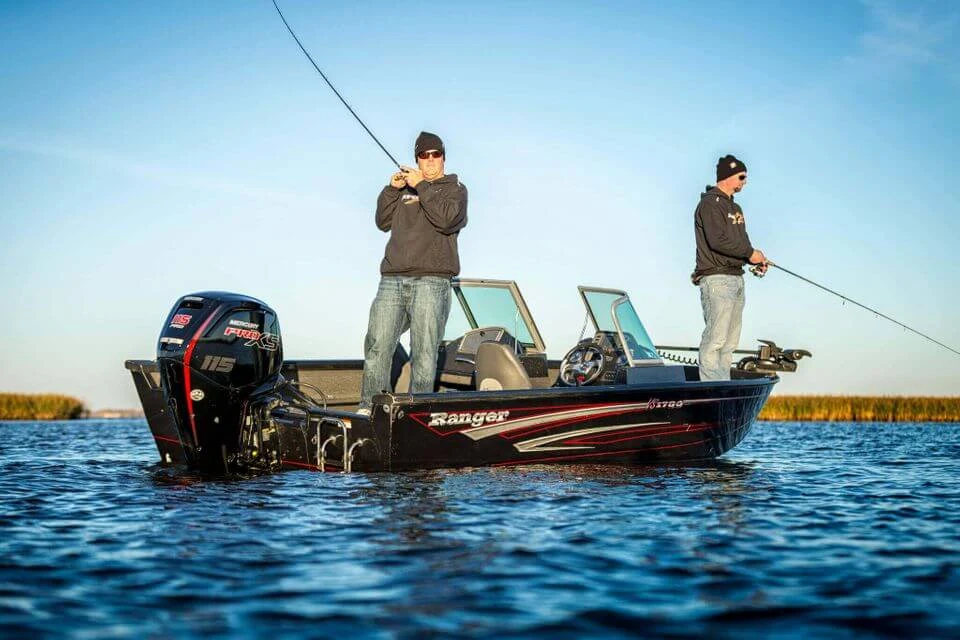
Official Mercury freshwater photography: the 115 Pro XS is shown here for comparison. It is a different model from the standard 115 FourStroke reviewed in this article; this photo does not establish the gearcase fitted to your boat.
The Propeller Can Change the Whole Review
Here are three current-family owner tests that show why propeller selection needs more than a chart.
Same Glastron, three pitches
A 2023 115 Pro XS owner tested 19, 20 and 21-pitch props on a 2012 Glastron GT-160:
| Pitch |
Reported maximum speed |
Reported maximum rpm |
| 19 |
48.5 mph |
5,920 |
| 20 |
49.5 mph |
5,770 |
| 21 |
48.0 mph |
5,600 |
The 20-pitch prop was fastest. The 21 pulled the engine down and lost speed. The 19 kept the engine closer to the upper part of its range and could still be the better all-around choice once people and gear go aboard.
Mercury 115 Pro XS owner tests 19, 20 and 21-pitch propellers
A current-generation 115 Pro XS owner tests three prop pitches on the same Glastron.
Same pontoon, large pitch correction
An owner with a 2018 22 ft dual pontoon and a 115 Pro XS Command Thrust compared two aluminum props on the same day and load:
- 14.5 × 17 four-blade: 4,400 rpm and 19 mph
- 16 × 12 three-blade: 5,500 rpm and 21 mph
The first prop held the engine far below its intended operating range. Changing the prop added rpm and speed at the same time.
Same Crestliner model, different prop designs
Mercury tested a 2023 Crestliner 1750 Hawk with two 15-pitch props:
- Spitfire aluminum: 41.2 mph at 5,814 rpm
- Spitfire X7 stainless: 46.9 mph at 5,978 rpm
That doesn't mean stainless steel automatically adds 5.7 mph. Blade shape, cup, stiffness and test conditions all matter. It does prove that the pitch number alone doesn't describe how a prop will perform.
Our propeller-selection guide explains the basics. The final answer still comes from running the boat with its normal load.
Real Freshwater Results, With the Boat Attached
These results come from documented freshwater tests. They are examples, not promises.
| Boat and setup |
Motor and prop |
Reported result |
| 2023 Crestliner 189XF, 18 ft 8 in aluminum |
115 Pro XS standard, 17-pitch Spitfire aluminum |
43.8 mph at 5,871 rpm; 0–20 mph in 3.81 s |
| 2023 Crestliner 1750 Hawk, 17 ft 6 in aluminum |
115 Pro XS standard, 15-pitch Spitfire X7 |
46.9 mph at 5,978 rpm; 0–20 mph in 4.04 s |
| 2023 Crestliner 1750 Super Hawk, 17 ft 9 in aluminum |
115 Pro XS standard, 15-pitch Spitfire |
39.5 mph at 6,174 rpm; 0–20 mph in 4.94 s |
| Crestliner 2070 Retriever HD, 20 ft aluminum (2024) |
115 Pro XS standard, 19-pitch Spitfire X7 |
37.9 mph at 5,869 rpm; 0–20 mph in 4.34 s |
| 2020 Manitou Aurora LE RF TT, 22 ft pontoon |
115 FourStroke CT, 13-pitch Black Max pontoon prop |
26.2 mph at 5,706 rpm; 0–20 mph in 4.74 s |
| Princecraft Sportfisher 21-4S, 21 ft 6 in pontoon (2025) |
115 Pro XS CT |
27 mph at 6,000 rpm; on plane in 3.6 s |
The useful point isn't that one boat ran 46.9 mph and another ran 26.2. It is that both results can be right.
Each result belongs only to the named boat, propeller and test conditions. The table shows why hull, load, gearcase and propeller must stay attached to every performance number; no row is a forecast for another boat.
What This Means on Ontario Water
Around Rice Lake and the Kawarthas, the 115 often ends up doing one of two jobs: pushing a family pontoon with people, canvas and gear, or powering an aluminum fishing boat that still needs clean handling and useful cruise speed. Those boats can share a horsepower rating and still need different gearcases and propellers.
For a pontoon, Command Thrust and the larger propeller are often the right tools. For a recreational aluminum V-hull, the standard gearcase is normally the better match. We start with the capacity plate, normal passenger load and how the boat is actually used, then confirm the setup during a water test on Rice Lake.
If the boat stays in Ontario through winter, deal with fuel, gear lube, cooling-system service and storage before freeze-up. HBW's in-person marina season closes on December 1, so the useful service window is in the fall, not after the first cold snap.
Common Mistakes
Buying the motor before checking the capacity plate
The capacity plate is the ceiling. A 115 doesn't belong on a hull rated for 90 HP, even if someone online says the transom can take it.
Treating Command Thrust as the expensive upgrade
CT is the correct tool for a pontoon. It is usually the wrong tool for a normal recreational V-hull.
Selecting a prop from an empty-boat speed run
Your normal boat includes fuel, batteries, a trolling motor, tackle, canvas, people and maybe a full livewell. A prop that looks perfect with one person and half a tank can lug the motor once the boat goes back to work.
Chasing one YouTube speed number
A speed number without hull, prop, mounting height, load and water conditions is entertainment. It isn't a buying specification.
Assuming Pro XS guarantees a big speed gain
It can make a responsive hull feel sharper. It can't rescue a poor setup or turn a heavy pontoon into a bass boat.
Where the 115 Is the Right Answer
The 115 makes sense when:
- the capacity plate allows it
- the current motor leaves the boat working too hard with its normal load
- a 90 and 115 share a suitable physical fit, but the owner wants more loaded performance
- the boat doesn't need the size and weight of the 150 class
- a pontoon needs a properly propped 115 Command Thrust
- the owner wants a mature, quiet four-stroke for a repower
Boat length alone is not enough. Two 18 ft boats can differ dramatically in hull shape, dry weight, batteries, livewells and expected load.
If you are choosing between the 90, 115 and 150, read the 115 versus 150 guide and the Mercury 90 FourStroke review. Then check the boat's rating and normal load.
Where the 115 Is the Wrong Answer
Skip it when:
- the capacity plate stops at 90 HP
- a normal loaded test shows the hull genuinely needs the 150 class
- the customer expects a heavy tritoon to run like a light fishing boat
- the owner wants maximum performance but won't finish the prop and mounting work
- the boat already performs properly and the repower case rests only on a hoped-for speed number
Mercury's current 150 FourStroke is a larger 3.0-litre inline-four. It is not a V6. It is a different engine family with a different physical and price class.
The correct question isn't “Can we hang a 115 on it?” The question is “Will this boat run properly with its normal load?”
What We See at HBW
The propeller allowance in our quote builder is there for a reason.
At HBW, motor pricing from 25 HP and up doesn't include a propeller. We match the starting prop to the boat, then check the result during water testing. If a customer already has a suitable prop, we can account for that, but “it fits the shaft” doesn't mean it is the right prop.
An existing Mercury mechanical control may be reusable, but we don't assume it is. We ask what is on the boat, then confirm the control box, cables, harness, key switch and gauges during inspection before recommending any adapter or replacement. Standard factory warranty and any additional promotional coverage depend on the exact motor and registration date. Mercury Product Protection is a separate optional extended service contract, with eligibility and plan options confirmed in the quote rather than hard-coded here.
We check:
- full-throttle rpm with the engine trimmed properly
- acceleration with a realistic load
- grip in turns
- ventilation
- steering and engine height
- whether the boat carries its normal load without making the motor labour
Top speed is only one line on that list. The more important result is a motor running in its intended range without giving away control or loaded performance.
That is also why we won't recommend Command Thrust on a recreational V-hull just because it sounds like the stronger version. The correct gearcase is the one that fits the application.
Reliability and Ownership Reality
In the current-generation manufacturer tests, trade reviews and owner reports examined for this article, we did not identify a well-documented recurring failure pattern.
That doesn't mean no owner has ever had a repair. Public owner material includes isolated power-loss complaints, an individual voltage-regulator repair and other one-off problems. It doesn't add up to a defensible trend.
The more honest reliability conclusion is simple: the 2.1-litre platform has been in market since 2014, and the sources examined did not establish a recurring fault that should drive a buyer away from it. That is not proof that none exists, and it is not a reliability guarantee.
Regular maintenance still matters. So do clean fuel, correct oil, cooling-system care and winterization. A mature engine design can't compensate for water in the fuel or an ignored overheat warning.
Ready to Price the Right 115?
Build the boat and motor together. The quote builder shows the current Canadian motor price and lets you account for installation, controls, propeller needs, trade-in and available programs.
Browse current pricing: Canadian Mercury pricing reference
Build a complete quote: Mercury motor selection
Address: 5369 Harris Boat Works Rd, Gores Landing, ON K0K 2E0
Sources and Review Notes
This review uses current-family evidence only. Performance numbers remain attached to the boat, propeller and test setup that produced them.
All speed and acceleration results vary by boat, propeller, load, mounting and conditions. Current prices come from the live HBW pricing reference, not this article.
Harris Boat Works sells, installs and services Mercury outboards in Gores Landing, Ontario.