The first question people ask about a 90 is usually, "How fast will it go?" That is fair. It is also the wrong first question. Mercury tested this motor on a 16.75-ft Crestliner and recorded 36.6 mph. A 20-ft Manitou pontoon ran 24.4 mph. A documented 17-ft Boston Whaler...
Quick answer: The Mercury 90 HP FourStroke is a strong match for many 16–18 ft aluminum fishing boats and lighter family runabouts. Choose the standard 2.07:1 gearcase for most recreational V-hulls. Choose the 2.38:1 Command Thrust version when a pontoon or heavy hull needs a larger propeller and better load-carrying grip.
The first question people ask about a 90 is usually, "How fast will it go?"
That is fair. It is also the wrong first question.
Mercury tested this motor on a 16.75-ft Crestliner and recorded 36.6 mph. A 20-ft Manitou pontoon ran 24.4 mph. A documented 17-ft Boston Whaler repower ran about 43–44 mph. Same horsepower. Three honest answers.
The boat, gearcase, propeller and normal load decide what the motor feels like. This review keeps those pieces attached.
What the Current Mercury 90 Actually Is
The current Mercury 90 FourStroke sits in Mercury's 2.1-litre inline-four family with the 75 and 115. Mercury introduced this platform in 2014, so this is a mature engine family rather than a new design being tested on customers.
The recreational 90 uses:
- a 2.1-litre inline-four powerhead
- an 8-valve single-overhead-cam layout
- electronic fuel injection
- a 5,000–6,000 rpm wide-open-throttle range
- a 2.07:1 standard gear ratio
- a 2.38:1 Command Thrust gear ratio
- electric start and power trim on the common remote-control models
- SmartCraft compatibility, with available information depending on the controls and gauges installed
Mercury's published literature puts the lightest 90 configurations in roughly the 163-165 kg (359–364 lb) range. Shaft length, gearcase and market specification can change the number, so the exact model code still matters when we check a transom.
Mercury describes the FourStroke valve train as maintenance-free for the life of the engine. That does not make the whole motor maintenance-free. Oil, filters, gear lube, spark plugs, anodes, cooling-system condition and the rest of the service schedule still matter.
The 80 and 100 HP versions you may see online are listed as international models in Mercury's operation manual. For a Canadian recreational buyer in this range, the practical comparison is 75 vs 90 vs 115.
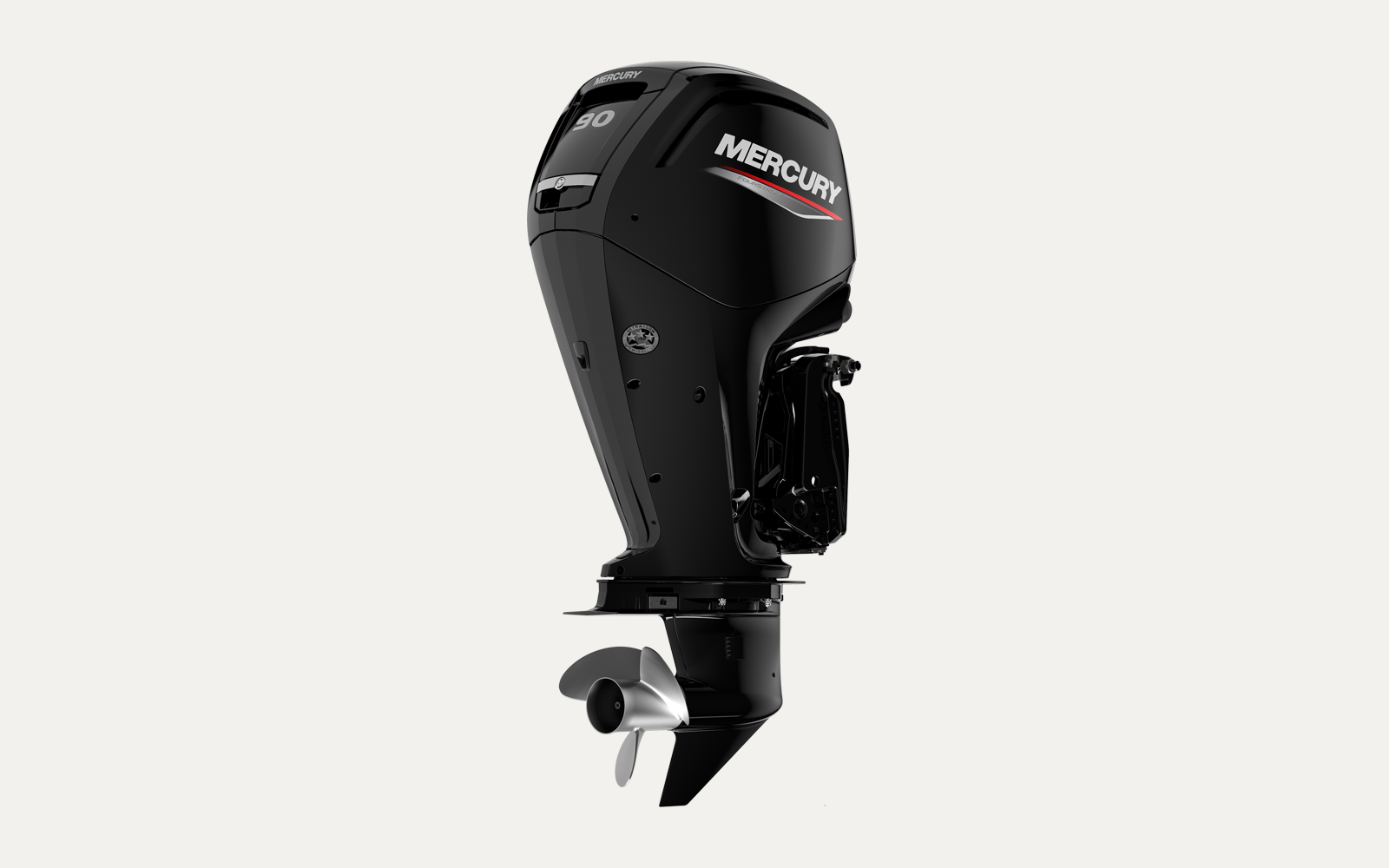
Official Mercury Marine studio photography of the current 90 HP FourStroke.
What It Feels Like on the Water
The 90 is not trying to act like a race motor. It starts cleanly, settles into a quiet idle and delivers power without much drama. On the right 16–18 ft aluminum hull, it has enough midrange to get the boat moving without making every throttle change feel abrupt.
That is the appeal. It is an everyday motor.
The original 2014 launch testing of this same 2.1-litre platform described it as exceptionally smooth and quiet enough for normal conversation at cruise on one test boat. More than a decade later, that basic character is still why the 90 works for fishing, cottage runs and family use.
It can also feel disappointing when the setup is wrong. A propeller with too much pitch can hold the motor below its intended rpm range. A motor mounted too low adds drag. A heavily loaded pontoon can make a healthy 90 feel tired if the hull really wants more power.
That is not a reason to avoid the motor. It is a reason to buy the finished setup, not just the horsepower number.
What Owners Actually Say Online
We screened public owner forums, boating discussions and long-term reports for the current 2.1-litre Mercury 90 introduced in 2014. Older carbureted engines, Yamaha-supplied powerheads and earlier “Veradito” 90s are different motors and were excluded from the conclusions below.
Owner posts are anecdotal, not warranty statistics. Their value is in the themes that repeat.
“I forgot it was still running” is almost a genre
The most common human reaction to the current 90 is not about speed. It is that the motor is so quiet at idle that owners and reviewers check the tachometer before reaching for the key.
A Boats.com test of a Boston Whaler 170 Montauk described accidentally leaving the 90 idling while fishing because the crew forgot it was running. That is a much more useful description for a family fishing boat than an isolated sound-pressure number.
Owners coming from an older two-stroke notice the difference most. One pontoon buyer described the old 40 HP two-stroke as an anxiety exercise because every trip raised the question of what would break next. That does not make every old motor unreliable. It explains why easy starting and an uneventful idle feel like luxury to someone who has spent years squeezing a primer bulb and listening for a miss.
The 90-to-115 “free horsepower” idea never dies
Because the 90 and 115 share a 2.1-litre family, online threads regularly ask whether a 90 can become a 115 with an ECU swap or a removed restrictor.
A detailed ContinuousWave owner discussion worked through the parts and found differences beyond one computer, including intake and camshaft components. More importantly, changing factory output creates emissions, warranty, insurance and capacity-plate problems.
The funny version of this question is that boaters want the 115 until the capacity plate says 90. Then they want the 90 to become a 115 without technically becoming a 115.
Our answer is less exciting: if the boat is rated for 115 and the loaded job needs it, buy the proper 115. If the plate stops at 90, keep the legal 90 and finish its propeller and setup.
Pontoon owners like the 90 until they ask it to be a 150
On a modest 20 ft pontoon, owners commonly describe the 90 as a good cruising motor with reasonable fuel use. On a larger 24 or 25 ft pontoon, the conversation changes quickly to slow acceleration, heavy passenger loads and whether water sports were part of the original plan.
That is why social advice about a “90 on a pontoon” is often contradictory. The posters may be describing boats that differ by several feet, a third tube, lifting strakes, gearcase, propeller and six passengers.
Command Thrust helps the right pontoon carry a larger propeller. It cannot make 90 HP perform the job of a 150. Owners who understand that tend to be happy. Owners who buy from the badge and an empty-boat speed video are more likely to be disappointed.
High hours create less concern than missing maintenance
In a high-hour Mercury 90 discussion, an owner reported that a 2015 current-generation 90 with about 620 hours still ran well with owner-performed maintenance.
One engine is not a durability study. It does show why an hour number by itself is a poor used-motor verdict. Service records, fault history, compression or leak-down results when appropriate, gear lube, corrosion, cooling flow and how the boat was stored matter more than whether the hour meter sounds large in a classified ad.
What the online buzz gets right
- quiet idle and clean starting are the 90's most loved everyday traits
- the 90 is a cruiser on a normal pontoon, not a disguised tow-sports motor
- Command Thrust and propeller choice matter more than many owners expect
- the shared 2.1-litre family does not make a 90 legally or mechanically interchangeable with a 115
- documented maintenance matters more than an isolated high-hour number
The 90 earns fewer dramatic online posts than a Pro XS. That is appropriate. Its best trick is making a normal day on the water feel normal.
Standard Gearcase vs Command Thrust
Command Thrust does not add horsepower. It changes how the 90 puts its power into the water.
| Version |
Gear ratio |
What changes |
Best fit |
Main trade-off |
| 90 FourStroke, standard |
2.07:1 |
Smaller, lower-drag gearcase with standard propeller family |
Most aluminum and fibreglass recreational V-hulls |
Less propeller leverage for high-drag loads |
| 90 FourStroke Command Thrust |
2.38:1 |
Larger gearcase with larger-diameter propeller options |
Pontoons and specific heavy or high-drag boats |
Larger case adds drag and is not a generic performance upgrade |
Best fit: Standard 90 FourStroke
Choose the standard 90 for a normal recreational V-hull unless the boat, load or manufacturer application points elsewhere.
This is the version most buyers picture on a 16–18 ft aluminum fishing boat. It keeps the smaller gearcase, lets a lighter hull run efficiently and still gives a qualified rigger enough propeller choices to tune the boat properly.
Best fit: 90 Command Thrust
Choose Command Thrust when carrying load matters more than minimizing gearcase drag.
Pontoons are the obvious case. Their tubes and broad deck create drag, and family loads change from one trip to the next. The 2.38:1 ratio lets the motor turn a larger propeller that can hold the water better and carry that load.
Our Command Thrust guide goes deeper into why CT is a fitment choice, not an automatic upgrade.
Real Freshwater Results, With the Boat Attached
These are exact examples, not speed promises.
| Boat and setup |
Motor and propeller |
Reported result |
Useful context |
| 2023 Crestliner 1650 Hawk, 16.75 ft deep-V |
90 FourStroke, standard 2.08:1 listing, 15-pitch Spitfire aluminum |
36.6 mph at 5,710 rpm; 0–20 mph in 4.07 s |
At 4,000 rpm: 25.7 mph and 17.8 L/h (4.7 US gal/h) |
| 2020 Manitou Aurora LE Angler, 20 ft pontoon |
90 FourStroke Command Thrust 2.38:1, 11-pitch Enertia stainless |
24.4 mph at 5,590 rpm; 0–20 mph in 4.23 s |
At 4,000 rpm: 17.1 mph and 15.5 L/h (4.1 US gal/h) |
| 2023 Harris Cruiser 210, 22.1 ft pontoon |
90 FourStroke, 2.38:1 setup, 12-pitch Spitfire aluminum |
22 mph at 5,566 rpm; 0–20 mph in 12.6 s |
At 4,000 rpm: 14.5 mph and 15.9 L/h (4.2 US gal/h) |
| 1968 Boston Whaler 17 repower and lake test |
Current-generation 90 FourStroke, 16-pitch Vengeance stainless |
About 43–44 mph; on plane in about 4–5 s |
Rigger considered trying 17 pitch after verifying rpm and handling |
Mercury's Crestliner test page labels that setup 2.08:1, while the current operation manual gives the standard production ratio as 2.07:1. The table keeps Mercury's test-page wording rather than silently changing it.
The 43–44 mph Whaler and 36.6 mph Crestliner results are not in conflict. A classic Whaler skiff, a newer deep-V fishing hull and a pontoon use the same 90 HP very differently. Boat length by itself cannot reconcile the results.
The Manitou and Harris examples are the useful warning. Both carry 90 HP and a 2.38:1 setup. One reached 20 mph in 4.23 seconds. The heavier Harris took 12.6 seconds.
The motor did not forget how to make 90 HP. The boat changed.
https://www.youtube.com/watch?v=F1Js6zGC6-s
Boat Trader's 2026 lake test of a classic 17-ft Boston Whaler repowered with a current-generation Mercury 90 FourStroke.
The Propeller Can Change the Whole Review
Mercury tells owners to choose a propeller that lets the motor operate in the upper half of its recommended full-throttle rpm range with the boat normally loaded.
For the recreational 90, that full range is 5,000–6,000 rpm.
The phrase normally loaded matters. A propeller chosen with one person, half a tank and no gear may pull the engine too low once the boat gets its batteries, trolling motor, canvas, cooler, passengers and full fuel back aboard.
On the Boston Whaler lake test, the 16-pitch Vengeance put the boat around 43–44 mph and the rigger still considered a 17-pitch test. That does not mean every 90 wants 16 or 17 pitch. It shows the proper sequence:
- Confirm the boat, capacity plate, transom and shaft length.
- Start with a propeller matched to the hull and gearcase.
- Run the boat with a realistic load.
- Check wide-open-throttle rpm, grip, steering and acceleration.
- Change the propeller if the numbers or handling say it is wrong.
Our propeller-selection guide explains the terms. The water test gives the final answer.
When the 90 Is the Right Motor
The 90 belongs on the shortlist when:
- the capacity plate allows 90 HP
- the boat is a typical 16–18 ft aluminum fishing hull
- the boat is a lighter family runabout
- the pontoon is modest in size and paired with the right Command Thrust setup
- the owner values quiet, predictable everyday use over maximum possible speed
- the normal passenger and gear load leaves reasonable power in reserve
It can be a very good repower for an older hull because the owner gets modern starting, cleaner operation, current instrumentation options and a known service path. Do not assume it will be lighter than the old motor. Some older two-strokes were lighter, and exact transom capacity still needs inspection.
When We Would Tell You to Buy Something Else
The capacity plate stops at 75 HP
Then the answer is 75. The 90 is not an upgrade path around the plate.
The boat regularly carries a heavy load
A 22-ft pontoon with two people on Tuesday and eight people, a dog, coolers and tube gear on Saturday is not the same test. If the boat is rated for 115 and spends most of its life loaded, the 115 may be the more honest recommendation.
You want a Pro XS personality
There is no current 90 Pro XS in Mercury's Canadian recreational lineup. Pro XS begins at 115 HP in this class.
If you care about maximum acceleration, propeller testing and running near the top of the capacity plate, read our 115 HP FourStroke and Pro XS review. Do not buy a 90 planning to alter its factory calibration later.
The boat needs a different shaft or gearcase
Shaft length is fitment, not a preference. Gearcase choice is application, not a trim package. We need the actual boat before we can call either one correctly.
75 vs 90 vs 115: The Honest Short Version
| Motor |
Why someone chooses it |
When it becomes the wrong call |
| 75 FourStroke |
Capacity plate, lower power requirement or a genuinely light rig |
Owner expects 90-like load carrying or buys only on initial price |
| 90 FourStroke |
Balanced everyday power for many mid-size freshwater boats |
Heavy regular loads or performance expectations exceed the boat/motor match |
| 115 FourStroke or Pro XS |
More reserve, stronger acceleration and better fit for boats rated to use it |
Hull cannot legally carry it, or the owner does not need the extra power |
The shared 2.1-litre platform does not make the three motors interchangeable. Horsepower, calibration, capacity and price still matter.
Read the dedicated 75 HP review if the plate or budget has you deciding between 75 and 90.
What HBW Checks Before Recommending a 90
We don't recommend the motor from boat length alone.
On Rice Lake and across the Kawarthas, the normal load is rarely the brochure load. Trolling batteries, an electric motor, a livewell, cottage gear, canvas, fuel and people all count. We ask what is actually aboard on a normal Saturday, not what the empty hull did in a catalogue test.
Before calling a 90 standard or Command Thrust the right fit, we check:
- the capacity plate and transom height
- hull type and actual boat model
- current motor, controls, steering and gauges
- typical passenger, fuel and gear load
- towing expectations
- battery, trolling-motor and kicker weight
- whether the boat needs standard or Command Thrust
- what can safely be reused after inspection
- the propeller starting point and water-test plan
Existing Mercury controls or SmartCraft equipment may be reusable. They are not automatically reusable because the old motor says Mercury on the cowl. Condition, generation, connectors and the rest of the rigging still need inspection.
We water test repowers because the invoice cannot tell us whether the propeller is right. The boat can.
Warranty, Product Protection and Current Pricing
Mercury's current U.S. and Canada warranty chart lists a 3-year limited warranty for a new FourStroke registered for pleasure use. Registration and the full warranty terms still apply. Any promotional bonus coverage must be confirmed at the time of sale because those programs can change.
Mercury Product Protection Platinum is separate. It is an optional extended service contract, not extra years silently added to the standard warranty. Its coverage begins after the applicable limited warranty and remains subject to eligibility, contract terms and covered components.
Read the Canadian Mercury warranty and Product Protection guide for the plain-language version.
We do not freeze motor prices into review articles. The live price link is deliberate: gearcase, shaft length and current programs can change the motor price, while the installed total also depends on rigging, propeller and what can safely be reused. Use the live Canadian pricing reference, then build a complete 90 HP quote.
Sources
Ready to Price a Mercury 90 for Your Boat?
Use the live pricing reference to compare the exact 90 configurations, then build a complete quote with rigging, propeller and installation choices. If the 90 is not the right answer for your boat, we will tell you.
Phone: 905-342-2153
Pricing: Live Canadian Mercury pricing
Configurator: Build a Mercury 90 quote
Harris Boat Works, 5369 Harris Boat Works Rd, Gores Landing, ON K0K 2E0.
