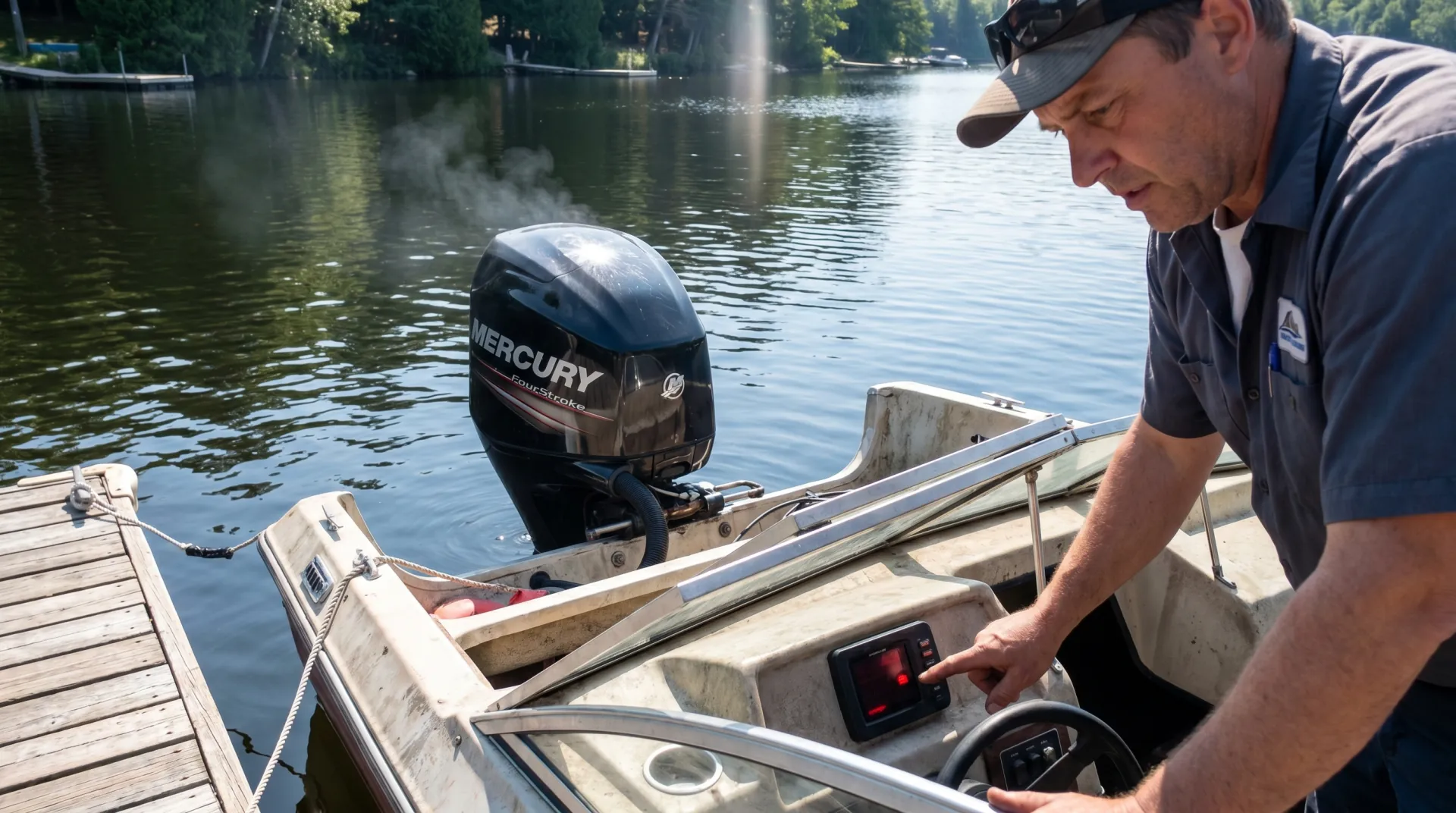
--- Use the exact engine guidance. Follow the response specified for your motor and any displayed warning. A telltale stream alone does not establish that engine temperature is safe. Record the serial number and warning message for a qualified technician; do not use a generic...
Use the exact engine guidance. Follow the response specified for your motor and any displayed warning. A telltale stream alone does not establish that engine temperature is safe. Record the serial number and warning message for a qualified technician; do not use a generic chart as a diagnosis.
Quick Answer
A Mercury that overheats at idle but runs fine at speed is a classic symptom of a worn water pump impeller. The impeller can generate enough vacuum at high RPM to move cooling water adequately, but loses suction at low RPM. It needs replacement, and the longer you wait, the more likely you are to turn a routine impeller job into a powerhead job. Other causes: blocked cooling intake, thermostat issue, or a sensor fault. Check the tell-tale first.
For engine repairs, we only service Mercury and MerCruiser. Book at hbwservice.ca.
Mercury Outboard Overheating at Idle: What's Actually Causing It (Ontario)
An outboard that overheats at idle but runs fine at cruise is not random, it's a specific diagnostic pattern that points to a short list of causes. The symptom matters because it tells you something about where in the cooling system the failure is.
Most cooling systems work by pumping water through a circuit. If the motor cools fine at high speed but overheats when you slow down for a no-wake zone or while trolling, the pump is the first suspect, because a worn pump can generate enough flow at speed to keep up, but not enough at low RPM.
This is the diagnostic sequence we'd walk through for this specific symptom.
Interactive: how your outboard stays coolDrag the throttle and switch on a fault to see how each one shows up. Values are illustrative.Step 1: Read the Tell-Tale
Check the tell-tale (the small water stream from the motor cowling) when the alarm sounds. This is the fastest diagnostic.
| Tell-tale at idle |
What it means |
| Strong and steady |
Water is leaving the telltale. That does not rule out overheat. The cause may still be thermostat, sensor, internal blockage, or another cooling path. Follow the display and the serial-specific manual. |
| Weak or sputtering |
Pump isn't generating enough flow at low RPM. Classic worn impeller. |
| Strong at cruise, weak at idle |
Classic worn impeller. At cruise RPM the pump gets by; at idle RPM it can't. |
| No tell-tale at all |
Pump has failed or intake is completely blocked. Shut down. |
If the tell-tale is weak specifically at idle and improves when you throttle up, the impeller is the most likely cause. Don't keep running, every minute at low RPM without adequate cooling flow is wear on the powerhead.
Step 2: Check the Cooling Intake Screens
Before assuming the impeller, check the intake screens on the lower unit. Weeds, debris, plastic, and in some Ontario waters, zebra mussel growth can partially block these screens. A partial blockage restricts flow at all RPMs but may be enough to cause problems specifically at idle (when flow is lowest).
- Motor tilted out of the water: inspect the intake screens on the lower unit
- Use a soft brush or wooden pick to clear any debris
- Zebra mussel growth on screens is increasingly common in some Ontario lakes, address it
If the screens were blocked and clearing them resolves the symptom, monitor it. If the symptom returns, the impeller may be worn anyway.
Step 3: Water Pump Impeller
If the tell-tale is weak at idle and the screens are clear, the impeller is the likely cause.
The impeller is a rubber vane wheel inside the lower unit that drives cooling water up through the motor. It wears with age, degrades from sand and debris, and can be damaged suddenly by a debris blockage that caught the vanes.
Signs of a worn impeller specific to the idle-overheating symptom:
- Tell-tale that streams normally at cruise, weakens or sputters at idle
- Overheat alarm that sounds when trolling or in no-wake zones but goes quiet when you bring RPM up
- Tell-tale that sputters but doesn't disappear entirely (a fully-failed impeller often produces no tell-tale at any RPM)
Service interval: Follow the exact engine manual. Many Mercury schedules place water-pump service around 300 hours or three years, but the model and operating conditions control. A telltale that was weak last season or an overheat warning needs diagnosis now, regardless of the calendar.
Replacement: The lower unit needs to come off to access the water pump. This is a job with straightforward procedure but it involves torquing the lower unit back on correctly and ensuring the shift shaft aligns. If you're mechanically confident, it's a DIY-possible job. If not, have it done by a technician.
Step 4: Thermostat
If the tell-tale is strong at idle (water is flowing), but the overheat alarm still sounds, the thermostat is the next suspect.
A thermostat stuck partially closed restricts the flow of cooling water through the powerhead even when the pump is delivering it. The result is an overheat even with good pump function.
A thermostat can also stick open, which usually shows up as the motor running too cold rather than overheating, but in some configurations can cause other symptoms.
Thermostat diagnosis requires removing it and testing or inspecting it. This is typically done at the same time as a water pump service or as part of the 100-hour/annual service. If the impeller is being replaced, it's good practice to check the thermostat at the same time.
Step 5: Sensor Issue
In some cases, the overheat alarm is triggered by a faulty temperature sensor rather than an actual overheating event. This is less common than impeller and thermostat issues, but worth considering if:
- The tell-tale looks normal at idle
- The motor doesn't feel or sound like it's struggling
- The alarm is intermittent and doesn't correlate with observable symptoms
Sensor diagnosis requires dealer tools to read temperature sensor values against actual powerhead temperature. If you suspect a sensor issue, this is a professional diagnostic.
The diagnostic sequence at a glance
| Step |
What you check |
What it points to |
| 1 |
The tell-tale stream at idle |
Strong at cruise and weak at idle is the classic worn-impeller pattern. No tell-tale at all means shut down. |
| 2 |
The cooling intake screens on the lower unit |
Weeds, debris and zebra mussel growth restrict flow, and the restriction bites hardest at idle when flow is lowest. |
| 3 |
The water pump impeller |
A worn impeller can keep up at cruise RPM and fall short at idle RPM. The lower unit has to come off to service it. |
| 4 |
The thermostat |
A thermostat stuck partially closed restricts flow through the powerhead even when the pump is delivering water. |
| 5 |
The temperature sensor |
Less common. Suspect it when the tell-tale looks normal, the motor does not sound like it is struggling, and the alarm is intermittent. Sensor diagnosis needs dealer tools. |
Your serial-number owner's manual controls the exact procedure and service interval for your motor.
Ontario Context: Why Idle Overheating Shows Up More in Summer
Ontario boating involves a lot of slow-speed running: navigating marinas and launch ramps, no-wake zones, trolling on Rice Lake and the Kawarthas, idling while waiting for a lock on the Trent-Severn.
A motor with a marginal impeller can go an entire season of mostly high-speed running without triggering an alarm, and then the first time you spend 20 minutes in a no-wake zone, the alarm sounds. The motor wasn't fine before; it was just masking the problem at speed.
This is why we recommend impeller replacement on schedule rather than waiting for a symptom.
When to Stop Running and Book Service
If the overheat alarm sounds at idle:
- Don't keep running to see if it clears. Running an overheated motor at any RPM risks powerhead damage.
- If the tell-tale is weak or absent: shut down immediately.
- If the tell-tale looks normal: that does not rule out overheat. Reduce load, follow the display and the serial-specific manual, and stop when a temperature, oil-pressure, or water-flow warning requires it. Do not treat a limp-back at idle as the default first step.
After any overheating event, have the motor inspected before the next run. Heat cycling can cause damage that isn't visible externally.
For engine repairs, we only service Mercury and MerCruiser.
Book at hbwservice.ca.
What we see at HBW
Rice Lake's central basin can be thick with stumps and milfoil in late July. If an overheat alarm sounds after a weed-heavy run, check the intake screens before assuming the impeller failed.
Follow the engine manual before inspecting or clearing intake screens. Do not probe or disassemble cooling components based on this summary. Have an overheat alarm diagnosed before the next run.