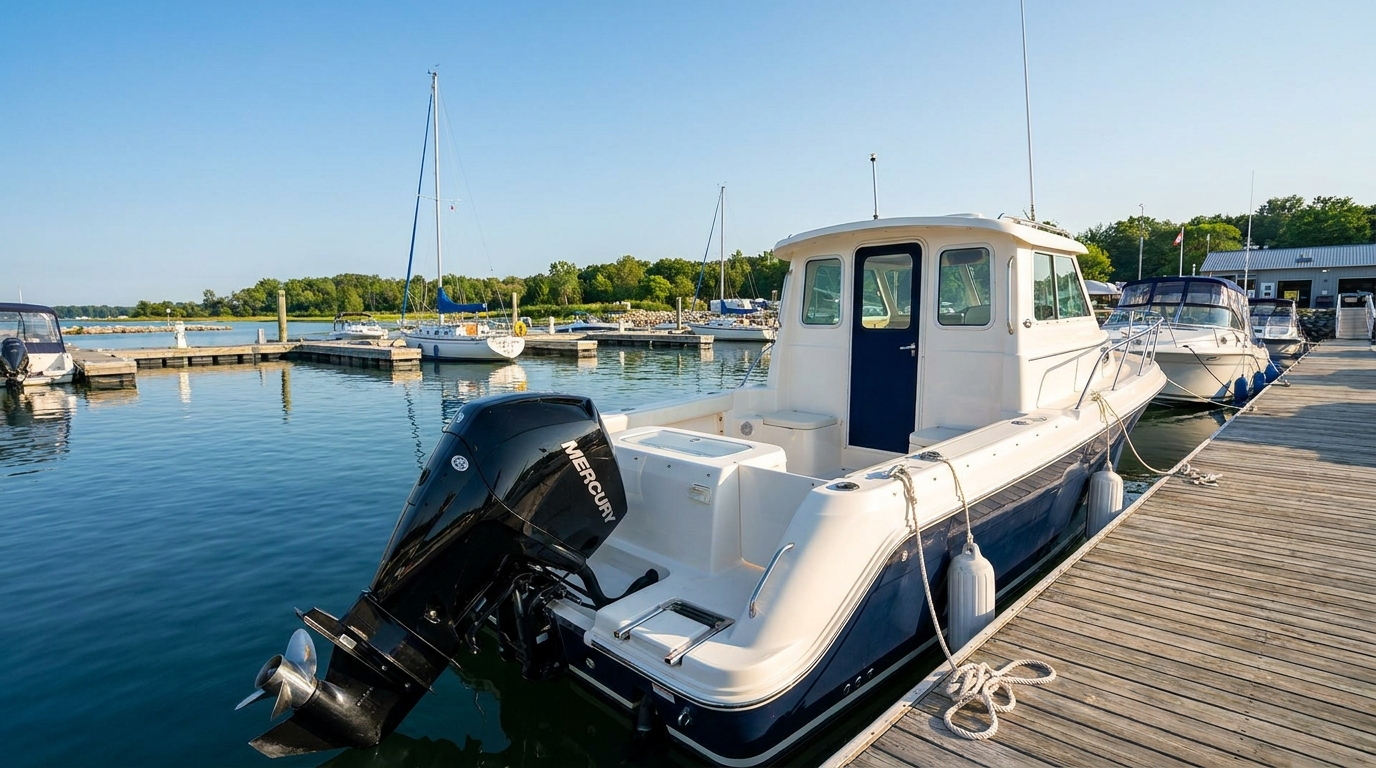
This illustrative scenario evaluates consolidating twin 115 HP FourStrokes into one Mercury 300 HP V8 on a 23-foot cabin or walkaround boat. The change can reduce maintenance and helm complexity, but it also changes weight distribution, low-speed handling, redundancy, steering, controls, and transom loading. HBW confirms manufacturer limits and the full configuration before treating it as a viable repower path.
Last reviewed: 2026-07-18
Quick answer: Replacing twin 115 HP outboards with one 300 HP V8 is a major naval-architecture and rigging decision, not a simple horsepower swap. This illustrative scenario shows the questions to ask. HBW must confirm the hull rating, transom, weight and balance, redundancy needs, steering, controls, propeller, and current written quote.
This illustrative scenario evaluates consolidating twin 115 HP FourStrokes into one Mercury 300 HP V8 on a 23-foot cabin or walkaround boat. The change can reduce maintenance and helm complexity, but it also changes weight distribution, low-speed handling, redundancy, steering, controls, and transom loading. HBW confirms manufacturer limits and the full configuration before treating it as a viable repower path.
Key facts
- Old setup: twin 115 HP FourStrokes, about 25 years old
- New setup: single Mercury 300 HP V8 Verado or Pro XS 4.6L
- Boat: 23-foot cabin / walkaround
- Pricing: written quote after hull, transom, controls, steering, and motor selection are confirmed
- Motor lead time and install schedule: confirmed for the selected Pro XS or special-order Verado configuration
- Fuel economy: no generic percentage; compare the measured twin baseline with the proposed single-engine setup
- Deposit: $1,000 for big-block / Verado
- Warranty: Mercury Limited Warranty, confirmed at quote
What was on the boat before?
The candidate is a 23-foot cabin or walkaround (small cuddy, head, narrow side deck) that was rigged twin from new in the late 1990s or early 2000s. Twin 115 HP FourStrokes made sense at the time. Two motors, two of everything. Plenty of power for the hull, redundancy on big water, and a helm setup that felt premium for the era.
Twenty-plus years later the math has changed. The two 115s are running but showing their age, corrosion under the cowl, fading electronics, fuel pumps and water pumps being chased every season. The owner is paying two service bills, running two fuel lines, and replacing two of every consumable. The boat doesn't leave Rice Lake or the Trent system, so true offshore redundancy isn't actually being used.
Why consolidate twin 115s into a single 300?
The comparison has four parts: service component count, measured fuel use, low-speed handling, and redundancy.
One motor reduces the number of engine-specific filters, plugs, fluids, water pumps, and control components, but a complete maintenance-cost comparison needs the exact old and proposed engines.
Fuel use cannot be assigned a generic improvement. Hull attitude, propeller efficiency, engine loading, cruise speed, wind, water, and total weight all affect the result, so the existing boat needs a measured baseline.
A single throttle and one engine network simplify the helm, but twin engines can provide different low-speed manoeuvring options. The new handling characteristics need to be assessed, not assumed.
The major trade-off is loss of get-home engine redundancy. The owner must evaluate operating area, towing access, and risk tolerance before treating a single-engine conversion as acceptable.
What did the job involve?
A twin-to-single is one of the bigger jobs we do. We start with a transom inspection, twin bolt patterns leave eight holes that need to be addressed, sometimes filled and sometimes left for hardware reuse depending on where the single mounts. The center bridge between the twin pockets often needs reinforcement to handle the torque of a single V8 in the middle. This is shop work, not a one-day install.
The proposed motor requires matched Mercury controls, steering, fuel routing, electrical work, gauges, and a boat-specific propeller. HBW would verify loaded WOT RPM, steering, trim, acceleration, and low-speed handling on the completed boat.
Motor availability, transom engineering or repair, and installation timing are confirmed in the written quote. Verado is special-order. Pickup is at Gores Landing; HBW does not ship or deliver outboards.
What did it cost?
The current bare-motor price is only one part of this project. The written quote depends on the selected 300 HP model, steering, controls, transom work, electrical changes, propeller, removal of two motors, and water testing. Verado availability is special-order; Pro XS availability is confirmed at quote time.
Trade-in on two 25-year-old 115 FourStrokes depends heavily on condition, clean, running motors with reasonable hours can take meaningful dollars off. Fill the trade-in form and we usually email a CAD figure within one business day.
HBW can arrange financing through DealerPlan and Canadian lenders on eligible purchases of $5,000 or more at the current 5.48% APR promotional APR through Dec 31, 2026 (OAC). The financed quote includes the $349 DealerPlan documentation fee where applicable and discloses the contract term, amortization, and any balance due at maturity. A $1,000 deposit holds the order.
Frequently Asked Questions
- Why go from twin to single?
- Potential advantages are fewer engine-specific service components and a simpler single-engine control network. Potential disadvantages are changed low-speed handling and loss of get-home engine redundancy. Fuel use and suitability must be evaluated on the actual hull; inland use alone does not make the conversion automatically appropriate.
- Do I need to modify the transom for single-engine conversion?
- Often yes. Twin transoms have two bolt patterns and a center bridge between them. We may need to fill the unused bolt holes, reinforce the center skin, and re-rig steering and controls for a single. This is included in the quote. We inspect the transom carefully before final quote.
- Can I trade in both old 115s?
- Yes. We take Mercury outboard trade-ins, and 25-year-old 115 FourStrokes still carry some core value depending on condition. Fill the trade-in form with details on both motors and we usually email a combined CAD figure within one business day.
- How long does a twin-to-single conversion take?
- Timing depends on current motor availability, the selected Pro XS or special-order Verado configuration, engineering or transom work, controls, steering, rigging, and water testing. HBW confirms both the motor lead time and the boat schedule in the written quote. Pickup is at Gores Landing.
Visit Harris Boat Works
Harris Boat Works · 5369 Harris Boat Works Rd, Gores Landing, ON K0K 2E0 · Phone (905) 342-2153 · Family-owned since 1947 · Mercury Premier Dealer, selling Mercury since 1965.
We're the repower side of Harris Boat Works in Gores Landing, Mercury Premier Dealer, selling Mercury since 1965. Twin-to-single is one of the most consequential repower decisions we walk customers through, and we walk through it honestly.
← All Mercury repower case studies