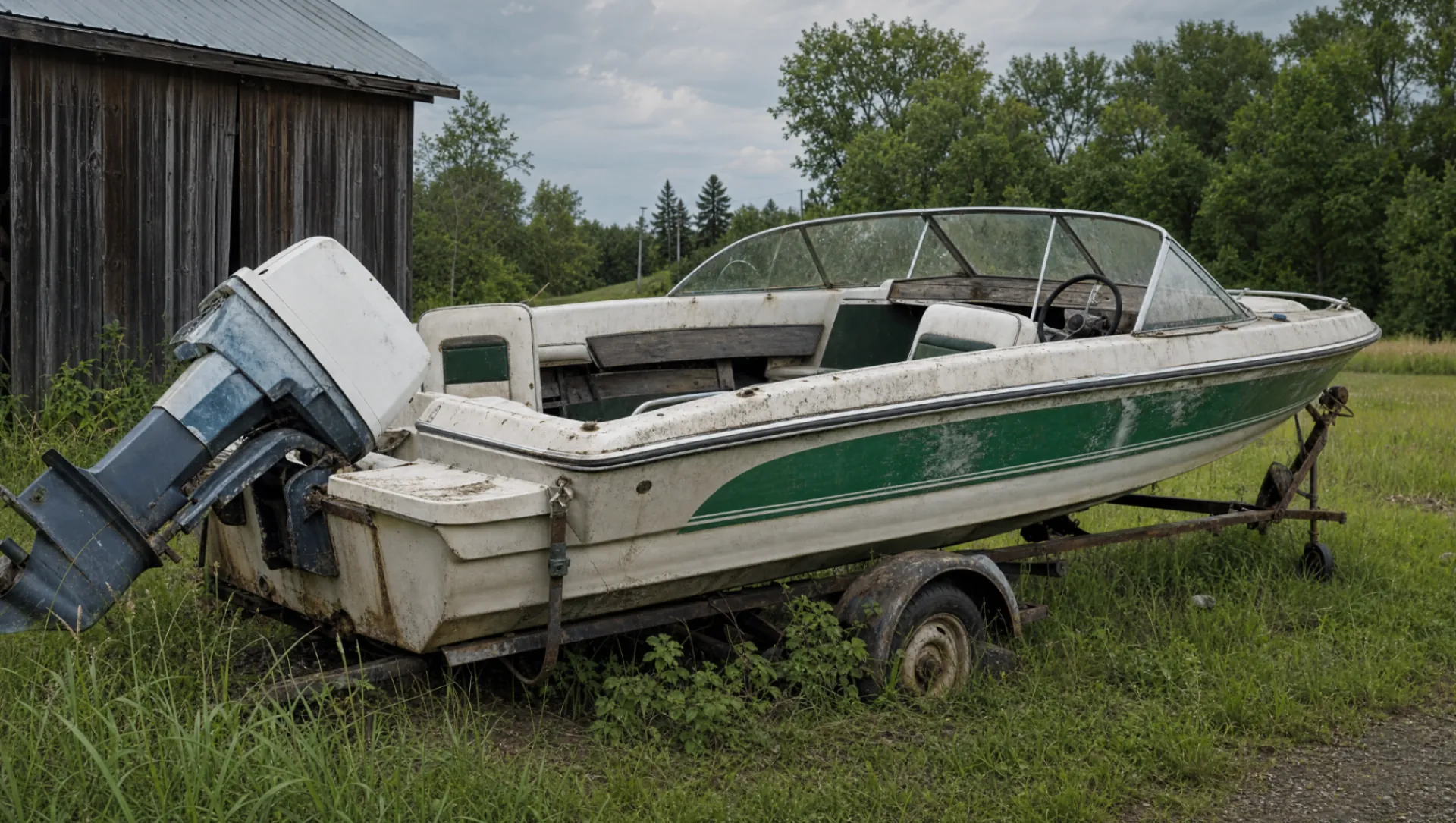
The Used Boat Market Is Full of Money Pits Every spring, thousands of Ontario buyers hit Kijiji, Facebook Marketplace, and AutoTrader looking for a deal on a used boat. Some find one. A lot don't. The boats that look like deals, priced just low enough to feel exciting,...
Quick answer: Some used boats are worth buying; many will drain your bank account. The worst offenders we see in Ontario: hulls with structural rot, sterndrives facing imminent rebuild, brand-orphaned motors with no parts pipeline, and wet-floor pontoons hiding deck damage. Inspect transom flex, lower-unit oil colour, and fuel system condition before any private-sale used purchase. The cheap boat is rarely the cheap boat.
The real trade-off
New Mercury outboard, or solid used?
Half our customers ask this within the first 10 minutes of walking in. Here's how we actually think about it on the showroom floor.
New Mercury
- ✓You want Mercury's 3-year factory warranty, with optional Mercury Product Protection available for up to eight total years
- ✓You finance and need lender-approved collateral
- ✓You will own the boat 7+ years and amortize the cost
- ✓You want the latest tech (SmartCraft, joystick, V8/V10 power options)
- ✓Resale value matters to you down the line
Higher upfront cost, but lower per-hour cost of ownership over a long run. Factory coverage plus optional Mercury Product Protection can extend protection to eight total years; the written terms and exclusions control.
Used Mercury
- ✓Cash budget is tight or you want to spend the difference on a better boat
- ✓You have a mechanic, or you're handy with a wrench
- ✓You only need the motor for 3-5 years
- ✓You're willing to accept some service history unknowns
- ✓You found a low-hour motor from a trusted source (like HBW certified used)
Lower upfront cost, higher risk on repairs after year 2 if the warranty is gone. Buy from a dealer who services Mercury and stand behind it.
When in doubt:Bring us the boat. We'll quote both a new motor and a comparable used motor from our inventory so you can see the real per-month cost difference. No pressure either way, we sell both.
The Used Boat Market Is Full of Money Pits
Every spring, thousands of Ontario buyers hit Kijiji, Facebook Marketplace, and AutoTrader looking for a deal on a used boat. Some find one. A lot don't.
The boats that look like deals, priced just low enough to feel exciting, described with just enough vagueness to keep you curious, are often the ones that will cost you the most. Not at purchase. After. When the season has started, the family is waiting, and the motor won't run.
We've been servicing and selling boats on Rice Lake in the Kawarthas (Ontario) since 1947. We've seen what comes through the door after a bad used-boat purchase. This list is what we'd tell a friend.
Why This Is Hard to Hear
Here's the real problem with buying a used boat in Ontario: most buyers don't know what they don't know. The seller isn't always lying, sometimes they genuinely believe the boat is fine. "Ran great last summer" is a true statement that tells you almost nothing about what's happening inside a carburetor that hasn't been properly serviced in a decade.
The financial hit isn't just the purchase price. It's the haul-out, the mechanic's time, the parts that are discontinued, the season you lose while it sits in a shop. A $3,000 "deal" on a used boat can easily become a $7,000 lesson.
You need a way to spot the traps before you hand over the cash.
The Boats and Motors We'd Walk Away From
Pre-2005 Carbureted 2-Stroke Outboards
These motors had a good run. That run is over.
Carbureted 2-strokes from this era are increasingly difficult to source parts for. Oil mixing is an extra step that a lot of owners either get wrong or skip altogether. Buyer interest often shifts toward 4-stroke and later direct-injection motors, but resale and marina rules vary. Confirm current local marina fuel and emissions rules instead of treating this as a provincial ban.
If the used boat you're looking at has an older carbureted 2-stroke hanging off the back, price the motor separately from the hull. Odds are, the motor needs to be factored out of the deal entirely, or you're budgeting for a repower sooner than you think. We've written more about this in our used outboard buying guide for Ontario.
Mid-90s to Mid-2000s Sterndrive Boats With Original, Unserviced Outdrives
Sterndrives from this era. MerCruiser and otherwise, are solid engineering. When they're maintained. The problem is that most of them weren't.
Bellows deteriorate. Gimbal bearings fail. When water gets into places it shouldn't, the damage is internal and invisible until it isn't. If the boat you're looking at has an original sterndrive that hasn't been touched since the Clinton administration, treat it as a project, not a boat. Rebuilding or replacing an outdrive is not a casual expense.
Ask specifically: when were the bellows last replaced? If the seller doesn't know, assume they haven't been. If you're seriously considering a hull in this category, our hull vs. repower decision guide can help you think through whether it's worth it.
Boats With Evinrude E-TEC G1 Motors
This one is delicate, so we'll be direct without being unfair. Evinrude made technically impressive motors. The E-TEC direct-injection 2-stroke was genuinely good engineering.
Then BRP exited the outboard market in 2020.
BRP stopped building Evinrude outboards in 2020, but still supplies genuine Evinrude parts, oils and warranty support through its dealer network. Stock for older models, especially electronics, is thinning, and Evinrude-focused service dealers are fewer. Price that risk into any offer. If something specific fails on an older G1 E-TEC, you may be hunting for parts from multiple suppliers with no guarantee of availability or timeline.
It doesn't mean every E-TEC is a write-off. It means the risk profile is different than it was five years ago, and that needs to be priced into any offer you make. We cover this in detail in our Evinrude to Mercury repower guide for Ontario.
Older Force, Chrysler, or Off-Brand Outboards
Short version: parts are limited, often aftermarket only, and hard to source. Service technicians who know these motors well are retiring. If the motor fails in a meaningful way, you're likely replacing it, which means the motor has zero value, and you're overpaying for a hull.
If you're seeing these on a listing and the seller is pricing the motor as a selling point, that's a problem.
Boats With Stringer Rot, Soft Floors, or Transom Mush
Walk the floor of any used fiberglass boat you're seriously considering. Literally walk it, bounce on it a little, push with your heel near the edges and at the transom. Soft spots are a structural problem, not a cosmetic one.
Stringers are the internal framework that hold a hull together. When they rot, usually from water intrusion through old, cracked gelcoat or improperly sealed fittings, the fix is a gut job. Transom mush (a soft, spongy transom, usually from water penetrating the wood core) can mean the motor mounting surface is compromised. This is not a DIY repair unless you know exactly what you're getting into.
Repair costs for serious stringer or transom work often exceed the value of the boat.
Wet-floor pontoons hiding deck damage
A pontoon can look tidy on the tubes and furniture while the deck underneath is the problem. Soft spots, swollen plywood, rusted fasteners, or a floor that flexes underfoot can hide water that has been sitting in the deck for seasons.
Ask to walk the whole deck, including under furniture and around gates. If the seller will not let you lift a hatch or check under the carpet, treat the floor as unknown. A wet pontoon deck is a structural repair, not a cosmetic refresh, and it belongs in the same walk-away category as a mushy transom until a qualified inspection says otherwise.
Boats With Fresh Paint on the Lower Unit
A freshly painted lower unit on an older motor is not a sign of good maintenance. It's a red flag.
Fresh paint on a lower unit is one of the oldest tricks for hiding corrosion, impact damage, or prop strikes that have never been properly assessed. A well-maintained motor has a lower unit that looks its age, with honest wear and the original finish, not a fresh coat of black slapped on before listing.
If you see it, ask why it was painted. If the answer is vague, factor in the cost of a full lower unit inspection before you commit.
Boats Stored Outside, Uncovered, for Years
Ontario winters are not kind to boats. UV breaks down upholstery, gelcoat, and plastic components. Freeze-thaw cycles work water into every crack and seam. Rodents find their way into wiring, fuel lines, and upholstery.
A boat that's been sitting outside uncovered for several seasons needs a full inspection before you can know what you have. Budget for that inspection, and budget for what it might find. Don't let the low price on the listing make you skip this step.
Boats With No Maintenance Records
"Well maintained" is one of the most common phrases in used boat listings. It's also one of the hardest to verify when the seller can't produce a single piece of paper.
Maintenance records don't need to be perfect or complete. But a boat owner who actually maintained their motor has receipts somewhere, from a dealer, a shop, or at minimum, their own notes. No records means you're taking the seller's word for the condition of the engine internals, the lower unit oil, the impeller, the fuel system, and everything else.
No records isn't an automatic deal-killer, but it changes the math. Price in the cost of a pre-purchase inspection and a full service before you use it.
Saltwater Boats Brought to Ontario Without Inspection
Ontario is freshwater. A lot of used boats come up from the US or from coastal provinces, and not all of them come with an honest description of their history. Saltwater corrosion is not always visible. It works into aluminum, electrical connections, fittings, and hardware in ways that surface inspection won't catch.
If a boat has any saltwater history and hasn't been professionally inspected since arriving in Ontario, factor that in. A marine surveyor is worth the cost here.
Boats Where the Seller Won't, or Can't. Run the Motor
There is one non-negotiable when buying a used boat with a motor: the motor has to run. In a tank, in the water, it doesn't matter. If it runs, great, now you can evaluate it. If it doesn't run, you're buying a guess.
"The battery's dead" and "I drained the fuel last fall" are common explanations. Bring a battery. Bring fuel. If the seller won't accommodate a running demonstration, walk away.
Anything Listed as "Mechanic Special," "Needs TLC," or "Ran When Parked"
These are not descriptions. They're disclosures. The seller is telling you, in plain language, that the boat does not currently work. The question is whether the problem is fixable at a cost that makes sense relative to the price.
Sometimes it is. But you need to know what's wrong before you decide, not after. Get it inspected before you buy, or negotiate a price that assumes the worst-case repair scenario.
Quick Red Flag Checklist
Use this on the first call with any seller:
- Can you run the motor for me before I drive out? (Yes/no answer, anything other than yes is a flag)
- Do you have any maintenance records or service receipts?
- Has the outdrive or lower unit ever been serviced? (For sterndrives: when were the bellows last done?)
- Has it ever been stored outside and uncovered?
- Does the floor feel solid everywhere, especially near the transom?
- Is there any history of impact, grounding, or prop strikes?
- Is there any saltwater or out-of-province history?
- Why are you selling it?
- What was done to it last fall before storage?
- Has it ever been described to a mechanic as a problem that couldn't be figured out?
If you get vague, defensive, or contradictory answers on more than two of these, move on. There are other boats.
What's Actually Safe to Buy Used
This list isn't meant to scare you out of the used market entirely. There are genuinely good used boats in Ontario. Here's what tends to hold up:
Mercury 4-stroke outboards from 2010 onward. Mercury's modern 4-stroke lineup. FourStroke, Pro XS 4-stroke, Verado, is well-supported, with a dealer network across Ontario and parts availability that's not going anywhere. An honest, documented service history on one of these motors is worth real money.
Well-maintained aluminum fishing boats. An aluminum hull is forgiving and durable. It doesn't rot. Dents are cosmetic. A mid-weight aluminum V-hull or tiller fishing rig with documented service, or at least a motor you can actually start and run, is one of the safer used-boat categories in this market.
Boats sold through a reputable dealer. Used boats that have been through a dealer's service bay come with at least some visibility into their condition. That's not a guarantee, but it's a different risk profile than a private sale from someone who "just doesn't use it anymore."
Boats where you can verify the story. One owner, local use, freshwater only, receipts from a recognizable marine shop, a motor that starts and runs cleanly. These exist. They're worth waiting for.
For a deeper look at what to evaluate when buying used, our used outboard buying guide for Ontario covers the pre-purchase inspection process in detail. And if you're weighing a used boat that needs a motor against starting fresh with a repower, the boat motor trade-in guide can help you figure out which direction makes more financial sense.
Bought One of These and Stuck With It?
It happens. The listing looked clean, the price felt right, and now you've got a problem motor or a hull that needs more than you bargained for.
We do Mercury repowers, full replacements that give an older hull a reliable, warranty-backed motor and a fresh start. If you're at the point where you're wondering whether it's worth fixing or replacing, that's exactly the conversation we have every day.
Get a repower quote at mercuryrepower.ca. Real prices, no runaround.
Harris Boat Works. Mercury Premier Dealer. Gores Landing, ON