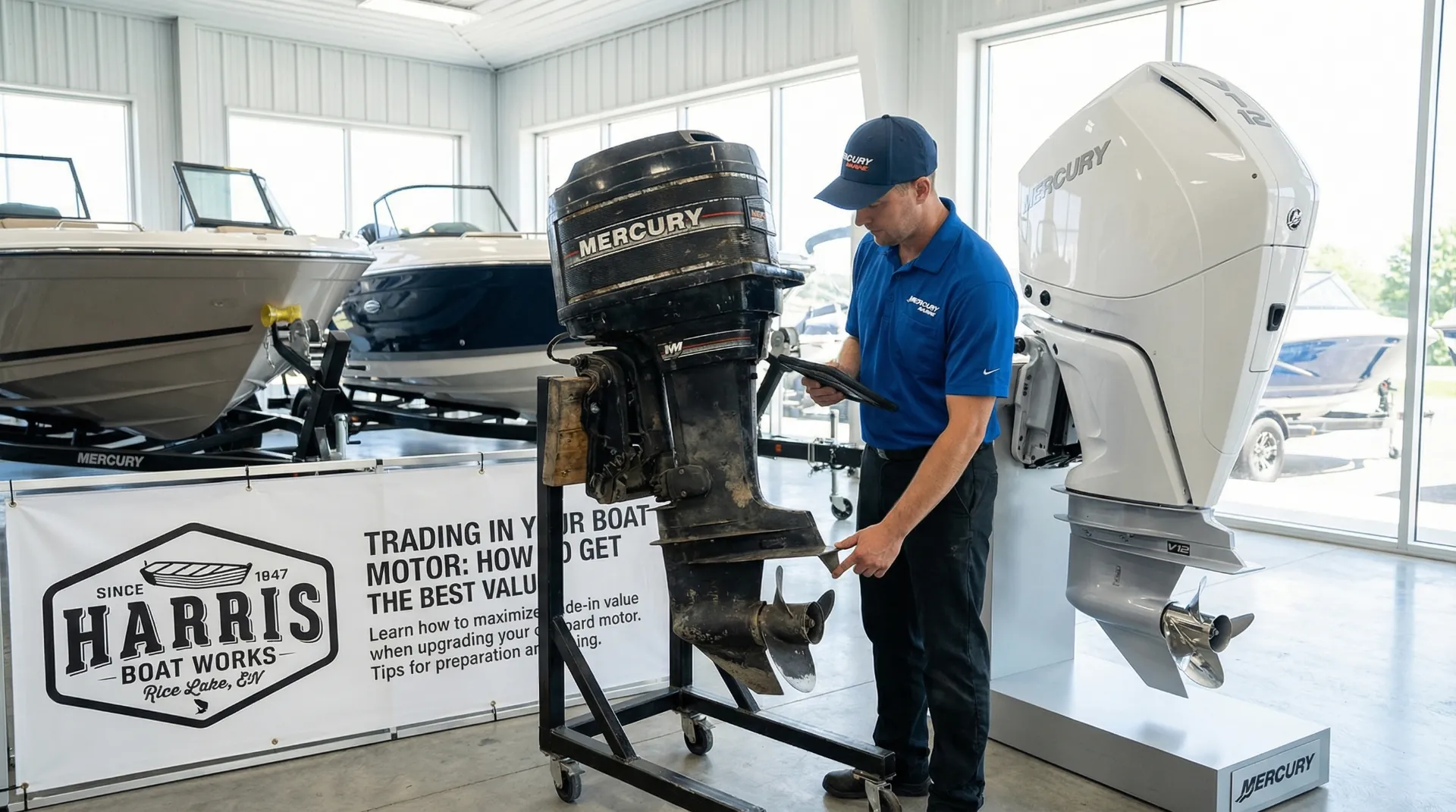
If you're thinking about a repower, your old motor isn't junk. It's part of the math. And in Ontario, that math is bigger than most boaters realize because the HST rules work in your favour the moment you trade. We've handled hundreds of trade-ins on Rice Lake. Most customers...
Quick answer: When you trade your old motor at an Ontario dealer, you only pay 13% HST on the difference between the new motor and the trade allowance, not on the full new motor price. On a $20,000 new motor with a $5,000 trade, that's $650 saved on tax. Get a free instant trade-in estimate at mercuryrepower.ca/trade-in-value, then roll it straight into a full repower quote.
If you're thinking about a repower, your old motor isn't junk. It's part of the math. And in Ontario, that math is bigger than most boaters realize because the HST rules work in your favour the moment you trade.
We've handled hundreds of trade-ins on Rice Lake. Most customers walk in thinking they need to sell privately to get top dollar. Then we run the HST numbers and the conversation changes. This post lays out how trade-in actually works in Ontario, what your motor is realistically worth in 2026, the documentation that moves the needle on your offer, and how HBW handles it from quote to dock.
Quick recommendation
If you just want a number, skip the rest and use our free trade-in estimator. Enter your motor's brand, year, model, and condition, and you'll get a current value in seconds, no account required. When you're ready to repower, you can roll the trade right into a full quote. Use the estimator at mercuryrepower.ca/trade-in-value.
The rest of this post is the math behind that number, and how the deal actually goes down at the shop.
The HST Math Most Boaters Miss
Here's the rule in Ontario: when you trade in a vehicle (including a boat or outboard) toward a new one at the same dealer, HST is calculated on the difference, not on the new motor's full price. Trade in your old Mercury for $5,000 against a new $20,000 Mercury, and you pay 13% HST on $15,000, not $20,000. That's $650 of tax savings per $5,000 of trade.
Prices here are planning figures as of July 2026. For live Mercury motor pricing, see the Mercury pricing reference.
Sell privately for the same $5,000, then buy the $20,000 motor outright, and you pay HST on the full $20,000. Same boat, same buyer, same trade value, but $650 more out of your pocket.
The threshold where this stops mattering: when the private-sale premium covers the lost HST savings AND your time. For a typical $5,000 to $10,000 trade, private sale needs to clear roughly 13% more than the trade offer just to break even on tax. Then add Marketplace tire-kickers, no-shows, the test ride on your lake, the messaging back and forth, and the cash safety conversation. Most boaters who do the math end up trading.
Confirm with your tax professional for your specific situation. The general rule is straightforward; edge cases like inter-provincial trades or commercial use get more nuanced.
What Your Old Motor Is Actually Worth (2026 Values, 2027 Coming July 1)
Real trade values move with three things: the motor itself (brand, model, HP, age), the condition (hours, service history, cosmetics), and the market we're seeing right now at HBW. Heads-up: Mercury's model year flips to 2027 on July 1, 2026, which means current 2026 Mercurys become "previous gen" overnight. Resale values don't move dramatically the day of the flip, but trading in before the flip lets us recondition and resell your motor at top-of-cycle pricing, which sometimes means a stronger trade offer.
We published a full reference table broken down by HP class and age in our Outboard Trade-In Value Ontario 2026 guide. Short version:
- 9.9-15 HP kicker, working condition, under 10 years: $800-$1,800
- 25-50 HP, 0-5 years, documented: $2,500-$5,500
- 60-90 HP, 0-5 years: $4,500-$8,500
- 115-150 HP FourStroke, 0-5 years: $7,000-$13,000
- 200-300 HP V8/V6, 0-5 years: $10,000-$20,000+
These are working, four-stroke, Mercury or Yamaha values. Two-stroke motors trade at substantially less because of emissions and fuel concerns. Hondas trade well but slightly under Mercury because of the smaller dealer network for resale. Anything older than 15 years or with major mechanical history is closer to parts value than retail.
There is no Kelley Blue Book for outboards. Condition and resale ease set the number, and we set it based on what we actually expect to recondition and resell into the Kawarthas market.
Trade vs Consignment vs Private Sale
HBW handles all three paths. The right one depends on what you value more: dollars, time, or the HST savings.
| Path |
Typical net |
Time to cash |
Best for |
| Trade-in toward repower |
Trade value + 13% HST savings on the difference |
Applied when the deal closes |
Customers applying the old motor to a repower |
| Consignment through HBW |
Higher than trade, minus our commission |
3-12 weeks |
Newer motors, no rush, want a stronger price |
| Private sale |
Highest potential, no commission |
Days to months |
Smaller motors, popular models, sellers with time |
The trade-in path is the cleanest. You roll in with the old motor, leave with the new one rigged on your hull, and pay HST only on the difference. We handle decommissioning the old motor, the paperwork, and the disposal or resale.
The consignment path matters for higher-end motors where the dollars per hour of work justify the wait. We list, show, run, and sell the motor while you keep boating on your new rig. It typically clears more than a straight trade but doesn't capture the HST benefit.
The private sale path maximizes top-line price, but you handle everything: photos, the listing, the calls, the no-shows, the test ride, the cash exchange, and the title work. Plus you pay full HST on the new motor.
If you're repowering and want to know exactly how the three paths shake out for your specific motor, we'll run all three numbers in writing.
What HBW Checks Before Quoting a Trade
Before we put a number on your old motor, we run the same inspection we'd run on a customer's used motor we're about to sell.
- Compression on every cylinder
- Lower unit oil condition (the milky-grey-of-doom check)
- Tilt and trim function and fluid condition
- Powerhead and gearcase corrosion
- Cosmetics: cowl condition, decals, scratches that affect resale
- Service history if you've kept records
- Known issues: alarm history, overheating events, prior repairs
- Hours if the motor has SmartCraft or a documented hour meter
We'd rather find a problem on the bench than have it come back from a customer next season. That's also why we'd rather you tell us about a known issue up front than have us find it. A known problem gets factored into the offer. A surprise problem kills the deal, or, worse, kills the price after the offer is made.
Documentation That Moves Your Trade Number
You don't need a thousand pages of records. You need the right ones:
- Original purchase receipt or dealer invoice if you have it (proves model year and original equipment)
- Service records, even handwritten ones (every winterization, every impeller, every oil change you can document is worth real dollars)
- Hour meter photo if your motor has SmartCraft or a dash-mounted hour meter
- Warranty paperwork if there's anything still active
- Recent service work receipts especially if you've replaced the powerhead, gearcase, or major electrical
- Ownership/title for the boat if you're trading boat-and-motor as a package
A motor with a clean documented service history can trade 10-25% higher than the same motor with no records. We've seen it move the offer by $1,500 on a 90 HP and $3,000 on a 200 V8. Records are the cheapest way to add value.
Common Mistakes Boaters Make on Trade-Ins
These are the things that cost real money on trade day. Avoid them.
- Detailing aggressively right before trade-in. A freshly detailed motor screams "trying to hide something." A regularly maintained motor looks like, well, a regularly maintained motor. Clean the cowl, wipe down the powerhead, but don't show up with a motor that looks newer than the records say.
- Hiding known issues. We'll find them. When we do, the offer drops more than if you'd disclosed up front, because surprise issues kill our confidence in everything else you said.
- Paying for a major service "to maximize trade value." You won't recoup what you spend. A $1,200 100-hour service before trade-in adds maybe $400 to the offer. Spend the money on basic cleaning and documentation instead.
- Negotiating trade in isolation from the new motor deal. Total deal matters. Sometimes we'll go higher on the trade if the new motor margin gives us room. Sometimes we'll give a better price on the new motor and hold the trade firm. Look at the whole package, not just one number.
- Trading in summer. July is the worst month to trade. Everyone's boating, nobody's repowering, and your old motor sits on our lot for three months before anyone looks at it. Winter is the best time. We're booking spring repowers and we want trade inventory ready to recondition and resell into the Kawarthas market.
How HBW Handles Your Trade From Quote to Dock
Here's the actual process if you trade through us:
- Quote stage. Tell us the motor (year, make, model, HP, shaft length, controls), the hours if you know them, and any service or issue history. We can quote a range from that alone. The firm number comes after we see the motor.
- Live inspection. Bring it in, or, for boat-and-motor packages on a trailer, we'll inspect on your trailer. Compression check, lower unit oil, run-up if it's runnable, cosmetics. Usually 30-60 minutes.
- Firm trade offer in writing. Tied to your new motor quote so you see the full deal: new motor price, rigging, trade allowance, HST on the difference, total out the door.
- Decommission and swap. We pull the old motor, transfer your old controls if compatible, install the new motor, rig and test. Old motor goes to our reconditioning bench or to the consignment line, depending on what makes sense.
- You leave on the new rig. Completion timing depends on the inspection, motor availability, rigging changes, parts, and the current shop schedule. HBW confirms the expected handoff in the written work plan rather than promising a generic turnaround.
Service is drop-off: you bring the boat to us at Gores Landing, we do not pick up, deliver, or arrange hauling. GTA and east Toronto customers trailer up routinely, and we have handled trades from as far as Ottawa and Niagara.
When to Use the Estimator vs Call Us
The fast path: get an instant estimate at mercuryrepower.ca/trade-in-value. It covers all common Mercury, Yamaha, Honda, and Suzuki outboards from the last 20 years and gives you a real number in seconds.
Call us if:
- You have a non-runner or older 2-stroke and want a human to look at it (the estimator won't price these well).
- You're trading a boat-and-motor package and want both lines itemized.
- You have a higher-end motor (150 HP+, under 5 years, low hours) and want to compare a straight trade against consignment.
- You want the firm number tied directly to a specific new motor configuration before deciding.
- You're driving in from outside the Kawarthas and want to sort out timing before you trailer the boat over.
The estimator gets you 80% of the way to a real number. The call is for the last 20% or the situations where the math is more complicated than a standard repower.
Ready to See Your Number?
Two minutes from now you can have a real trade-in value for your motor.
Instant trade estimate: mercuryrepower.ca/trade-in-value (free, no account, rolls into a full quote)
Build your repower quote with trade: mercuryrepower.ca/quote/motor-selection
Call us if your situation is non-standard: 905-342-2153