Quick Answer Prop selection is one of the first fuel-efficiency checks on a Mercury outboard. The right prop depends on the hull, the load, and the engine's specified wide-open-throttle RPM range, confirmed on a measured trial.
Quick Answer
Prop selection is one of the first fuel-efficiency checks on a Mercury outboard. The right prop depends on the hull, the load, and the engine's specified wide-open-throttle RPM range, confirmed on a measured trial. After prop: trim discipline, hull cleanliness, and cruise speed selection. Engine horsepower class matters less than most owners assume. Modern Mercury FourStrokes are efficient when set up correctly. Setup problems masquerade as engine problems constantly.
Mercury Outboard Fuel Efficiency: Get More Distance Per Tank
Most conversations about fuel economy start in the wrong place. People ask which horsepower is most efficient, or whether two-strokes or four-strokes burn less fuel. Those questions have answers, but they're not the answers that actually change what you spend at the fuel dock.
The real conversation starts with your prop.
This guide covers what actually drives fuel economy on a Mercury outboard, in the order that matters. We rig and Lake Test Mercurys at our shop in Gores Landing every season, and we see the same setup problems cutting the same owners' fuel economy year after year.
Shopping while you read: Mercury outboard prices in Canada.
The Five Levers, in Order
Fuel economy on an outboard comes down to five controllable variables. Fix them in this order, the first two deliver the most gain.
1. Prop selection
A wrong prop is the most common cause of poor fuel economy we see at HBW. A prop that's too high in pitch loads the engine down and prevents it from reaching its rated WOT RPM, the engine lugs, burns more fuel, and wears faster. A prop that's too low in pitch allows over-revving at WOT, which also wastes fuel at cruise.
Use a measured Lake Test to check the propeller match under the load you actually carry. The engine needs to reach the wide-open-throttle (WOT) RPM range specified in its owner's manual. If it falls outside that range, the next prop choice has to suit the engine, hull and load. Dropping one inch of pitch or switching from four blades to three isn't a fix for every boat.
On a typical day at HBW, we'll trial a motor with different props before settling on the right one for a specific hull and load combination. It's not guesswork, it's measurement.
For fuel economy, compare fuel used over a known distance and keep the units the same: litres per 100 km, or nautical miles per US gallon. Record the boat load, speed, trim and conditions so the next run is a useful comparison. A before-and-after claim needs the measured runs behind it.
2. Trim
Running flat at cruise (no trim up) is one of the easiest fuel economy mistakes to make and one of the easiest to fix. Properly trimmed, the bow lifts slightly and the hull rides efficiently through the water rather than plowing. The fuel economy difference between flat and properly trimmed is typically 10 to 20% at cruise speeds.
The right trim angle is the one where the motor is working least to maintain your target speed. If you're not in the habit of adjusting trim as speed and load change, start there.
3. Hull cleanliness
A weedy or fouled hull adds drag. This matters more for boats that sit in slips than for trailer boats, but even moderate growth on a hull increases fuel consumption. During spring commissioning, check the bottom and props for debris, growth, and damage.
4. Weight
Every unnecessary 45 kg (100 lb) on the boat costs fuel. The cumulative effect of a full cooler, extra anchors, gear that never leaves the boat, and passengers is real. It doesn't mean you should kick people out, it means if you're comparing fuel burns across trips, load matters.
5. Cruise speed selection
Modern Mercury FourStrokes have a cruise efficiency sweet spot, typically somewhere in the 3,500-4,500 RPM range, but this varies by motor and hull. Running above or below that band costs efficiency. The right approach is to identify your motor's best cruise RPM (your dealer or owner's manual can help), and aim for it.
What Horsepower Actually Does to Fuel Economy
Modern Mercury FourStrokes burn significantly less fuel than older two-strokes of equivalent power, Mercury's published figures show substantial efficiency gains for current FourStroke models compared to comparable two-stroke technology, though exact percentages vary by model and operating conditions.
Within the FourStroke lineup, the fuel economy difference between a correctly-rigged 90 HP and a correctly-rigged 115 HP on the same hull is smaller than most people expect. The bigger engine can run at lower RPM to do the same work, which partially offsets the larger displacement. The motor that's set up right for its hull will outperform a mismatched motor of any size.
This is why we don't recommend "getting a smaller motor to save fuel." If the smaller motor isn't properly matched to the hull, it will work harder and burn more, not less.
2026 Ontario fuel cost ranges
What you'll actually spend on fuel per season
Estimates based on Ontario marina gas pricing and realistic L/h (GPH) for a properly propped Mercury FourStroke 90 to 150.
Weekend family cruiser (50 hrs/season)$550 to $850
Mostly cruise speeds, light to moderate load. Mid 90 to 115 HP class.
Heavy weekender (100 hrs/season)$1,100 to $1,800
Tubing and skiing pulls burn 20 to 30 percent higher than straight cruising. 115 to 150 HP class.
Seasonal angler (75 hrs/season)$700 to $1,100
Lots of trolling and idle hours stretch fuel further. A kicker cuts main engine burn in half on slow days.
Lake Ontario offshore (150 hrs/season)$2,200 to $3,400
Longer runs at higher cruise, often loaded. 200 HP class FourStroke or Pro XS.
Biggest variableProp pitch, not horsepower
A mismatched prop can raise fuel use on every line above. Match the prop to hull, load and the engine's specified WOT range on a measured trial.
Practical Fuel Consumption Ranges
Real-world fuel consumption depends on hull design, load, prop selection, mounting height, water conditions, and how you operate the boat. The following are typical ranges based on boats we've rigged and run at HBW. These are rough orientation numbers, not guarantees, and not a substitute for a lake test with your specific setup.
| Application |
Typical fuel consumption range at cruise |
| Small aluminum with 25-40 HP FourStroke |
2.5-4.5 L/hr at cruise |
| Mid-size aluminum with 60-90 HP FourStroke |
5-10 L/hr at cruise |
| Fiberglass runabout with 115-150 HP FourStroke |
10-18 L/hr at cruise |
| Larger boats with 200+ HP |
Highly variable; setup-dependent |
If your fuel burn is significantly above these ranges for your setup, prop pitch, trim, or hull condition is the first place to look.
Ethanol and Fuel Quality
At HBW, we sell ethanol-free fuel on-site. We recommend it for outboards, ethanol absorbs water over time, which causes phase separation in stored fuel and contributes to fuel system corrosion, particularly in older motors and boats with fibreglass tanks. If you're running pump gas with ethanol, use a quality fuel stabilizer when the boat sits for more than a few weeks, and change your fuel filter at service intervals.
Fuel quality affects both economy and reliability. Stale or contaminated fuel is one of the leading causes of spring no-start problems we diagnose every May.
When Fuel Economy Changes Suddenly
If your fuel economy gets noticeably worse between seasons or even during a season, something changed. Common causes:
- Prop damage. A ding or bend in a prop blade changes pitch and efficiency dramatically. Inspect your prop every season.
- Impeller or cooling system issue. An impeller or cooling-system fault can cause overheating and engine damage. Follow your exact engine's overheat instructions and have the fault investigated before further operation.
- Fouled fuel system. Clogged injectors or a dirty carburettor on older motors reduces combustion efficiency.
- Ignition or tune issues. Fouled spark plugs, incorrect timing on older motors.
- Increased hull drag. Growth, damage, or added gear.
A sudden change in fuel economy is worth investigating. Don't assume it's "just how the boat runs."
Getting Your Prop Right at HBW
HBW's standard repower handoff includes an on-water setup check on Rice Lake, Ontario before pickup when safe seasonal conditions allow. If you bought your motor elsewhere, or if your prop was selected years ago for a different boat or load, it is worth having the setup checked. Any alternate acceptance plan is documented with the customer.
For engine repairs, we only service Mercury and MerCruiser.
Build a package quote at mercuryrepower.ca, or request service at hbwservice.ca.
Quick answers from the shop floor
Does a bigger motor always burn more fuel?
Not necessarily at cruise. A larger motor running at lower RPM to maintain the same speed can burn similar amounts of fuel to a smaller motor working harder. The bigger factor is whether either motor is correctly matched to the hull with the right prop.
How much does the right prop actually matter?
A well-matched prop matters to efficiency, acceleration and engine loading. The size of the improvement depends on how well the previous prop suited the boat. Confirm the match with a measured trial against the engine's specified WOT range for your hull and load.
Does trim really make a meaningful difference?
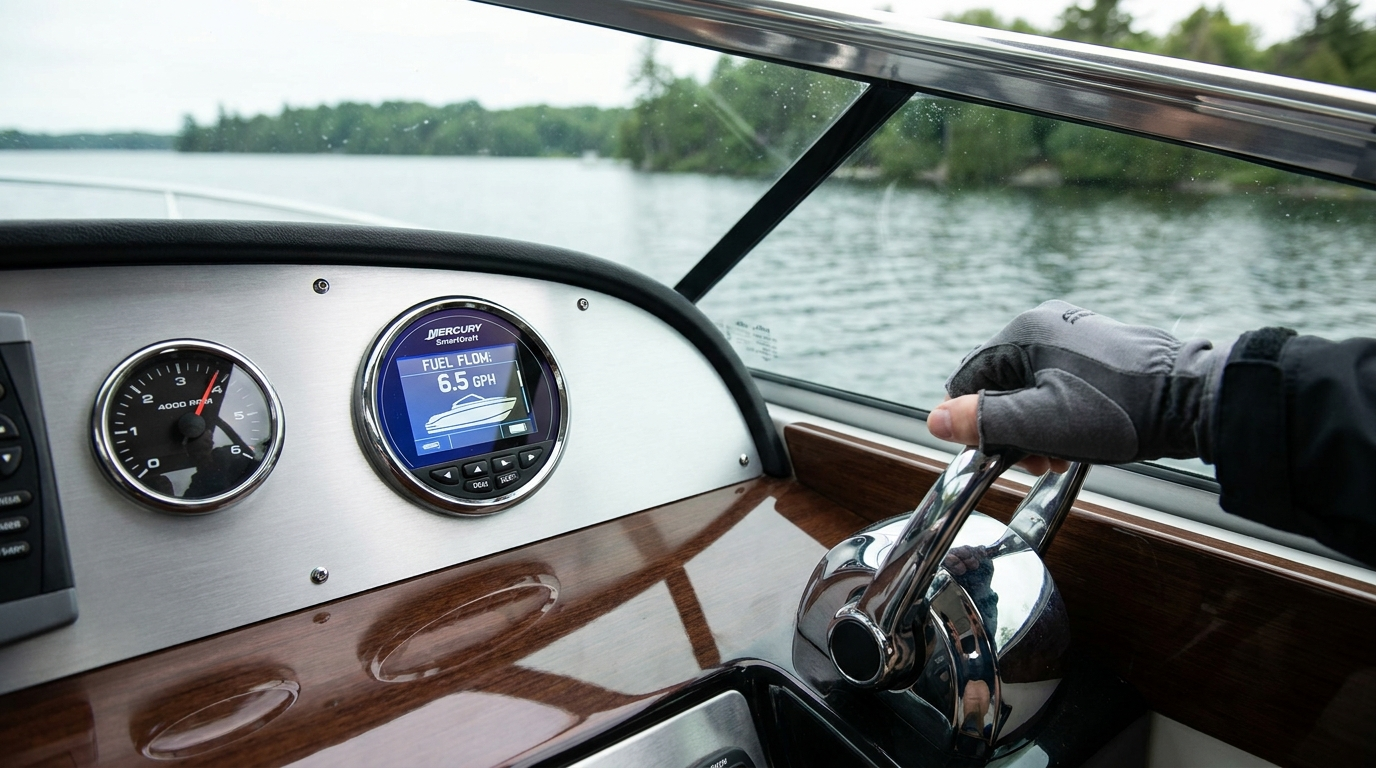
Yes, and it costs nothing. Trimming out at cruise lets the hull run clean instead of plowing, and a SmartCraft fuel gauge shows the difference in real time. If you never touch the trim switch after the holeshot, you're leaving fuel money on the table.
What's the best cruise RPM for fuel economy?
It varies by motor and hull. Most Mercury FourStrokes have a cruise efficiency range that your dealer or owner's manual can identify. The goal is to find the RPM where you're making acceptable speed without the motor working unnecessarily hard.
Can I improve fuel economy on an older motor?
Often yes, prop tuning, fresh plugs, cleaned injectors or carburettor, and fresh fuel all help. At some point, an aging motor with worn rings and seals will burn more fuel regardless of tuning. That's when a repower conversation makes sense.
Ready to dial in your Mercury?
Whether you want a prop check, a full service, or a quote on a new motor package: hbwservice.ca is where to start. Or build a motor quote at mercuryrepower.ca.
Harris Boat Works, Gores Landing, ON | Since 1947
