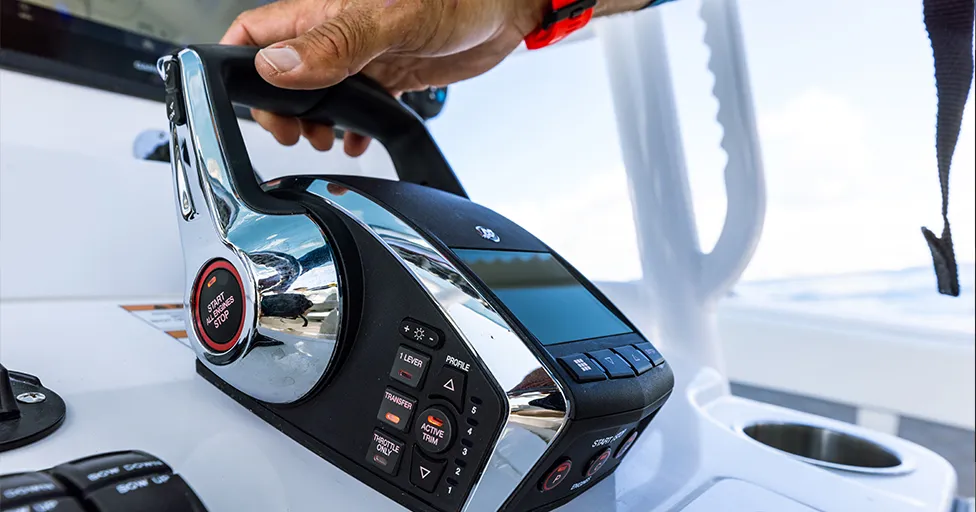
Hero image: Mercury digital-control example. The pictured control does not establish retrofit eligibility; confirm the engine serial number, control part number and complete rigging package. > Quick answer: Most current Mercury motors built with DTS already have it (all...
Hero image: Mercury digital-control example. The pictured control does not establish retrofit eligibility; confirm the engine serial number, control part number and complete rigging package.
Quick answer: Most current Mercury motors built with DTS already have it (all current Verado, plus the Pro XS and FourStroke configurations that were built with it; Mercury still offers mechanical versions in several of those horsepower classes). True retrofit of a mechanical Mercury to DTS is rarely cost-effective. The honest eligibility path for most boaters is: repower into a DTS-equipped motor.
Most callers asking about DTS retrofit are surprised by the answer. They expect a parts catalog and a labor estimate. What they actually need is a yes-or-no on whether their current motor already has DTS (many do without the owner realizing), and if not, an honest assessment of whether retrofitting makes more sense than just repowering with a DTS-equipped motor.
This post is the eligibility decision tree. It covers what DTS actually is, how to check if your motor already has it, when retrofit is realistic, and when the right answer is a new motor instead. We do this conversation every spring at HBW, and the pattern is more predictable than online forums make it sound.
Quick eligibility check
| Motor situation |
DTS retrofit eligible? |
Honest path |
| Current Verado V8/V10/V12 (250-600 HP, 2020+) |
Already has DTS |
You already have it. Check your throttle handle. |
| Current Pro XS 150-300 HP (2018+) |
Depends on configuration |
Mercury lists both mechanical and DTS versions in this range. Verify by serial number. |
| Current FourStroke 200-300 HP (2018+) |
Depends on configuration |
Many are mechanical; Mercury lists both versions at 300 HP. Verify by serial number. |
| Older Verado I6 (2006-2017, 200-350 HP) |
DTS-equipped, harness compatibility varies |
Often workable for harness/controls upgrade |
| Mechanical Mercury 150 HP+ (any age) |
Retrofit possible but rarely worth it |
Quote a repower side-by-side. |
| Mechanical Mercury under 150 HP |
Rarely eligible |
Check Mercury's current specifications for your exact model before assuming either way |
| Twin or triple Mercury rig |
Eligible if all motors are DTS-capable |
Required for joystick. Worth the conversation. |
| Single small motor (under 75 HP) |
Not a DTS use case |
Save the money. Mechanical is correct here. |
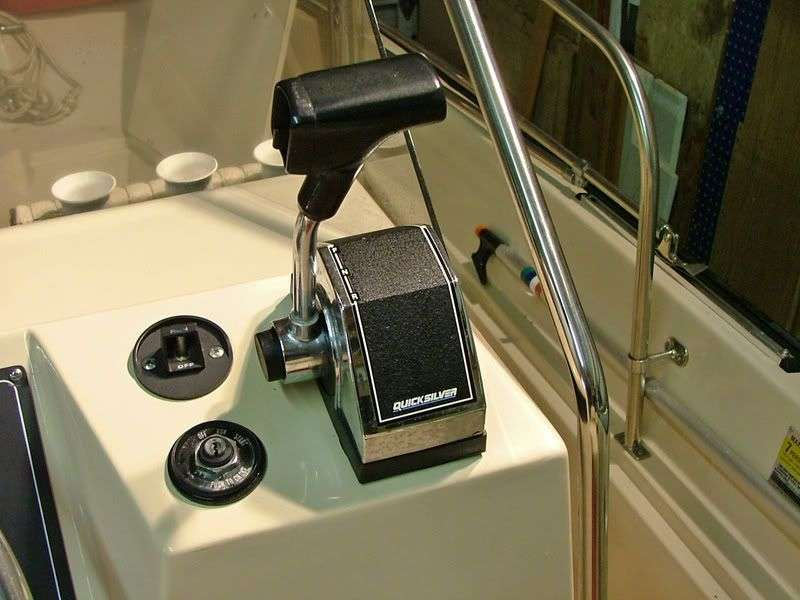 Mechanical control example. The photograph does not show the complete cables, harness or engine installation; confirm compatibility from the exact components.
What DTS actually is (and isn't)
DTS is Mercury's drive-by-wire system. Digital Throttle & Shift. Instead of mechanical cables running from the helm control to the motor, DTS uses electrical signals over a SmartCraft network. The throttle and shift commands travel as data, not as cable pulls.
What that buys you in real boating:
- Smoother, more precise throttle response (no cable lag or stretch)
- Lighter helm feel (no force-loaded cables)
- One-handed multi-engine control (single lever controls multiple motors)
- Joystick piloting compatibility (joystick requires DTS)
- SmartCraft integration (live data, diagnostics, alarms)
- Cleaner helm install (one harness instead of dual cables)
What DTS does NOT do:
- It does not add horsepower. A DTS motor and a mechanical motor of the same model make the same peak HP.
- It does not affect fuel economy meaningfully. Drive-by-wire doesn't change combustion.
- It does not make the motor go faster. Top speed is the same.
- It does not work on motors that weren't designed for it. You can't bolt DTS onto a 1990s Mercury 200 HP.
- It does not replace mechanical controls in motors below roughly 75 HP. Mercury still sells mechanical for the smaller classes.
That last point is the one that catches people. DTS is a feature available on Mercury's larger motors only. The smaller portable and mid-range FourStrokes use mechanical controls and will continue to do so. If you're shopping for a 25 HP or 60 HP, this whole eligibility question doesn't apply.
Step 1: Does your motor already have DTS?
The most common surprise: customers calling to ask about retrofit who already have DTS and don't realize it.
The five-second visual check at the helm:
- Throttle/shift control. A DTS control has no visible cable coming out the bottom of the binnacle. It's a sealed unit with a wiring harness. Mechanical controls have two visible push-pull cables.
- Throttle feel. A DTS throttle moves smoothly without the spring-loaded resistance of a cable. It also has a soft click at neutral/forward/reverse detents.
- Multi-engine sync. If you have twins or triples and a single lever controls all engines together, that's DTS.
- SmartCraft gauge or VesselView display. Most DTS rigs have a SmartCraft gauge or VesselView screen showing live engine data.
- Joystick. If you have a joystick at the helm, you definitely have DTS. Joystick requires it.
If any one of those five is true, you have DTS already. The eligibility question becomes "what's the upgrade path within DTS" rather than "can I retrofit."
For the long version of motor age and model decoding, our Mercury Outboard Serial Number Guide walks through year and model identification.
Step 2: If you don't have DTS, can you retrofit?
Yes in theory, no in practice for most customers.
DTS isn't a kit you bolt onto an existing mechanical motor. The DTS-equipped motor has different internal components (electronic throttle body, electronic shift actuator, dedicated DTS engine harness, SmartCraft-compatible ECU). A motor that was built mechanical can't usually be converted to electronic shift without replacing major engine sub-systems.
What CAN be converted in some cases: the helm side. If your existing motor is already DTS-capable (some older Verado I6 models in particular), you can sometimes upgrade just the helm controls and harness while keeping the engine. That's a real upgrade path and the only retrofit conversation that's economically rational.
What CAN'T be converted: A mechanical Pro XS, mechanical FourStroke, or any pre-2010 Mercury that didn't come with DTS. You'd be replacing more parts than the motor is worth.
The honest decision matrix:
- Motor is already DTS-capable but you have mechanical controls → helm-side upgrade is real. Get quoted.
- Motor is mechanical, under 5 years old, low hours, otherwise excellent → quote a full repower against the retrofit cost. Usually repower wins.
- Motor is mechanical, 5+ years old or high hours → repower territory. Don't pour money into retrofit.
- Single motor, smaller boat, no joystick interest → DTS is a "nice to have" not a "need." Mechanical is the right call.
- Twins or triples without joystick → adding DTS enables joystick, which is the real value driver. Worth the conversation.
Step 3: HP class eligibility
Here is where DTS versions show up on our current price list (2026 model year):
| HP class |
Motor family |
On our current price list |
| 250-600 HP |
Verado V8/V10/V12 |
Standard on all (Verado is a special order at HBW) |
| 200, 250, 300 HP |
Pro XS |
DTS and mechanical versions both listed |
| 150, 175, 225 HP |
Pro XS |
Mechanical versions listed |
| 300 HP |
FourStroke |
DTS and mechanical versions both listed |
| 150-250 HP |
FourStroke |
Mechanical versions listed |
| Under 150 HP |
FourStroke, Pro XS |
No DTS versions listed |
Mercury can add or drop DTS versions between model years, and our list shows what we price, not every model Mercury builds. The safe rule: confirm DTS fitment by exact model and serial before you plan the helm.
For the official source, Mercury's product pages at mercurymarine.com list DTS as a feature on each model.
The joystick path: why most DTS retrofit calls are actually joystick calls
Roughly half the customers who call us asking about DTS retrofit are actually asking about joystick piloting, even if they don't say it that way. They want the ability to slide the boat sideways at the dock or hold position with one hand.
Conventional Mercury Joystick Piloting for Outboards requires:
- Two or more Mercury outboards
- All engines DTS-equipped
- Specific helm hardware (joystick module, SmartCraft gateway, compatible VesselView display)
- Proper boat geometry (motors must be far enough apart for vectoring to work)
That conventional package is not the whole lineup. Mercury also lists Joystick Steering for Single-Engine Vessels and Joystick Piloting for Single-Engine Outboards with Thruster. The thruster package is limited to electric-steering Verado and SeaPro V8, V10, and V12 models from 250 to 600 HP paired with a compatible CAN-based variable-speed thruster.
If you're calling about a DTS retrofit with one engine, do not assume DTS alone enables joystick. Most single-engine rigs do not qualify, and the package-specific exceptions require more than a control-box change. We confirm the exact engine, steering, controls, and thruster package before quoting.
If you have twins or triples, joystick is the real eligibility question. DTS is just the prerequisite.
Step 4: How to check your specific eligibility
Five things to confirm before you commit money.
- Current motor model and year. From the serial/model label on the starboard side of the transom (clamp) bracket, or the VesselView display.
- Current motor serial number. This tells us which DTS configurations are available for that motor year.
- Helm controls. Are your current controls mechanical (visible cables) or already DTS (sealed binnacle with wiring harness)?
- Multi-engine rig? Single, twin, or triple. Joystick eligibility lives here.
- Boat year and make. Some older boats have helm/dash configurations that complicate DTS install. Worth flagging up front.
What we see at HBW
A few patterns from our DTS conversations every spring on Rice Lake and the Kawarthas.
Before considering a DTS retrofit, have the motor serial number checked to establish which controls it supports and which system is already fitted.
The second pattern: customers wanting DTS for the "smoother throttle" alone usually back off when they see the cost. A standalone DTS upgrade on a single-engine boat is a four-figure ticket once you add helm controls, harness, gateway, and labour; we quote it per job. Our /pricing-reference page carries current motor pricing, not retrofit labour figures. The smoother-throttle benefit is real but rarely worth the price. The customers who DO pull the trigger are usually twins-or-more rigs upgrading for joystick.
The third pattern, specific to Ontario boating: late-season dock approaches in fall winds at Rice Lake or in tight cottage dock spaces in the Kawarthas. Joystick piloting earns its keep in those moments. Customers who switch from twin mechanical to twin DTS with joystick almost never go back. The ability to crab sideways into a dock in a cross-wind without a second person on the bow is the kind of thing you don't appreciate until you have it.
Fourth pattern, illustrative rather than a specific customer event: an owner buys a "DTS retrofit" kit online for an older mechanical motor that was never DTS-capable, then spends months on helm wiring before asking a dealer. A kit cannot turn a non-DTS engine into a DTS engine. Not every retrofit story has a happy ending, and sometimes the honest answer is "this isn't the path."
“A common shop conversation: someone asks about adding DTS to a recent Pro XS, then finds the motor already has it. Checking the helm first can avoid quoting a retrofit you do not need.
–Illustrative HBW conversation pattern, not a named customer or a documented dollar saving
DTS retrofit decision
Retrofit DTS or repower?
Repower territory
- ✓Mechanical motor 5+ years old
- ✓High hours on the existing engine
- ✓You want conventional multi-engine joystick (requires DTS-equipped twins or more)
- ✓Retrofit cost is close to a new motor
New DTS-equipped motor is the right answer
Retrofit makes sense
- ✓Your motor is already DTS-capable (some older Verado I6 models)
- ✓You currently have mechanical controls at the helm
- ✓The helm-side upgrade enables DTS without engine work
- ✓Single-engine and you're not chasing joystick
Helm-side retrofit is the real upgrade
When in doubt:Quote both paths if your mechanical motor is under 5 years old, low hours, and otherwise excellent. Get the retrofit and a full repower quoted side by side before committing.
Why this matters for Ontario boaters
A few Ontario-specific notes that make DTS hit different here.
Multi-engine boats are common on bigger water. Lake Ontario, Simcoe, Couchiching, and the Trent-Severn run a lot of twin-engine setups. DTS versions are common on the motors that fit those boats. Customers in those markets either already have DTS or are repowering into it on the next motor change.
Single-engine pontoons rarely need DTS. Most Rice Lake and Kawartha Lakes pontoons run a single motor in the 90-200 HP range. The DTS conversation rarely applies. Mechanical is correct for most pontoon repowers.
Late-season docking conditions. Ontario boaters often run into October. Cross-winds, current at lock approaches, tight cottage docks. Joystick piloting (which requires DTS) is the real upgrade story here, not DTS for its own sake.
Verado lineup matters. All current Verado V8/V10/V12 (naturally aspirated, 250-600 HP) come standard with DTS. If your boat is in that class, you don't have a DTS retrofit decision. You have a Verado vs Pro XS vs FourStroke decision. At 200, 250, and 300 HP our current price list carries both DTS and mechanical Pro XS versions, and at 300 HP both FourStroke versions, so confirm the exact model before assuming DTS comes with it.
Ready to confirm DTS eligibility?
Quote a repower: mercuryrepower.ca
Harris Boat Works · 5369 Harris Boat Works Rd, Gores Landing, ON · Mercury Marine dealer since 1965, current Premier Dealer.