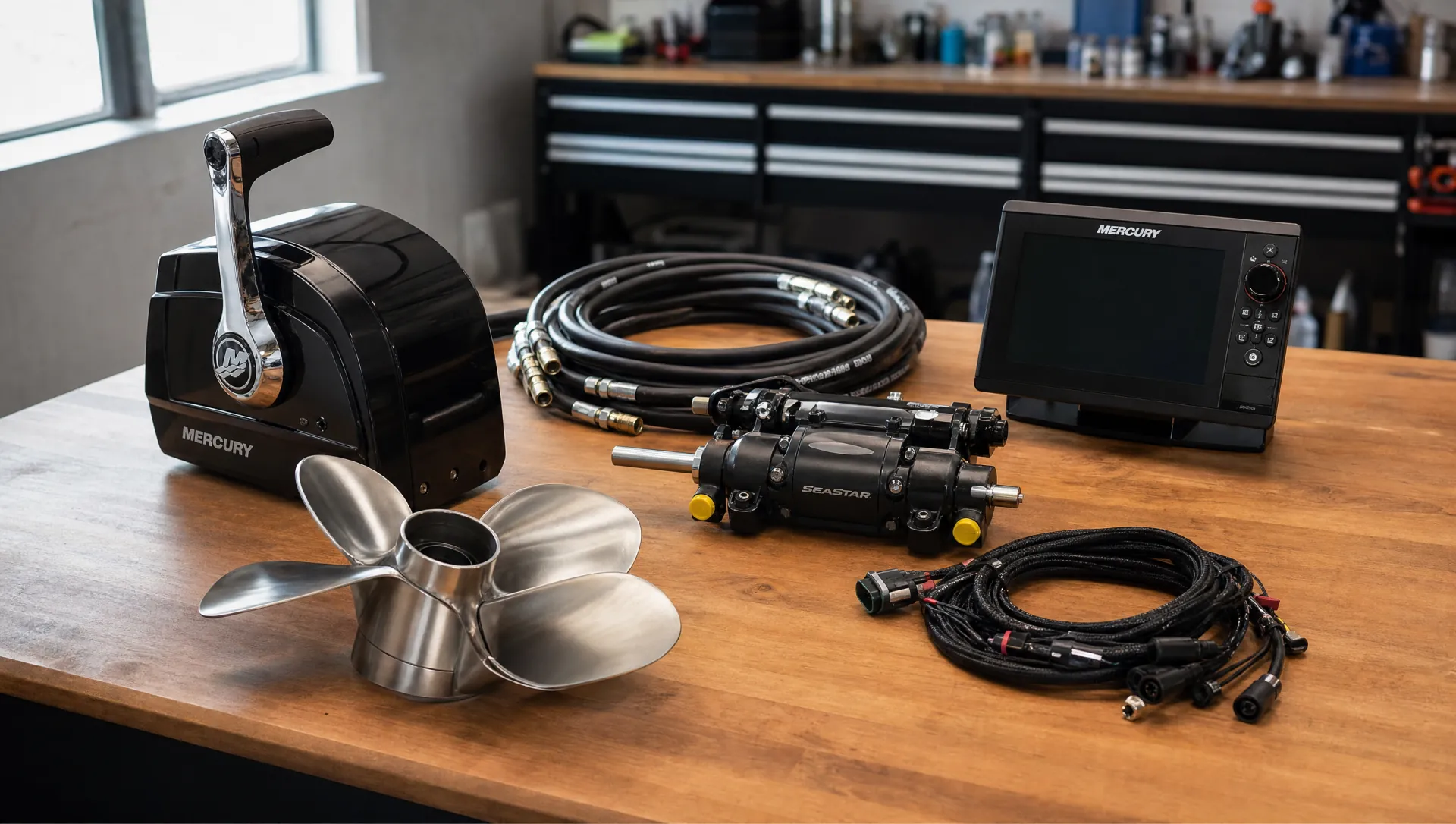
Quick Answer A Mercury repower needs more than just the motor. Controls, steering, gauges, wiring, and the right prop together add roughly CAD $2,000 to $6,000+ to the install cost, depending on HP class and configuration. For 40-115 HP: typically a binnacle or side-mount...
Quick answer: Controls, steering, gauges, wiring, and prop can add a significant amount to a Mercury repower, depending on the exact engine, control option, and boat. A 40 to 115 HP install typically means a binnacle control, cable or hydraulic steering, and SmartCraft Connect. At 150 HP and above, horsepower does not identify the family: 150 FourStroke and 150 Pro XS are inline-four, FourStroke 175-225 are V6, and 200-300 Pro XS plus FourStroke 250-300 are V8. Build the controls, steering, and gauges for that exact package at mercuryrepower.ca.
Quick Answer
A Mercury repower needs more than just the motor. Controls, steering, gauges, wiring, and the right prop together add roughly CAD $2,000 to $6,000+ to the install cost, depending on HP class and configuration. For 40-115 HP: typically a binnacle or side-mount control, cable or hydraulic steering at 115+, and SmartCraft Connect or analog gauges. From 150 HP up, rebuild the package around the exact engine and control option. A 150 is an inline-four, not a V6. FourStroke 175-225 are V6; 200-300 Pro XS and FourStroke 250-300 are V8. This guide covers the 40-225 HP range. Sub-25 HP portables and Verado V8/V10/V12 follow different rules.
The motor is the headline. The rigging is the line item most buyers underestimate.
Between the motor and the helm sits a system: control box, throttle and shift cables or digital wiring, steering ram, helm pump, hydraulic lines, gauges, key switch, kill switch, battery wiring, prop. If any component is wrong or worn, the motor can underperform or the install cost can rise unexpectedly.
Three patterns come up most often at Harris Boat Works:
Reusing old controls that don't match the new motor. A 1998 binnacle from a carbureted 90 HP does not always work cleanly on a 2026 Mercury 90 EFI. Corroded wiring and a worn kill switch can turn into a mid-season service call.
Skipping the gauge upgrade. A new SmartCraft-equipped motor connected only to old analog gauges can hide much of the information the motor makes available, including fault codes, fuel economy data, engine hours and advance warnings.
Underspeccing steering on a higher-HP motor. Cable steering on a 150 HP technically works. After three hours of driving, it becomes obvious why hydraulic is a common recommendation for many 115 HP and up boats. The exact steering still depends on the engine, control option, and hull.
Compatibility Matrix: Mercury 40-225 HP
| HP Class |
Typical Controls |
Typical Steering |
Typical Gauges |
Typical Wiring |
Rigging Est. (CAD) |
| 40-60 HP |
Side-mount or binnacle mechanical |
Cable mechanical |
Analog (tach + fuel) |
Single battery, basic harness |
$1,500 to $2,500 |
| 75-90 HP |
Binnacle Gen II mechanical |
Cable or hydraulic |
Analog or SmartCraft Connect |
Single battery, isolator if accessories |
$2,000 to $3,000 |
| 115 HP inline-4 |
Binnacle Gen II mechanical |
Hydraulic (SeaStar Pro) |
SmartCraft Connect or VesselView 4 |
Single or dual battery |
$2,500 to $4,000 |
| 150 HP inline-4 (FourStroke or Pro XS) |
Confirm mechanical or DTS for the exact engine |
Hydraulic is common; power-assist is option-specific |
SmartCraft Connect or VesselView if the package includes it |
Dual battery is common, not automatic |
$3,500 to $5,500 typical, quote the boat |
| 175 HP V6 (FourStroke or Pro XS) |
Confirm mechanical or DTS for the exact engine |
Hydraulic or power-assist per the package |
VesselView only if that display is part of the order |
Dual battery + ACR when the boat needs it |
$4,500 to $6,500 typical, quote the boat |
| 200-225 FourStroke V6 or 200-225 Pro XS V8 |
Do not infer DTS from HP. Build from the engine and control option |
Power-assist hydraulic is common on these boats, not proven by cylinder count |
VesselView 7 or 9 only when specified |
Dual battery + ACR, switch panel when the boat needs it |
$4,500 to $7,500 typical, quote the boat |
Prices here are planning figures as of September 2026. For live Mercury motor pricing, see the Mercury pricing reference.
These are typical configurations. Specific boat, helm, console, and budget change the numbers.
Controls: Binnacle vs. Side Mount vs. DTS
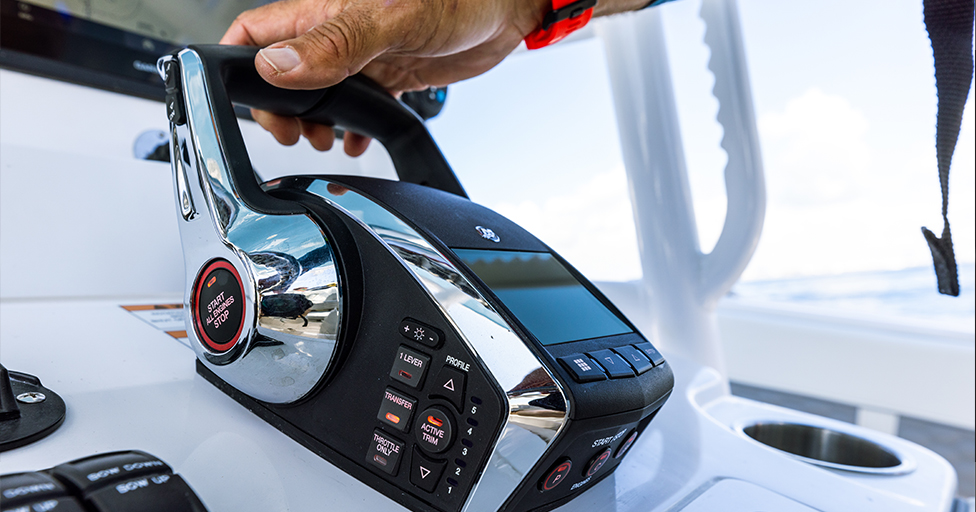
Binnacle (Top-Mount) Controls
Single lever that mounts on top of the helm console. Push forward for forward gear, pull back for reverse. Includes neutral lock, throttle-only mode, trim/tilt switches, and kill switch lanyard. The standard setup for runabouts, bowriders, fishing boats, and most pontoons with a console.
Binnacle Gen II Single Lever (mechanical): CAD $700 to $1,200. The workhorse. Connects via push-pull cables. Works reliably on single-engine setups up to 200 HP.
Binnacle Gen II Single Lever DTS (Digital Throttle & Shift): CAD $1,400 to $2,400. Same physical lever, but cables are replaced by an electronic harness. Smoother shifting, supports multi-engine sync, integrates with SmartCraft. Standard on current Mercury Verado V8/V10/V12 packages, and the right call for twin-engine setups or when VesselView integration needs to feel clean.
Side-Mount Controls
Mounts on the side of the helm console or a pedestal. Same function as a binnacle. Used on smaller boats (40-90 HP), some pontoons with limited dashboard space. Mechanical only, no DTS in side-mount form. CAD $400 to $800.
DTS (Digital Throttle & Shift)
Mercury's electronic control system. Replaces mechanical throttle and shift cables with a wiring harness. Smoother shifting, no "clunk" between gears, multi-engine sync, cruise control, SmartTow integration. DTS is standard on current Mercury Verado V8/V10/V12 packages in the 250-600 HP range. Confirm DTS fitment on the exact Pro XS or FourStroke model rather than inferring it from horsepower. For most single-engine Ontario repowers under 250 HP, mechanical controls are the right call.
Steering: Cable, Hydraulic, or Power-Assist Hydraulic
Cable Steering
Mechanical cable from helm wheel to motor arm. Simple, durable, inexpensive. Works well through 90-115 HP on most boats. CAD $300 to $700 for the cable and helm assembly. Gets tiring on 115+ HP V-hull boats, especially in sporty conditions or after hours of driving.
Hydraulic Steering
Helm-mounted pump pushes fluid to a hydraulic ram at the motor. Smoother, lighter, self-centering at speed. The right call for most 115-225 HP boats. SeaStar Solutions is the standard brand, SeaStar Pro for entry-level, HC5345 for V6+ applications. CAD $1,500 to $2,500 for a complete kit plus CAD $300 to $500 install labor.
Power-Assist Hydraulic
Electric pump does most of the work. One-finger steering at any speed. Recommended for many 175-225 HP V6 FourStroke and 200-225 HP V8 Pro XS boats, especially twin-engine setups or boats over 22 feet, when the exact engine and helm support it. CAD $2,500 to $4,000 for the kit plus install. For most Ontario buyers in the 115 HP zone, standard hydraulic is the call. For 150 HP inline-four and above, lean toward power-assist only after checking the engine, control option, and boat. Do not infer V6 architecture from a 150 HP rating.
Controls upgrade decision
Is digital throttle worth the upgrade?
DTS (Digital Throttle and Shift) is smoother, future-proof, and built for the new Mercury platform. It also adds $1,500 to $3,000 to the rigging bill. Match it to the boat.
Stick with mechanical cable controls
- ✓Motor is 90 HP or smaller
- ✓Existing rigging is in good shape
- ✓You're not planning to upgrade the boat soon
- ✓Budget matters more than the smoother feel
Cable controls, $0 to $400 to refresh
Go to DTS digital controls
- ✓Motor is 100+ HP, new build or full repower
- ✓You want smooth idle shifting and joystick-ready wiring
- ✓You plan to keep the boat 7+ years
- ✓You'd add VesselView or autopilot later
DTS controls, $1,500 to $3,000 extra
When in doubt:If you'll see this boat in five years, the digital path is the cheaper long-term choice. If you'll flip it in two, cable is fine.
Gauges: Analog, SmartCraft Connect, or VesselView
Analog Gauges
Mechanical needles for tach, fuel level, and trim. CAD $400 to $800 for a full set. Work well for 40-90 HP on basic fishing boats. Give up fault codes, engine hours, fuel economy data, and advance warning.
SmartCraft Connect Mobile (formerly VesselView Mobile)
Bluetooth module under the cowl that streams engine data to the Mercury Marine app on a phone. The app is free. What you see: RPM, fuel rate, total fuel used, engine temp, battery voltage, engine hours, fault codes with plain-English descriptions, maintenance reminders, Boost eligibility. Compatible with Mercury 4-strokes from 2004 forward, 40 HP and up (25/30 HP only from 2022+). CAD $300 to $500 for the module and SmartCraft tach.
VesselView
Mercury's color touchscreen displays, the hardwired version of what SmartCraft Connect does over Bluetooth. VesselView 4: CAD $700 to $900. VesselView 7: CAD $1,200 to $1,500. VesselView 9: CAD $1,800 to $2,400, the sweet spot for most V6 repowers. VesselView 12: CAD $2,500 to $3,200. Integrates with chartplotters, fuel tanks, and autopilots.
Wiring and Battery Setup
Single battery + basic harness (40-90 HP): Single Group 24 or 27 starting battery, basic harness, battery switch, fuse panel. CAD $400 to $700.
Dual battery + ACR (115-150 HP): Electronics (chartplotter, fishfinder, stereo) increase the load. Battery 1 for starting, Battery 2 for electronics and accessories. ACR combines them when the engine runs, isolates when off. CAD $700 to $1,200.
Dual or triple battery + switch panel (175-225 HP V6): V6 motors with VesselView, multiple electronics, livewells. CAD $1,200 to $2,000, higher on tournament-prepped boats. Use marine-grade tinned copper wiring with heat-shrink connections. A $200 shortcut in wiring materials can become a $1,500 mid-season problem.
Prop Selection by HP Class
| HP |
Diameter |
Pitch Range |
Material |
| 40–50 |
12–13" |
11–15" |
Aluminum standard, stainless optional |
| 60–90 |
13–14" |
13–19" |
Aluminum standard, stainless for performance |
| 115 |
14" |
15–21" |
Stainless recommended for sport use |
| 150 |
14–15" |
17–23" |
Stainless standard |
| 175–225 |
14–16" |
19–25" |
Stainless strongly recommended |
These are starting points. Hull weight and intended use change the correct pitch. Wrong pitch: motor lugs (pitch too high) or revs out without making power (pitch too low). Both wear the motor faster than they should.
Aluminum: CAD $200 to $500. Cheaper but flexes at higher loads.
Stainless: CAD $500 to $1,200. Holds shape, lasts longer, recovers better after a strike.
Real-World Rigging Examples
18-foot aluminum fishing boat, Mercury 60 ELPT FourStroke:
Controls $850 + cable steering $300 + SmartCraft Connect $400 + single battery harness $500 + 13.5"×17" stainless prop $650 + install labor $1,400 = ~$4,100 rigging on top of the motor price.
21-foot pontoon, Mercury 90 ELPT Command Thrust FourStroke:
Controls $900 + hydraulic steering $1,800 + VesselView 4 $850 + dual battery + ACR $900 + 14"×17" stainless CT prop $750 + install labor $1,800 = ~$7,000 rigging.
19-foot bowrider, Mercury 150 L FourStroke Repower:
Controls $1,000 + power-assist hydraulic $3,200 + VesselView 7 $1,400 + dual battery $1,000 + prop $850 + install labor $2,200 = ~$9,650 rigging.
What HBW Includes vs. Charges Separately
Always included in the rigging line: Mercury wiring harnesses, control cables, DTS harnesses (if DTS), lake test, break-in instructions, a review of the model-specific maintenance schedule, and Mercury Canada warranty registration.
Quoted as separate line items: Control box, steering system, gauges or VesselView, battery and battery system, prop, old motor removal and disposal (typically CAD $200 to $400).
Not part of a standard quote: Trolling motors, fishfinders, stereos, trailer work, cosmetic restoration.
For engine repairs, we only service Mercury and MerCruiser.
Common Rigging Mistakes
The three big ones, reusing tired controls, skipping the gauge upgrade, and underspeccing steering on a V6, are covered at the top of this guide. Two more we see every season:
Picking prop pitch by guessing. Wrong pitch is the most common reason a "perfectly good motor" feels slow. Lake test it.
Single battery on a boat full of electronics. A single battery running the chartplotter, fishfinder, stereo, and starter can leave you stranded. See the wiring section above for when dual-battery makes sense.
What we see at HBW
The controls-and-rigging audit is the first thing we do on every repower quote. In our shop experience, many motors that look fine to keep the existing controls still need new cables, shift linkage or a fresh harness. Skipping the audit and quoting a drop-in install is how customers end up with surprise add-ons mid-job.
The exception: identical replacement (a 60 EFI for a 60 EFI). Carbon-copy swaps re-use existing rigging cleanly. Anything jumping HP class or family triggers the full audit.
It's also why we quote the installed number, not the box-only number. The price on a competitor's website is usually MSRP without HST, controls, rigging, install, or prop. Half our first conversations are clarifying what's actually included.
About the author
Jay Harris helps run Harris Boat Works, a third-generation family marina in Gores Landing on Rice Lake, established in 1947. HBW is a Mercury Marine Premier Dealer and Legend Boats dealer serving Rice Lake, the Kawarthas, and Ontario boaters who want straight answers before spending real money. Read Jay's full bio.
Related guide: Mercury DTS vs mechanical controls for Ontario repowers.
See real CAD pricing on every rigging line item.
Build your Mercury repower quote at mercuryrepower.ca, choose motor, controls, steering, gauges, wiring, prop, and see the configured total before calling anyone.
Harris Boat Works, Mercury dealer since 1965. Gores Landing, ON.
If you're spec'ing a pontoon or heavy-load setup, our Command Thrust vs standard gearcase guide covers when CT makes sense.