Once you've decoded the serial, you'll likely want to look up Mercury Outboard Warranty (Canada 2026), check pricing in the Ontario Mercury Outboard Price Guide, or compare engine families in Mercury Motor Families: FourStroke vs Pro XS vs Verado. Repower customers should...
Quick answer: Mercury motors carry two different numbers, and they do two different jobs. The Serial Number (looks like 0T123456 or 1B234567) is your motor's unique identifier, you use it to look up year, parts, warranty status, and recalls in Mercury's catalog or any dealer system. You don't decode it, you look it up. The Model Number (looks like 90ELPT or 1F60413GZ) is the spec code that you CAN decode, it tells you the horsepower, family, electric start, shaft length, power trim, and (on newer codes) model year. This guide covers finding both numbers, decoding the model number, and looking up the serial.
::cta
variant: inline
heading: Prepare one complete service request
body: Capture the engine serial number, hours, exact symptoms, fuel history and recent work before contacting the shop. Clear details help HBW start with the correct engine and concern.
primaryLabel: Download service prep sheet (PDF)
primaryHref: /downloads/mercury-service-request-prep-sheet-hbw.pdf
::
Once you've decoded the serial, you'll likely want to look up Mercury Outboard Warranty (Canada 2026), check pricing in the Ontario Mercury Outboard Price Guide, or compare engine families in Mercury Motor Families: FourStroke vs Pro XS vs Verado. Repower customers should also read Mercury Repower Cost: Ontario 2026 (CAD).
Your Mercury's serial number is the only piece of information on the motor that actually matters for parts, service, warranty, and history. Not the year on the cowl. Not the boat's title. Not what the previous owner remembered.
This is how to find it, what it tells you, and what we can look up for you with it.
What a serial number actually looks like
A real Mercury serial number is short, alphanumeric, and unique to your specific motor. Examples:
0T1234561B2345672A6789010M345678 (older motors sometimes have a leading 0 that newer references ignore)
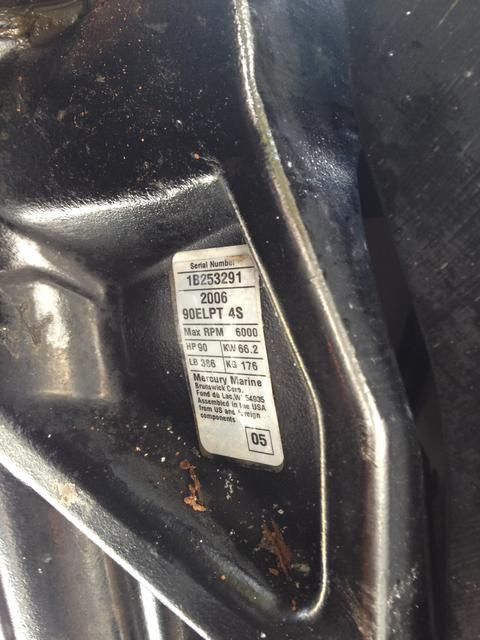
The serial is stamped or laser-etched on a small plate on the motor's transom bracket. You will NOT find date or horsepower hidden in the digits, Mercury does not embed the spec into the serial like a car VIN. You look the serial up in Mercury's catalog or any reputable parts site (Crowley Marine, PartsVu, MarineEngine) to get year, model variant, and parts compatibility.
Once you have the numbers, find out what your outboard is worth as a trade-in.
How to decode your Mercury Model Number
The Mercury Model Number is the spec code, and unlike the serial, this one IS decodable. Newer Mercury motors carry a full SKU string like 1F60413GZ. Older motors use a shorter human-readable code like 90ELPT or 25EXLHGA.
Record both identifiers. Photograph the complete serial number and model information. Use the serial number in Mercury's official parts or service lookup. Do not infer a year or parts fit from an unverified character-position chart.
The model number encodes product spec. Use it together with the serial number when ordering parts, planning a repower, or registering warranty.
For older Mercurys, the model code usually reads as horsepower + letter combination. Common letters and meanings:
- M: Manual start
- E: Electric start
- L / XL / CXL / XXL: Long, extra-long, counter-rotation long, extra-extra-long shaft
- H: Tiller handle
- RC: Remote control steering
- PT: Power trim/tilt
- O: Oil injection (older two-strokes)
Example: 115ELPT reads as 115 HP, Electric start, Long shaft, Power Trim.
Two identical-looking Mercury 90 HP FourStrokes can use completely different parts depending on which serial number range they fall into. Mercury revises components mid-year, mid-production-run, even mid-month. The model number tells you the spec; the serial tells you which production run you have.
If you're ordering parts, planning service, checking warranty, or looking up bulletins, start with both numbers in hand.
Where to Find It
There are three places, in order of where to look first:
1. The transom bracket ID tag (primary)
On most Mercurys, look at the port (left) side of the swivel bracket, the metal piece that mounts the motor to the boat's transom. There's a stamped or laser-etched plate with:
- Model number (a code like
90ELPT, 25EXLHGA)
- Serial number (alphanumeric, like
0T123456 or 2B345678)
- Sometimes the year
Bring a flashlight. If the boat's mounted, you may need to tilt the motor up and look from underneath. Take a photo so you don't have to keep crouching.
2. The engine block freeze plug (backup)
If the bracket plate is missing or unreadable (rust, paint over, theft), there's a backup. The serial is also stamped on a small metal disc on the engine block itself. You'll need to pull the cowl to see it. Location varies by motor; for most modern Mercurys it's on the powerhead, near the starter.
3. Inside the cowling (newer models)
2018+ Mercurys often have a sticker inside or under the cowling with the serial in a more readable location. Pull the cowl, check the inner walls.
If all three are missing or unreadable, the motor's been parted out, replaced, or had its identity stripped. That's a flag for any used buyer.
Decoding the Model Number
The model number isn't the serial, it's the configuration code. It tells you shaft length, starting type, steering, and trim/tilt.
Shaft length codes:
| Code |
Length |
Common Use |
| Short shaft (E, EH, M, MRC) |
15" |
Low-side dinghies, car-toppers |
| MSL |
17.5" |
Rare, specialty |
| Long shaft (EL, ELH, L, ML) |
20" |
Most aluminum fishing boats, runabouts |
| Long-Long (ELLH, MLL) |
22.5" |
Specialty deep-draft |
| Extra-long (CXL, EXLH, XL) |
25" |
Pontoons, some larger fishing boats |
| Extra-extra-long (CXXL, XXL) |
30" |
Bracket-mounted offshore setups |
Feature codes:
| Code |
Meaning |
| C |
Counter-rotation (left-hand prop, V6 twin setups) |
| CT |
Command Thrust gearcase |
| E |
Electric start |
| H |
Tiller handle steering |
| M |
Manual start (rope pull) |
| O |
Oil injection (older 2-strokes) |
| PT |
Power trim |
| RC |
Remote control steering |
Putting it together
A model code like 115ELPT decodes as:
- 115, 115 horsepower
- E. Electric start
- L. Long shaft (20")
- PT. Power trim
A more loaded code like 115EXLPT-CT:
- 115 HP
- Electric start
- XL. Extra-long shaft (25")
- PT. Power trim
- CT. Command Thrust gearcase (heavier-duty for pontoons and big aluminum)
The cowl says "115 FourStroke." The model number says exactly which 115 FourStroke you have, what shaft, and what gearcase. Different parts depending on the answer.
Decoding the Year (When the Year Isn't Printed)
Mercury doesn't always stamp the model year on the engine. Production years run mid-July to mid-July, not Jan-Dec, and Mercury thinks in serial number ranges, not calendar years.
To find the year:
- Check the bracket plate first, many models include "MFG YEAR" on the plate.
- If not there, use a serial-to-year lookup chart. The most reliable are:
- Or call a Mercury dealer, we can pull the year from Mercury's dealer system in 30 seconds.
One thing that catches used buyers: the engine year doesn't have to match the boat year. A 2018 boat might have a 2017 engine. A 2005 hull might have a 2010 repower on it. Always verify the engine's year separately from the boat's year.
What the Serial Number Tells You
Once you have the serial, here's what we (or any Mercury dealer) can pull up:
1. Exact parts catalog
Mercury's official parts catalog uses the serial to give you the right exploded diagrams. No guessing whether the Generation 1 or Generation 2 water pump is yours.
2. Outstanding service bulletins
Mercury issues service bulletins by serial range, known issues, recommended fixes, sometimes free recall work. A dealer pulls these against your serial to see if anything applies.
3. Warranty status
Standard warranty registration, extended warranty (Mercury Product Protection), and remaining coverage are all keyed to the serial. Any Mercury dealer can confirm what you have left when the motor is in for service.
4. Engine hours (on SmartCraft motors)
Modern Mercurys store hour data inside the engine's computer, independent of any dashboard meter. Plug a diagnostic tool into the SmartCraft port; the serial confirms the model; the hours come up. Treat the ECM reading as one part of the inspection, alongside the motor condition and available service records.
5. Service history
If the motor was ever serviced at a Mercury dealer (any dealer, anywhere in North America), there's likely a record tied to the serial in Mercury's dealer network. A dealer can pull it when the motor is in the shop.
Buying a Used Mercury? Check the Serial Before You Pay
Before you hand over money for a private-sale Mercury, do this yourself:
- Get a clear photo of the bracket plate, model number + serial number both visible. No readable plate and no backup stamp, no deal.
- Decode the model number with the letter codes above: shaft length, start type, trim, steering. Make sure it matches the transom it's going on.
- Pin down the year. Some plates print it. If not, ask the seller for the original bill of sale or any dealer service receipt, both reference the serial and the year. The parts-finder sites (Crowley Marine, MarineEngine.com) will land you in a rough year range for ordering parts, but they are not a model-year lookup and a seller's "it's a 2015" can't be checked against them.
- Check the price against the market with the used outboard buying guide.
The exact model year, warranty status, service bulletins, and dealer service history are dealer-network lookups, not something you can do from a phone. If the motor is headed for Rice Lake, that research is the first five minutes of a pre-purchase inspection (compression, gearcase pressure, on-water test) with the motor in our shop. Sometimes the research alone tells you to walk away.
What If the Serial Is Missing?
If the bracket plate is gone and the freeze-plug stamp is unreadable:
- Check service receipts, any prior service work would have referenced the serial.
- Check the boat's Pleasure Craft Licence, sometimes the serial was recorded.
- Check insurance documents, same.
- Bring it to us, we can sometimes identify the motor from the casting numbers and other markings, but this is detective work, not a quick lookup.
- Worst case, we can pressure-test, compression-test, and document the actual current condition without the serial. It's a less complete picture, but it's something.
A motor with no serial isn't necessarily stolen, but it's a flag worth taking seriously. Reduce your offer accordingly, or walk.
Try the calculator
Want a real number? Run the Shaft Length Picker - no signup, no email gate, takes 30 seconds.
Quick Reference Card
The five pieces of information on every Mercury and where they live:
| What |
Where |
| Model number (e.g. 115ELPT) |
Bracket plate, port side |
| Serial number (e.g. 0T123456) |
Same plate, just below model |
| HP rating |
First numbers in model code |
| Shaft length |
L = 20", XL = 25", CXL = counter-rotation 25" |
| Year |
Sometimes plate, otherwise serial lookup |
Take a photo of the plate the day you buy the boat. Save it on your phone. You'll thank yourself the next time you order a part.
