At an Ontario fuel pump, “premium,” “87” and “E10” can appear close together. That makes them feel like one decision. They are not. Here's the safe choice. Make two independent checks: 1. Does the octane meet the engine's minimum? 2. Does the ethanol content stay within...
Quick answer: Octane and ethanol answer different questions, and only one of them is really a decision. Meet the octane minimum in your engine's manual and then stop thinking about octane. Ethanol is the part that decides how long your fuel system lasts. Mercury allows a maximum of E10, but fresh ethanol-free gasoline is the better fuel for a marine engine, which is what ethanol-free marine gas is for. Premium does not mean ethanol-free, and in Ontario it no longer reliably is.
At an Ontario fuel pump, “premium,” “87” and “E10” can appear close together. That makes them feel like one decision. They are not.
Here's the safe choice. Make two independent checks:
- Does the octane meet the engine's minimum?
- Does the ethanol content stay within Mercury's limit?
::cta
variant: inline
heading: Take the fuel checks to the pump
body: Octane and ethanol are separate checks. This one-page guide also covers storage preparation and the details to record when fuel may be contaminated.
primaryLabel: Download fuel guide (PDF)
primaryHref: /downloads/marine-fuel-storage-quick-guide-hbw.pdf
::
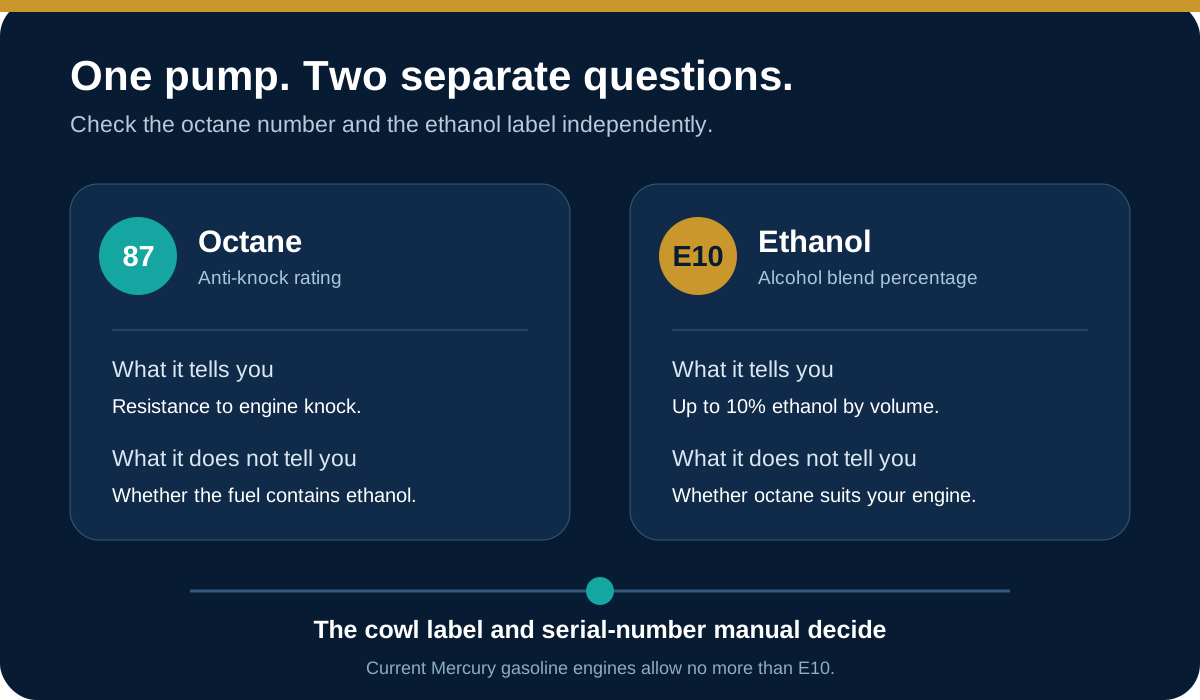
Octane and Ethanol Describe Different Properties
Octane is an anti-knock rating. In Canada, the number displayed at the pump is normally the Anti-Knock Index, shown as (R+M)/2. An engine designed for 87 doesn't gain a guaranteed power or cleanliness benefit merely because 91 is more expensive.
Ethanol content is the percentage of alcohol blended into the gasoline. E10 can contain up to 10 percent ethanol. It doesn't mean 10 octane points, and the octane number doesn't reveal the ethanol percentage.
| Pump information |
What it tells you |
What it does not tell you |
| 87, 89, 91 or 93 |
Anti-knock rating |
Ethanol content |
| E10 |
Up to 10% ethanol |
Whether octane meets the engine minimum |
| Premium |
Higher octane grade than regular at that retailer |
Automatically ethanol-free |
| Ontario renewable-fuel compliance |
Supplier-level renewable-content obligations |
The blend in one grade at one pump |
Read the complete pump label, then compare both answers with the exact engine manual.
What Octane Does a Mercury Outboard Need?
The owner's manual and cowl label for the exact engine are the authority. Don't rely on a broad rule such as “all Verados need mid-grade.”
A useful current example is Mercury's naturally aspirated 5.7-litre V10 Verado family. Mercury's published specifications for the 350, 400 and 425 hp models list 87 octane minimum (R+M)/2. That is worth knowing, because "Verado" has covered two very different engines, and the older one has a higher requirement.
| Engine |
Octane minimum |
| Current V10 Verado (350, 400, 425 hp, naturally aspirated 5.7L) |
87 AKI |
| Earlier supercharged inline-six Verado 350 |
89 AKI minimum, 91 recommended for full performance |
| Every other Mercury |
Check the manual matched to your serial number |
So the folklore that "every Verado needs 89" is wrong for the current V10, and right for the engine it came from. Match the fuel to your exact engine, not to the family name.
Other engine families, model years and calibrations can have different requirements. Meet the published minimum. Buying higher octane is not a substitute for correct fuel quality, propeller load, maintenance or diagnosis.
"My Manual Says 91" - RON vs AKI
This one catches people out, especially boaters who learned to drive somewhere other than North America.
There are two different octane scales:
| Scale |
Where it's used |
Typical pump grades |
| AKI, shown as (R+M)/2 |
Canada and the United States |
87, 89, 91, 94 |
| RON |
China, Europe, Australia and much of the world |
92, 95, 98 |
They are not the same number for the same fuel. Mercury's own specifications often state both, for example "87 Octane Minimum (R+M/2) or 91 RON."
That means a manual or engine decal reading 91 RON is asking for regular 87 at a Canadian pump, not premium 91. Roughly, 87 AKI is about 91 to 92 RON, and Canadian 91 premium is about 95 RON.
If you have just moved to Ontario and your engine literature quotes a 91 or 92 figure, check which scale it uses before paying premium prices every fill. For most current Mercury outboards, including the 9.9 and other portables, regular 87 at a Canadian pump meets the requirement.
Mercury's Ethanol Limit
Mercury states that current gasoline engines are designed to operate on fuel containing no more than 10 percent ethanol. That makes E10 the upper approved blend for those engines. E15 and E85 exceed the limit and should not be used.
This matters even when the octane number looks suitable. An E15 product with an adequate anti-knock rating still fails the ethanol-content requirement.
For an older Mercury, a portable, or an engine with an uncertain fuel-system history, identify the serial number and consult its manual. Do not assume the current-engine statement answers every legacy application.
E15 Has Arrived in Ontario
For years E15 was a thing Ontario boaters read about but rarely met. That changed.
As of August 2026, E15 is being sold at select Ontario retail locations, including Costco and Valero sites, with further rollout expected as Canada moves toward a 15 percent blending target for 2030. The stations selling it are ordinary road stations, which is exactly where many boaters fill portable tanks and jerry cans.
Mercury's position hasn't changed: all current Mercury gasoline engines are designed to operate on a maximum of 10 percent ethanol. Mercury states that the metal, rubber and plastic components in the engine and fuel system are not designed to tolerate the corrosive effects of an ethanol blend higher than 10 percent.
Two practical consequences:
- The grade you always bought may not be the blend you always got. A pump that sold you E10 regular last season can be dispensing E15 this season under the same octane number.
- Damage from fuel outside the published specification is your problem, not a warranty matter. Check current coverage terms before assuming otherwise.
If you fill portable tanks at a road station, this is the single most important change to your routine this year.
Why “Premium” Does Not Mean “Ethanol-Free”
Premium names an octane grade. Ethanol-free names a blend. A retailer may sell premium that contains ethanol, premium that does not, or different blends by location and season.
The only reliable pump-level evidence is the actual label and retailer information for that product. If the dispenser doesn't clearly identify ethanol content, ask the retailer. Don't infer it from the colour of the nozzle, price, brand or octane number.
This also means regular is not automatically wrong for a boat. If 87 meets the engine's minimum and the product is E10 or lower, it meets Mercury's published fuel specifications for a current engine.
But “meets the specification” and “good for the engine” are not the same sentence. On a marine fuel system, ethanol is the variable that actually causes trouble, not octane. Ethanol attracts water. A portable tank sitting half full for three weeks between trips is close to the worst case for it, and phase separation causes far more of the fuel problems we see than anti-knock rating ever has.
So the honest order of preference:
- Fresh ethanol-free gasoline that meets your octane minimum. The best fuel you can put in a marine engine.
- Fresh E10 from a busy station, bought in small amounts and used up. Fine, as long as it doesn't sit.
- Anything that has been sitting in the tank for weeks. This is where the repair bills come from, whatever the grade.
And higher octane does not buy you lower ethanol reliably enough to be a strategy. If ethanol is what you are trying to avoid, buy fuel that is actually labelled ethanol-free.
If the Pump Won't Tell You, Test It
There is no rule that forces a pump to state its exact ethanol percentage, and many labels only say "may contain up to 10% ethanol." That is a ceiling, not a measurement.
So the advice "read the label" needs a fail-safe behind it:
If you cannot confirm the fuel is E10 or lower, don't put it in the engine. Choose a different pump, or a different grade you can verify.
If you want certainty rather than a label, Mercury sells a tool for exactly this: the Quicksilver Fuel Tester (part number 91-879172T28) measures the ethanol percentage in a fuel sample. For anyone running a portable tank filled at varying road stations, it removes the guesswork permanently.
Why Ethanol-Free Marine Gas Exists, and Why Premium Stopped Being the Workaround
This is the part most fuel advice skips, and it explains the whole situation.
Ontario's Cleaner Transportation Fuels regulation (O. Reg. 663/20) requires fuel suppliers to put renewable content into the gasoline they place in the Ontario market. That requirement keeps climbing: 10 percent from 2020, 11 percent now, 13 percent in 2028, and 15 percent in 2030.
But the regulation lets a supplier deduct certain volumes from the total it has to blend into. Section 9(3) lists them, and two matter to boaters:
- gasoline the supplier reasonably expects is for “marine vessels or marine equipment”
- gasoline with “an antiknock index of 89 or greater”
That is the legal reason ethanol-free marine gas can exist at a fuel dock, and it is why premium grades were historically where you went to avoid ethanol.
Note the word “may.” The deduction is permitted, not required. It removes the regulatory pressure to blend into those grades; it does not oblige anyone to keep them ethanol-free. As the provincial requirement climbs, suppliers have been blending into more of the pool, not less.
That is why premium is easy to misread. The octane number does not prove ethanol content. Read the pump label. If you want ethanol-free, buy fuel sold as ethanol-free.
The practical translation for 2026:
- Assume every grade at a road station contains ethanol. 91 and 93 often carry less than 87 or 89, but less is not none, and you cannot verify it at the pump.
- If you want ethanol-free, buy fuel sold as ethanol-free. In Ontario that mostly means a marina fuel dock.
- Ours is one of them. HBW sells ethanol-free 89 at the Gores Landing dock during the marina season, which is that deduction in physical form.
For a purchase decision, use the pump label. For the engine decision, use the manual.
Video: why gas goes bad over winterWatch: how ethanol fuel picks up water and can separate over a long sit, why plain gas still ages, and what to do before storage. 78 seconds, captions available.Fuel Quality and Storage Are Separate Again
Fuel can meet both the octane and ethanol specifications and still be a poor choice if it is contaminated or has been stored improperly. Water, debris, oxidation and an unknown storage history are fuel-quality concerns, not octane ratings.
Mercury's owner guidance emphasizes:
- buy fuel from a reliable, high-volume source
- purchase ethanol-free gasoline when possible
- keep water and debris out of the fuel system
- use products and storage procedures specified for the engine
- avoid storing untreated fuel beyond the guidance for the system and product
- follow the exact manual when preparing the engine for storage
Mercury's own fuel guidance is blunt about this: in as little as two weeks, fuel components can begin to oxidize, forming a gum-like substance that settles in fuel lines, tanks, carburetors and injectors. That doesn't mean every two-week-old tank is unusable. It means a shelf-life estimate isn't a guarantee.
Ethanol-free fuel avoids ethanol-related moisture absorption and phase separation, but it can still oxidize, collect water or become contaminated. Use the boat and turn the fuel over. If it may sit for more than a couple of weeks, treat fresh fuel with a marine-rated stabilizer and run the engine long enough to circulate the treated fuel through the system, following Mercury's instructions.
There's no responsible universal countdown to phase separation. Temperature, water exposure, tank design, fuel composition and storage conditions all matter. Topping old fuel with fresh fuel doesn't remove water or reverse separation.
If contamination is suspected, stop experimenting. Safe disposal and diagnosis are better than repeatedly sending questionable fuel through injectors or carburetors.
Mercury's own fuel care line covers the three jobs separately: Quickare for routine treatment at fill-up, Quickleen as a periodic deep-clean during the season, and Quickstor before the boat sits or goes into storage. Call ahead to confirm what we have on the shelf.
A Simple Pump-Side Decision
Use this sequence every time the fuel source changes:
- Identify the engine. Know the model, serial number and manual.
- Read the octane. It must meet or exceed the published minimum.
- Read the ethanol statement. Current Mercury gasoline engines allow no more than E10.
- Choose ethanol-free when possible. It still needs to be fresh and meet the engine's octane requirement.
- Assess the source. Buy from a reliable, high-turnover retailer.
- Plan for inactivity. If the boat may sit for more than a couple of weeks, stabilize fresh fuel and circulate it through the system according to Mercury's instructions.
- Keep fuel moving. Regular use and fuel turnover are part of fuel care.
- Keep the receipt. If a problem begins after refuelling, the date, grade and location help the diagnosis.
This takes less time than guessing from “regular versus premium,” and it gives you a much better answer.
What We See at HBW
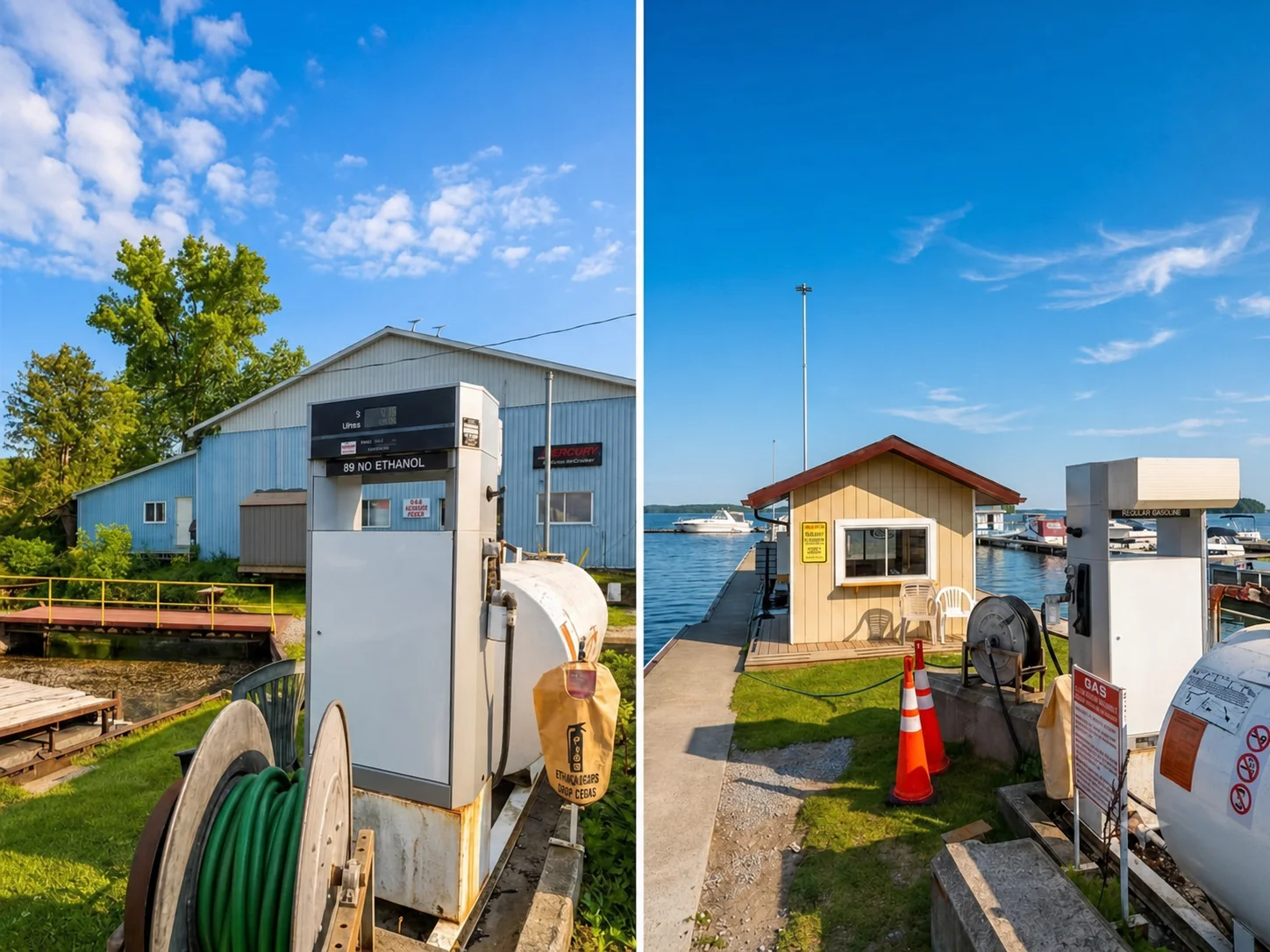
HBW's Gores Landing fuel dock, where boaters can buy ethanol-free 89-octane marine gas by road or water during the marina season.
Around Rice Lake and the Kawarthas, the question usually isn't “what does AKI mean?” It's “which pump can I use without hurting the motor?” Start with the cowl label and the serial-number manual, then read the fuel label at the pump. That's the whole decision.
During the marina season, HBW sells ethanol-free 89-octane gasoline at our Gores Landing fuel dock. Most people simply call it marine gas, and boaters can buy it from us by water or by road. For a Mercury whose manual permits 89 octane, fresh ethanol-free 89 is the best local fuel choice we can offer.
We still see fuel-related running problems in boats filled with ethanol-free gas. Usually the fuel has sat in the tank for weeks or months without enough turnover. Ethanol-free removes one major problem, not every problem. Gasoline still ages, and engines still need fresh fuel moving through them.
If the labels don't give you a clear answer, take a photo of the pump and include the engine serial number in a service request. We'd rather identify the exact specification than have you pay for premium that doesn't solve the real question.
Common mistakes
Assuming premium or 89 means ethanol-free. Higher octane doesn't prove a different ethanol blend. HBW's 89 is ethanol-free because that is the actual product specification, not because every mid-grade fuel is.
Believing every Verado needs 89. Current V10 Verado specifications list 87 minimum. Check the exact model rather than repeating a family-wide claim.
Using E15 because the octane is high enough. The ethanol percentage still exceeds Mercury's current-engine limit.
Assuming an Ontario average describes one pump. Supplier rules do not replace dispenser labels.
Treating stabilizer as a repair. Stabilizer cannot remove water, undo phase separation or clean every existing deposit.
Treating ethanol-free fuel as permanent. It still oxidizes, collects contamination and causes problems when it sits too long.
Diagnosing by smell or colour alone. Observations can support a history, but safe testing determines whether fuel is usable.
Unsure What Your Engine Requires?
Send the serial number and the exact fuel label with your service request. We'll identify the Mercury application and start with the right specification instead of a pump-grade guess.
Start a Mercury service request
Sources
