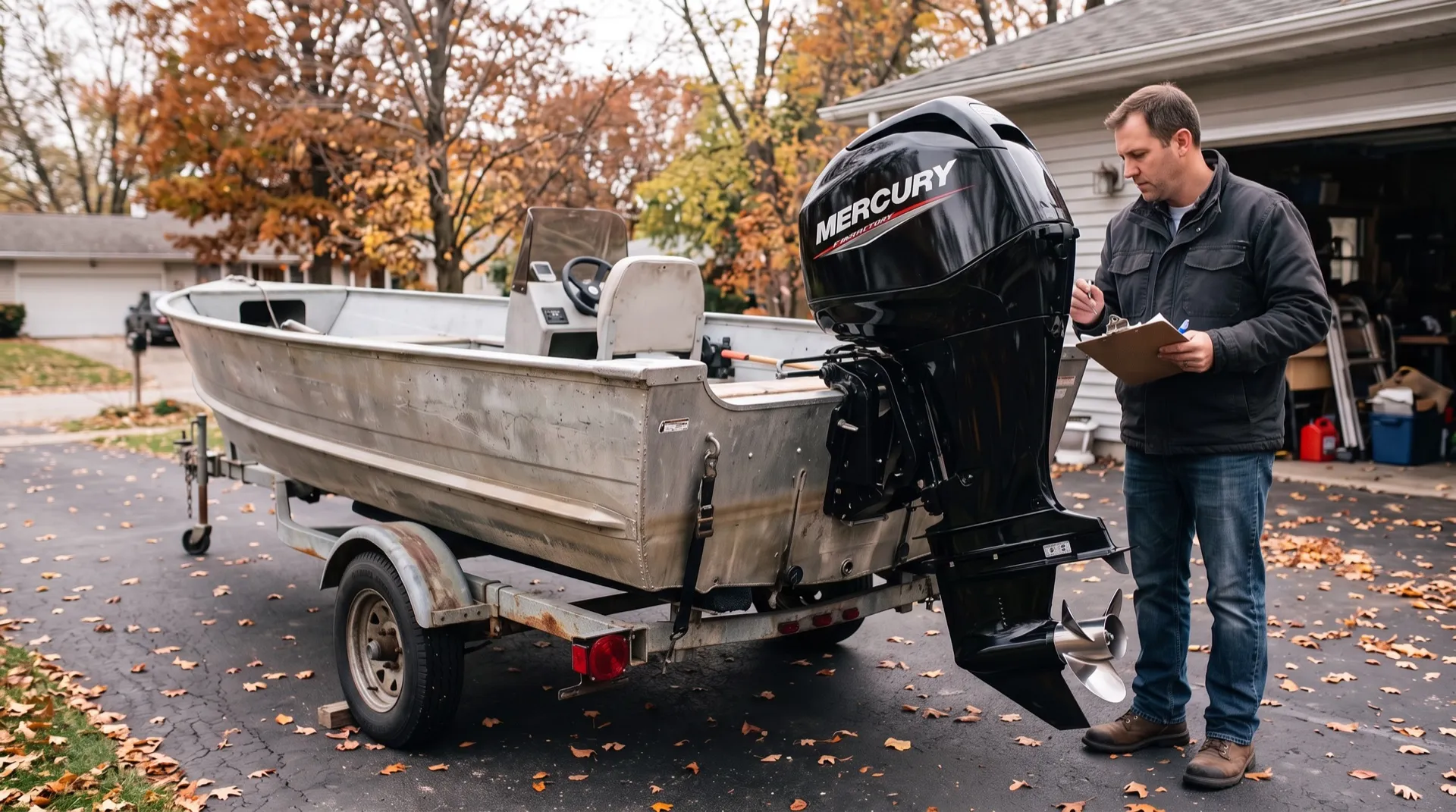
::walkaround-lead-capture # The 30-Minute Used Boat Walkaround: An Ontario Buyer's Inspection Guide > Quick answer: A 30-minute walkaround inspection catches most of the issues that turn cheap used boats into expensive lessons. Check transom flex with foot pressure,...
Quick answer: A 30-minute walkaround inspection catches most of the issues that turn cheap used boats into expensive lessons. Check transom flex with foot pressure, lower-unit oil colour with a flashlight, deck softness with a stomp test, fuel-system age and ethanol exposure, electrical for corrosion, and outboard compression numbers if you can. Most private-sale used boats hide one or two of these. Walking away costs nothing.
Kijiji. Facebook Marketplace. The listing looks clean. The price feels right. The seller says it "runs great." Now you're driving two hours to go look at it.
Most buyers show up without a plan. They like the look of it, take a quick ride, and pull the trigger, only to find out a month later the transom is rotting and the floor stringers are soft. At that point, the money they "saved" is long gone.
This is the inspection process we'd run ourselves. Work through it in order. Let the boat make the decision.
For broader context on which hulls and brands to steer clear of, see our bad used boats to avoid in Ontario post. If you're zeroing in on the outboard specifically, the used outboard buying guide for Ontario covers motor-specific checks in full detail.
Before You Go: 5 Minutes from Your Couch
Don't waste a long drive. A quick call filters the listings that aren't worth showing up for.
Ask the seller:
- What's the HIN? (12 characters, letters and digits, marked on the upper starboard side of the transom, look it up before you leave)
- Do you have maintenance records? On any boat over 5 years old, this matters. No records on an older boat means you're assuming the worst.
- Can you send a cold-start video? Cold start, not a warm idle. A seller who won't do this has a reason.
- When was it last in the water? A boat that's been sitting for two seasons needs extra scrutiny.
- Is the ownership clean? Ask for the applicable Pleasure Craft Licence or Canadian vessel registration, plus seller and ownership documents, and confirm they match the HIN. A licence is not itself proof of ownership. Transport Canada does not describe an "Ontario OHVS" vessel document.
If a seller won't answer these questions before you show up, that tells you something.
Minutes 0-5: First Impression
Before you touch anything, take 60 seconds to just look.
Does it look stored well, or does it look like someone cleaned it up for the listing? Mildew smell under the cover, missing rub rail sections, faded gelcoat that's never been maintained, a bilge with standing water, none of these are automatic deal-breakers alone, but they build a picture.
If it's on a trailer: Look at the trailer first. Check tire sidewalls for dry rot (hairline cracking in the rubber). Find the DOT date code, four digits on the sidewall, last two are the year. Tires more than six years old are a liability on a boat trailer regardless of tread depth. Check that safety chains are present and the winch strap isn't fraying.
Minutes 5-15: Hull Inspection
This is the most important ten minutes. Structural problems are expensive, often more expensive than the boat itself.
Tap test
Bring your knuckles or a screwdriver handle and tap the hull systematically. Solid fiberglass sounds sharp and hard. Delamination sounds dull and hollow. Work the bottom, the sides, and especially the transom in a grid. Don't just tap two spots and move on.
Transom check
Grab both sides of the motor mount and push and pull. There should be zero flex. Any movement means the transom core is rotted. A transom replacement is a four-to-five-figure job, often more than the boat is worth. Walk away.
Chines and keel
Get down and look at the keel and the lower chines. These take the first damage in a grounding. Look for impact gouges, radiating cracks, or patches. A repaired ding isn't necessarily a problem, boats get grounded. Structural cracks extending beyond a repair are.
Stress cracks around hardware
Anywhere hardware is through-bolted (cleats, rod holders, ski tow points), look for spiderweb gelcoat cracks. Small surface cracks from normal use are common. Cracks that penetrate the laminate indicate load stress and potential water intrusion.
Osmosis blisters
Look at the hull near the waterline. Clusters of small bubbles or pocks in the gelcoat? Poke one, if it weeps brownish liquid with a sour smell, that's osmosis. Minor blistering can be addressed; extensive osmosis into the laminate is a significant repair job.
Minutes 15-20: Topside and Interior
Walk every inch of the floor
Start at the transom and walk slowly toward the bow, pressing firmly with each step. You're feeling for softness, flex, or sponginess. A solid floor doesn't move. Soft spots mean the plywood sub-floor is saturated and rotting, which often means the stringers below are compromised too. Stringer rot is a major structural repair, not a quick fix.
Don't stand in one place. Walk the full floor. Soft spots cluster near the bilge drain, live well, and anywhere water tends to pool.
Under the cushions and at the helm
Lift every cushion, open every hatch, smell every locker. Standing water, mildew, and a fuel smell from the bilge are all worth noting. Look at the wiring behind the helm, it should be organized and properly connected, not taped-over splices. A full electrical rewire is a multi-day job. Shoddy wiring is also a fire hazard.
Turn on the battery switch and test everything: fuel gauge, tach, trim, bilge pump, nav lights, horn. Every broken item is either a negotiating point or a cost you're absorbing.
Minutes 20-28: Outboard or Sterndrive
Visual inspection
Ask to have the cowl removed. A seller who won't take it off has something to hide. Look at the powerhead: oil leaks, corrosion, cracked hoses, carbon around the exhaust ports. Fresh paint on the powerhead is a yellow flag, it can be hiding corrosion or repair work.
Prop
Inspect for bent blades, nicks, and signs of a spun hub. A spun hub means the rubber insert between the prop and shaft has failed. The prop looks fine but won't transmit power correctly, look for polishing on the hub bore or a displaced rubber bushing.
Gear oil, this one matters
Ask the seller to drain a sample of lower unit gear oil onto white paper towels. Fresh gear oil is translucent golden or greenish. Milky, grey, or chocolate-brown oil means water intrusion, a failed seal or cracked housing. If left unaddressed, it destroys the gears. Milky gear oil is a deal-breaker.
Trim, tilt, and tell-tale
Cycle the trim through its full range. It should move smoothly. Look for hydraulic leaks on the trim rams. If you can run the motor, watch the tell-tale water stream, it should be consistent with good pressure. Weak flow or no flow means a cooling issue that can damage the motor quickly.
Compression test
If the motor is over 5 years old, request a compression test, or bring your own tester (auto parts stores carry them). All cylinders should read within 10% of each other. Low or uneven compression means rings, valves, or something worse. A seller who won't allow a compression test is hiding something.
Minutes 28-30: Trailer
You checked the tires at the start. Now go a bit deeper.
If the trailer moved at all to get here, feel the wheel hubs immediately after it stops. Warm is fine. Hot, too hot to hold your hand on, means failing bearings. Check the frame for rust that's eaten through the steel (surface rust is normal). Look at the bunk boards to make sure the boat isn't sitting on rotted wood grinding into the hull.
Plug in the lights and test brake lights, turns, and running lights. Trailer wiring is usually a simple fix, but add it to the list.
Bring This With You
Everything fits in a backpack:
- Phone with flashlight or a dedicated LED pocket light
- Bright LED inspection light, for bilge areas, under consoles, inside lockers
- Screwdriver set, for tapping the hull and checking hardware
- Magnet, run it along the hull; fiberglass won't attract it, but bondo or hidden steel repairs will
- White paper towels, for checking gear oil colour and testing bilge water
- Gloves, bilges are not clean
- Marine compression tester, rent or buy at any auto parts store; bring it on any motor over 5 years old
- Notepad, write down every issue. You'll forget half of them on the drive home, and the list tells you what the negotiation should look like
Walk Away Immediately If...
Some findings are negotiating points. These are not.
Leave the listing if:
- The transom flexes when you push and pull on the motor mount
- The gear oil is milky or grey, water in the lower unit, likely needs a rebuild
- The floor is soft anywhere, saturated stringers, major structural repair
- The seller won't run the motor, excuses mean reasons
- No maintenance records on a 10+ year old boat, you're assuming the worst because you have no evidence of the best
- Fresh paint on the lower unit or powerhead, ask what's underneath
- Compression is low or inconsistent, or the seller refuses the test
- Ownership documentation is unclear or missing, unclear ownership becomes your problem the moment you sign
What Costs More Than the Boat to Fix
Soft transom. Pulling the motor, removing hardware, cutting out the core, laminating new marine plywood or composite, and glassing it back in. On most production boats, this is a major repair, thousands in labour alone.
Cracked block or blown head gasket. A motor that's overheated has potentially warped heads, scored cylinders, or a cracked block. In many cases, a repower is more cost-effective than rebuilding an old motor with unknown history. More on that in our boat motor trade-in guide.
Stringer rot. The floor comes out, the stringers get rebuilt, everything goes back together. This is a major structural repair.
Hub failure. Replaceable, but repeated impact damage may mean other lower unit or driveshaft issues underneath.
Full electrical rewire. A day or more of marine electrician time, and it always runs longer than the estimate.
The good news: if the hull is solid and the motor is the weak link, that's a solvable problem. A sound boat with a tired outboard is a much better starting point than the reverse. For more on that trade-off, see our hull vs. repower decision guide.
The Bottom Line
Work through the walkaround in order. Take notes. Don't let the drive, the asking price, or the seller's enthusiasm override what your hands and eyes are telling you.
A 30-minute inspection won't catch everything, but it will catch the things that matter most. The deals that go sideways are almost always the ones where someone moved too fast to look carefully.
Found a boat with a tired motor but a sound hull? That's exactly what we repower. Build your quote at mercuryrepower.ca, real prices, no runaround. Need a hand evaluating what you're looking at? Reach out through hbwservice.ca.
Family-owned since 1947, Mercury dealer since 1965, Mercury Premier Dealer.
905-342-2153 | harrisboatworks.ca
About the author
Jay Harris helps run Harris Boat Works, a third-generation family marina in Gores Landing on Rice Lake, established in 1947. HBW has been a Mercury dealer since 1965 and is a Mercury Marine Premier Dealer and Legend Boats dealer serving Rice Lake, the Kawarthas, and Ontario boaters who want straight answers before spending real money. Read Jay's full bio.
Get the printable guide