Hero image: Mercury digital-control example. Control configuration and compatibility vary by engine and rigging package. # Mercury DTS vs Mechanical Controls, What Ontario Repower Buyers Should Know ## Quick answer Mercury Digital Throttle & Shift (DTS) replaces the old...
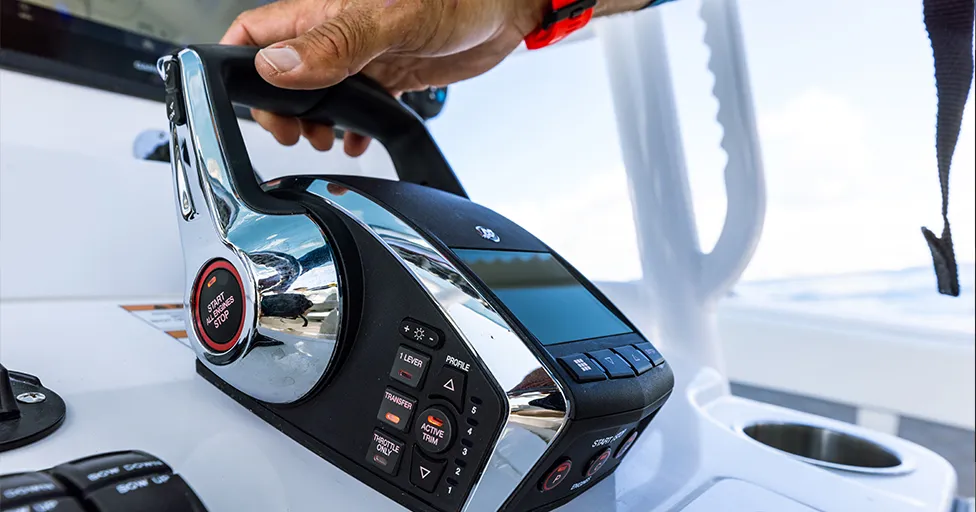
Hero image: Mercury digital-control example. Control configuration and compatibility vary by engine and rigging package.
Quick answer
Mercury Digital Throttle & Shift (DTS) replaces the old mechanical cable-and-lever system with an electronic control head that sends digital signals to the motor. DTS feels smoother and looks cleaner at the helm. Whether a motor uses DTS or mechanical controls depends on the exact model and configuration, not horsepower alone: our current Mercury price list carries Pro XS models from 200 to 300 HP in both mechanical and DTS versions, while Verado is DTS in the current generation. Mechanical controls still work fine on most Mercury FourStroke outboards from 9.9 HP up to about 150 HP. For an Ontario boater repowering a small-to-mid-size fishing boat or pontoon with a Mercury 25-115 HP, mechanical is usually the smarter buy. We install both at Harris Boat Works, and the right call depends on the exact motor, confirmed by model and serial, and what the helm looks like today.
Prices here are planning figures as of October 2026. For live Mercury motor pricing, see the Mercury pricing reference.
What you're actually choosing between
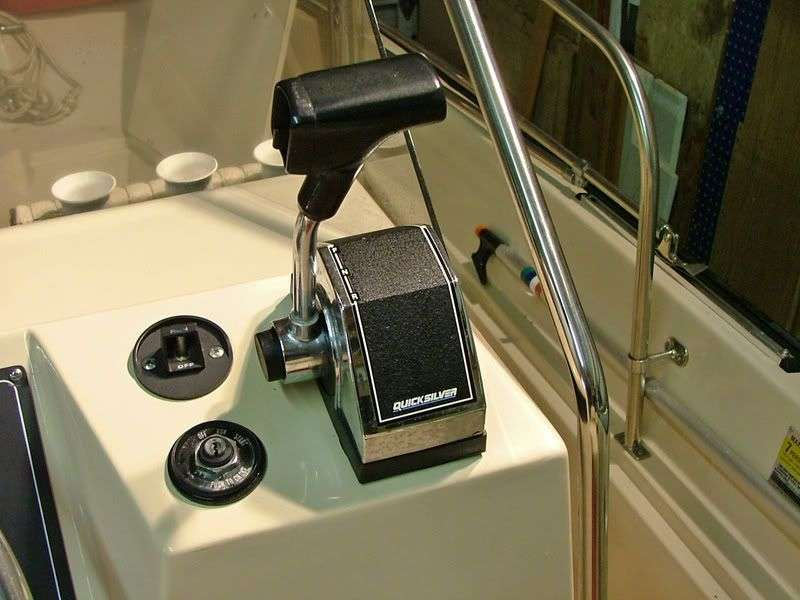
Mechanical controls are the traditional setup. A throttle/shift lever at the helm connects to the outboard via two steel push-pull cables routed through the boat. Move the lever, the cable moves, the motor responds. The system is mature, cheap, and easy for any marine tech to service. If a cable seizes or kinks, replacing it is a few hundred dollars in parts and labour.
DTS is Mercury's digital control system. The control head at the helm is electronic, with a chrome lever, digital display, and a START/STOP button. Instead of cables, the control sends signals over the Mercury SmartCraft network to the motor's electronic throttle and shift actuators. There are no cables to seize, the response is precise, and the system integrates with VesselView, autopilot, and joystick if you have them.
The difference between the systems creates real consequences in compatibility, cost, ride, and serviceability.
Compatibility (quick check)
DTS is standard on current Mercury Verado V8/V10/V12 packages in the 250-600 HP range. Confirm DTS fitment on the exact Pro XS or FourStroke model rather than inferring it from horsepower. Smaller motors (under 75 HP) typically use mechanical controls. Older mechanical motors generally cannot be retrofitted to DTS without replacing major engine components.
For a full eligibility table with every motor class, year cutoff, joystick prerequisites, and what to do if your motor isn't DTS-capable, see our dedicated eligibility post: Is Your Mercury Outboard Eligible for DTS Retrofit? (2026).
Mercury DTS compatibility by family and HP range
| Mercury family |
HP range |
DTS support |
Notes |
| FourStroke |
9.9-115 HP |
Mechanical only |
DTS not offered. Standard controls and cables. |
| FourStroke |
150 HP |
Mechanical only |
DTS not offered on the inline 4. Use standard binnacle. |
| FourStroke V6 (3.4L) |
175–225 HP |
Optional DTS |
DTS availability depends on the exact model and configuration. |
| FourStroke V8 (4.6L) |
250–300 HP |
Optional DTS |
DTS availability depends on the exact model and configuration. |
| Pro XS |
115-200 HP |
Depends on model |
Confirm DTS fitment by exact model and serial. |
| Pro XS V8 (4.6L) |
250-300 HP |
Mechanical or DTS |
Both versions appear on our current price list. Confirm by exact model and serial. |
| Verado V8 |
250-300 HP |
DTS standard |
Verado has been DTS-only for the current generation. |
| Verado V10 |
350-425 HP |
DTS standard |
Joystick Piloting requires DTS. |
| Verado V12 |
600 HP |
DTS standard |
Joystick Piloting requires DTS. |
| Avator (electric) |
7.5e-110e |
Drive-by-wire native |
Throttle is electronic by design, separate platform from DTS. |
| SeaPro |
varies |
Mechanical or DTS |
Commercial-rated. Match to existing helm setup; HBW will verify. |
Note: DTS retrofit on motors built for mechanical only is rarely worth it. New rigging cost varies depending on helm; see our /pricing-reference page for current figures. The decision usually only makes sense on a new repower or a multi-engine setup where Joystick Piloting is the goal.
Cost: compare the motor and the helm separately
Two different numbers get mixed together here. The first is the motor itself. Where Mercury sells the same Pro XS in mechanical and DTS versions, the DTS motor costs more. On our pricing reference in September 2026, the gap was about $1,870 at 200 HP, $2,057 at 250 HP and $2,008 at 300 HP, before any rigging.
The second number is the helm: control head, harness or cables, and rigging labour. That depends on your boat and on what is already installed, so we quote rigging per job. The full installed difference comes from a written quote for your exact motor and boat, not a rule of thumb. Check the Mercury pricing reference for current motor prices.
Ride feel: DTS is smoother
This is the honest one. DTS has a noticeable feel advantage at low speeds. The shift engagement is silky, the throttle response is linear and predictable, and there's no cable lag. On a properly-rigged mechanical setup, the difference is small. On a poorly-rigged or older mechanical setup with worn cables, the difference is significant.
Where DTS really shines is in maneuvering: docking, slow trolling, holding position in current. The digital system gives you precise small throttle adjustments without the dead spot a mechanical cable can develop. For an Ontario boater who docks regularly in tight Kawartha marina slips or runs slow trolling speeds for walleye, that precision is genuinely useful.
For a boater who launches and runs out to a fishing hole at cruise speed, the mechanical setup will do exactly the same job for less money.
Serviceability: mechanical is more democratic
A mechanical control system is something any competent marine tech can service anywhere. Cables, levers, pulleys: 50-year-old technology that hasn't fundamentally changed. If something seizes in the middle of a season, parts are available off the shelf at any Mercury dealer.
DTS service requires Mercury diagnostic tools (CDS or G3) and trained service technicians. The system is reliable but when it does fail, the repair is dealer-level, not roadside. For a boater who keeps the boat at a remote cottage and likes to fix things themselves, mechanical has a real edge.
This is one reason we recommend keeping rigging documentation in the boat. Our Mercury Controls & Rigging Compatibility Matrix covers the spec sheets in detail.
When mechanical is still the right answer
The mechanical decision usually wins when at least two of these are true:
- The motor is 150 HP or smaller
- The existing helm already has mechanical controls and the cables are recent
- You like simple, owner-serviceable systems
- The boat is a fishing platform where the helm sees more abuse than precision
Customers we steer toward mechanical: repowers on 16-18 foot aluminum fishing boats, owners who flip boats every 3-5 years, and any project where the money saved on controls buys a better trailer or fishfinder.
When DTS is the right answer
The DTS decision usually wins when at least two of these are true:
- The exact motor you want is only offered with DTS (Verado, for example)
- The boat is a center console, pontoon, or runabout where the helm aesthetic matters
- You run twin or triple engines and need integrated SmartCraft
- You already use VesselView or want joystick piloting
Customers we steer toward DTS: V8 and V10 repowers, premium pontoon packages with the Boost software upgrade, and any boat where the SmartCraft network is doing real work.
What we do at Harris Boat Works
We've been a Mercury dealer since 1965, and we install both systems regularly. When a customer comes in for a repower, the first thing we check is the motor model they're putting on, because that often makes the choice for them. The second thing we check is the existing helm: if the boat already has mechanical and the cables are in good shape, keeping mechanical is the cheap, clean answer. If the cables are tired or the helm wiring is a mess, DTS sometimes makes more sense even on a smaller motor because we're rebuilding the helm anyway.
About the author
Jay Harris helps run Harris Boat Works, a third-generation family marina in Gores Landing on Rice Lake, established in 1947. HBW is a Mercury Marine Premier Dealer and Legend Boats dealer serving Rice Lake, the Kawarthas, and Ontario boaters who want straight answers before spending real money. Read Jay's full bio.