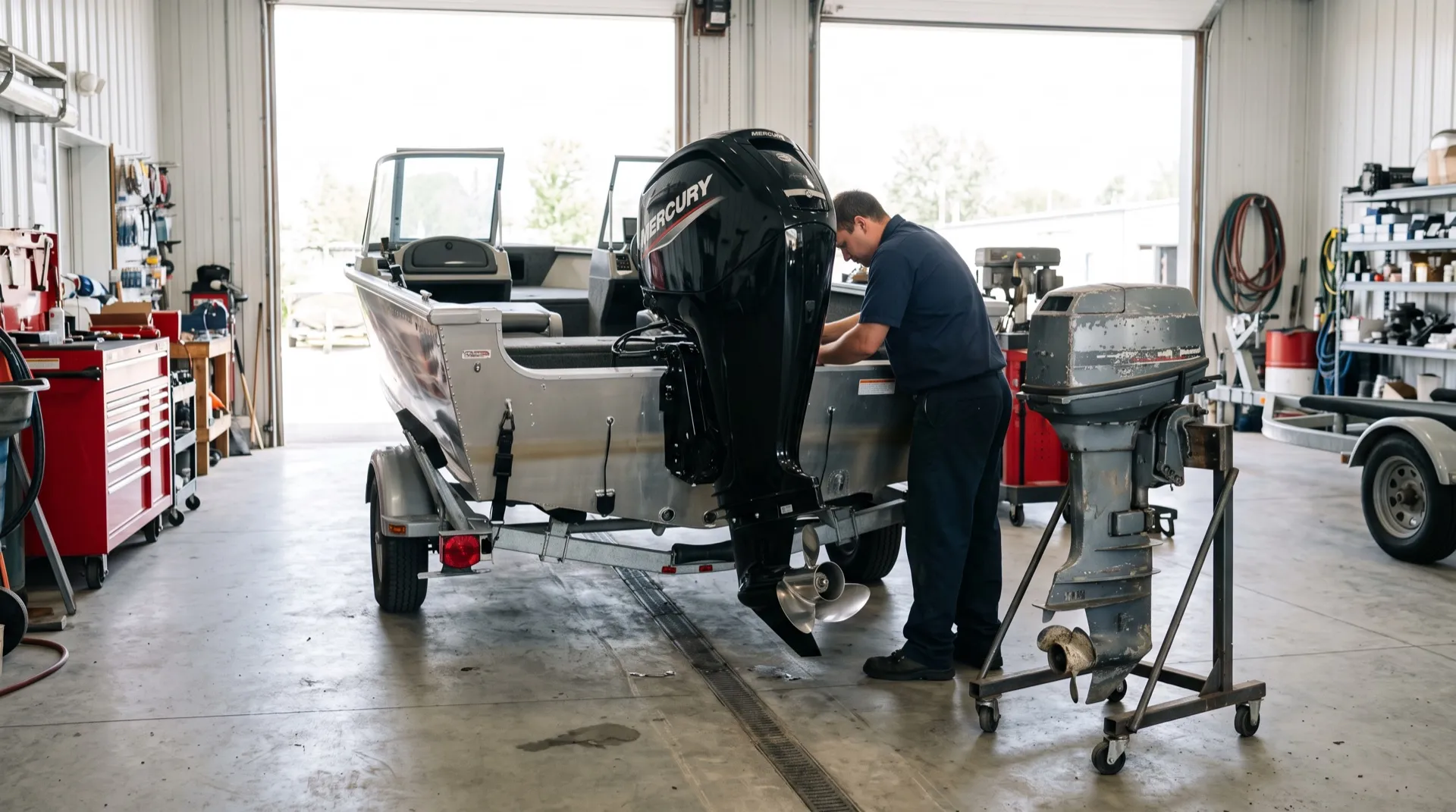
The signs your motor needs replacement are usually consistent: harder starts each spring, fuel system problems, declining performance, repair bills creeping up, or you're a worry-cycle into every fishing trip.
Quick answer: Repower when the itemized repair no longer compares well with the motor's remaining condition and expected use, when parts for your old powerhead are scarce, or when the hull is sound but the motor is tired. A modern Mercury FourStroke pays back in fuel, reliability, and resale. Start your Mercury repower, motor, rigging, and labour priced in CAD at mercuryrepower.ca.
The signs your motor needs replacement are usually consistent: harder starts each spring, fuel system problems, declining performance, repair bills creeping up, or you're a worry-cycle into every fishing trip. For most Ontario boaters, the right time to repower is the off-season after the second or third year of those signs, not the morning the motor finally dies. Live pricing on every Mercury we sell is at /quote/motor-selection. If you are wondering when it is time to replace your motor, read our guide first and then get a boat repower in Ontario from the team at Harris Boat Works.
Repower now, wait, or hold? at a glance
| Signal |
Repower now |
Wait for off-season |
Not yet |
| Motor state |
Dead/unreliable, metal in gearcase oil, failed cylinder |
Runs fine but 15+ yr or 1,500+ hr |
Post-2010, maintained, still reliable |
| Repair versus full repower |
Major work with other unresolved faults |
Get itemized quotes for both options |
Isolated repair; the rest of the motor checks out |
| Engine era |
2-stroke (pre-2005) |
FourStroke 2002-2009 |
Post-2010 |
| Move |
Quote a repower ($6.5K-$40K CAD) |
Plan and order over winter for an early-spring install |
Keep running, stay on maintenance |
Prices here are planning figures, last reviewed 2026-08-26. For live Mercury motor pricing, see the Mercury pricing reference.
Quick recommendation
There are three honest answers to "when should I repower?":
- Now if the motor is dead or unreliable. Hard starts, fuel issues, warning lights, and rising repair bills are signs.
- This off-season if the motor is "fine" but old (15+ years). Plan ahead. Old motors die mid-season at the worst time.
- Not now if the motor is reliable and recent. Modern Mercury FourStrokes have decades of life with proper maintenance.
The customers who plan and order over the off-season (our shop is closed December 1 through April 1, but we take orders by phone and email all winter) get first pick of motors and the earliest spring install slots. The customers waiting for the motor to die mid-season are competing for shop time during the rush. Plan ahead.
What changes the timing
Five things move the right repower timing:
- Motor age. A 25-year-old motor is closer to end of life than a 5-year-old motor regardless of hours.
- Hours of use. Hours alone don't decide it, so read them alongside compression, service history and corrosion. A modern Mercury at 500 hours has years left.
- Maintenance history. Well-maintained motors last longer. Skipped winterization shortens motor life dramatically.
- Symptom severity. Hard starts and minor fuel issues are early warnings. Compression problems and metal in the gearcase oil are end-stage.
- Repair cost trajectory. $200 spring service every year is normal. $500-plus repair bills two years running is a sign.
The signs your motor is approaching end of life
These show up in a predictable order:
Early signs (motor has years left, plan for repower)
- Harder starts in spring even after proper winterization
- Fuel system gum-up requiring carb cleaning or fuel filter replacement
- Idle quality dropping (rough idle, occasional stalling at low RPM)
- Performance dropping slightly (top speed off by 2 to 3 mph from when new)
- Fuel economy declining (15 to 20% worse than original)
- Starting to need more service to keep running well
When these signs appear, plan the repower for the next off-season. Do not wait for a mid-season failure.
Mid-stage signs (1 to 2 seasons of life left)
- Starting problems persist despite battery replacement and fuel system work
- Compression checking lower than spec
- Cooling system needing more attention (impeller failures, telltale issues)
- Spark plug fouling consistent across plugs
- Mid-RPM hesitation or surging
- Repeated major repairs, especially when other faults remain unresolved
At this stage, the math shifts toward "order a spring repower now." Continued repairs are throwing good money after bad.
End-stage signs (motor is at end of life)
- Motor will not start at all without significant work
- Lower unit problems (oil leaks, metal in gearcase oil, gear damage)
- Major internal damage (failed cylinder, bent rod, blown head gasket)
- Cooling system failure that overheats the powerhead
- Electrical system catastrophic failure (failed CDI box, harness damage)
At this stage, repower is the only honest answer.
What changes the answer (motor type)
Different motor types have different end-of-life patterns:
2-stroke motors (pre-2005 mostly)
Older 2-stroke Mercurys (and Evinrudes, Yamahas) are at increasing end-of-life risk in 2026. Reasons:
- Fuel system technology is older and more sensitive to ethanol
- Parts availability is dropping for older 2-strokes
- Service expertise is rarer (fewer techs trained on 2-strokes)
- Emissions regulations make 2-stroke motors less viable in some regions
Most 2-stroke owners should plan to repower with a modern FourStroke within the next 3 to 5 years.
Pre-2010 FourStrokes
Earlier FourStrokes (mostly 2002 to 2009) are mid-aged motors in 2026. They were a generational improvement over 2-strokes but lack some refinements of post-2010 motors:
- EFI systems are first-generation
- Electrical systems are simpler than current
- Service intervals are shorter than newer motors
Most pre-2010 FourStrokes still have life if maintained well. Plan ahead but no urgent repower necessarily.
Post-2010 FourStrokes
Service life on a current-generation FourStroke (2010 onward) depends on the engine family, maintenance, load, corrosion, storage and use, so there is no honest universal hour or year promise. The serial-specific maintenance schedule and a dealer inspection tell you more than an average does.
If your motor is post-2010 and has been maintained, no repower is needed. Run it.
What changes the answer (use case)
How you use the motor affects when it needs replacement:
- Cottage use (30 to 80 hours per season). Motors last calendar years longer than commuter boats. A 20-year-old cottage motor with 800 hours may have a decade left.
- Commuter or daily use (200+ hours per season). Motors hit their service-life limits faster. A 10-year-old commuter motor can carry far more hours than a cottage motor of the same age, so read the hours alongside compression, service history and corrosion.
- Tournament or commercial use. Heavy duty cycles wear motors faster. SeaPro variants are built for this.
- Intermittent storage use. Motors that sit for years between use sometimes have more issues than continuously used motors. Fuel system gum-up and seal degradation are common.
What HBW checks before recommending repower
When customers come to HBW asking "should I repower?" we want to know:
- Boat make, model, year, and hull condition
- Motor make, model, year, HP, and hours
- Maintenance history (winterization records, service history)
- Current symptoms and recent repair history
- Use pattern and intensity
- Long-term ownership plan
- Budget tolerance and financing
We give the honest answer per motor and use case. Sometimes the answer is "not yet, your motor has years left." Sometimes it's "order now so we can install as soon as we open in early April." We will not push a repower that isn't warranted.
The cost of waiting too long
Boaters who wait for the motor to die before repowering pay extra in three ways:
- Mid-season repower bookings are expensive and slow. Spring rush ends in May, fall rush starts in September. June through August is shop chaos. Mid-season repower can mean a longer wait for the motor to arrive, in peak boating season.
- Lost season time. Every week the boat is in the shop is a week of lost summer.
- Pressure decisions. Customers under pressure to get back on the water sometimes make rushed motor selection decisions they regret.
The customers who plan ahead pay the same motor price but skip all three costs. Plan ahead.
Repower vs full repair
When a motor has a major problem, the question becomes: repair or repower?
For older motors (15+ years), compare the complete repair quote with an installed repower quote, including any other work the old motor still needs. The repair fixes one problem; the next problem is usually 2 to 3 years away. Cumulative repair costs over a few years exceed replacement cost.
For mid-age motors (8 to 15 years), repair sometimes makes sense when the estimate still compares well against a full repower and the motor has otherwise been well-maintained.
For new motors (under 8 years), repair almost always makes sense unless the damage is catastrophic.
We do this math with customers at HBW. Not every problem is a repower trigger. Some are.
Build a quote on the motor selection page if you've decided. Live Mercury pricing in CAD with full configuration including rigging.
Build Your Mercury Quote
Pricing ranges in this article are HBW's working 2026 estimates, last reviewed 2026-08-26. The actual price for your specific motor and configuration is on the motor selection page. Mercury model years change every July 1, and we refresh ranges in articles annually.
Try the calculator
Want a real number? Run the Repower Cost Estimator - no signup, no email gate, takes 30 seconds.