Mercury motor maintenance in Ontario follows the seasonal cycle: spring commissioning (April-May), summer mid-season check (July), fall winterization (October-November), and a winter storage period. We do all of these at HBW.
Quick answer: For most current Mercury FourStrokes, scheduled maintenance is due at 100 engine hours or annually, with expanded work commonly due around 300 hours or three seasons. Ontario owners should combine that manual-based schedule with spring checks and proper fall storage preparation. There is no universal Mercury 20-hour oil-change requirement. For fall work at HBW, complete hbwservice.ca, then drop off anytime, including after hours.
Mercury motor maintenance in Ontario follows the seasonal cycle: spring commissioning (April-May), summer mid-season check (July), fall winterization (October-November), and a winter storage period. We do all of these at HBW. For a scope based on your specific motor, request service.
Quick recommendation
Most preventable service problems start with skipped maintenance, old fuel, restricted cooling water, or a storage procedure that did not match the engine. A model-specific schedule costs less than guessing after a warning horn or no-start.
The useful question is not whether the motor has reached a round number. It is which hour-based and calendar-based items are due for the exact serial number.
We have been servicing Mercury motors at HBW since 1965. The mistakes we see are the same every year. Use the seasonal cycle below to organize the exact work listed in the manual for your motor.
What changes the maintenance picture
Five things move how often and how aggressively you should service:
- Hours of use per year. A motor running 50 hours a season needs different service than a motor running 200 hours a season. More hours means earlier service intervals.
- Operating environment. Sheltered Rice Lake, Ontario fishing is gentle on a motor. Lake Ontario salmon fishing in 4-foot chop is hard. Saltwater is harder still (most Mercury motors in Canada do not see saltwater regularly).
- Storage conditions. A dry, secure cover and correct engine position matter. HBW offers outdoor storage with professional shrink wrap, outdoor uncovered storage, and shrink-wrap-only service. We do not offer indoor or heated boat storage.
- Motor family and age. Current FourStrokes, older two-strokes, SeaPro, ProKicker, and Verado models do not all share one checklist. The serial-number manual decides the cadence.
- Fuel quality. Ethanol-blended pump gas is the standard fuel in Ontario and is fine for modern motors as long as you do not let it sit untreated. Old gas in old motors is the leading cause of fuel system problems we see at HBW.
The seasonal cycle
Spring commissioning (April to early May)
After winter storage, the motor needs to be brought back to operational state before the boating season starts.
Spring commissioning at HBW can include:
- Confirm the gearcase lubricant was serviced and inspect for leaks
- Battery reconnect and load test
- Fuel system check (replace fuel filter if due)
- Cooling system flush
- Spark plug inspection or replacement
- Anode inspection
- Visual inspection of harness, controls, prop, hull
- Test run on muffs or in water
- Trailer prep (bearings, tires, lights)
HBW is closed from December 1 through April 1. You can submit a service request before reopening so the job is ready to schedule, but service work resumes after April 1.
Spring outboard commissioning checklist walks through this in more detail.
Summer mid-season service (mid-July if running heavy hours)
Recreational boaters running 50 to 100 hours a season usually do not need a mid-season service. The motor goes from spring to fall with no intervention.
Boaters running 200+ hours a season should consider a mid-season check. Quick visual, oil top-up if needed, prop check, anode check. Catches small problems before they become big ones in August when the shop is busiest.
Fall winterization (October to early November)
Fall service is where most Ontario owners combine the annual interval with off-season preparation. The exact storage procedure varies by engine. Follow the manual instead of assuming every FourStroke needs the same fogging routine.
Fall preparation at HBW can include:
- Fuel stabilization
- The model-specific internal engine protection procedure
- Gearcase lubricant service and a check for water
- Cooling-system and telltale checks
- Anode inspection and replacement when due
- Spark plug service when the manual calls for it
- Lubrication of cables and pivot points
- Battery test, disconnect, and maintenance plan
Some boaters DIY winterization, which is fine for confident owners on smaller motors. The DIY winterization guide walks through the procedure. For bigger motors or owners who want it done right without doing it themselves, request service at HBW.
For pricing context, see the boat winterization cost guide.
Winter storage
If winterization is done correctly, the motor mostly takes care of itself over winter. A few things to do or avoid:
- Battery: a healthy battery may remain aboard only if fully charged, disconnected, secured, and permitted by the approved storage plan. The model/serial manual and approved storage plan control.
- Storage cover: snow load can damage seats, electronics, and canvas
- Mid-winter check (for boats stored at home): a 5-minute visual once a month catches mouse intrusion, cover damage, or other issues before spring
HBW offers outdoor storage with professional shrink wrap, outdoor uncovered storage, and shrink-wrap-only service. We do not offer indoor or heated boat storage. For current rates, see the winter-storage rate page.
Common maintenance mistakes
We see these every year:
Skipping the storage procedure. Old fuel, water-contaminated gear lubricant, corrosion, and a poorly protected battery can turn into spring repairs.
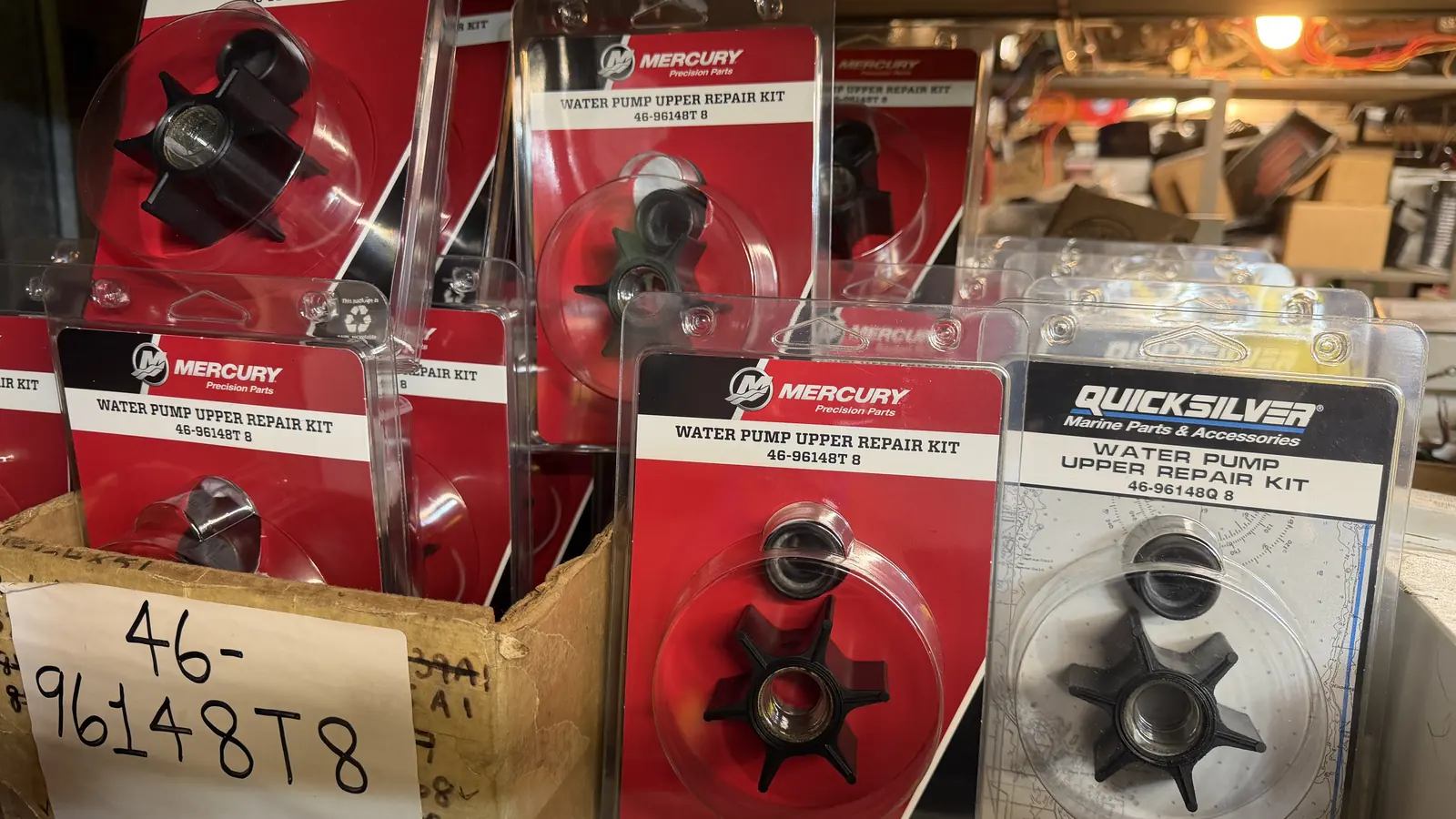
Ignoring the cooling-system schedule. Water-pump impeller timing varies by engine. Many Mercury schedules use an expanded interval around 300 hours or three years. Replace it sooner if the manual, operating conditions, overheating, or reduced water pressure call for it.
Letting old gas sit. Pump gas with ethanol breaks down over months, especially without stabilizer. Old gas gums up carburetors and injectors. Run tanks down or stabilize.
Skipping anodes. Sacrificial anodes protect the motor from galvanic corrosion. Inspect them regularly and replace them by the manual, commonly when about half consumed. Freshwater applications may use aluminum or magnesium; zinc is for saltwater.
Wrong oil for FourStroke motors. Use an FC-W-rated four-stroke marine oil that meets the specification and viscosity in the manual for the exact engine. Do not substitute automotive oil or TC-W3 two-stroke oil, and do not assume one horsepower-based viscosity chart applies to every family and model year.
Running on a weak battery. A weak battery can create slow cranking, unreliable starts, and misleading electrical symptoms. Load-test it, maintain clean connections, and replace it based on condition and the battery maker's guidance instead of one universal age rule.
Ignoring the prop. A nicked or bent prop costs you fuel economy and stresses the motor. We inspect and recommend prop replacement when needed during winterization.
What HBW checks at every service visit
Even a basic spring or fall service includes:
- Visual inspection of motor cowl, lower unit, and prop
- Oil and filter check (FourStroke)
- Spark plug inspection
- Anode inspection
- Steering, throttle, and shift cable smoothness
- Battery condition
- Hose and connection condition
- Fuel filter condition
We log the work we complete. Those records matter for warranty support and resale value.
Service intervals at a glance
For many current recreational FourStrokes, this is the planning framework. The exact manual controls:
| Service stage |
Typical timing |
| Break-in |
Follow the model-specific procedure, often through the first 10 hours on current examples |
| Optional dealer check |
A few weeks after purchase if recommended; not a universal 20-hour requirement |
| Scheduled service |
100 engine hours or annually for most current recreational FourStrokes |
| Expanded service |
Commonly 300 hours or about three seasons, with model-specific parts |
| Condition checks |
Before use and whenever a warning, impact, leak, weak telltale, or performance change appears |
For high-hour use, the hour trigger can arrive before the calendar. Commercial-duty SeaPro and other specialized engines follow their own schedules.
For exact intervals on your specific motor model, the Mercury owner's manual is the authoritative source. We follow Mercury's published schedules at HBW.
Ready to request service?
HBW handles fall winterization and outdoor storage first come, first served. Complete hbwservice.ca, then drop off anytime, including after hours. The marina is closed December 1 through April 1.
Request Service
Not sure what your specific motor needs? Put in a service request at hbwservice.ca with your motor details and we'll lay it out.
Sources
Service pricing varies by motor, condition, and work due. HBW confirms the current scope and price from the service request and the exact engine details.