Quick Answer A boat is worth considering for a Mercury repower when five things line up: the structure is sound, the manufacturer documentation supports the motor choice, the complete rigging fits, the boat still suits how you use it, and the whole project makes sense beside...
Quick Answer
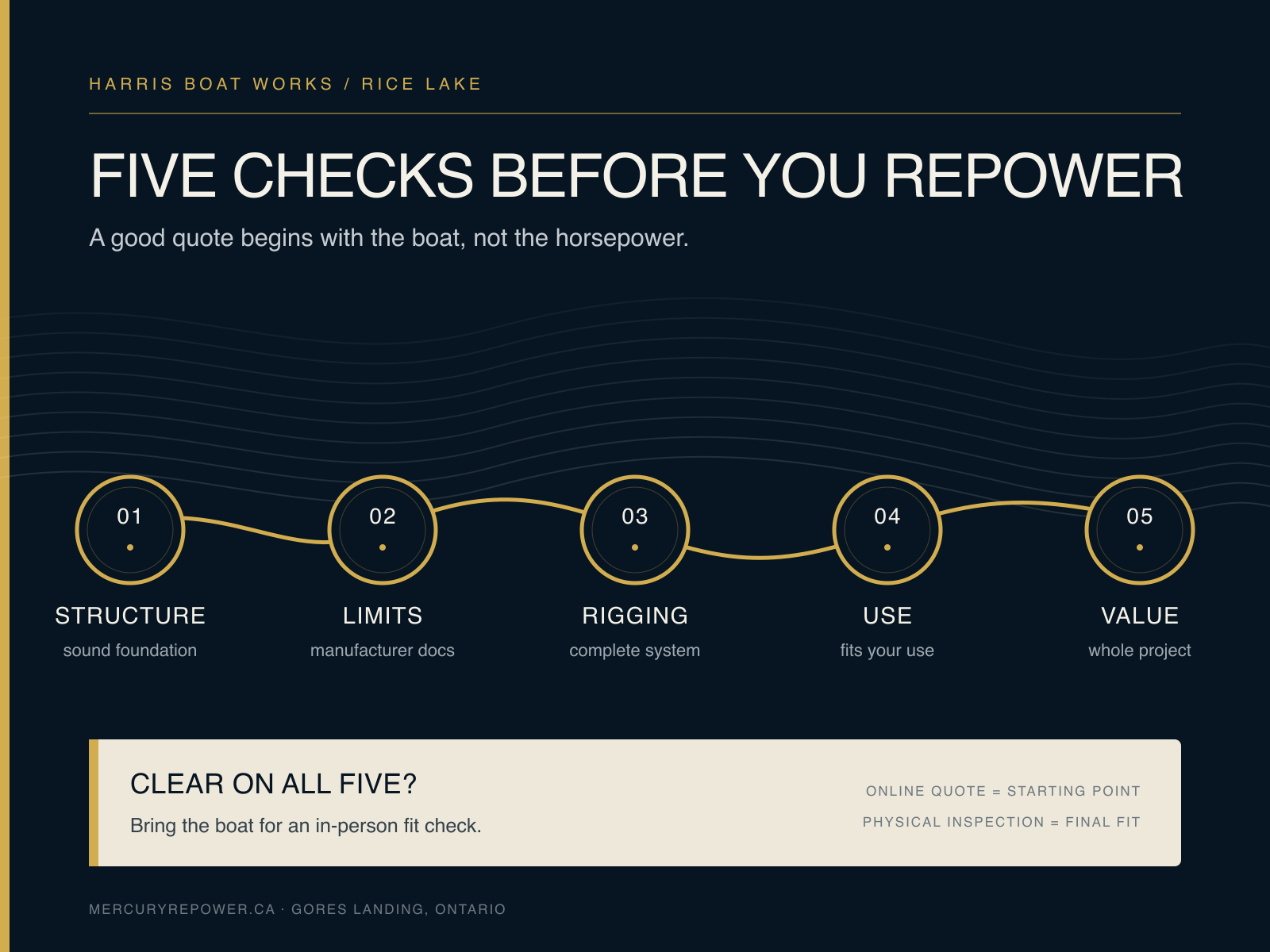
A boat is worth considering for a Mercury repower when five things line up: the structure is sound, the manufacturer documentation supports the motor choice, the complete rigging fits, the boat still suits how you use it, and the whole project makes sense beside a comparable replacement boat.
You can screen those questions at home. You cannot certify a transom, approve horsepower, or finalize an installation from a driveway test or an online quote. HBW inspects the actual boat before accepting a repower.
What a Good Repower Candidate Looks Like
The best candidate is not simply an old boat with a tired motor. It is a boat whose expensive wear item is the motor while the hull, transom, steering, electrical system, trailer, and layout still justify the investment.
That distinction matters. A new Mercury can transform how a familiar boat starts, idles, charges, steers, and performs. It cannot repair hidden structure, change the manufacturer's limits, or make the wrong layout fit your family.
Use these five checks to decide whether the next conversation should be a repower assessment, a repair-first plan, or a comparison with another boat.
Check 1: Is the Structure Worth Building On?
Start with the transom, floor, stringers, hull, mounting area, and any previous repairs.
Warning signs include:
- movement at the transom while the engine is carefully tilted or supported
- cracks radiating from mounting points or stress areas
- soft flooring or visible laminate separation
- persistent water where the bilge should drain dry
- corrosion, pitting, distorted metal, loose rivets, or cracked welds on an aluminum hull
- repairs with no records or workmanship you cannot verify
A home walkaround is useful because it can find reasons to stop. It is not proof that hidden structure is sound. Tapping, pressing, or looking at the surface alone cannot clear a cored transom or internal structure for a new engine. When the structure is uncertain, get a qualified marine technician, repair specialist, or surveyor involved before choosing the motor.
Check 2: What Do the Hull Documents Actually Allow?
Photograph the hull serial number and every compliance, conformity, or capacity notice before discussing horsepower.
Transport Canada distinguishes between the notices:
- For an outboard-powered boat up to 6 metres, a Canadian capacity label includes recommended maximum safe limits such as engine power, people, and load.
- Boats longer than 6 metres use a conformity label. It confirms construction compliance but does not use the same capacity-label format.
- Some older, imported, rebuilt, or privately constructed boats need more documentation before the engine-power question is clear.
Treat the manufacturer's recommended maximum safe engine power as the limit unless authoritative written documentation for the exact hull says otherwise. An oversized motor already hanging on the boat, a forum answer, or a similar-looking model is not approval.
If the notice is missing or unreadable, record the hull serial number and contact the builder or importer where possible. Transport Canada explains the notice types and exceptions in its official compliance-notice guidance.
Check 3: Does the Complete System Fit?
Horsepower is only one line in a repower scope. The exact installation also depends on:
- engine weight and balance
- transom height and shaft length
- steering type and condition
- mechanical or digital controls
- gauges and engine-data compatibility
- fuel tank, lines, filtration, and venting
- battery capacity, cabling, switches, and charging needs
- available rigging space at the transom and helm
- propeller family and normal loaded use
Two engines with the same advertised horsepower can require different controls, steering, electrical work, or mounting decisions. Use the current documentation for the exact motor and serial family. Mercury's owner resources are the right starting point for model-specific manuals.
Check 4: Does the Boat Still Fit Your Life?
This is the human check, and it saves people from putting a beautiful new motor on the wrong boat.
Think about your normal day, not the lightest possible test run:
- people, fuel, fishing gear, coolers, batteries, and a kicker if you carry one
- the water you actually use, including weeds, chop, shallow launches, or long no-wake sections
- fishing layout, family seating, watersports, cottage hauling, or cruising
- trailer condition, tow vehicle, storage, and launch access
- whether the boat will still suit you several seasons from now
If the hull is too small, the layout frustrates everyone, or the trailer and interior are also nearing replacement, a repower may solve the motor problem while leaving the ownership problem untouched.
Check 5: Does the Whole Project Make Sense?
Compare like with like. A motor-only advertisement is not the same thing as a completed repower, and a bare hull price is not the same thing as a ready-to-use replacement package.
For the existing boat, account for the current motor, controls, steering, gauges, rigging, propeller, installation, tax, and any hull, trailer, electrical, or cosmetic work you already know it needs. For the replacement option, compare a boat with the size, equipment, power, trailer, and use case you would genuinely buy.
There is no universal percentage that decides this correctly. The answer changes with hull condition, the amount of reusable rigging, the replacement boat being compared, and how long you expect to keep it.
Use the live Mercury quote builder for a current starting scope, then let the physical inspection turn that starting point into an installable plan.
How to Read Your Five Results
| Result |
What it means |
Next step |
| Clear on all five |
The boat is worth an in-person repower assessment. |
Gather the identifiers and photos, build a starting quote, and arrange the physical inspection. |
| One check is uncertain |
Do not guess. The uncertainty may change the motor, scope, or economics. |
Confirm the label, structure, rigging, or repair question before committing. |
| Structure or documentation says stop |
The repower is not ready to proceed in its current form. |
Repair and document the boat first, or compare it honestly with another hull. |
| The boat no longer fits your use |
A new motor would solve the wrong problem. |
Price the replacement-boat path before spending on the repower. |
What to Send HBW
A useful first review includes:
- one photo showing the whole boat and trailer
- straight-on photos of the outside and inside of the transom
- the hull serial number
- every compliance, conformity, or capacity notice
- the current motor model and serial label
- the steering, controls, helm, battery area, and rigging entry points
- a plain-language description of your normal load and how you use the boat
Those details let us identify the open questions before anyone assumes the motor fit is simple.
Ready for the Next Step?
Start with a live Mercury repower quote. It is a planning tool, not final installation approval.
If you want HBW to review the actual boat, complete the online service check-in with the photos and identifiers above. The form is not an appointment; our team confirms the next step after reviewing the submission.
Harris Boat Works is a family-owned Mercury Premier Dealer in Gores Landing on Rice Lake, serving boaters across the Kawarthas, Northumberland, Durham Region, and the eastern GTA.
