The 5-Check Repower Eligibility Test: if all five are true, a repower is worth pricing and comparing Before the cost comparison matters, confirm five things: the hull and transom are structurally suitable; the boat still fits how you use it; the manufacturer documentation...
Quick answer: Repower can win when the hull is structurally suitable, the boat still fits your use, and the complete installed repower quote beats the complete replacement package. Buying new can win when the hull or several major systems need work, the layout no longer fits, or you simply want a different boat. Compare current written totals, not old article ranges: HST, trailer, structural repairs, rigging, steering, controls, gauges, propeller, batteries, electronics, financing cost, trade value, and exclusions.
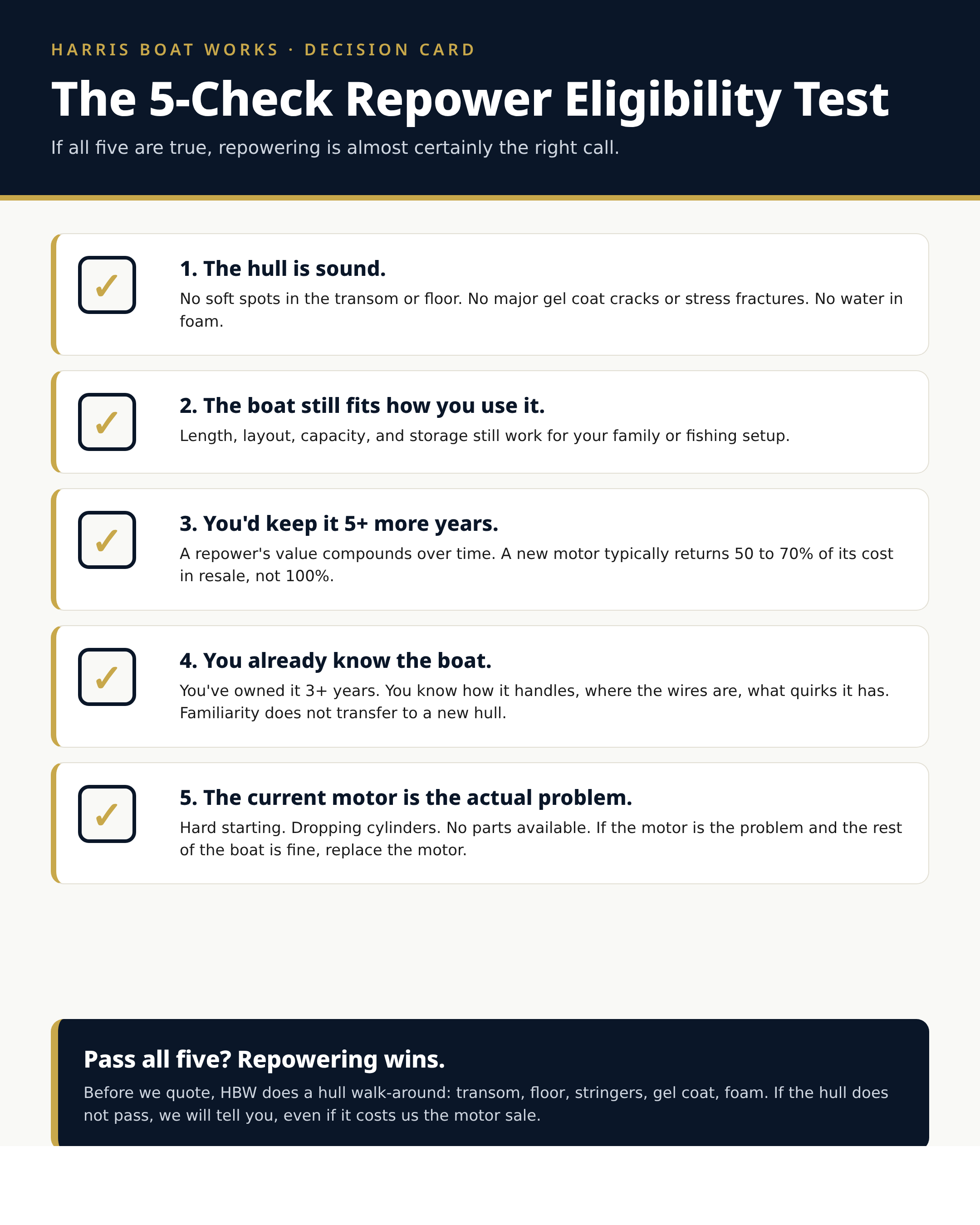
Before the cost comparison matters, confirm five things: the hull and transom are structurally suitable; the boat still fits how you use it; the manufacturer documentation supports the proposed motor; the other systems are included in the scope; and the current motor is actually the problem. Clearing those checks makes a repower worth pricing, not automatically the right answer.
There's a moment most boat owners eventually meet. The motor that has started every spring for fifteen years turns over, coughs, and goes quiet. You drift for a second, and you start doing math.
The math usually frames itself as one question: new boat, or new motor? That is incomplete. First decide whether the hull is suitable and whether it still fits your boating. Then compare the two complete current scopes. For the structural checklist, use is your boat hull worth repowering?. For the broader repair and sale paths, use the repair, repower, or sell decision guide.
When does repowering save real money?
Repowering deserves a price comparison when the boat itself is still a keeper: the structure is suitable, the layout works, and the motor is the main problem. It does not automatically win just because the hull is sound.
Build the repower side from the live Mercury pricing reference and the boat-specific written quote. Build the new-boat side from a current written package quote. Put both into the same comparison:
| Cost to compare |
Repower |
Buy new or different |
| Motor, hull, trailer, and rigging |
Include every required part and repair |
Include the complete package and any upgrades |
| HST and financing |
Use the signed quote and lender disclosure |
Use the signed quote and lender disclosure |
| Steering, controls, gauges, propeller, batteries, electronics |
Identify what stays and what changes |
Identify what is included and what is optional |
| Storage, dock, cover, and towing fit |
Confirm the existing boat still fits |
Price every change created by the new boat |
| Trade or resale |
Use a current written value |
Use the actual trade allowance or sale estimate |
The result is specific to the two boats and two written scopes. A generic savings range cannot make the decision for you.
What are the hidden costs of buying a new boat?
Not hidden in a dishonest sense, just easy to forget while comparing headline prices. Check whether the new package changes the trailer, HST base, insurance value, storage footprint, cover, dock fit, tow-vehicle requirement, batteries, electronics, safety gear, and financing cost. A repower has its own non-motor costs, so list those with the same discipline.
When does buying a new boat actually make more sense?
Three honest conditions tip the math toward new.
First, hull condition. A transom, stringer, floor, mounting-area, or water-intrusion concern needs a diagnosis and written repair scope before the motor is ordered. A tap sound or photo is not enough to price or approve structural work.
Second, design fit. If the boat does not suit how you actually use it now, repowering is solving the wrong problem. Family grew, fishing gave way to cruising, kids want to tube. Sometimes the boat needs to change, not just the motor.
Third, want. Some customers come in and admit they just want a new boat. That is a valid reason. Repower math wins on paper, but if the boat no longer makes you happy, the math does not matter. The honest question is not only "what is cheaper?" It is "what will I still be happy to own two seasons from now?"
The hardest case is the boat with a sentimental connection. Dad's old fibreglass, the cottage boat the family grew up in, the aluminum that never quits. Sentimental value belongs in the decision, but it does not prove the structure or predict another fixed number of seasons.
How do I know if my hull is worth repowering?
Five things we check on every boat that comes in for a repower quote.
First, the transom. We press on it from inside and outside. Soft spots, flex, or water staining are warning signs. A solid transom takes a heavier modern FourStroke without issue.
Second, the stringers. The longitudinal beams under the floor. Rotted stringers mean major hull work.
Third, the deck. Soft deck panels often indicate water intrusion in the foam or core below.
Fourth, the hull itself. Cracks, repaired damage, or signs of stress around the keel are reasons to take a second look.
Fifth, the existing rigging and wiring. Old wiring harnesses, cracked fuel lines, and corroded battery cables all need replacement. Boats neglected for 15-plus years often need more.
If the boat passes the structural assessment, it is ready for a real repower quote and total-cost comparison. Our complete Kawarthas repower guide explains the broader process.
What does a typical Mercury repower include?
An installed repower quote should identify the exact Mercury outboard, controls, steering, rigging, propeller, removal, installation, testing, warranty registration, HST, and exclusions that apply to the boat. Do not assume that every item is bundled the same way on every project. Confirm current warranty terms and any eligible additional promotional coverage on the promotions page, and use the Mercury outboard warranty guide for context. Financing is OAC through HBW's Canadian lending provider; the lender's current disclosure controls the rate, contract term, amortization, fees, down payment, and approval. Build a starting quote at mercuryrepower.ca and rely on the written boat-specific total. Pickup only at Gores Landing, no shipping, no delivery.
How long will a repowered boat last and how do I decide?
There is no honest universal hour or year promise for a Mercury FourStroke. Service life depends on the engine family, installation, maintenance, load, corrosion, storage, use, and operating history. Use the serial-specific maintenance schedule and the warranty terms, then model ownership around how long you expect to keep the boat rather than a guaranteed lifespan.
When it is time to decide, inspect the hull honestly and separate three ideas: what the motor needs, what the hull needs, and what you want your boating life to look like for the next decade. If the first answer is "motor," repower probably wins. If the second or third answer is "boat," stop forcing the repower math to carry more than it should.
A repower can be the most rational move and still feel emotional because it keeps the boat you already know. That is just part of boating. If repower is the right call, we are the marina to do it. If new is the right call, we are also a Legend Boats dealer and can show you new Legend hulls with Mercury power already paired.
What we see at HBW
Three patterns from three generations of repowering boats on these lakes.
The hull assessment belongs before the motor order. A good motor cannot correct a soft transom, structural damage, tired wiring, unsuitable steering, or an incomplete fuel system. The written quote should reflect what the boat actually needs.
A sound hull can make repower the better value, but the math is boat-specific. Compare the written repower total with hull condition, transom, wiring, steering, trailer, interior, expected ownership horizon, and the price of the realistic replacement boat. A transom check belongs before the recommendation.
Sometimes the right answer for the customer is new. When that's the case, we say so, and we walk them through what a new Legend boat with Mercury power looks like. We sell new boats too. We just don't push them when a repower is the better answer.
Trade-In Is the Third Option
There is a third path most owners forget. Two trade-in moves to consider:
Trade in the whole boat and put that value toward a different boat with a current Mercury on it. This works when the hull is decent and someone else wants what you have.
Ask whether HBW will value the old motor. Acceptance and value depend on the specific engine, ownership documentation, condition, hours, service history, and current market. Use the written allowance in the comparison, not an article range.
The Question Most Dealers Won't Ask
"What would actually make you happier with this boat?"
If the answer is "a new motor," repower. If the answer is "more space," or "I need a different layout," or "I want to fish water this hull can't handle," a new engine will not fix that.
The correct recommendation may be repair first, repower, buy a different boat, or keep the existing setup. The evidence from the boat and the owner's actual use should control the answer.
Ready to do the math on your boat?
Build the repower configuration at mercuryrepower.ca, then compare the complete written scope with a current replacement-boat quote. HBW confirms the motor, rigging, timing, and safe handoff or alternate acceptance plan for the actual boat.
Phone: 905-342-2153
Address: 5369 Harris Boat Works Rd, Gores Landing, ON
Service: hbwservice.ca
