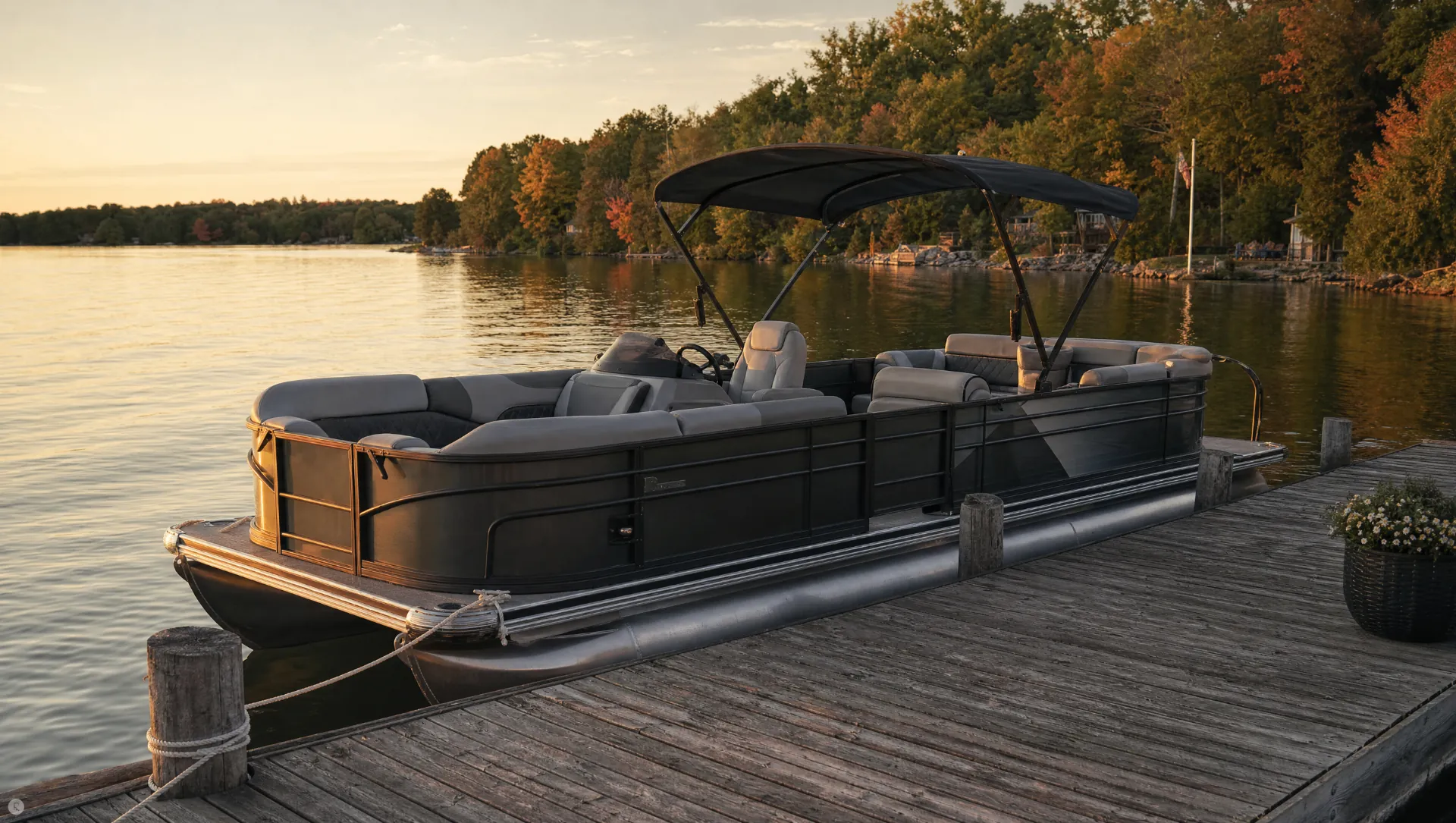
There's a reason videos about pontoon boat problems rack up millions of views. People buy pontoons expecting the easiest, most relaxed boating experience possible, and they're not wrong to expect that. Done right, a pontoon is the perfect Rice Lake, Ontario (in the Kawarthas)...
Quick answer: Most pontoon problems we see are preventable, and the biggest one is motor size. Too small and it lugs under load. Maxed out and it's overkill: extra cost and extra weight on the transom. The best fit is one Mercury model below the hull's max HP rating. Inspect tubes and deck annually, run ethanol-free fuel, and most pontoons stay reliable for decades.
There's a reason videos about pontoon boat problems rack up millions of views. People buy pontoons expecting the easiest, most relaxed boating experience possible, and they're not wrong to expect that. Done right, a pontoon is the perfect Rice Lake, Ontario (in the Kawarthas) boat.
But we see what happens when things go wrong. Every season, boats roll into the shop at Harris Boat Works with the same handful of issues. Most of them were preventable. Some of them were baked in from the day the boat was bought.
This isn't a scare piece. It's what our service techs actually deal with, written plainly so you know what to watch for, and how to avoid an expensive headache on the water.
Why HP Sizing Is the #1 Mistake Pontoon Buyers Make
Before we get into the full list, this one gets its own section. It causes more problems than everything else combined, and people get it wrong in both directions.
Pontoons are heavy. A 22-foot pontoon loaded with a cooler, canopy, six adults and gear can easily top 1,361 kg (3,000 lb). Add drag from two or three aluminum tubes and you've got a boat that needs real power to perform.
Too little motor. The mistake we see constantly: a 22- or 24-foot pontoon with a 60 HP on the back because the dealer said it would "work." Technically, yes. It moves the boat. But it won't come up to cruise under load, it lugs when you push it, and that engine works twice as hard as it should for its entire life.
Too much motor. The opposite mistake is buying the biggest number on the capacity plate. Jay Harris, our owner, tells customers the max HP rating should really be labelled "overkill." The plate tells you the most the hull is rated to carry. It isn't a recommendation. Going to the max usually means more money up front, more weight hanging off the back of the boat, and a pontoon that often performs no better than one a step down. Just because the boat can handle it doesn't mean it's a good idea.
The weight difference is real. A Mercury 150 FourStroke weighs 206 kg (455 lb) dry. A 115 FourStroke weighs 163 kg (359 lb). That's about 43 kg (96 lb) more on the transom for power the boat didn't need. (Dry weights from our Mercury outboard weight chart.)
The HBW rule: one Mercury model below the max. Cost aside, the best fit is the next Mercury model down from the max HP on the capacity plate. Plate says 150? The best fit is a 115. For most 20 to 24 ft pontoons, that lands at 90 to 115 HP. Tritoons rated higher get more.
| Capacity plate max |
HBW best fit |
| 75 HP |
60 HP |
| 90 HP |
75 HP |
| 115 HP |
90 HP |
| 150 HP |
115 HP |
| 200 HP |
175 HP |
| 250 HP |
225 HP |
If you're shopping repowers or new setups, the Mercury Command Thrust guide for pontoons is worth reading. CT motors are specifically designed for the high-drag, low-RPM torque demands of pontoon hulls. And if you want a side-by-side comparison of motor options, see our breakdown of the best Mercury outboards for pontoon boats.
The 8 Pontoon Problems We See at the Shop
1. Wrong-Sized Motor (Usually Too Small, Sometimes Too Big)
Already covered above, but it's worth reinforcing: being underpowered isn't just a performance problem, it's a maintenance problem. An engine that's constantly working near its limits runs hotter, wears faster, and costs more to maintain. You'll be in the shop more often, and the repairs won't be cheap.
Going the other way doesn't fix it. A maxed-out motor costs more to buy, adds weight you carry on every trip, and rarely makes the boat better. The sweet spot is one Mercury model below the max.
If you're running an undersized motor and on the fence about repowering, the math usually favours the repower.
2. Pontoon (Tube) Leaks and Welding Cracks
The tubes are the boat. If they're taking on water, your boat rides lower, handles worse, and is quietly failing from the inside.
Welding cracks typically develop at stress points, around baffles, at the nose of the tube, and where the crossmembers attach. These aren't always obvious. You might not notice anything until the boat is noticeably down on one end.
What to watch for:
- Uneven trim when the boat is sitting level at the dock
- Visible weeping or staining on the exterior of a tube
- Unexplained sluggishness, especially after rough water
Annual inspection matters here. If you're noticing symptoms, don't wait. Tube repairs are manageable when caught early. Full tube replacement is a much bigger job.
3. Deck Rot and Soft Spots
Pontoon decks are built over a wood subfloor. That subfloor sits under carpet or vinyl, materials that trap moisture instead of letting it drain. Once water gets underneath, whether through a seam, a screw hole, or a fitting that wasn't sealed properly, rot follows.
You'll feel it before you see it: a soft spot underfoot, usually near the bow, the stern, or around cleats and fittings. Left alone, it gets worse fast.
Prevention is straightforward:
- Inspect carpet seams and vinyl edges annually for lifting or gaps
- Reseal around any deck fittings when you see signs of wear
- Don't leave pooled water sitting on the deck after rain
If you're buying a used pontoon, press down on the deck with your foot in a few spots before you commit. A solid deck is firm. A compromised one will give slightly. That flex tells you everything.
Pontoon diagnostic flow
Pontoon acting up? Run this check before calling
Most Rice Lake pontoon calls trace back to one of these four. Work through them in order.
Weeds in the prop
?Tilt the motor up. Are there weeds, fishing line, or zebra mussels wrapped around the prop shaft?
💡Rice Lake is shallow and weedy. A wrapped prop kills hole shot and overheats the lower unit. Clear it before you assume the motor is bad.
Corroded fittings at the helm
?Check the back of the helm and the bow nav-light wiring. Any green crust, soft insulation, or loose ring terminals?
💡Pontoon wiring lives in open weather. Green corrosion is the most common cause of intermittent gauges, no-start, and dead bow lights. Disconnect, clean, dielectric grease, reconnect.
Soft spots in the deck
?Walk the deck barefoot. Any spongy areas, especially around the fuel tank, the helm base, or the rear corners?
💡A soft deck means the marine plywood is rotting under the carpet. Catch it early and it's a panel swap. Catch it late and it's a full deck rebuild.
Tube damage from grounding
?With the pontoon out of the water, inspect both tubes for dents, weld cracks, or unusual streaking near the nose cones.
💡Rice Lake has rock shelves. A hard grounding can crack a weld without obvious leakage. If a tube sits lower in the water than the others, get it pressure-tested before next season.
🔧Found something or unsure?
Bring it in for a pontoon inspection. We diagnose tube, deck, wiring, and motor on the same visit. Book at hbwservice.ca or call (905) 342-2153.
4. Wiring Corrosion at the Helm and Bow
Aluminum pontoons are excellent platforms for corrosion. The combination of moisture, aluminum, dissimilar metals, and electrical current in a marine environment creates ideal conditions for corrosion to take hold, especially at the helm console and anywhere in the bow.
What we see most: corroded wiring harnesses at the helm, green and brittle connections at the battery, and failing bow light wiring that's been wet for years inside the deck.
Symptoms:
- Gauges reading incorrectly or not at all
- Intermittent starting issues (especially when the motor is otherwise fine)
- Navigation lights that work sometimes and don't work other times
- Accessories that stop functioning mid-season
Wiring work is time-consuming to fix right. Keeping up with it (cleaning and protecting connections with dielectric grease, replacing any corroded terminal ends before they fail) is far cheaper than rewiring a console.
5. Bimini and Furniture Wear
This is less critical than the others, but it affects the experience and the resale value. Pontoon bimini tops take a beating from UV, rain, and repeated folding. The stitching goes first, then the fabric. Snap hardware corrodes, frames develop stress cracks, and what was a solid canopy becomes a liability.
Pontoon furniture, typically marine-grade vinyl, fades and cracks if it's not protected. On a boat that spends summer days in full sun on Rice Lake, that process is accelerated.
The fix is simple: cover the boat when it's not in use. A quality boat cover is one of the best investments a pontoon owner can make. UV protectant on the vinyl seats extends their life considerably.
6. Tube Damage from Grounding and Rocks
Rice Lake is beautiful. It's also shallow in a lot of places, and the shoreline around Bewdley, Harwood, and the eastern end of the lake has rock and gravel that will find the underside of your tubes if you're not paying attention.
Pontoon tubes sit low. At slow speed, at the launch, or cutting a corner too close, it's easy to drag a tube across the bottom. The damage ranges from cosmetic scuffing to actual gouges and dents, and sometimes hidden cracks that don't show up until the tube starts taking on water.
On Rice Lake specifically:
- Give unfamiliar shorelines more room than you think you need
- Back off the throttle early when approaching docks, not just at the last moment
- If you know you've hit bottom hard, have the tubes inspected before assuming you're fine
See our guide to pontoon boats and cottage use on Rice Lake for more on navigating the lake responsibly.
7. Wrong Propeller. Pitch Too High
A propeller that's pitched too high for the boat's load and motor will prevent the engine from reaching its optimal RPM range. The motor strains, performance suffers, fuel consumption goes up, and you're doing wear you don't need.
It's a surprisingly common problem. Pontoons change over time. You add a bimini, upgrade the stereo, load more people. The prop that worked well three years ago may not be the right choice anymore.
Signs your prop pitch is off:
- Motor won't reach its rated WOT RPM under normal load
- Sluggish hole shot even with a properly sized motor
- Excessive fuel burn with no explanation
Prop selection isn't complicated, but it's worth doing right. Our Mercury propeller selection guide walks through what to look for. A prop swap is usually one of the cheapest performance fixes available.
8. Hard-to-Start Outboards from Sitting and Fuel Issues
Ethanol-blended fuel is the enemy of any outboard that sits for more than a few weeks. Ethanol absorbs moisture, phase-separates from the gasoline, and leaves behind gum and varnish in carburettors and fuel injectors. The result: a motor that's hard to start in spring, rough at idle, or won't start at all.
We sell ethanol-free fuel at Harris Boat Works for exactly this reason. It costs a little more per litre. It costs nothing compared to a carb rebuild or injector cleaning.
If your motor has been sitting:
- Don't assume it'll start fine just because it ran fine last fall
- Use fresh fuel, ideally ethanol-free, at the start of every season
- Run fuel stabilizer through the system before any storage period longer than 30 days
- If it won't start cleanly after sitting, get it looked at before you're stranded mid-lake
The Short Version
Here's what our techs would tell you if you asked them after a long week in the shop:
- Buy the right motor. One Mercury model below the hull's max HP rating. Not the minimum, not the max.
- Look at the tubes. Check for leaks and damage every season.
- Feel the deck. Soft spots catch up with you.
- Protect the wiring. Corrosion is slow and then expensive.
- Cover the boat. Sun and rain destroy furniture and canvas.
- Know Rice Lake's bottom. Shallow areas are shallower than you think.
- Check the prop. Wrong pitch costs you power and costs the engine.
- Use good fuel. Mercury approves fuel with up to 10% ethanol (E10), but ethanol-free is the better choice for a motor that sits.
None of these require a mechanical background. They just require paying attention.
Ready for a Tune-Up or a Repower?
If your pontoon is showing any of these signs, or if you're running an undersized motor and you're done settling for mediocre performance, we can help.
Book service: hbwservice.ca
Get a repower quote: mercuryrepower.ca
Harris Boat Works has been on Rice Lake since 1947. We're a Mercury Marine Premier dealer, and we know what boats in this region actually need, not what looks good on a spec sheet.