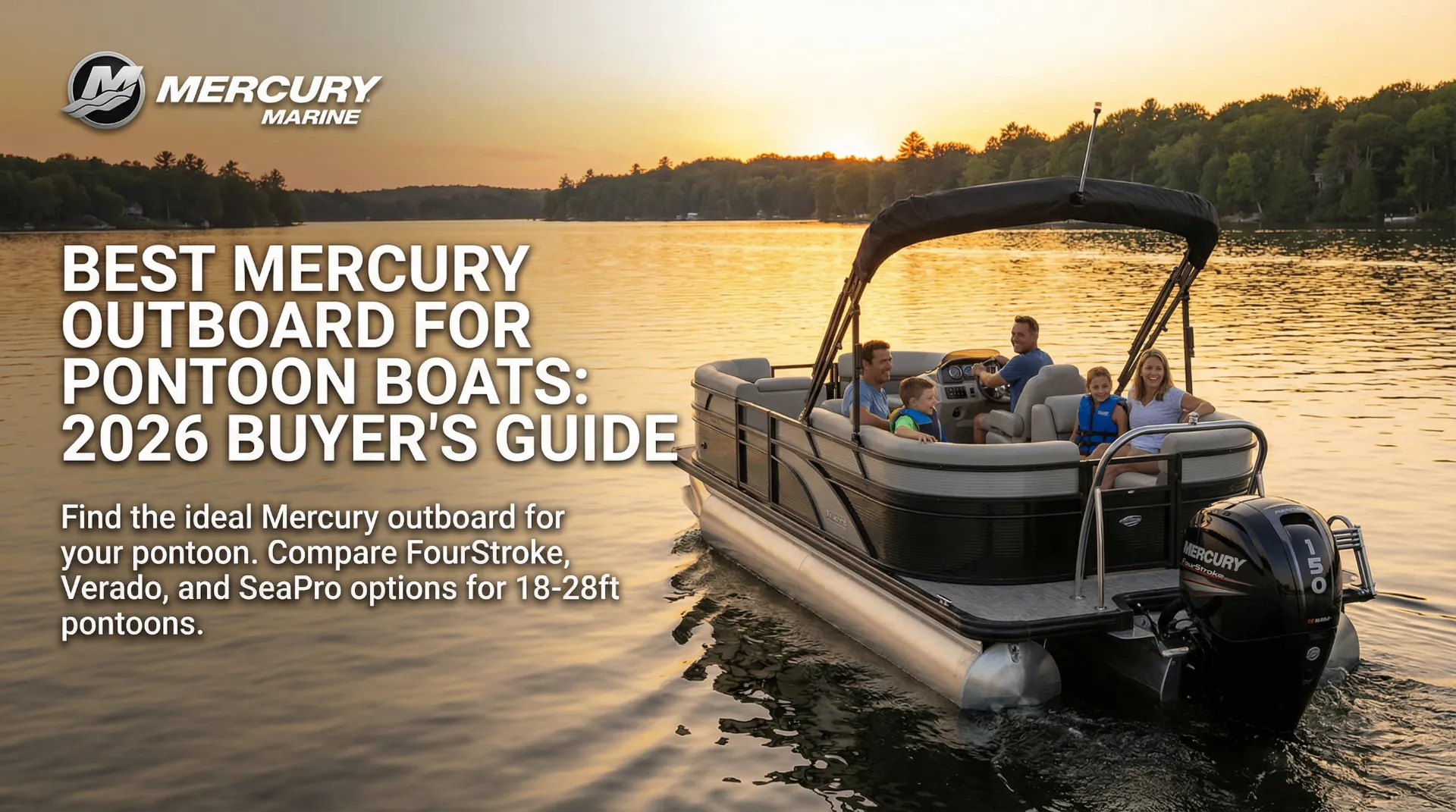
--- > Quick answer: Mercury Command Thrust uses a larger gearcase and larger prop than the standard FourStroke at the same horsepower. On a loaded pontoon, that translates to faster lift to cruise, better mid-range torque, and less working the throttle. The premium is small...
Quick answer: Mercury Command Thrust uses a larger gearcase and larger prop than the standard FourStroke at the same horsepower. On a loaded pontoon, that translates to faster lift to cruise, better mid-range torque, and less working the throttle. The premium is small relative to the gain. See real pricing at mercuryrepower.ca.
What Command Thrust actually is, and what it isn't
Command Thrust is a gearcase option, not a separate motor family. The powerhead is the same Mercury FourStroke. What changes is everything below the water: a larger gearcase nose, a larger prop, and torque-tuned gear ratios designed for heavy boats.
It is available on select Mercury models, including common pontoon-friendly HP classes. When customers ask us "should I get Command Thrust?", the first question is always: what hull are you running? Because Command Thrust is purpose-built for pontoons and other heavy displacement hulls, and it's the wrong call on small, light boats.
What changes in a Command Thrust gearcase
Larger gearcase nose. More volume displaced under load. Less cavitation on heavy hulls.
Larger prop diameter. The bigger gearcase fits a bigger prop, which moves more water per revolution. More water moved = more thrust at low RPM.
Torque-tuned gear ratio. Command Thrust trades some top-end speed for more hole-shot and pulling power. On a pontoon, this is exactly the trade you want. On a bass boat, it's the wrong trade.
Heavier-duty internal components. Built for sustained heavy-load running.
It is not a motor swap. It is a gearcase swap on the same powerhead.
Why Command Thrust matters specifically on pontoons
Pontoons are different from runabouts. They are:
- Blunt-fronted, the tube noses push water instead of slicing it
- Heavy, aluminum tubes, fibreglass decking, full hardware
- Wide, significantly more drag than a similar-length runabout
- Slow to come up on cruise, the hull geometry resists the transition from displacement to cruise
Standard gearcases are built around runabout physics. Command Thrust matches pontoon physics. The result on a pontoon: faster lift to cruise, stronger hole shot when loaded, more comfortable cruising at lower RPM, better load-handling for water sports. None of this comes from extra horsepower. It comes from the gearcase.
Customers switch from standard-gearcase pontoon setups to Command Thrust and notice the difference immediately, especially with a full load aboard.
When to spec Command Thrust, and when not to
Clear yes:
- 18–24 ft pontoons (most pontoon repowers we do at HBW)
- Tritoons and party pontoons
- Heavy fishing rigs with full gear, dual livewells, heavy electronics
- Heavy commercial workboats, charters, and water taxis (Mercury SeaPro CT territory)
- Any boat used for water sports where hole shot matters
Clear no:
- Small aluminum tin boats (12–16 ft), too light; the gearcase advantage is wasted and you give up top speed
- Tournament bass boats and any planing V-hull, CT is a pontoon and workboat gearcase and on a V-hull it just adds drag
- Light recreational runabouts under 18 ft, standard gearcase is plenty
Assess case by case:
- 17–19 ft aluminum console fishing boats, standard gearcase (CT is a pontoon and workboat gearcase and is not recommended on a V-hull, even loaded)
- 20 ft fibreglass runabouts, depends on use case
We make this call per boat at HBW. The right answer depends on the specific hull and how you use it.
Command Thrust prop selection
A Command Thrust gearcase requires Command Thrust props. The larger diameter, different geometry, and different hub design mean standard props won't fit or perform correctly.
You can build a live CAD quote for your repower online at Mercury Repower Centre.
Command Thrust props typically:
- Run larger diameter than standard (specific size depends on motor HP)
- Use a lower pitch range, optimized for hole shot and load handling rather than top speed
- Use 4-blade designs more often, better hole shot and smoother trolling
- Come in aluminum or stainless depending on HP class and use
For pontoons, 4-blade aluminum is a common Command Thrust starting point. Final prop selection depends on the hull, load, motor, and safe seasonal testing conditions.
Common Command Thrust mistakes
1. Skipping Command Thrust to save money on a pontoon. The single most common pontoon repower mistake. Customer picks the cheaper standard gearcase, trades up to Command Thrust within two or three seasons. The savings disappear. Pay once.
2. Using a standard prop on a Command Thrust gearcase. Some customers try to save money on the prop. The performance loss eats the savings fast, and standard props may not even fit correctly.
3. Speccing Command Thrust on a small light fishing boat. A 14-foot tin boat with a 90 HP Command Thrust gives up top speed in exchange for nothing. Standard gearcase is right on small, light boats.
4. Pairing Command Thrust with an undersized motor. Command Thrust doesn't fix underpowering. A 90 HP Command Thrust on a 22-foot pontoon used for water sports is still underpowered. Right HP first, then add Command Thrust.
5. Forgetting to budget for a new prop when upgrading. When converting from a standard gearcase to Command Thrust, the existing prop won't fit. A new Command Thrust prop is required.
Can you retrofit Command Thrust to an existing motor?
Technically yes, practically rarely worth it. The gearcase, driveshaft, water pump, and prop are all different parts. By the time you add it all up, you're usually within striking distance of a trade-in toward a new Command Thrust motor.
For the full retrofit decision framework, including which scenarios make sense and which don't, see our dedicated eligibility post: Is Your Pontoon Eligible for Mercury Command Thrust? (2026).
We quote both paths (retrofit vs new motor) at HBW. Call 905-342-2153 if you want to compare.
Ready to repower with Command Thrust?
Build a quote at mercuryrepower.ca. Or call 905-342-2153, we rig Command Thrust setups every week and can give you the honest answer for your hull.
Sources