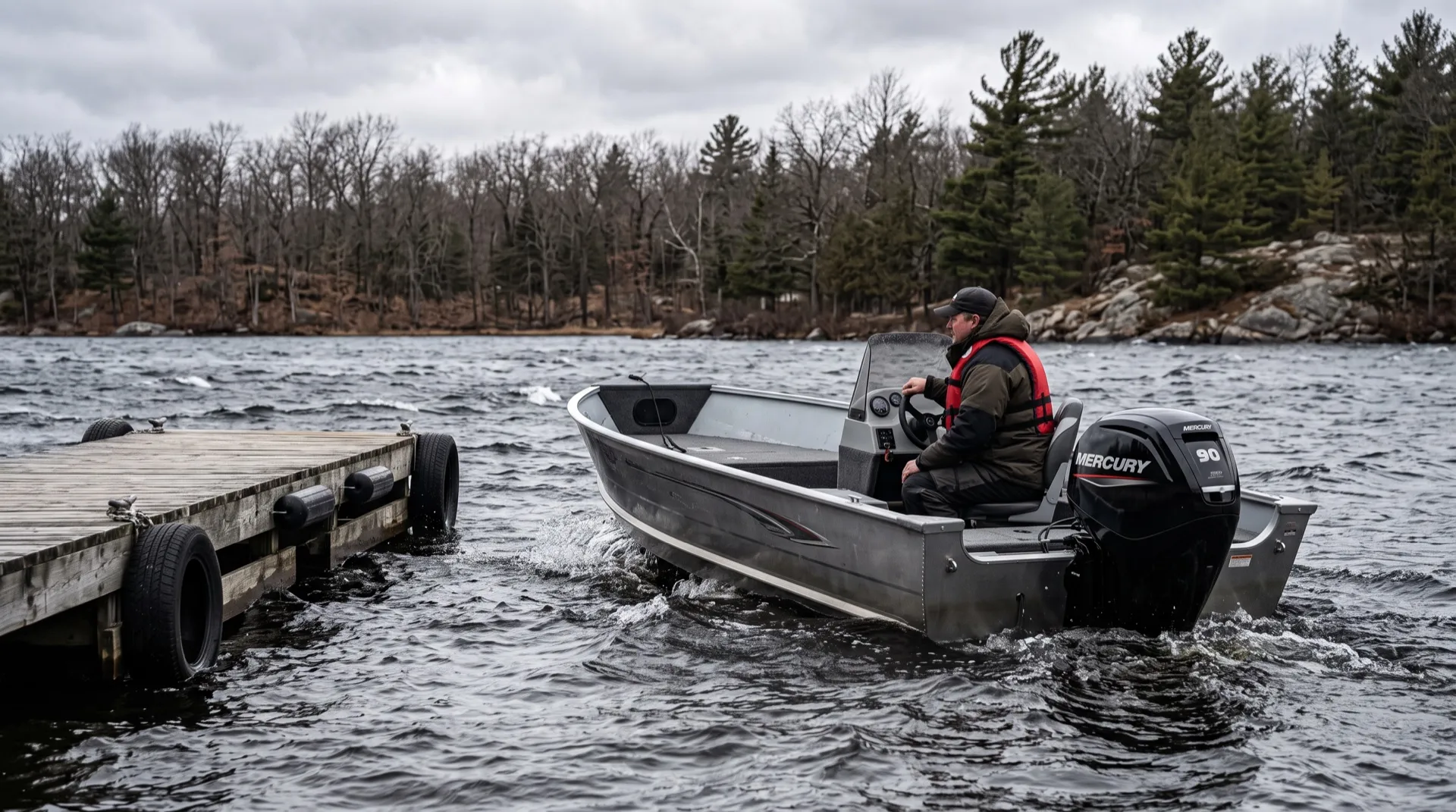
--- You know the feeling. You're coming back into Bewdley on a Tuesday afternoon, the southwest wind has built to 15 knots the way it always does by 3 o'clock on Rice Lake, and there are three people watching from the dock. One of them is drinking a beer. Your heart rate goes...
Quick answer: Docking a single-outboard boat in wind on Rice Lake is technique, not muscle. Approach into the wind at slow controlled speed, use short bursts of forward and reverse to steer, never fight the wind with throttle, and let momentum carry you the last few feet. Tie the bow first if wind is pushing you off the dock; tie the stern first if wind is pushing you onto it. Practise in calm conditions before you need it.
You know the feeling. You're coming back into Bewdley on a Tuesday afternoon, the southwest wind has built to 15 knots the way it always does by 3 o'clock on Rice Lake, and there are three people watching from the dock. One of them is drinking a beer.
Your heart rate goes up. You add a little throttle. Then a little more. The bow blows sideways, you jab reverse, and now you're doing a slow-motion pivot in full view of your audience.
Every boater has been here. The good news: it's almost never as hard as it feels, and a few technique adjustments take most of the drama out permanently.
Why Wind Feels Worse Than It Is
Boats are big, light, high-surface objects. Wind has an outsized effect on them.
More specifically: your bow is lighter and higher than your stern. On most single-outboard boats, the engine weight keeps the stern somewhat planted. The bow is a big empty fiberglass scoop up in the air, wind grabs it like a sail and pushes it downwind, fast.
On a pontoon, this effect is amplified. Pontoon boats have enormous lateral surface area, the tubes, decking, furniture, all of it acts like a billboard in crosswind. A 24-foot pontoon can drift sideways at a surprising rate in a modest 10-knot breeze. The boat doesn't feel like it's moving until suddenly it is.
Understanding this physics is step one. The wind isn't attacking you, it's just doing what wind does. Your job is to use it, not fight it.
Read the Conditions Before You Commit
Before you point the bow at the dock, spend 60 seconds doing recon.
Watch boats already docked, if they're leaning hard to one side, that tells you exactly what the wind is doing. Check nearby flags. Note whether the wind is pushing you onto the dock or away from it. Each scenario needs a different approach.
A southwest wind commonly builds on Rice Lake on summer afternoons, which is predictable enough to plan around before you even leave in the morning. The Rice Lake boating guide covers typical wind patterns by area of the lake.
The Golden Rule: Approach Into the Wind Whenever Possible
If you take one thing from this post, make it this: approach into the wind.
Driving into the wind slows you down and gives you more time to assess and correct. More importantly, if your approach is wrong, you can simply pull back, let the wind push you clear, and circle for another attempt. Clean getaway.
Approach downwind and the wind is adding speed while you're trying to bleed it off. Less time, less margin, harder abort. Sometimes you have no choice, but into the wind is always the preferred direction when you have options.
Wind-docking sequence
Coming in on a windy Rice Lake afternoon? Run the list before you commit
Rice Lake's prevailing west wind builds steady chop by mid-afternoon. The wrong approach turns a routine dock into a fender-grinding mess. Work the five steps in order before final approach.
Assess wind direction relative to the slip
?Is the wind pushing you onto the dock, off the dock, or square at the slip mouth?
💡Cross-onto wind is the easiest, you can let the boat drift in. Cross-off wind is hardest and requires power-on holding. Decide before you commit to a line.
Set fenders and lines before final approach
?Are bow, stern, and spring lines pre-rigged on the windward side?
💡A crew member fumbling for a line in 20 km/h wind is how dings happen. Tie the lines on the cleats, coil them in the cockpit, and place fenders at the right height before you turn into the wind.
Approach into the wind whenever possible
?Can you turn the boat so the bow points into the wind on final?
💡Wind into the bow lets you control speed with throttle alone. Wind from behind takes away your brakes. If approaching with the wind is unavoidable, plan a slower, longer approach.
Use the wind to lay the boat down
?Can you cut power early and let the wind drift you the last few feet onto fenders?
💡On a cross-onto wind, kill power 8 to 10 feet out and let the wind do the work. Idle in is harder to control than a gentle drift.
Know when to abort
?If the approach is going wrong, will you re-circle or push through?
💡A clean re-circle costs 90 seconds. A bad dock costs a fender, a rub rail, or worse. The right call is almost always to back off, go around, and try again with a fresh setup.
🔧Want better control on windy days?
Power-assist steering and a bow thruster make a real difference on bigger boats.
Slip-Style Docking in a Crosswind
Come in at an angle, 20-30 degrees off the slip centerline, from the upwind side. This puts the wind at your back quarter rather than broadside.
Use the wind to do the last 2-3 feet. As you get close, reduce throttle and let the wind nudge the bow across into alignment. You're not fighting the breeze, you're using it as an invisible hand to guide you in. This sounds counterintuitive until you try it once.
Never add throttle to fight wind at close range. Seeing the boat go sideways and adding power is how you arrive at the dock too fast. Slow down, use neutral, and let the physics help. Short bursts in gear are better than sustained throttle when you need to hold position.
Side-Tie Docking in a Crosswind
Wind onto the dock (onshore): Approach at 30-45 degrees, aim upstream of where you want to land, cut throttle earlier than feels right, and drift in. Get a bow line to the dock first, then use it as a pivot to walk the stern alongside. Easier than it looks once you trust it.
Wind off the dock (offshore): Trickier. Approach steeper, closer to 45 degrees, maintain a little more speed than feels comfortable, and get a spring line on the dock mid-ship as fast as possible. A spring line running forward to a cleat gives you control that throttle cannot replicate. The late season safety guide covers line handling in rougher conditions.
Regardless of scenario: at 4-5 feet out, a short burst of reverse kills forward momentum and straightens the boat. Then get a line on before you drift.
Pontoon-Specific Advice
The standard "slow and steady" advice can work against you on a pontoon.
Pontoons need more throttle into the wind than people expect. All that windage (furniture, bimini, full-length deck) kills momentum fast. If you're going too slowly, you lose steerage before you get where you need to be and the bow starts washing sideways.
The fix: carry a bit more speed, maintain steerage until you're closer, then cut to neutral and use a short reverse burst just before the dock. The same wind drag that fought you at speed now helps you stop.
A Mercury Command Thrust gearcase can help here on the models that offer it. It is built to turn a larger prop, which helps heavy boats at lower speeds, though wind and technique still matter most. If you're babysitting throttle inputs on every docking, this is worth a look.
The 3 Things to Do Before You Dock
Do these before you're close enough to the dock that timing matters.
1. Fenders out, both sides. You don't always know which side you'll land on. Both sides, every time, stop second-guessing it at 20 feet out.
2. Lines pre-tied with loops. Dock lines should be cleated on the boat end with a loop ready on the dock end. Your crew should be able to drop them over a piling one-handed. If someone is untying a knot while you're trying to dock in 15 knots, that's a problem.
3. Crew briefed. One person drives. Everyone else has a defined job. Who has the bow line? Who has the stern? Who has the spring? Brief it before you're within sight of the dock. Improvised crew coordination at close range in wind is where people get hurt and boats get dinged.
The Wind Speed Cheat Sheet
5 knots: Barely a factor. Slight bow drift. Good day to practice.
10 knots: Noticeable. Pontoons need active steerage. Technique matters but all skill levels can manage it.
15 knots: This separates confident from stressed. Approach angle is critical. Abort threshold comes up sooner.
20+ knots: Think carefully. If you have a protected slip, this may be a "leave it and walk" day. If you're coming in, use the most sheltered approach available and slow down before you think you need to. If you're genuinely uncertain, stay out until it lays down.
When to Abort
If your approach is off by more than 4 feet at 8 feet out, abort.
The geometry isn't fixing itself. Throttling through a bad approach is how damage happens. Back out, circle wide, and come in again, 90 seconds. Nobody watching cares nearly as much as you think they do.
The most experienced boaters on Rice Lake abort regularly. It's a tool, not a failure.
Common Mistakes
Panic gas. When the boat goes sideways, instinct says add power. Usually the right move is less, not more.
Fending off with hands. A moving boat against a fixed dock generates forces that fingers can't absorb. Fenders exist for this reason. Use them.
Fighting wind in reverse. Reverse steering is already counterintuitive. Add a strong crosswind and it gets much worse. Exit and re-approach from a better angle.
No spring line. One mid-ship line running forward to a dock cleat gives you more control than everything else combined. Practice using it.
Fenders on the wrong side. Or no fenders at all. Both sides, always.
Solo docking in heavy wind without practice. Build the skill in calm conditions first. Heavy wind is not the time to learn how your boat behaves single-handed.
Practice Plan
You won't get good at windy docking by reading about it. You'll get good by doing it when the stakes are low.
Pick a calm morning on Rice Lake, before the afternoon southwest wind builds. Find an empty section of dock or a quiet anchorage and run deliberate approaches.
Start in 5 knots. Practice approach angles, aborting on purpose, and using lines. Then 10 knots, notice how your decision timing shifts. Then 15. By the time you've practiced in 15 knots with nothing at stake, docking at Harwood with people watching feels like exactly what it is: just parking the boat.
Thirty minutes of intentional practice on a Tuesday morning is worth more than thirty dockings where you just hoped for the best.
When Upgraded Controls Help
Technique is the foundation. But some equipment makes a real difference.
Digital throttle and shift (DTS): Removes cable lag from throttle input. What you feel in your hand is what the engine does, immediately. The precision at slow speed is meaningfully better than a cable system, and slow-speed precision is exactly what matters near a dock. The VesselView / SmartCraft guide covers real-time engine data that DTS systems surface.
Mercury Command Thrust gearcase: Purpose-built for pontoons. More low-end thrust from a larger prop, offered on select models. It can help with low-speed control on heavy boats, but docking in wind is still mostly technique and windage.
Mercury Joystick Piloting (eligible packages): Point the joystick where you want the boat to go. Conventional outboard packages use multiple DTS-equipped engines. Mercury also offers Joystick Piloting for Single-Engine Outboards with Thruster for an electric-steering Verado or SeaPro V8, V10, or V12 from 250 to 600 HP paired with a compatible CAN-based variable-speed thruster. Most single-engine rigs do not qualify, so the exact engine, steering, controls, and thruster package must be confirmed.
Most Rice Lake boaters are running a single outboard on a pontoon, bowrider, or fishing boat. For that setup, good technique handles most docking situations.
Thinking about a digital throttle upgrade or a Command Thrust gearcase? Build a quote at mercuryrepower.ca, or request service at hbwservice.ca.
No pressure. But if you want to stop having that heart-rate moment every time you come back into Bewdley or Gores Landing with a southwest breeze on your beam, it's worth knowing your options.
Harris Boat Works. Est. 1947. Gores Landing, ON. Mercury Premier Dealer
Related guide: Boat trim explained for Rice Lake boaters.