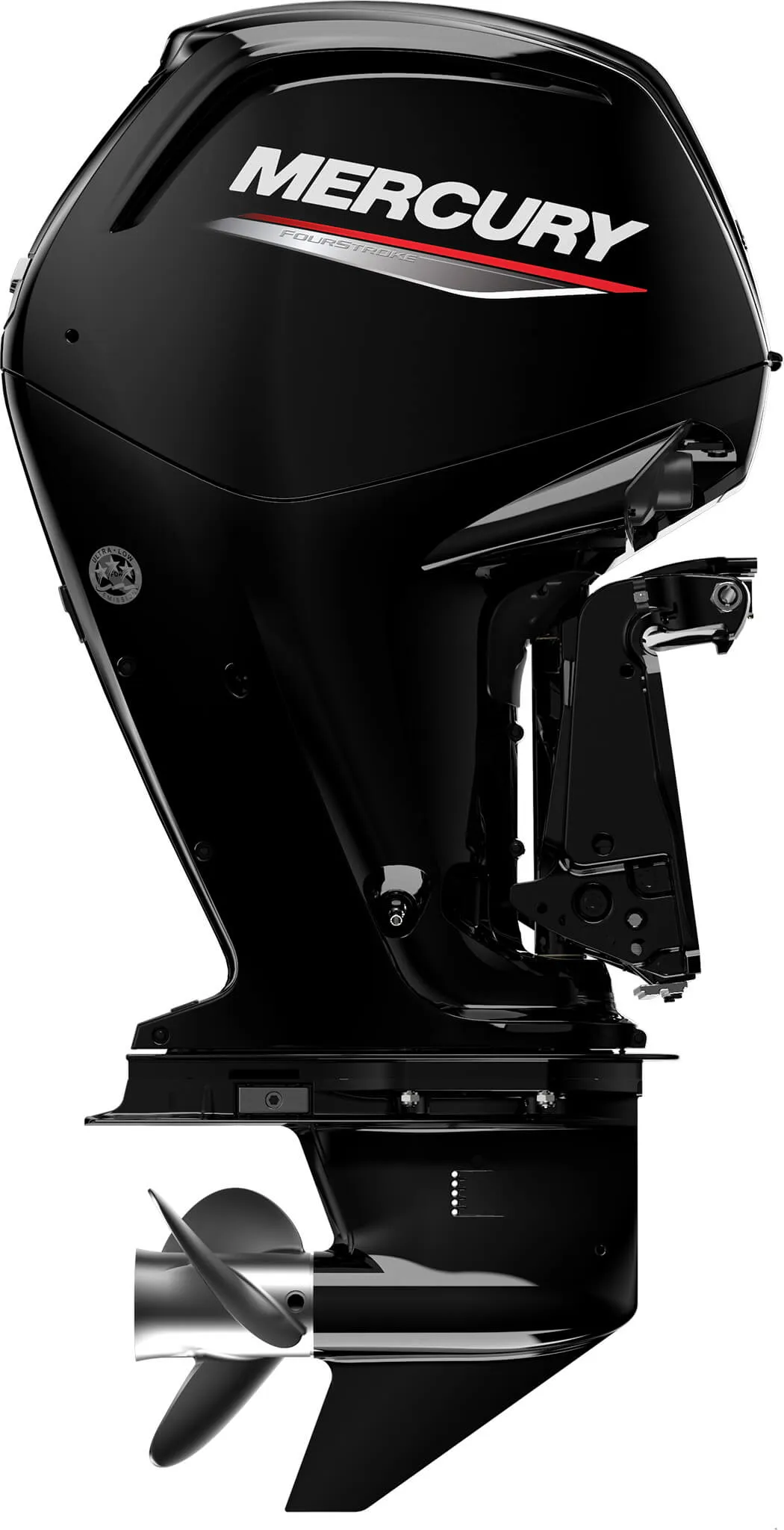
Quick Answer The Mercury 75 HP FourStroke is the same physical motor as the 90, same 2.1L inline-4 block, same 163 kg (359 lb) weight, with a lower RPM ceiling and a smaller price difference than most people expect. Harris Boat Works doesn't stock the 75 because the 90 is...
Quick Answer
The Mercury 75 HP FourStroke is the same physical motor as the 90, same 2.1L inline-4 block, same 163 kg (359 lb) weight, with a lower RPM ceiling and a smaller price difference than most people expect. Harris Boat Works doesn't stock the 75 because the 90 is often the stronger comparison when the hull and load suit it and the capacity plate allows 115 HP. We'll order the 75 for a 90 HP plate. Cost aside, one Mercury model below the maximum is the best fit.
Why HBW doesn't stock 75
75 HP or 90 HP? The honest answer
We will order 75 HP, but here is why almost every buyer ends up with the 90.
Choose 90 HP if
- ✓Your capacity plate allows 115 HP; the 90 is one Mercury model below the maximum
- ✓You want stronger hole shot and a bit more top end
- ✓The price difference vs 75 HP is typically under $1,500 in 2026
- ✓Resale value holds better (more buyer demand for 90 HP)
- ✓You want flexibility to add a kicker without underpowering the main
Pick 90 HP FourStroke
Choose 75 HP if
- ✓Your capacity plate allows 90 HP; the 75 is one Mercury model below the maximum
- ✓The budget gap matters more than 15 HP of headroom
- ✓You are not towing or carrying full passenger loads
Pick 75 HP FourStroke
When in doubt:We do not stock 75 HP because, when the hull and load suit it and the capacity plate allows 115 HP, the price and weight gap is small and the 90 has more headroom. If you want 75, we will order it. If your plate allows 90, choose the 75. A 115 HP plate makes the 90 the best fit.
Mercury 75 HP FourStroke: Why We Don't Stock It
We get asked about the Mercury 75 HP FourStroke regularly. Usually the question sounds like: "Is the 75 good enough, or should I go to the 90?" Here's our honest answer: the 90 is the better call on a hull plated for 115 HP; on a 90 HP plate, the 75 is the best fit, and the reason we don't stock the 75 is that it's the same motor.
We're a Mercury Marine Premier dealer that sells, rigs, water-tests, and services these motors on Rice Lake. This isn't us trying to upsell you, it's us explaining a legitimate engineering reality.
What the Mercury 75 HP Actually Is
The Mercury 75 HP FourStroke is part of the same family as the 90 and 115. All three motors run on the same 2.1L inline-4 block with an 8-valve single overhead cam, maintenance-free valve train, and the same alternator, dimensions, and factory testing.
Compare fit and complete cost. Use the 75, 90 and 115 HP comparison with your boat's capacity plate and loaded use. Check current motor pricing; confirm the exact configuration and availability with HBW.
| Specification |
Mercury 75 ELPT |
Mercury 90 ELPT |
| Block |
2.1L inline-4 |
2.1L inline-4 |
| Valve train |
8-valve SOHC, maintenance-free |
8-valve SOHC, maintenance-free |
| Dry weight |
163 kg (359 lb) |
163 kg (359 lb) |
| Full-throttle RPM |
4,500–5,500 |
5,000–6,000 |
| Alternator |
35 amp / 441 watt |
35 amp / 441 watt |
| Fuel system |
EFI |
EFI |
| SmartCraft compatible |
Yes |
Yes |
| Warranty |
3-year standard |
3-year standard |
The difference between the 75 and 90 is software, prop tuning, and RPM ceiling. That's it. The 75 is tuned to peak at 4,500-5,500 RPM. The 90 runs to 5,000-6,000. No weight change. A very small price difference.
The 90 also holds better resale value and has more demand on the used market. If you're ever selling the boat, the 90 is a much easier conversation than the 75.
Why HBW Doesn't Stock the Mercury 75
Three reasons:
- It's the same motor as the 90. Same block, same weight, same maintenance requirements.
- The price difference is minimal. We don't publish exact figures because Mercury pricing and dealer pricing vary, but it's not enough to justify the headroom you give up.
- The 90 holds resale value better. The 75 sits in a gap between motors people actually want: the 60 below it and the 90 above it.
When the hull and load suit it and the capacity plate allows 115 HP, the 75 is usually the weaker comparison: same physical motor, lower RPM ceiling, and a smaller price difference than most people expect.
When the 75 Might Actually Make Sense
There are three real scenarios where the 75 is the right call:
The capacity plate sets the fit. A 90 HP capacity plate makes the 75 our best-fit size; some smaller hulls are plated for only 60 or 75 HP. That plate is the ceiling, not a suggestion, not a starting point for negotiation. If the plate says 75, the best fit is a 60, one Mercury model below the maximum. We'll order it and we won't try to talk you into something illegal.
An insurance or licensing constraint applies. Rare in Ontario, but some commercial or shared-use applications have HP caps that land on 75.
A used 75 with low hours is priced low enough to matter. If a used 75 with 200 hours is available for significantly less than a new 90, the math might work out. We can help you assess the used motor honestly and tell you if it's worth it.
What We'd Put on Your Boat Instead
| Boat Type |
Our Recommendation |
| Aluminum fishing boat plated above 90 HP, typically 17-18 ft |
90 ELPT FourStroke, standard gearcase, on a 115 HP plate. On smaller 14-16 ft hulls, pick one Mercury model below the plate maximum: 50 on a 60 HP plate, 60 on a 75 HP plate, or 75 on a 90 HP plate. |
| Small pontoon under 20 ft |
90 ELPT Command Thrust, CT gearcase makes a meaningful difference on flat-bottom hulls. A 75 standard would technically work but run harder than ideal. |
| Lighter cottage runabout |
90 ELPT FourStroke, same logic as fishing boat. |
| Repowering an old 60-75 HP two-stroke |
90 ELPT FourStroke, lighter, quieter, cleaner, more efficient. Holds resale better than the 75 over the life of the motor. |
If your hull is rated for 60 HP maximum, you're in the Mercury 60 ELPT FourStroke conversation, not this one. The 60 runs on a smaller 1.0L block, an entirely different motor.
If your hull is rated for 90 HP or higher, skip directly to the 90 review or go build a quote.
For current Mercury dealer pricing, see the Mercury pricing reference.
Build a Quote, on the 90
If you came here looking at the 75 and this confirmed what you suspected, go build a quote on the 90 at mercuryrepower.ca. Real CAD prices, real configurations.
Harris Boat Works, 5369 Harris Boat Works Rd, Gores Landing, ON K0K 2E0.