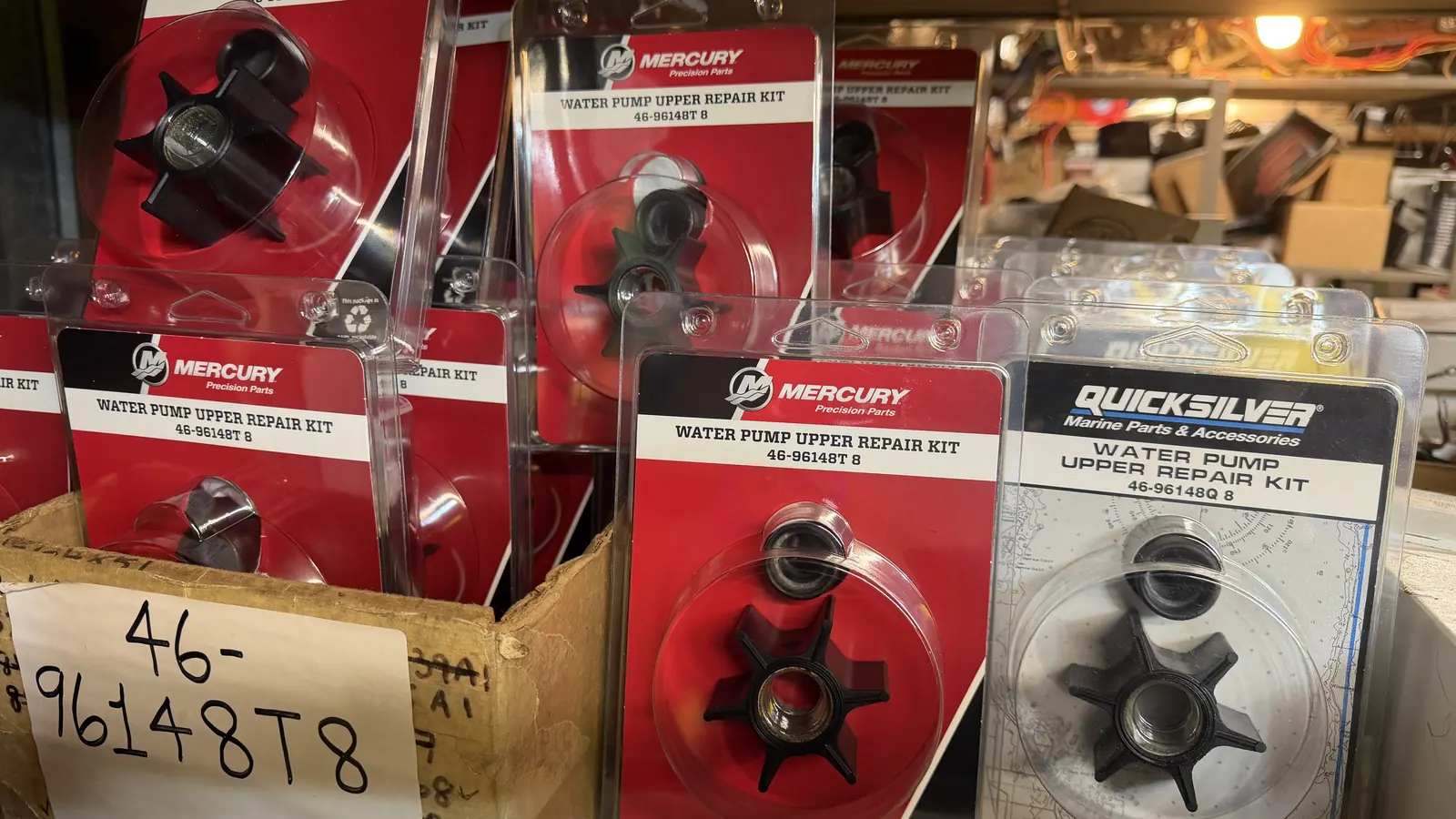
When an outboard or sterndrive comes to us with an overheat alarm, a weak telltale stream (the small stream of water that shows the pump is working) or a "running hot" complaint, the water pump was the cause in a little over half the jobs with a recorded cause (54%).
When an outboard or sterndrive comes to us with an overheat alarm, a weak telltale stream (the small stream of water that shows the pump is working) or a "running hot" complaint, the water pump was the cause in a little over half the jobs with a recorded cause (54%). In about one job in five the cooling water path was simply blocked, usually a telltale hose that a short blow-out cleared. Thermostats and poppet valves, the usual suspects, were only 3%.
Quick answer
- The water pump is the leading cause. 79 of the 145 jobs with a recorded cause (54%) ended with a new impeller, new gaskets or a corrected pump assembly.
- A blocked water path is next (19%). Mostly telltale hoses plugged with mud, stone or wasp nests, plus a few strainers, water tubes and thermostats choked with sand and weeds. A debris-choked thermostat counts here.
- About one in five was not a cooling fault. 11% were a bad sender, gauge, wiring or a different alarm, and 9% were no fault found, often an overheat logged earlier that never repeated.
- Typical labour was a median of $210 for a pump job and $135 for a blocked-path job, before parts and HST.
- It is a summer problem. 133 of the 151 jobs fell between May and September, and July alone had 46.
What we did
We read the technician notes on every repair job in HBW's service records from April 2023 to October 26, 2026 that might involve cooling. A text match on the write-ups (overheat, thermostat, poppet, temperature, water pump, impeller) found 489 job lines on 444 repair orders. A second pass on job names and customer descriptions added 40 more, mostly "blew out the telltale."
Then we sorted the 529 lines by what the customer actually brought in. We kept the ones where the complaint was an overheat, a temperature alarm, no or weak telltale stream ("pee stream"), or running hot: 155 job lines on 150 repair orders. Four of those lines were continuations of jobs split across two rows, so the table below counts 151 jobs. Six of those had no recorded cause, leaving 145.
What we left out: about 200 lines where an impeller or water pump was replaced as scheduled maintenance or alongside other work with no cooling complaint (context, not findings), lines where overheat damage turned up while fixing something else, and gauge-only complaints.
This covers every brand that came through the shop, outboards and sterndrives. Counts are job lines, not boats, and a text match is not a diagnosis. Where a technician fixed several things we counted the main fault, and about 20 lines were judgment calls of that kind.
What the overheating actually turned out to be
| What fixed it |
Share of the 145 jobs with a recorded cause |
| Water pump: worn, burnt or cracked impeller, torn or wrong gaskets, pump put together wrong |
54% |
| Blocked water path: plugged telltale hose, strainer, water tube or a thermostat choked with debris; weeds |
19% |
| Not a cooling fault: bad sender, gauge or wiring, a different alarm, or a fuel or ignition fault that tripped it |
11% |
| No fault found or could not be reproduced |
9% |
| Thermostat or poppet valve (the part itself failed or was serviced) |
3% |
| Engine already damaged (blown head gasket, failed cylinder) |
1% |
| Other (drive belt and pulley, water hose) |
1% |
The rounded figures add to 98, not 100.
The pump failure is rarely just "old rubber." In the 79 pump jobs, technicians wrote down burnt, cracked or broken impeller fins again and again. At least five had the pump put together wrong: a gasket doubled up or upside down, a missing cup, the wrong brand of impeller, or an impeller installed badly (a couple of write-ups noted fins turned backwards).
A new impeller is not always the answer. In about ten jobs an impeller had already been fitted and the symptom was still there. At least five of those ended up being a plugged passage or an assembly mistake, not a worn pump.
Most blocked-path jobs were solved by clearing the blockage. Of the 28, roughly two-thirds were a telltale hose or line plugged with mud, a stone or a mud wasp nest. Most of the rest were a strainer, water tube or thermostat full of sand and weeds, and a few were weeds around the gearcase with nothing to repair.
Check the "not a cooling fault" group. Most of its 16 jobs were a bad temperature sender, gauge or wiring, or a different alarm (low oil, gear oil monitor). The rest were engine problems that set off the alarm, such as fuel trouble.
Season matters. By month: April 6, May 13, June 30, July 46, August 27, September 17, October 8, November 4. That is 68% in June to August.
Motor age. 87 of the 145 jobs with a cause were newer EFI or four-stroke outboards, and the pump led there too (56%). The other 58 were too few in each group to compare fairly, so we are not reporting a split: older carbureted or two-stroke motors (24), sterndrives (20), and 14 where the records do not say what the motor was.
What it cost
Median labour, before parts and HST, for paid lines (warranty and no-charge lines excluded). A median, not a quote.
| Category |
Paid job lines |
Median labour |
| Water pump |
77 |
$210 |
| Blocked water path |
25 |
$135 |
The other categories had fewer than 15 paid lines each, which is too thin to quote. None of the 151 jobs was flagged as warranty, and 16 had no labour charge, which is why the table counts 77 paid pump jobs out of 79 and 25 paid blocked-path jobs out of 28. Some lines include other work done on the same job, and the amounts span three and a half years, so treat them as a rough scale. We did not total parts here. Our water pump cost guide covers that side.
What this means for you
- Check the telltale stream every time you launch. A steady stream is your first free test. If it is weak, intermittent or gone, stop and sort it out before you load the engine. A plugged hose is the cheap outcome; a dry-run impeller is the expensive one.
- Follow the 300-hour or three-year interval. Mercury's water-pump interval is 300 hours or three years, whichever comes first. Calendar years count even when the hour meter does not.
- Treat the first alarm as real. Several write-ups say the engine had been overheated more than once and blame weeds. Back off and shut it down. Restart only if you found and cleared an obvious blockage (weeds on the gearcase), let the engine cool, and see a strong telltale stream and normal temperature at idle. If you did not find a clear cause, or it alarms again, shut it down and bring it in.
- Never run it without water. Many built-in flush ports are for engine-off flushing only, so check your manual first. On muffs with water flowing, keep the engine at idle and never rev it. In one job the technician wondered whether running on a flush adapter was how an engine reached 213 degrees Fahrenheit.
- Do not trust a new impeller alone. If the alarm or weak stream returns after a pump job, ask about the base gasket, the water tube, the strainer, the thermostat and the sender.
- One overheat can do real damage. Several sterndrive jobs involved burnt exhaust hoses or water in the cylinders after an overheat. See our overheating emergency guide for the safe first response.
- Report an alarm that comes and goes. The Mercury diagnostic computer keeps an overheat history, which helped in jobs where the alarm never repeated on the test run. If it only beeps at 4,000 RPM, say so.
When to bring it in
Bring it in after any overheat alarm where you did not find and clear an obvious cause yourself, or if it sounds a second time, the telltale stream stays weak after you clear the hose, the engine drops into limp mode with no obvious cause, or the impeller is past 300 hours or three years. Do not wait for the next long run, because one overheat can cook exhaust hoses and the engine.
To book, use our service request form at hbwservice.ca: Complete Service Request, drop off, done.
Sources
- HBW service records review, October 2026: technician notes on 151 jobs from 150 repair orders (155 job lines before four split lines were merged), April 2023 to October 2026, classified by the main fault fixed (no customer data used)
About the author
Jay Harris runs Harris Boat Works in Gores Landing, Ontario, a third-generation family marina on Rice Lake, Ontario since 1947 and a Mercury dealer since 1965.