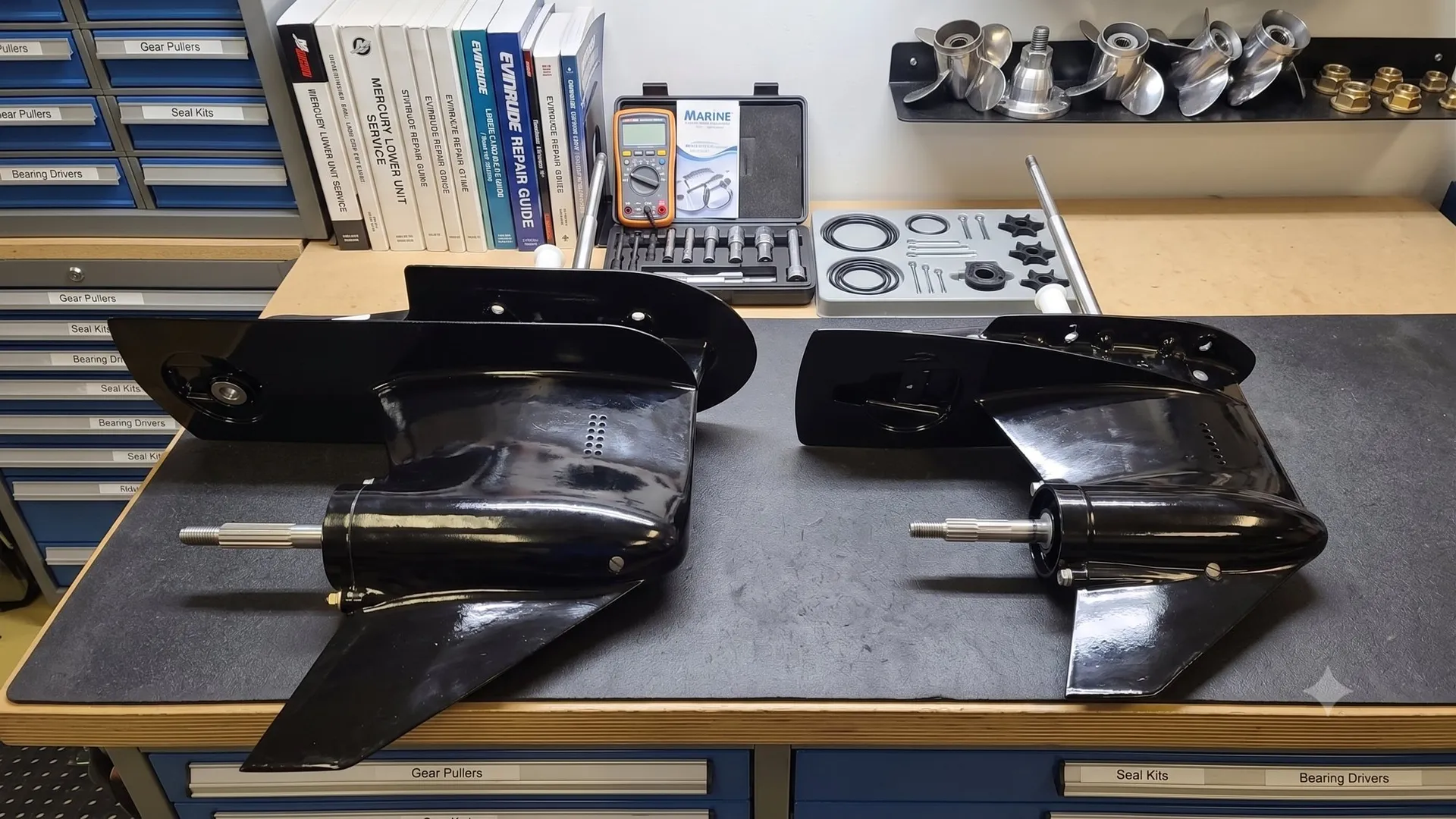
Most of the water we found in gear lube got in through seals you can't see from outside the lower unit: the shift shaft seal and the seals under the water pump.
Most of the water we found in gear lube got in through seals you can't see from outside the lower unit: the shift shaft seal and the seals under the water pump. Seals of one kind or another were the cause in 56% of the jobs where we found one, and one job in five had no leak at all.
Quick answer
- Of 154 gearcase jobs with a recorded cause, 42% were internal seals (shift shaft, water pump base and similar). Prop shaft seals were 14%, and drain or vent screw gaskets were 16%.
- 22% passed the pressure test with no leak found. Six of those traced the apparent leak to exhaust oil, engine oil, storage oil or antifreeze dripping from elsewhere.
- Only 22 of the 178 job notes (12%) were caught at winterization. 142 (80%) came in as a complaint, and the other 14 were routine visits such as spring startups.
- Typical labour was about $280 for an internal seal job, about $205 for a gasket fix and about $200 for a clean test (a median, not a quote).
- On sterndrives, 63% of causes were internal seals, against 37% on newer outboards.
What we did
We read the technician notes on every job from April 2023 to October 2026 that mentioned water in the gear lube, milky or cloudy oil, a pressure or vacuum test, a prop shaft, driveshaft or shift shaft seal, fishing line, or a gearcase or lower unit leak. That is 588 job lines on 515 repair orders. It covers every brand we service, not just Mercury.
We then kept only notes where the technician found or fixed water intrusion, milky oil, a failed or passed leak test on a complaint, or a gearcase leak. Routine gear lube changes with no contamination noted were set aside, along with impeller jobs that included a routine pressure test, impact damage with no leak, and water in the fuel. That left 178 job notes (187 job lines on 168 repair orders, because the same note is sometimes copied across several lines of one order).
Two limits matter. These are counts of job notes, not boats, and one boat can appear more than once. And a text match is not a diagnosis: we recorded what the technician wrote they found, assigned one main cause, and used judgment where a note named two. Twenty-four notes recorded water or a leak but no cause, so they are left out of the percentages.
What the water in the gear lube actually turned out to be
| Main cause found |
Share of the 154 jobs with a recorded cause |
Note |
| Internal seals: shift shaft, water pump base, bearing carrier o-ring, sterndrive input seals |
42% |
The biggest group by a wide margin. |
| Passed the pressure test, no leak found |
22% |
Oil was often coming from somewhere else. |
| Drain, fill or vent screw gaskets and threads |
16% |
Missing, doubled-up, wrong type or damaged. |
| Prop shaft seals |
14% |
Three notes recorded fishing line or rope in the seals. |
| Housing, carrier or bearing damage |
5% |
Cracked bearing carrier, damaged case, damaged shaft. |
The shares add to 99% because of rounding. The shift shaft seal or bushing is named in 54 of the 178 notes and the water pump base seals in 39, Many notes name both, which is why a water pump service so often shows up beside a seal repair.
Sterndrives and outboards behave differently. Of 38 sterndrive jobs with a recorded cause, 24 (63%) were internal seals, usually the shift shaft seal, or the seals under the water pump on drives that carry the pump in the lower unit. Of 67 newer outboards (EFI, four-stroke or 2007 and newer), internal seals were 37%, passed tests were 27%, and prop shaft seals 18%. We had only 22 older carbureted or two-stroke outboards with a cause, below our 25-job minimum, so we don't report a breakdown for them. The remaining 27 notes didn't say what motor it was.
"No leak" is a real answer. Thirty-four jobs ended with a clean pressure test. In six, the real source was exhaust oil, engine oil, storage oil or antifreeze that looked like a gear lube leak on the lower unit. In one, the gearcase had simply been left without oil. A clean test is still worth the visit, because it rules out the expensive answer.
Timing. Jobs ran from April to November, with peaks in May to July (86 notes) and again in October (29). Ten of the 22 winterization notes were written in October.
What it cost
These are median labour figures before parts and HST, from jobs not billed to warranty. A median is not a quote. Labour sometimes includes other work on the same repair order, such as an impeller or carburetor, so a straight seal repair can come in lower.
| Main cause |
Jobs |
Median labour |
| Internal seals |
65 |
about $280 |
| Prop shaft seals |
22 |
about $210 |
| Drain or vent screw gaskets |
25 |
about $205 |
| Passed test, no leak found |
34 |
about $200 |
| Housing, carrier or bearing damage |
8 |
too few for a median |
Across all 154 jobs the median was about $210. The eight housing and bearing jobs ranged from about $135 to $560 in labour, and parts rather than labour drive that group, so we won't guess a figure. Internal seal jobs cost more mostly because the gearcase has to come off and go back on, and in 46 of the 65 an impeller was replaced at the same time. Parts are not included in any figure here.
What this means for you
- Treat milky oil as a leak until a pressure test says otherwise. Seals, internal and prop shaft together, were 56% of the recorded causes. Topping up and carrying on is how a small leak becomes a bearing problem.
- Look for the cheap causes first, but don't skip the test. One job in six was a gasket, and several were screws missing, doubled up or the wrong type. A pressure test finds those without taking the gearcase apart.
- Pull the prop and check the shaft for line after weedy or fishing-heavy trips. Three prop shaft seal jobs recorded fishing line or rope in the seals. One winterization note found line wrapped on the shaft before it had leaked.
- Pair the seals with the impeller. When the lower unit is off for an impeller, ask whether the shift shaft and pump base seals are worth doing. An impeller was replaced in 46 of the 65 internal seal jobs.
- Don't count on the oil monitor alone on a sterndrive. Several notes started with an empty monitor bottle or an alarm, which means oil had been leaking for a while.
- Gear lube that is dark or "muddy" is not the same as water. Two notes recorded black or muddy oil with a clean test, so judge by a drain and test, not by colour alone.
- We saw at least three seized gearcases where the technician noted the case had been run low on oil. They are outside the counts, but they show where an ignored slow leak ends up.
When to bring it in
Bring it in if the gear oil looks milky or cloudy, the oil level keeps dropping, you see oil on the water behind the prop, a sterndrive monitor alarm sounds, or fishing line is wrapped on the prop. Don't run the boat until it has been checked, especially if a sterndrive lube alarm is sounding or you can see an oil slick behind the boat.
The fall oil change at winterization is the cheapest time to find it. Of 22 winterization notes, 20 recorded water or milky oil, and seven of those shared a repair order with a gearcase repair note. We winterize all brands, but engine and gearcase repairs are done on Mercury and MerCruiser only. Six winterization notes sent the owner to an Evinrude, OMC or Volvo dealer for the seal work. We are closed December 1 to April 1, so fall is the window.
To book, use the service request form at hbwservice.ca: Complete Service Request, drop off, done.
Sources
- HBW service records review, October 2026: 178 technician notes (187 job lines on 168 repair orders), April 2023 to October 2026, classified by the main fault fixed (no customer data used).
About the author
Jay Harris runs Harris Boat Works in Gores Landing, Ontario, a third-generation family marina on Rice Lake, Ontario since 1947 and a Mercury dealer since 1965.