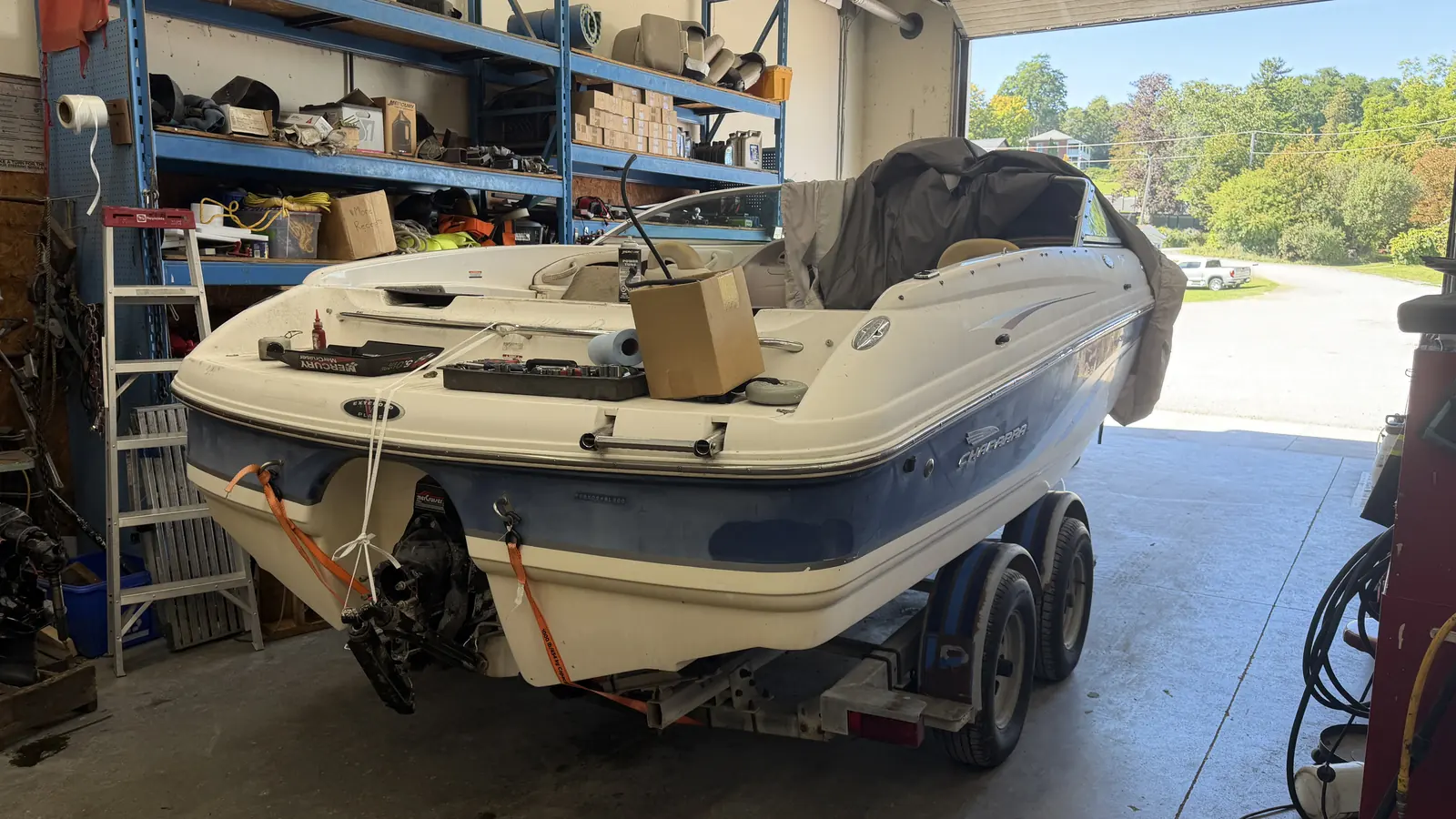
We service MerCruiser sterndrives and Mercury outboards, and we'll tell you plainly when keeping your sterndrive is the better call. Start with the condition and design of your existing boat. An outboard conversion and a replacement sterndrive can involve different structural...
Quick answer: Compare a replacement sterndrive with an outboard conversion for your specific hull. Have a qualified marine professional assess the transom, structure, weight distribution, and installation requirements, then compare complete written quotes. Neither approach is automatically the better choice.
We service MerCruiser sterndrives and Mercury outboards, and we'll tell you plainly when keeping your sterndrive is the better call.
Start with the condition and design of your existing boat. An outboard conversion and a replacement sterndrive can involve different structural and installation work; price the complete scope before comparing them.
Here's the full picture, the good, the honest, and the stuff that will actually help you make a decision.
Repower platform decision
Outboard or sterndrive on your hull?
For most Ontario bowriders and runabouts, the math points one way. Big hulls and dedicated tow boats are the exception.
Boat is under 20 ft (bowrider, runabout, pontoon, deck boat)
- ✓Ontario freshwater, mostly inland lakes
- ✓Reliability and fuel economy matter
- ✓You want shallow-water trim ability for Kawartha shoals
- ✓Resale matters in 5 to 10 years
Assess an outboard option against the exact hull requirements and installed quote.
Boat is 22+ ft with high-deadrise hull or dedicated tow boat
- ✓Big-water cruiser with cabin, indoor cockpit comfort matters
- ✓Watersports inboard tow boat where wake shape is the whole point
- ✓You want maximum cockpit space with no transom motor
- ✓You'll keep the boat 10+ years and accept the service intervals
Sterndrive or inboard can still make sense
When in doubt:Bring the boat in for an honest look. We repower with Mercury outboards and service MerCruiser sterndrives. Most 18 to 22 ft bowriders coming for sterndrive repower leave with an outboard quote.
Outboard vs sterndrive at a glance
| Factor |
Outboard |
Sterndrive (I/O) |
| Installation assessment |
Check hull and transom suitability for conversion |
Check replacement engine and drive compatibility |
| Failure points |
No coolant system, bellows, or gimbal bearing |
Bellows / gimbal / water-intrusion risk |
| Fuel economy |
Modern V6/V8 FourStroke more efficient |
Older I/O less efficient |
| Shallow water |
Trims up in seconds (Kawartha shoals) |
Limited |
| Cockpit & looks |
Takes some transom space |
Wins: clean transom, swim platform, quieter cruise |
| Service access |
Fully external, faster/cheaper labour |
Engine box, harder access |
| Resale after repower |
Strongly improves |
Tired I/O is a liability |
| Still makes sense when |
Under 20 ft |
22 ft+ high-deadrise or dedicated tow boat |
Compare the Installation Your Boat Needs
For an existing boat, market share does not establish whether a conversion is suitable. Compare the exact engine options, required structural work, service access, and total installed cost for your hull.
Meanwhile, sterndrive R&D has slowed. MerCruiser still makes quality products, and the existing install base is enormous, but the trajectory is clear. The marine industry has voted with its production lines.
An engine platform with a growing user base means better parts availability, more trained technicians, and stronger resale demand for years to come.
Quick Refresher: What's the Difference?
If you're newer to the conversation, here's the short version.
Sterndrive (Inboard/Outboard or "I/O"):
The engine sits inside the hull, in an engine bay below the cockpit or under a centre hatch. The outdrive unit hangs off the transom and handles steering, trim, and propulsion. MerCruiser is the dominant brand; Volvo Penta is the other major player. Sterndrives were the dominant setup on bowriders and runabouts from the 1970s through the 2000s.
Outboard: The entire engine (powerhead, midsection, and lower unit) mounts on the transom and is fully external. Everything is accessible without opening a hatch or pulling a floor panel. Tilt it up, the prop clears the water entirely. Modern Mercury outboards are four-strokes with electronic fuel injection (the smallest portables are carbureted), from 2.5 HP up to 600 HP.
If you want deeper background on how sterndrives work and their service requirements, our MerCruiser sterndrive guide for Ontario owners covers the full picture.
The Case for Keeping a Sterndrive
We're not here to trash a platform that served generations of boaters well. There are still real reasons some owners prefer a sterndrive setup.
Interior cockpit space. With the engine hidden below decks, you get a cleaner transom, more seating room and an unobstructed swim platform. On a dedicated watersports boat where the back of the boat is constantly in use, this matters.
Lower centre of gravity. An inboard engine sitting low in the hull contributes to handling stability during aggressive skiing and wakeboarding manoeuvres. High-end wake boats and ski boats still use this to advantage.
Quieter ride at cruise. A well-maintained inboard sterndrive is genuinely quieter inside the cockpit at highway cruise speeds than most outboards. If you're doing long runs in a cabin cruiser, that can matter.
Traditional aesthetic. Some owners, and some boats, just look right without an engine hanging off the back. For a certain vintage of hull, a sterndrive is the period-correct setup.
These are legitimate advantages. If you're in that category, keep your sterndrive and maintain it properly, we'll help you do that (more on that below). For bowriders, deck boats, pontoons, and multi-purpose runabouts, the case for outboards is stronger.
The Case for Going Outboard
Consider these factors when comparing the two installations.
Reliability and Service Intervals
Modern 4-stroke outboards are genuinely durable. Mercury's V6 and V8 FourStroke platforms have been in Ontario freshwater use since 2018 and follow the service schedule in the Mercury owner's manual. Fewer wear parts. No coolant system. No bellows. No gimbal bearing to fail.
No Engine Box, No Hidden Problems
Service access on an outboard is a different experience entirely. There's no engine compartment to crawl into, no bilge to check for oil or water, no flame arrestor to inspect. The entire powerhead is visible and accessible. That means faster diagnostics and lower labour hours when something needs attention.
No Flooded Engine Bay Risk
Sterndrives have a specific failure mode that outboards simply don't: water intrusion through a cracked or degraded bellows. When a bellows fails mid-season, water enters the hull. The consequences range from a flooded bilge to a ruined engine. Outboards don't have bellows. The risk category doesn't exist.
Better Fuel Economy in Most Applications
This surprises people. A modern Mercury V6 or V8 FourStroke running at cruise RPMs is measurably more efficient than most carbureted or early EFI sterndrives. The efficiency gap between old technology and new is real.
Higher Trim Range and Shallow-Water Ability
This one matters specifically on Rice Lake and across the Kawarthas. Ontario waters are not the Gulf of Mexico. Shallows, rock shoals, and weedy bays are part of every season. An outboard trims up in seconds. You can pick your way through water that would put an outdrive at risk. This is a practical, season-long advantage for Ontario boaters.
Tilts Fully Out of the Water
Ontario freshwater storage is a real consideration. When you're not running the boat, a tilted outboard hangs clear of the water, cleaner lower unit, less growth, no barnacles. For boaters who leave their boats in the water across the season, this matters.
Modern Mercury Digital Controls and Joystick Options
Mercury's DTS and VesselView are available on current outboards. Joystick docking needs a specific setup, usually twin engines with DTS. Mercury's single-engine joystick is limited to select models with a thruster, so ask us whether your boat qualifies. Newer boaters expect these features; experienced boaters appreciate them when docking in a crosswind. The technology ecosystem has been built around outboards.
Resale Value
This is the number that ends most debates. A late-model outboard repower dramatically increases the resale value of a sound hull. An old, tired sterndrive on an otherwise good boat is a liability to most buyers, they're calculating the cost of repair or conversion before they even make an offer. A clean outboard installation changes the conversation entirely.
Cleaner Repower Process
A sterndrive-to-outboard conversion involves removing an outdrive, motor mounts, and associated systems and replacing them with a bracket and outboard package. It's real work, but it's not an engine bay rebuild. There's no cylinder head work, no manifold replacement, no exhaust riser risk assessment. The installation is purpose-built and clean.
When Does a Sterndrive-to-Outboard Conversion Actually Make Sense?
The honest answer: not every time. Here's how we think through it.
When the outdrive is at end of life.
Outdrive service costs are significant, and parts availability for older MerCruiser Alpha One and Bravo series units has gotten tighter. If you're looking at a major outdrive overhaul, the economics of conversion get a lot more interesting. Read more about what's involved in a full repower before you decide.
When the engine is also tired.
If both the engine and the outdrive need attention, the rebuild-or-replace math usually favours replace. A full sterndrive mechanical refresh (rebuilt engine, new outdrive, updated exhaust components) often costs more than a properly scoped outboard conversion. Our Mercury repower cost guide for Ontario (2026) breaks down what you're actually comparing.
When the transom is structurally sound.
This is the critical check. Outboard brackets mount to the transom. If the transom is soft (delamination, rot, moisture intrusion), that's a separate project that needs to be addressed first. A reputable repower shop will inspect and tell you the truth here. We do.
When the boat is worth it.
A repower should make economic sense for the hull you have. Don't spend $35,000-$45,000 on a fresh outboard package for a hull with $12,000 in market value. If you're uncertain where you land, our boat hull vs. repower decision guide is a good starting point.
Prices here are planning figures as of October 2026. For live Mercury motor pricing, see the Mercury pricing reference.
When you plan to keep the boat.
Repowers are long-term plays. If you're keeping the boat for another 10-15 years, the investment makes sense. If you're planning to sell in two seasons, the calculus is different.
The Cost Reality: What a Conversion Actually Involves
We're going to be straight with you here, because this is where a lot of owners get surprised.
A sterndrive-to-outboard conversion is not just bolting on a motor. The project scope typically includes:
- Outboard bracket, purpose-built transoms for outboards require the right mounting platform. Some hulls need a custom bracket; others have aftermarket bracket solutions that work well.
- Motor removal and outdrive removal, the old powerplant, mounts, and outdrive unit come out.
- Rigging, new Mercury Digital Throttle & Shift (DTS) controls, wiring harness, gauges, and VesselView integration.
- Fuel system updates, fuel fill, vent, and primer system may need modification depending on hull design.
- Transom work, if the transom is soft or requires reinforcement for the new mounting configuration, that's added scope.
- Exhaust and coolant system decommissioning, the old inboard exhaust system is removed.
- Lake test and commissioning, you should expect a proper break-in run with documentation.
Budget range varies meaningfully based on engine size, hull complexity, transom condition, and the rigging choices you make. The total changes case by case. Start with the motor quote builder for the outboard itself, and we confirm the final price for the full conversion.
The right question isn't "how much does a conversion cost?" It's "does the total cost make sense for this hull, and what does the break-even look like over the years I plan to keep it?"
For Kawarthas and GTA boaters, our complete Kawarthas repower guide and repower information for Toronto-area boaters walk through the logistics in detail.
From the Shop: MerCruiser Sterndrives We Still Service
If you have a sterndrive and you want to keep it, we support that decision.
Harris Boat Works continues to maintain and service MerCruiser sterndrives for owners who want to run them well for years to come. Our service team is Mercury-trained and the platform is one we know inside out.
One note on scope: for engine repairs, we only service Mercury and MerCruiser. If you have a Volvo Penta or other brand, we'll point you to the right specialist.
Sterndrive owners who want a reliable shop with genuine expertise: request service here.
Why HBW Recommends Outboard Repowers in 2026
The recommendation should follow the condition of the boat, the work required, and the intended use.
A few specific reasons we're confident in this recommendation for most Ontario owners:
Long-term Mercury parts support. Mercury has committed its engineering investment to 4-stroke outboard development. Parts will be available, technicians will be trained, and the platform will be supported for the working life of any motor we install today.
We're a Mercury Premier Dealer. That designation isn't marketing language, it reflects volume, training, and service capacity. We have the tooling, the certification, and the technicians to install and support Mercury outboards properly.
We're not the biggest dealer in Ontario. But we're on the water, we know Rice Lake, and we tell people the truth, including when the truth is that their hull isn't worth a repower, or that keeping their existing engine makes more sense.
Try the calculator
Want a real number? Run the Repower Cost Estimator - no signup, no email gate, takes 30 seconds.
The Bottom Line
Compare service access, installation requirements, and ownership costs for the specific options available for your boat.
If you have a tired sterndrive, a sound hull, and a boat you want to keep running for another decade, a Mercury outboard conversion is worth a serious look.
If you want to keep your MerCruiser running, we can help with that too.
Either way, you deserve a straight answer, not a sales pitch.
Thinking about converting your sterndrive to an outboard? Build a real quote in 2 minutes.
Start your quote at mercuryrepower.ca →
Request service at hbwservice.ca.
Harris Boat Works. Gores Landing, ON. Mercury Marine Premier Dealer.