--- > Quick answer: There is no single formula that spits out the right HP. Read the hull's documented power and weight limits from the capacity plate and manufacturer documentation, then inventory hull, engine, fuel, equipment, people, and gear for a normal trip and the...
Quick answer: There is no single formula that spits out the right HP. Read the hull's documented power and weight limits from the capacity plate and manufacturer documentation, then inventory hull, engine, fuel, equipment, people, and gear for a normal trip and the heaviest planned trip, without double-counting anything already included in a listed weight. Stay inside those limits. Length, percent-of-plate, and weight-per-HP shortcuts are not a verified method.
Pick the right shaft: Try our Shaft Length Picker to check if you need a 20" or 25" shaft for your boat. Free, no email.
Why motor sizing isn't just about the HP number
People tend to arrive at a motor size conversation one of two ways: they've heard "bigger is better" and they want the most HP they can fit, or they've heard "don't waste money" and they're shopping at the bottom of the capacity range.
Both shortcuts skip the number that actually matters.
The right motor size matches the exact hull documentation, proposed motor weight, typical load, use, steering, rigging, and budget. That is a boat-specific problem, not a one-variable calculation.
Here's how to work through it.
Start with the compliance notice and hull documentation
On an outboard-powered pleasure craft up to 6 metres, the Canadian compliance notice shows the manufacturer's maximum recommended safe engine power, people, and load limits. It is commonly visible near the operating position.
Treat the engine-power figure as the boundary unless authoritative documentation for the exact hull says otherwise. Going beyond it can create safety, warranty, insurance, liability, financing, and resale problems. HBW works from the documented rating and a boat-specific assessment.
The people and load figures matter too. Transport Canada says the craft reaches capacity when either limit is reached, and difficult conditions can require a lower load.
The factors that move the right HP
Boat type and hull design
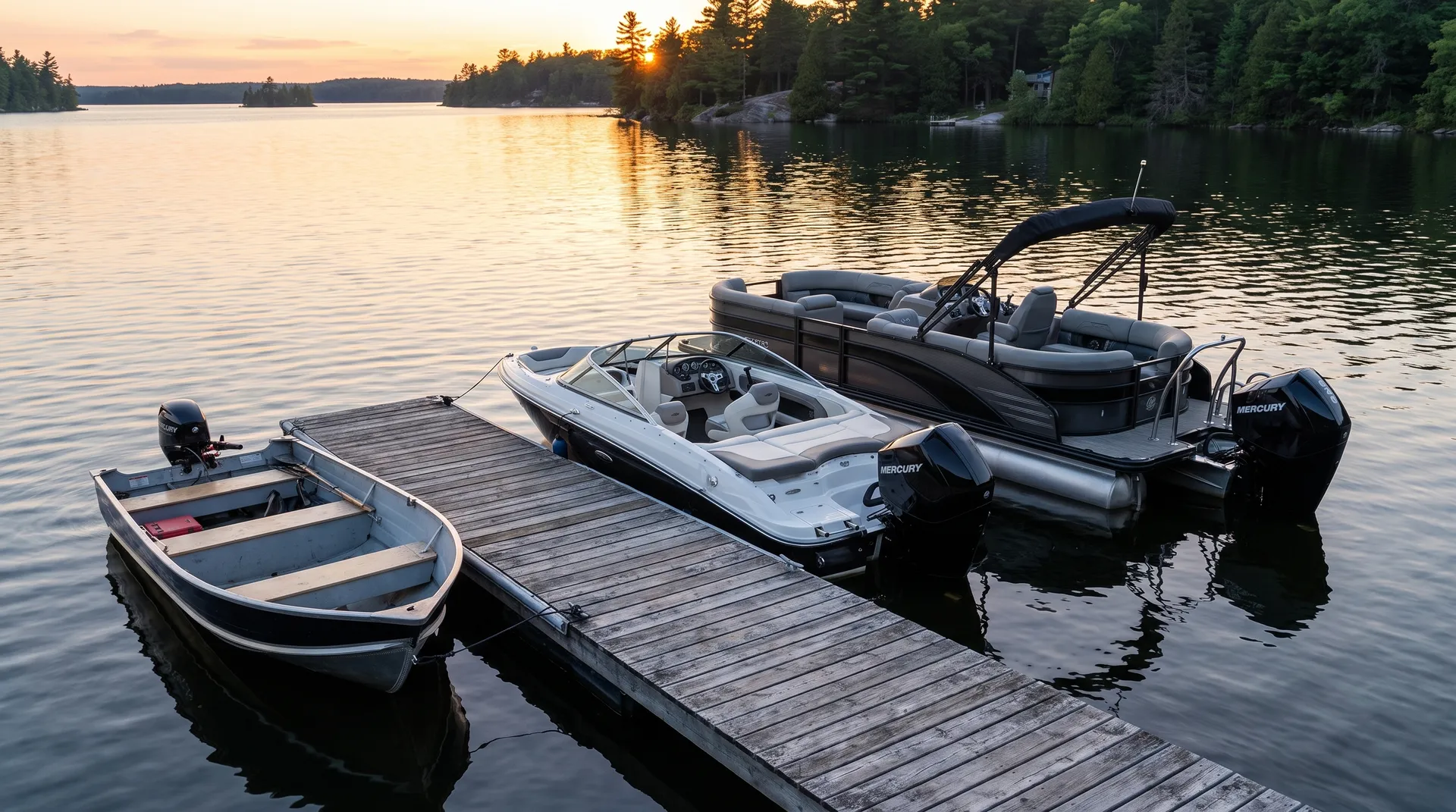
Different hulls have different HP efficiency:
- V-hull runabouts: Efficient hull designs; need less HP for a given speed
- Pontoons: Blunt-fronted tubes with significant drag; length and HP-per-foot do not pick the motor
- Jon boats: Light, plane easily, lower HP thresholds
- Deep-V hulls: Need power for rough water performance and stability
Typical load
This is where most people make their mistake. They size the motor for an empty boat or solo use, then load it up with family, gear, and a full cooler and wonder why it feels underpowered.
Write down a normal trip and the heaviest planned trip, and stay inside the people and weight limits. If a listed hull or trailer weight already includes the engine, fuel, or equipment, do not add those lines again.
Water conditions
Protected Kawartha bays: lower HP works fine. Open Rice Lake in the afternoon wind: more HP is a safety consideration, not a luxury. Lake Ontario: even more so. Bigger, more exposed water changes the practical HP minimum.
Intended use
- Cruising: mid-range HP is efficient and appropriate
- Fishing: consider trolling needs alongside main-motor requirements
- Water sports: more HP for pulling people on tubes and skis
- Speed-focused use: HP at or near the capacity plate maximum makes sense
HP sizing approach
Are you matching a new hull or repowering one you know?
The right HP target depends as much on how well you know the boat as on what the plate says.
New boat, hull you don't know yet
- ✓Buying a hull you haven't owned before
- ✓Resale matters in 3 to 5 years
- ✓You'll typically run with mixed loads
- ✓You want the boat to handle worst-case days
Stay within documented power, transom, and motor-weight limits
Repower of a hull you know well
- ✓You've owned this boat 5+ seasons
- ✓You know your typical load and usage
- ✓You want efficiency, not max top end
- ✓Resale is not the primary concern
Compare those same limits to how this hull is loaded and used
When in doubt:The under-powered complaint is the #1 thing we hear on resale day. If you're on the fence, step up, not down.
Load inventory
Weight-per-HP ratios are not a verified way to pick an engine, and a hull-plus-max-passenger total is not a complete load.
| Line |
What to record |
| Hull |
Documented hull or dry weight; note what it already includes |
| Engine |
Exact proposed motor weight |
| Fuel |
Normal trip and heaviest planned fill |
| Equipment |
Batteries, electronics, furniture, installed gear |
| People |
Usual crew and heaviest planned people |
| Gear |
Coolers, tackle, toys not already listed |
Add a line only if it is not already inside another figure. Then check the exact manufacturer power, people, payload, transom, and motor-weight limits in the documentation and on the capacity plate. Do not read a horsepower answer from the total.
Real-world Ontario examples
16-foot aluminum fishing boat
- Hull: about 363 kg (800 lb) if that figure is hull only
- Engine, fuel, equipment: add each only if it is not already inside the hull figure
- People and gear: about 272 kg (600 lb) as one typical-day illustration, then write the heaviest planned day
- Limits: this hull's documented power, people, payload, and motor-weight figures from the manufacturer documentation and capacity plate
- Examples to compare: 40 HP or 60 HP FourStroke, where those limits, steering, both loads, and use support them
22-foot pontoon
- Hull: about 907 kg (2,000 lb) if hull only; skip engine or furniture already inside it
- Engine, fuel, equipment: add only what the hull figure omitted
- People and gear: about 680 kg (1,500 lb) as one cottage-family illustration, then the heaviest planned load
- Limits: this pontoon's documented power, people, payload, and motor-weight figures
- Example to compare: 115 HP Command Thrust, where that model and those limits support it
20-foot bass boat
- Hull: about 816 kg (1,800 lb) if hull only
- Engine, fuel, equipment: add only what is not already counted
- People and gear: about 227 kg (500 lb) as one tournament-day illustration, then the heaviest planned load
- Limits: this hull's documented power and motor-weight figures from the manufacturer documentation and capacity plate
- Example to compare: 200 HP Pro XS, where those limits, steering, both loads, and use support it
When to size up vs. size down
Size up if:
- You fish or run on large, exposed water regularly
- Full family loads are the norm, not the exception
- You're planning to keep the boat 10+ years
- Resale value matters and more HP holds it better
Size down if:
- Calm, protected waters only (small Kawartha lakes, sheltered bays)
- Usually solo or light loads
- Fuel economy is the primary concern
- Budget is tight and underpowering is better than no boat at all
The middle ground: we usually find the right answer is one HP class above the bare minimum, enough headroom to be comfortable, not so much that you're over-buying for your actual use.
What HBW brings to this conversation
Harris Boat Works has been matching Mercury motors to Ontario boats since 1965. Three generations of doing this on Rice Lake in the Kawarthas gives us a practical picture that no HP calculator captures: the lakes you're running, the conditions you'll face in July when the wind comes up, and what it feels like to be underpowered on a Kawartha afternoon.
Bring us your boat info, make, model, year, length, and how you actually use it, and we'll give you a straight answer. That includes telling you when you don't need a bigger motor.
Ready to size your motor?
Build a real installed quote at mercuryrepower.ca, real pricing across every Mercury HP class.