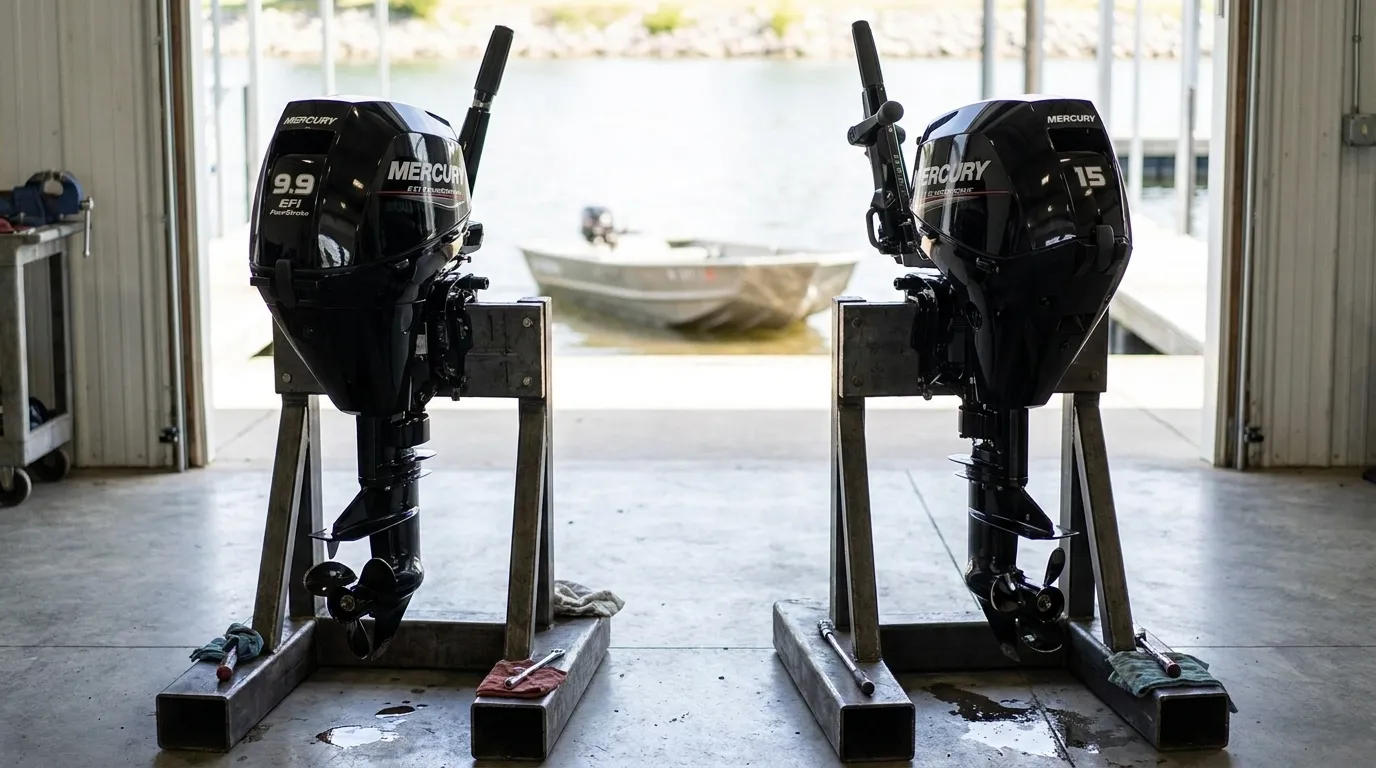
For a variant-by-variant breakdown of the 9.9 line itself, see our Mercury 9.9 tiller, kicker, and ProKicker guide. There's a moment with every small-motor customer where the conversation lands on the same question. They're standing on the showroom floor, looking at two...
Quick answer: Compare the exact currently offered 9.9 and 15 model codes, generation, dry weight, gear ratio, and service parts. They are not proven to be the same block with a calibration-only difference. Current 8/9.9 EFI FourStroke material lists 209.8 cc; do not use older 333 cc family data to claim shared consumables. Pick by capacity plate, lake horsepower rules, and the actual model you can buy. If you fish a tournament, check that event's current motor rules rather than assuming a province-wide 9.9 kicker cap.
For a variant-by-variant breakdown of the 9.9 line itself, see our Mercury 9.9 tiller, kicker, and ProKicker guide.
There's a moment with every small-motor customer where the conversation lands on the same question. They're standing on the showroom floor, looking at two outboards that visually look identical, and they ask the version of the question that everyone asks: "What actually changes if I spend the extra money?"
It's a fair question. From across the parking lot, current 9.9 and 15 tillers can look similar. That is not proof they share a powerhead, gearcase, or parts list.
So here's the honest take from a Mercury Premier dealer that sells both. Compare the exact current model codes. There are still clear reasons to pick the 9.9 and clear reasons to pick the 15. By the end of this guide, you'll know which conversation belongs on your transom.
Who This Is For
This guide is for the boater shopping a new or replacement Mercury tiller in the 9.9 to 15 HP class. That covers:
- 12 to 16 foot aluminum jon boats and tin-can fishing rigs
- Tiller skiffs and small runabouts
- Kicker motor shoppers running a bigger main outboard
- Sailboat owners replacing a tired auxiliary
- Cottage tenders, dinghies, and lake-runabout duck boats
If you're shopping bigger (40, 60, 90, 115 HP), check our Mercury 40 vs 60 HP comparison or the FourStroke buyer guide. This post is the small-motor edition.
The Plain Truth: Confirm the Current Generation
Do not treat the current 9.9 EFI FourStroke and 15 EFI FourStroke as one 333 cc block with different stickers. Mercury introduced the EFI 8/9.9 FourStroke and ProKicker in 2024, establishing a newer portable generation. The 2024/2025 8/9.9 EFI owner's material lists 209.8 cc. Older 333 cc ProKicker/15/20 family data cannot establish current portable 9.9/15 interchangeability.
That means reliability, parts, dry weight, gear ratio, and consumables have to be read from the exact current model code and the serial-specific latest manual. We will not invent replacement displacements, weights, or a shared-parts list for the current 15 here.
Mercury June 2024 EFI 8/9.9 and ProKicker introduction.
What's Actually Different
| Check |
What to confirm on the current 9.9 |
What to confirm on the current 15 |
| Rated horsepower |
9.9 HP |
15 HP |
| Model generation and code |
Current EFI portable / ProKicker SKU, not an older 333 cc family assumption |
Current 15 SKU; do not copy 9.9 displacement onto it |
| Displacement |
209.8 cc on the documented 8/9.9 EFI generation |
Use the serial-specific latest specification; do not guess |
| Dry weight, gear ratio, shaft options |
Read the current model-code sheet |
Read the current model-code sheet |
| Service parts |
Serial-specific impeller, plugs, oil, gear lube, filters |
Serial-specific; not proven interchangeable with the 9.9 |
| Fuel and start options |
Confirm tiller/remote, manual/electric, tank, CT |
Confirm the same options on that 15 SKU |
| Best first question |
Capacity plate, lake HP rule, or a named tournament's current kicker rule |
Plate allows 15 and you want more thrust than a 9.9 |
The useful comparison is still use case and legality, not a shared-block story. The price gap is usually smaller than the cost of buying the wrong generation or the wrong lake/tournament fit.
HP-Restricted Lakes: When the 9.9 Is the Only Legal Choice
This is the cleanest case for the 9.9. Some Ontario lakes, cottage associations, and conservation areas have a hard horsepower cap, often at 9.9 HP or 10 HP. If your lake is one of them, the 15 isn't a "more power" decision. It's a "you can't be on the water" decision.
A few things worth knowing if HP restriction is in play:
- The cap is on the motor's rating, not its actual output. A 15 HP motor de-rated to 9.9 with a Mercury flash is still the same engine underneath, and whether an HP-restricted lake accepts it depends on what the motor's rating plate and cowl decals show and how that lake's authority reads them. Check the rating plate and confirm with your specific lake authority before you spend.
- Tournament kicker rules are event-specific. Some organizers restrict boat or motor size. That is not a province-wide 9.9 HP ceiling, and a 15 is not automatically legal or illegal. Check the current rules for the derby you actually fish.
- Cottage associations are often stricter than provincial rules. Some Kawartha cottage associations and small lakes near the Trent-Severn have 9.9 HP or even 7.5 HP house rules. Read the association bylaws before buying anything bigger.
If you're unsure whether your lake has a cap, engine-power caps on specific waters are set under the federal Vessel Operation Restriction Regulations (SOR/2008-120). Restricted waters are listed in Transport Canada's TP 15587 schedules; Schedule 4 covers power limits. These list restricted waters, not every federally regulated body of water. But house rules at the cottage association level aren't there. Check both.
The Capacity Plate Question
Most powered pleasure craft under 24 metres require a visible Canadian compliance notice, subject to exceptions. On an outboard-powered pleasure craft up to 6 metres, the notice also states the manufacturer's maximum recommended safe engine power, people, and load limits. Treat those limits as the boundary and confirm the exact hull documentation before choosing between 9.9 and 15 HP.
For the 9.9 vs 15 conversation, the capacity plate matters when:
- Your boat is plated at 9.9 or 10 HP. Many 12 foot aluminum boats, smaller tin-can fishing rigs, and older car-topper hulls cap at 10 HP. Go with the 9.9.
- Your boat is plated at 15 HP. Many 14 foot jon boats and 12-14 foot utility hulls cap here. The 15 is the right choice. The 9.9 will feel underpowered, especially loaded with two adults, gear, and a full fuel tank.
- Your boat is plated higher than 15 HP. This guide isn't really for you. A 16 foot hull plated at 25 or 40 HP wants a 25 or 40 HP motor, not a 9.9. Check the FourStroke buyer guide for that range.
Boaters sometimes ask whether they can run a 15 HP motor on a hull plated at 9.9 HP and just "be careful." The answer in Ontario is no, and we won't rig it. The plate is the hull manufacturer's published maximum and Transport Canada's reference for compliance. Over-powering can put insurance coverage at risk, so confirm with your carrier. Mercury's warranty position is that overpowering creates compliance, insurance, liability, and potential warranty problems. None of those problems are worth the extra 5 HP.
What HBW Checks Before Quoting a 9.9 or 15
When a customer walks in shopping a Mercury tiller in this size class, here's what we check before we recommend anything:
The capacity plate. We look for the rated horsepower stamp first. Without that number, we're guessing.
The use case. A kicker motor for trolling on a bigger bass boat has different priorities than a primary motor on a 14 foot utility hull. A sailboat auxiliary cares about shaft length and weight aft. A cottage dinghy cares about portability. Same two motors, different right answers.
The shaft length. Most small tillers come in short (15 inch) and long (20 inch). Measure from the top of the transom at the motor mount straight down to the bottom of the hull at the centreline. A shaft that's too short lets the prop ventilate and can starve the water intake, causing overheating. A shaft that's too long adds drag and spray and costs speed.
The lake. HP restriction or no HP restriction. Cottage association rules. Whether you need the Command Thrust gearcase for slow-speed control on a heavy sailboat or pontoon.
The budget. CAD pricing on both motors is similar enough that the call almost always comes back to capacity-plate fit and HP-restriction status, not price.
Kicker Motor Use: 9.9 vs 15 for Trolling
If you're rigging a kicker motor on a bigger boat, the 9.9 EFI FourStroke is the standard pick. Three reasons:
- If you fish a specific tournament, check its current motor and trolling rules before buying. Do not treat every Rice Lake or Kawartha derby as a 9.9-only event, and do not assume a 15 is universally legal.
- Weight still matters on a kicker bracket. Confirm the current model-code dry weights rather than using an older shared-block 7 kg story.
- A 15 HP kicker is often more motor than a light aluminum needs at idle. Consider hull, wind, and the named event rules before paying for unused top-end.
The only exception: a heavy boat that struggles to maintain trolling speed in chop or wind. A pontoon kicker, for example, sometimes benefits from the 15 because it has the headroom to push the boat into the wind at slow speed.
Sailboat Auxiliary: Long Shaft, Weight, Command Thrust
Sailboats add three wrinkles to the 9.9 vs 15 decision.
Shaft length matters more. Most sailboat transoms are tall. You'll usually need a 20 inch (long) shaft, sometimes a 25 inch (extra long) shaft on bigger displacement hulls. Wrong shaft length on a sailboat auxiliary is a more expensive mistake than on a powerboat because the boat is harder to manoeuvre back to the dock when the motor's cavitating.
Weight matters more, aft. Sailboats are sensitive to transom weight. Confirm the current 9.9 and 15 dry weights from the model-code sheet rather than assuming a 7 kg shared-block gap. On a small sailboat (~24 to 28 foot) extra transom weight shows up in stern squat.
Command Thrust may be worth it. The Command Thrust gearcase option puts a larger-diameter prop on the same motor. It's slower at the top end but pushes a heavy displacement hull better at low RPM. For a sailboat under sail-handling load (motoring into wind to drop sails, manoeuvring in tight marinas), Command Thrust is often the right call regardless of whether you pick 9.9 or 15. Read more in our Command Thrust vs Standard Gearcase guide.
Fuel Economy: The Difference Is Smaller Than You'd Expect
Customers sometimes ask whether the 9.9 will save them meaningful money on fuel. It won't.
At wide-open throttle, the 15 burns about 1.1 to 1.9 L/h (0.3 to 0.5 GPH) more than the 9.9. Spread that across 50 hours of running per season (which is high for most small-motor users), it's an extra 57 to 95 L (15 to 25 US gal) of fuel. At Ontario marina pump prices, call it 100 to 150 CAD more per season.
For most small-motor users, the actual difference is even smaller, because nobody runs a 9.9 or 15 at WOT continuously. You spend most of your time at cruising RPM where the fuel-burn delta drops to under a litre per hour (a few tenths of a GPH). The 15 is more efficient per horsepower-hour than the 9.9 when you account for the work being done.
Translation: pick the motor that fits the boat and the use case. Don't pick the 9.9 to save money on fuel. The savings are too small to be a decision driver.
What We See at HBW
Here's the pattern we see in small-motor sales on Rice Lake and across the Kawarthas:
In our shop experience, the 15 HP is the more common choice for small boats that are plated for it. Typical buyers are rigging a 14 foot aluminum jon boat, replacing a tired 9.9 on a 16 foot tiller skiff and wanting more headroom, or running a heavier pontoon kicker that needs extra push into the wind.
The 9.9 is still a common fit for anglers whose named tournament requires it, sailboat owners replacing an aging auxiliary, and boaters on HP-restricted lakes where a 15 is not permitted.
Some buyers simply replace a failed 9.9 or 15 with the same size. That's a legitimate reason on its own. Familiar controls, fuel tank, prop and bracket all matter.
The one thing we don't see often is a customer who buys the 9.9, runs it for a season, and wishes they'd saved the weight. Most of the regret-cases go the other direction: a 9.9 that doesn't quite have the power to push the loaded boat onto plane, and the owner wishes they'd spent the extra for the 15.
Pricing in 2026 CAD
Mercury's MSRP and Canadian dealer pricing both shift through the year, so the numbers below are a snapshot. Build a current quote for either motor in CAD at Mercury Repower Centre for the exact figure.
As of September 2026, a typical Mercury 9.9 EFI FourStroke tiller (manual start, short shaft, 23-litre / 6 US gal portable tank) runs in the low 4-figures CAD installed. The 15 EFI FourStroke equivalent runs closer to a thousand dollars more in the same tiller, short-shaft configuration (9.9MH vs 15MH on HBW's pricing reference, September 2026). Give us a call for current availability on both motors. Electric start, long shaft, and Command Thrust options each add an incremental cost. The online quote builder itemizes everything in Canadian dollars with no form gate or callbacks required. To see Mercury prices by horsepower across the full lineup, check our price reference.
Common Mistakes
- Picking the 9.9 because it sounds cheaper. The price gap is small enough that capacity-plate fit and HP-restriction status should drive the call, not the motor cost.
- Ignoring the capacity plate. "I'll just be careful" doesn't fly with insurance carriers or warranty claims.
- Wrong shaft length. Measure the transom before you order. We measure for you if you bring the boat in.
- Buying based on what the neighbour at the cottage has. Their boat isn't your boat. Their lake might not have the same rules.
- Skipping the kicker bracket for an underpowered main motor. A 9.9 on a 16 foot tiller skiff is fine. A 9.9 as a get-home motor on a 23 foot deep-V is not.
Why Buy From HBW
HBW has been on Rice Lake since 1947 and a Mercury dealer since 1965. We sell both the 9.9 and the 15 every season, install them, water-test them on Rice Lake before you pick up the boat, and service them long after the sale. We're a Mercury Marine Premier Dealer, which means our service techs are factory-certified on every motor we sell.
We're not in Toronto. We're in Gores Landing, roughly 1 hour 45 minutes from central Toronto in light traffic, on the south shore of Rice Lake. We are pickup-only, by design: the standard handoff includes a real water test before you drive home when safe seasonal conditions allow. That's why customers from the GTA, Peterborough, Cobourg, and the Kawarthas drive to us instead of buying elsewhere.
Ready to Pick One?
If your capacity plate caps at 9.9 or you're on an HP-restricted lake, the 9.9 EFI FourStroke is the right call. If a named tournament restricts kicker size, follow that event's current rules. Weight-sensitive sailboat owners should compare current model-code weights. For everyone else whose plate allows it, the 15 EFI FourStroke is often the stronger all-around boat motor.
Build a quote for either motor in Canadian dollars at the configurator.
Phone: 905-342-2153
Configurator: mercuryrepower.ca
Service: hbwservice.ca
Address: 5369 Harris Boat Works Rd, Gores Landing, ON
Sources