--- > Quick answer: Start with the boat manufacturer's documented power, transom, and weight limits, then match the motor to the hull, exact motor weight, usual and heaviest planned load, and intended use. The printed maximum is a boundary, not a target.
Quick answer: Start with the boat manufacturer's documented power, transom, and weight limits, then match the motor to the hull, exact motor weight, usual and heaviest planned load, and intended use. The printed maximum is a boundary, not a target. Going beyond it creates safety and possible insurance, warranty, liability, financing, and resale problems, so verify the boat and policy documentation rather than relying on a rule of thumb.
Recommended HP by boat type at a glance
| Boat & length |
Typical use |
Mercury HP |
| Aluminum 12-14 ft |
Solo / two-person rough water |
9.9-15 HP tiller / 20-25 HP |
| Aluminum 14-16 ft |
Trolling / get on plane |
25-40 HP / 40-60 HP (sweet spot) |
| Console 16-18 ft |
All-round (most common HBW repower) |
90-115 HP (90 or 115 ELPT FourStroke) |
| Pontoon 18-20 ft |
Cruise & fish / tubing |
90 HP CT / 115 HP CT |
| Pontoon 20-24 ft |
Cruise & fish / watersports |
115 HP CT / 150 HP (standard gearcase) |
| Runabout / bowrider 18-22 ft |
General |
150-200 HP |
| Bass boat 17-21 ft |
Recreational / tournament |
150 HP / 200-250 HP Pro XS |
Do not use a fixed percentage as a substitute for a boat-specific assessment. Stay within the boat manufacturer's documented limits and choose for the usual and heaviest loads you will actually carry.
The one thing most people get wrong on horsepower
It's not buying too much. It's buying too little.
Every season we see it: someone buys the smallest motor they can justify, fights their boat for two summers against wind and load, then trades up at full retail for what they should have bought the first time. That's paying twice for one job.
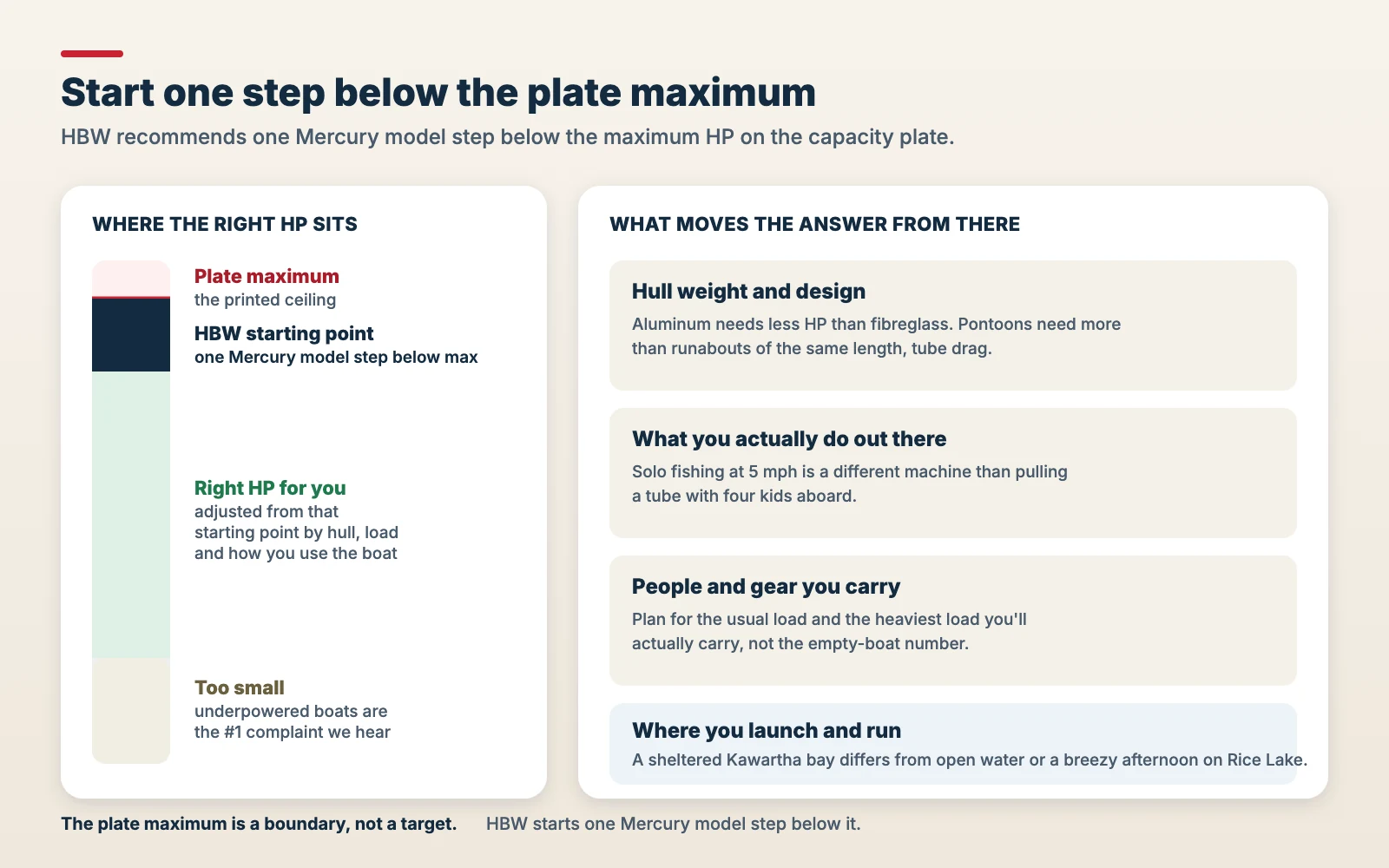
The capacity plate on your boat sets the ceiling. Work inside it, always. But within that range, the right HP is almost never the bottom of the range.
Here's how to think through it.
What actually changes the answer
Six variables move the right HP for your specific boat:
Hull weight and design. A 16-foot aluminum tin boat needs less HP than a 16-foot fiberglass runabout. Aluminum is lighter. Pontoons need more HP than runabouts of the same length because of drag from the tube configuration.
What you actually do on the water. Solo fishing at 5 mph is a different machine than pulling a tube with four kids aboard. Same boat, totally different right answer.
How many people and how much gear. A two-person boat needs meaningfully less HP than one you're routinely loading with six people, a cooler, and a trolling setup. Plan for the usual and heaviest loads you will actually carry.
Where you launch and run. Sheltered bays on a small Kawartha lake are different from Lake Ontario open water or a breezy afternoon on Rice Lake, Ontario. Bigger water punishes underpowering in ways that feel dangerous, not just slow.
The capacity plate or compliance notice. Treat the labelled engine-power limit as the ceiling. It is the manufacturer or importer's recommended maximum safe engine power, and HBW will not rig above it.
How long you plan to keep the boat. If you're keeping this hull for 15 years, a bigger motor makes more sense than if you're planning to sell in three.
HP sizing decision
How heavy do you actually load the boat?
The plate max is the ceiling, not the recommendation. Pick inside that range based on your hull, loads, and how you use the boat.
Light load (1 to 2 people, fishing gear)
- ✓Solo or two-person fishing most outings
- ✓Light tackle, no tow toys, half tank
- ✓Calm or sheltered water (small Kawarthas, Rice Lake on a calm day)
- ✓You care more about fuel economy than hole shot
Stay within manufacturer limits; check your everyday load and occasional fully loaded trips.
Heavy load (4+ people, tubes, full gear)
- ✓Family of four plus a friend most weekends
- ✓Tubing, wakeboarding, or skiing on the regular
- ✓Full cooler, full tank, full gear
- ✓Bigger lakes with chop (Simcoe, Scugog, Lake Ontario shoreline)
Stay within manufacturer limits; assess performance with the full planned load and towing needs.
When in doubt:Underpowered boats are the #1 complaint we hear. Step up before you step down.

HP recommendations by boat type
These are working guidelines for typical recreational use on Ontario and Kawartha freshwater. For your specific motor and real installed pricing, build a quote at mercuryrepower.ca.
Small aluminum fishing boats (12–14 ft)
Solo fishing on sheltered water: 9.9 to 15 HP tiller. Drop-in install, no rigging. Just the motor cost.
Two people or rougher water: 20 to 25 HP. Still tiller-friendly.
Aluminum fishing boats (14–16 ft)
Solo or two-person at trolling speeds: 25 to 40 HP remote.
Two to three people who want to plane and move between spots: 40 to 60 HP. This is the sweet spot for 14–16 ft aluminum repowers in the Kawarthas.
Console boats (16–18 ft, aluminum or fibreglass)
Family use, moderate loading, recreational running: 90 to 115 HP. This is the most common repower we do at HBW. The Mercury 90 ELPT FourStroke or 115 ELPT FourStroke lands here consistently.
Pontoons (18–20 ft)
Cruising and fishing without water sports: 90 HP FourStroke Command Thrust is plenty for most setups.
Family use including tubing or skiing: 115 HP Command Thrust. The Command Thrust gearcase makes a real, noticeable difference on hole shot and load-carrying with people aboard.
Pontoons (20–24 ft)
Cruising and fishing: 115 HP Command Thrust.
Active water sports, tubing, skiing, multiple passengers: 150 HP FourStroke (standard gearcase; confirm the exact engine and gearcase specification). Above 150 HP starts to be diminishing returns on most two-tube pontoons.
Runabouts and bowriders (18–22 ft)
Recreational family use: 150 to 200 HP. The exact answer depends on hull weight and whether water sports are in the picture.
Bass boats (17–21 ft)
Tournament-level performance: 200 to 250 HP Pro XS. The Pro XS line is the standard tournament motor.
Recreational bass fishing: 150 HP FourStroke or Pro XS, depending on whether you need the performance step-up.
What we ask before recommending an HP class
When someone calls and asks "what HP should I get?" we want to know:
- Boat make, model, year, and length
- What the capacity plate says
- What you actually do on the water
- Usual and heaviest planned passenger and gear load
- Where you launch and run
- How long you plan to keep the boat
- What prop and rigging you already have
We won't over-power your boat. We also won't recommend the cheapest option if we know it'll leave you frustrated. You'll get the honest answer for your specific setup.
The most common HP mistakes we see
1. Buying too small to save money. We've watched customers fight a 9.9 HP on a 16-foot boat that needed a 25. They trade up two seasons later at full price. The savings disappear.
2. Going over the capacity plate. A 250 HP motor on a hull labelled for a 150 HP recommended maximum exceeds the manufacturer's safe engine-power limit. That creates serious handling, transom, insurance, financing, resale, liability, and potential warranty problems. It is not accurate to describe every pleasure-craft case as an automatic blanket warranty void or a single automatic offence. Respect the label and confirm the hull manufacturer's rating before choosing power.
3. Buying for one use and ignoring the rest. "I just need it for fishing" is fine until your kids want to tube next summer. Think through the full use case before you buy.
4. Ignoring the prop. A right-sized motor with a wrong prop loses real performance. Prop verification is matched to the motor, hull, rigging, work order, and safe seasonal testing conditions.
5. Ignoring load. Empty boat numbers are aspirational. A family of five with gear and a cooler is a different boat than the demo run.
When to step up, when to stay
Step up to the next class when:
- You routinely run with a full load
- Water sports are part of the plan
- You launch on bigger, windier water
- You want to plane quickly to beat afternoon chop
- You're keeping the boat 10+ years
Stay at the current class when:
- Your typical load is light, solo or two-person
- Your use is consistent and focused (fishing only, cruising only)
- You launch on sheltered lakes and bays
- You're genuinely comfortable with current performance
Ready to figure out your HP?
Build a quote at mercuryrepower.ca, real installed pricing across every Mercury HP class, no games.
