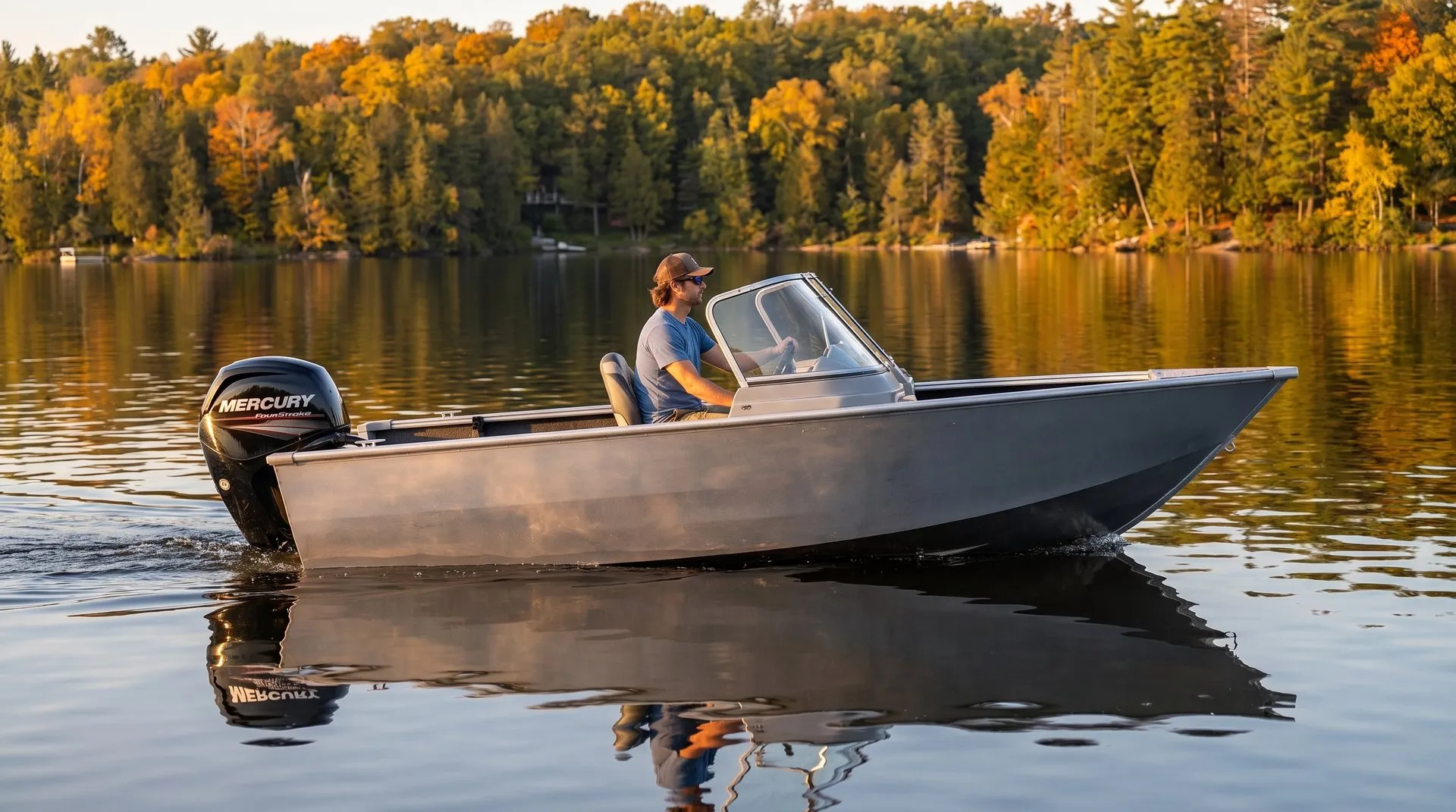
The 115 vs 150 question is the most common repower decision we see at HBW. Customer has an aluminum V-hull, an aging 115 or 90, and is trying to figure out whether the next motor should match what they have or jump up a tier. Most online answers fall back on "depends on the...
Quick answer: On some 18 ft aluminum V-hulls, the Mercury 115 is a strong comparison; at 19 to 20 ft with a heavier crew, the 150 is another. On some 18 to 20 ft pontoons, 60 Command Thrust is worth comparing where that exact CT model and the boat's limits support it; on some 22 to 24 ft tritoons, the 150 is another. Length alone does not decide. HBW current sell prices: 20-inch 115ELPT ProXS $17,490, 20-inch 150ELPT ProXS $24,349 (CAD, bare motor, excluding HST, rigging, controls, and propeller), also listed on /pricing-reference. Build a quote at mercuryrepower.ca.
The 115 vs 150 question is the most common repower decision we see at HBW. Customer has an aluminum V-hull, an aging 115 or 90, and is trying to figure out whether the next motor should match what they have or jump up a tier. Most online answers fall back on "depends on the boat" without giving you actual dividing lines.
From the shop: On a planing aluminum V-hull, we do not use Command Thrust to make a 115 behave like a 150. We choose the horsepower the capacity plate and loaded use support, then match the standard gearcase and propeller to the boat.
This page gives you the actual dividing lines. By hull type, by boat length, by use case. We base it on hundreds of repowers we've rigged on Rice Lake and the Kawarthas. It's not theoretical.
The dividing lines, by hull type
These are the recommendations we give at our desk. They reflect real-world performance on Ontario waters, not best-case test tank numbers.
Aluminum V-hull boats
16 to 17 ft aluminum V-hull: 60 to 90 HP, almost never 115. The boat is light enough that 115 over-propels easily and the cost premium isn't justified.
18 ft aluminum V-hull (Lund, Princecraft, Crestliner, similar): Mercury 115 HP is the best choice for most use cases. Two adults, fishing gear, modest tubing, cruising at 30-32 MPH. The 150 is overkill on an 18-footer unless you're regularly running heavy tournament loads.
19 to 20 ft aluminum V-hull: Mercury 150 HP. The hull starts demanding more thrust to plane efficiently with a full crew and gear. The 115 will run the boat but works hard. The 150 cruises easier and gives you margin for headwinds.
21+ ft aluminum V-hull: 150 minimum, often 175 or 200. Outside the 115 vs 150 conversation.
Pontoon boats (this is where most dealers get it wrong)
Pontoons 18 to 20 ft: 60 Command Thrust is worth comparing. Use that CT model only if Mercury currently offers it and this pontoon's documented power, transom, motor-weight, steering, and both planned loads support it. A 115 on this length suits a different load and use.
Pontoons 22 to 24 ft (especially tritoons): Mercury 150 HP. Tritoons add hull surface and weight, and on a 22 to 24 ft tritoon the 150 is the right baseline. 115 is undersized for a tritoon of this size.
Bowriders and runabouts
Outside the 115-vs-150 conversation in most cases. Bowriders in the 18 to 22 ft range typically run 200+ HP. If you're cross-shopping 115 and 150 for a bowrider, the hull is unusually small.
Current HBW pricing (2026)
Our most popular models in these two HP classes:
| Model |
HBW Sell Price (CAD, pre-HST) |
Notes |
| Mercury 115 ELPT FourStroke |
starts around $17,083 |
Standard 115, good for most 18ft V-hulls |
| Mercury 115ELPT ProXS (20-inch) |
$17,490 |
Our most popular 115, performance variant, bare motor excluding HST, rigging, controls, and propeller |
| Mercury 150 L FourStroke |
starts around $22,242 |
Standard 150 |
| Mercury 150ELPT ProXS (20-inch) |
$24,349 |
Our most popular 150, performance variant, bare motor excluding HST, rigging, controls, and propeller |
Pricing as of 2026. Install costs vary by what's on the boat now. Build a real quote at mercuryrepower.ca for your specific situation.
What changes between 115 and 150
Beyond the obvious horsepower number.
Top speed on a 19ft aluminum V-hull (load: 3 adults + gear):
- 115 ProXS: typically 38-42 MPH
- 150 ProXS: typically 44-48 MPH
The 150 isn't a dramatic top-end difference. Where you actually feel it:
Hole-shot and time-to-plane:
- 115 on a 19ft V-hull with full crew: 6-8 seconds to plane, noticeable bow rise
- 150 on the same setup: 4-5 seconds, cleaner transition
Cruising RPM at 25 MPH (Mercury's own tests of one 18.8 ft Crestliner XFC 189 with each motor, run the same day):
- 115 Pro XS: about 3,550 RPM (working harder)
- 150 FourStroke: about 3,150 RPM (relaxed)
Fuel burn at 25 MPH cruise (rough planning figures; they vary with hull, load and prop):
- 115 Pro XS: about 16 L/h (4.2 GPH) in that test
- 150 FourStroke: about 18.6 L/h (4.9 GPH) in that test
Across Mercury's published tests on 17.5 to 20 ft aluminum hulls, both motors land between roughly 13 and 20 L/h at that speed. A boat loaded for a real day burns more than a test boat. See the Mercury test sheets for the 115 and the 150.
The 150 burns slightly more fuel per hour at the same cruise speed but runs at lower RPM, which is easier on the engine and on your ears. Over 200 hours of use, the fuel delta is real but not catastrophic.
Cruising RPM at 35 MPH:
- 115 Pro XS: about 4,700 RPM in the same test (near the top of comfortable cruise)
- 150 FourStroke: about 4,000 RPM in the same test (still comfortable)
This is the practical "ceiling speed" difference. The 150 gives you more usable cruising range above 30 MPH.
The fuel cost math (with honest Ontario use patterns)
Online comparisons often assume 100 hours of use per season. The examples below use a 20-hour light-use scenario and a 100-hour heavy-use scenario so you can see how the answer changes. They're planning illustrations, not a claim about the average Rice Lake owner.
Using two illustrative Ontario use patterns:
20-hour light-use scenario (115 vs 150 at 25 MPH cruise, using a sample Ontario marine fuel price):
- 115 fuel: 20 hr × 16 L/h (4.2 GPH) × $1.85 = $592
- 150 fuel: 20 hr × 18.6 L/h (4.9 GPH) × $1.85 = $688
- Annual delta: about $96
100-hour season fuel cost delta (heavy use):
- 115 fuel: 100 hr × 16 L/h (4.2 GPH) × $1.85 = $2,960
- 150 fuel: 100 hr × 18.6 L/h (4.9 GPH) × $1.85 = $3,441
- Annual delta: about $481
In the 20-hour illustration, fuel cost isn't the deciding factor. The motor price delta matters more.
Motor price delta over the ownership period
Mercury 20-inch 150ELPT ProXS at HBW: $24,349. Mercury 20-inch 115ELPT ProXS at HBW: $17,490, both bare motors excluding HST, rigging, controls, and propeller. Delta: $6,859 plus 13% HST.
If you keep the motor for 10 years, the $6,859 motor price delta is $686 per year of ownership whether you run 20 or 100 hours per year. Motor price doesn't change with use.
For a customer who'll genuinely use the extra HP (full crew, heavy load, regularly cruising at 30+ MPH), the 150 is worth it.
For a customer fishing solo or with one partner, running the boat at idle or low speed most of the time, $686/year over 10 years is real money to give up for HP you won't use.
The Command Thrust correction (a common dealer mistake)
This deserves its own section because we see it routinely on customer boats that come to us for service.
Command Thrust is a hull, load, and propeller choice, not a pontoon-only switch. HBW still prefers it on many pontoons and some workboats where a current CT model exists; check the exact model's gearcase specifications. If the boat is rated above available CT models, compare a non-CT motor this hull actually allows.
Command Thrust (CT) uses a larger gearcase, larger propeller diameter, lower gear ratio (typically 2.33:1 instead of 2.07:1), and is engineered for low-speed thrust at the expense of top-end speed. It's the right call for:
- A pontoon or workboat only where Mercury offers a current Command Thrust model and this boat's power, transom, motor-weight, steering, rigging, and load support that exact model. CT does not suit every pontoon and does not guarantee planing
- Commercial work boats that need thrust over speed (push boats, certain barges)
Command Thrust is the WRONG call for:
- Standard aluminum V-hull fishing boats (115 CT or 60 CT on a V-hull gives up top speed for thrust you don't need)
- Bowriders
- Runabouts
- Any planing hull where the customer values top speed
We see other dealers rig V-hull customers with 115 CT thinking "more thrust is better." For a V-hull, it's not. The standard 115 ELPT or 115 Pro XS is the correct choice on an 18 ft V-hull.
If you're being quoted a Command Thrust motor on a V-hull, ask the dealer specifically why. There may be a legitimate reason (e.g., propping up an overweight specific build), but for the majority of V-hull buyers, the standard gearcase is what you want.
What HBW checks before pickup
Repowers combine a new motor with an existing hull and rigging, so the combination needs an acceptance test. HBW's standard handoff includes an on-water load test before pickup when safe seasonal conditions allow: cold start, idle quality, low-speed handling, on-plane behaviour, top-end RPM at WOT, and charging-system behaviour. Any alternate acceptance plan is documented with the customer.
Common mistakes
- More HP is always better. No. Overpowering a boat creates capacity-plate compliance issues, insurance complications, and shortens hull life. Stay within the capacity-plate maximum HP rating. If you want more boat, get more boat.
- I'll get the 150 because resale is better. Marginal. A 115 in good condition resells well. A 150 in good condition resells well. The delta isn't enough to justify the up-front price difference for most owners.
- Command Thrust gives me more low-end on my V-hull. Slightly, at the cost of top end. For an aluminum V-hull, the standard gearcase is the engineering-correct choice. Don't let a dealer talk you into CT unless your hull legitimately needs it.
- I'll prop it for top speed. Most customers prop wrong. Prop pitch should be set so the motor reaches WOT RPM within Mercury's recommended range for the exact model (the ranges differ between FourStroke and Pro XS; check the current spec sheet) under typical load. We dial this in at our dock.
- My buddy has a 150 on the same boat and it's faster. Maybe. Or your buddy's boat is set up differently, has a different prop, runs at different load, or you're comparing perceived speed vs measured speed. Don't make a $6,900 decision on one anecdote.
Customer language we hear
- "I want to do some tubing this summer" If 18ft V-hull or smaller, 115 is fine. If 19+ V-hull or 22+ pontoon, jump to 150.
- "Can we waterski with this?" 115 will waterski an adult on an 18ft V-hull. 150 has comfortable margin.
- "I'm planning to fish tournaments" Bass tournament use case usually points at 150 ProXS or 175 ProXS for the headroom.
- "Just for cruising the cottage" If 18ft V-hull, 115 is worth comparing. If pontoon 18-20ft, 60 CT is worth comparing where that model and the boat limits support it.
- "When can you get me in?" Call 905-342-2153.
Ready to talk repower?
Build a quote at mercuryrepower.ca and we'll show you the exact pricing for the right HP class on your specific boat.
Phone: 905-342-2153
Email: info@harrisboatworks.ca
Configurator: mercuryrepower.ca
Harris Boat Works - 5369 Harris Boat Works Rd, Gores Landing, ON. Mercury Marine dealer since 1965, current Premier Dealer, with authorized Mercury service directly on Rice Lake.
See live CAD pricing for every Mercury we stock at the Mercury pricing reference.