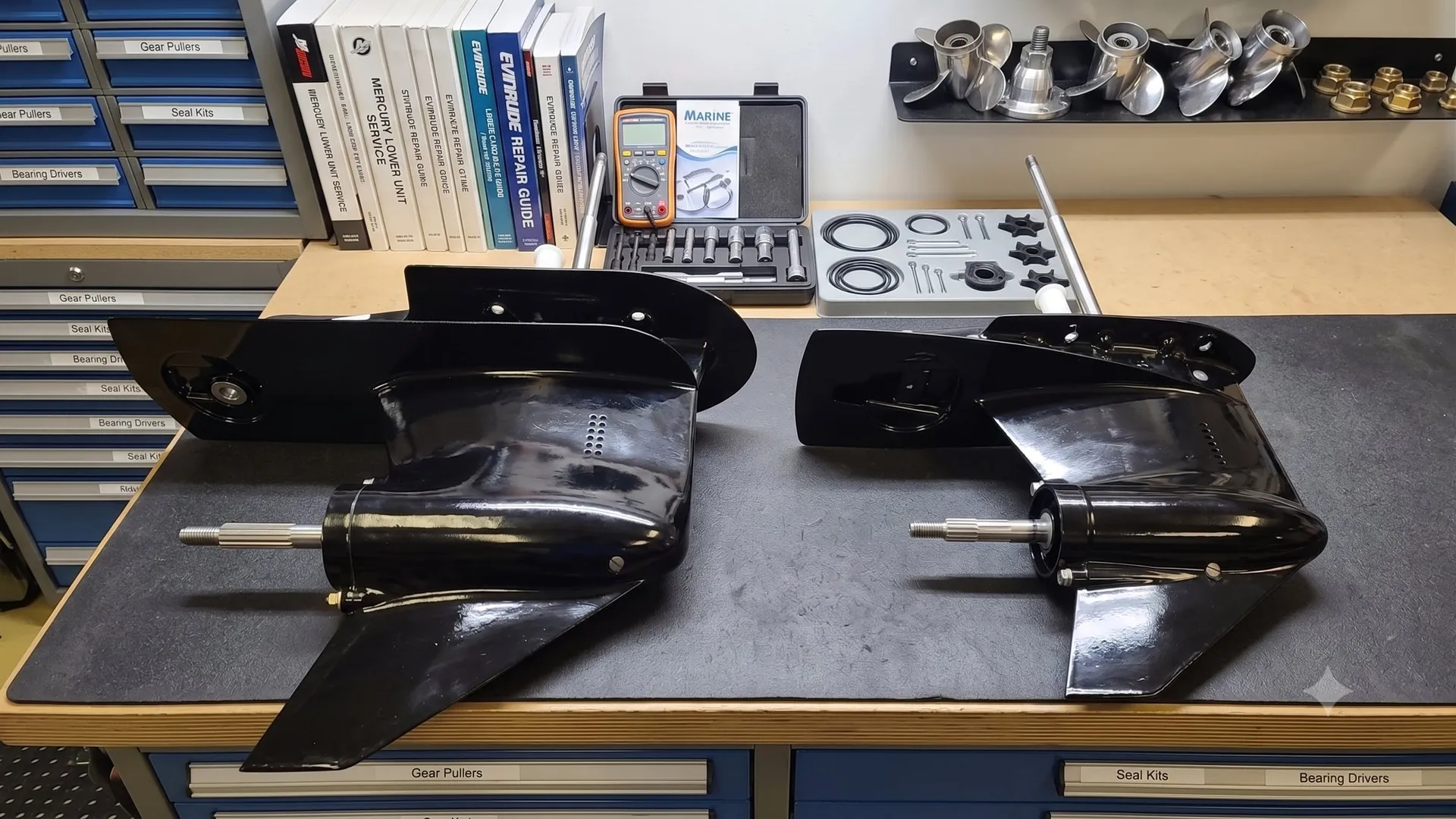
Last reviewed: 2026-07-12 > Quick answer: Command Thrust is Mercury's big-gearcase option, born as BigFoot in the 1990s to push pontoons and workboats. Bigger gearcase, taller gear ratio, bigger prop, more push. On a pontoon it's the standard choice. On a planing V-hull it...
Last reviewed: 2026-07-12
Quick answer: Command Thrust is Mercury's big-gearcase option, born as BigFoot in the 1990s to push pontoons and workboats. Bigger gearcase, taller gear ratio, bigger prop, more push. On a pontoon it's the standard choice. On a planing V-hull it costs real speed: our own back-to-back test on a 16 ft hull measured 6 mph gone. Call 905-342-2153 if you're not sure which gearcase your boat wants.
Somewhere right now, a boater with a 16-foot aluminum fishing boat is being told the Command Thrust model is "the upgrade." Costs a few hundred more, must be better, right?
We've tested exactly that setup. Two 16-foot Legends on Rice Lake, one rigged with a standard-gearcase Mercury 60, the other with the Command Thrust 60. The "upgrade" ran 6 mph slower.
We've been watching that sales pitch since the motor was called BigFoot. It was misleading then and it's misleading now. Command Thrust is a genuinely great piece of engineering that we sell and recommend constantly. For the boats it was designed for.
Here's the whole story: where it came from, what's actually different inside that gearcase, why pontoons love it, and why your V-hull almost certainly doesn't want it.
Quick recommendation
Pontoon or workboat: take Command Thrust. Planing V-hull (aluminum fishing boat, runabout, bass boat): take the standard gearcase. Not sure which one your boat is: call 905-342-2153 and we'll sort it in two minutes.
The BigFoot Story
Back in the 1990s, pontoon boats were taking off, and they created a problem the outboard industry hadn't fully solved. A pontoon sits high on the water, doesn't plane like a V-hull, and carries big loads at modest speeds. A standard mid-range gearcase spinning a small prop just wasn't moving that kind of boat well.
Mercury's answer was BigFoot. Take a 40-60 HP powerhead and hang it over a much bigger gearcase, with a larger-diameter driveshaft and propshaft closer to what a 90 HP class motor carries. The bigger case swings a bigger, deeper prop through a taller gear ratio (2.33:1 vs 1.83:1 on the 60). The result is push power: the ability to move a heavy, high-sitting boat with authority at the speeds it actually runs.
Mercury's own literature at the time called BigFoot "the industry's only outboard engine made specifically for pontoons." That's the origin, from the horse's mouth: a pontoon and workboat motor. Around 2014, Mercury quietly renamed BigFoot to Command Thrust. New name, same idea.
What's Actually Different Inside
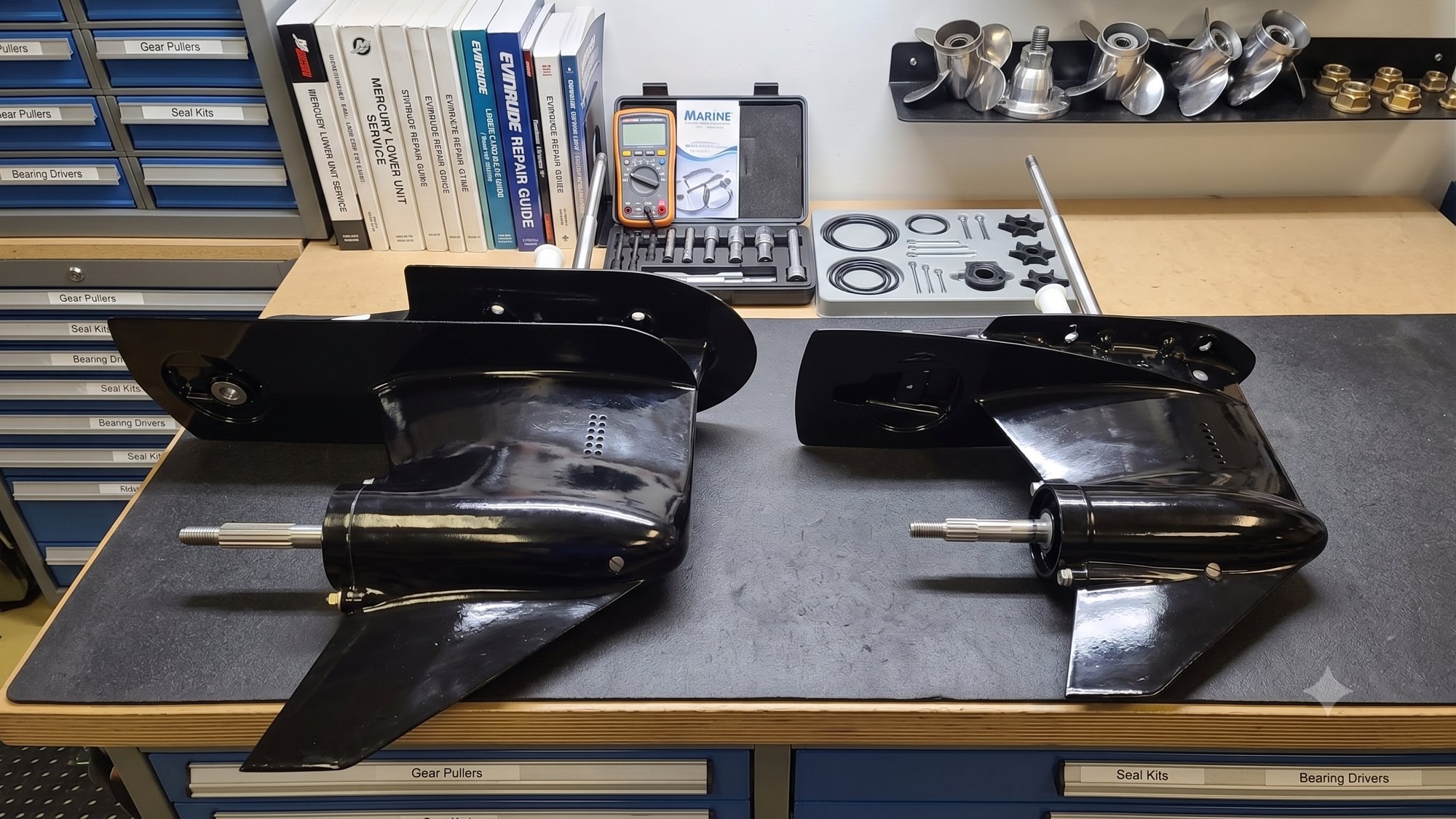
The two gearcases side by side on our bench. Same powerhead family, very different tools.
This isn't a trim package or a sticker. The CT gearcase changes the physics of what the motor can push:
| Spec |
60 HP standard |
60 HP Command Thrust |
| Gear ratio |
1.83:1 |
2.33:1 |
| Gearcase |
Standard case |
Larger case, heavier-duty shafts |
| Prop |
Standard wheel |
Roughly 3 inches more blade diameter |
| Gearcase depth |
Shallower |
Several inches deeper, prop runs in cleaner water |
| Spec |
90/115 standard |
90/115 Command Thrust |
| Gear ratio |
2.07:1 |
2.38:1 |
| Gearcase diameter |
~4.2 in |
~4.9 in (the same gearcase the 150 FourStroke runs) |
| Prop |
Standard wheel |
Bigger blade, more disc area |
The taller ratio spins the prop slower for the same engine RPM, and the bigger case lets it swing a much bigger blade. Slower shaft speed plus more blade area equals torque at the water, which is exactly what a heavy, slow-hulled boat needs to get moving and hold speed into wind and chop.
Nothing about the powerhead changes. A 60 CT makes the same horsepower as a standard 60. What changes is how that power reaches the water.
Why Pontoons Love It
A 22-foot pontoon with a family, a cooler, and a dog aboard can be pushing well over 3,000 lbs of boat and cargo, sitting high with tubes that shove water instead of slicing it. That boat doesn't need shaft speed; it needs a paddle wheel's worth of grip.
Command Thrust gives it exactly that. Better hole-shot with a full deck, better control docking in wind, less strain holding cruise into a headwind. Mercury's own R&D backs the engineering: in their testing, a 60 CT out-accelerated a Yamaha 70 under both light and heavy loads. Great gearcase. Right application.
This is why CT is the default answer on pontoons at HBW: the 60 CT is the hero motor for 18-20 ft two-log pontoons, and from 90 HP up on bigger pontoons and tritoons we spec CT almost every time. Our pontoon CT eligibility guide covers the size-by-size calls.
Same logic applies to true workboats: barges, water taxis, heavy displacement utility hulls that push weight all day. That's the duty the bigger shafts and case were built for.
Why Your V-Hull Doesn't Want It: The 6 MPH Nobody Mentions
A planing V-hull plays a completely different game. It climbs on top of the water and slices; past hole-shot, what it wants is low drag and efficient shaft speed.
Put a CT gearcase on that boat and you're dragging a case nearly three-quarters of an inch fatter and several inches deeper through the water at 30+ mph, swinging a prop tuned for push instead of speed. The sales pitch writes itself: it costs more, so it must be better. What the pitch never includes is a number.
We will, because we tested it. Two 16-foot Legend hulls on Rice Lake, one with a standard-gearcase Mercury 60, one with a Command Thrust 60. The CT boat gave up 6 mph on top speed.
Same hull. Same HP. Six miles an hour gone. The only difference in the water was the gearcase.
On a 16-footer that tops out in the mid-30s, that's roughly a sixth of your top speed handed over to a gearcase your boat never asked for. And you paid about $300 extra for it. That's not an upgrade; that's a downgrade with a markup.
The honest engineering summary: CT trades top-end efficiency for low-speed push. Pontoons live where the push matters. V-hulls live where the efficiency matters. That's the whole decision, and the GPS doesn't care what the brochure said.
The "Upgrade Model" Problem
Here's the part most dealer content won't say out loud.
Because CT costs a few hundred dollars more, it's easy to sell as "the upgrade model" or "the better gearcase" to V-hull buyers. We've seen it for decades: boaters with 16-foot tinnies being steered into BigFoot and CT motors that make their boats slower, because that's what was on the floor or because "bigger is better" is an easy pitch. Boating forums have carried threads about exactly this since the 2000s, usually ending with someone's V-hull pointing at the sky trying to get on plane.
Here's the thing: even Mercury doesn't call it an upgrade. When the 75-115 FourStroke family launched, Mercury's own category manager described Command Thrust as "basically a bigger rudder in the water" and aimed it at heavier 18-plus-foot boats and pontoons, while crediting the slim standard gearcase with a 15% cut in hydrodynamic drag. Two tools, two jobs, straight from the factory. "The upgrade model" is a sales-floor invention.
To be fair to the other side of the argument: some brands ship taller gear ratios as their standard case, the bigger CT case is genuinely tougher, and there are boaters who like a deeper prop in rough water. Those points are real. They still don't make CT the right call on a recreational planing hull, because the drag penalty and the prop mismatch come with every one of those trade-offs.
At HBW we're on the water. Every repower gets an on-water test on Rice Lake before pickup. No exceptions. So we see exactly what a gearcase choice does to a real boat with a real load. That's why our advice on this is blunt: we love Command Thrust, in the applications it was engineered for.
The Few V-Hull Exceptions
"Almost never" isn't "never." The legitimate V-hull cases we see:
- True workboats. A heavy steel or aluminum work hull that pushes loads at displacement speeds all day is a CT application no matter the hull shape. Same for barges and camp boats hauling material up the lake.
- Kickers and trolling. The 9.9 and 15 ProKicker line runs a CT-style deep gearcase, and it's brilliant at what it does: slow, precise trolling control. That's a purpose-built configuration, not an upsell.
- Heavy-duty duty cycles. A hull that spends its life towing, pushing, or loaded to the plate at low speed is worth a conversation. That conversation should end with a lake test, not a brochure.
If a dealer recommends CT on your V-hull and none of the above applies, ask them one question: "What will my top speed be compared to the standard gearcase?" We can answer that with a GPS log. See if they can answer it at all.
What HBW checks before speccing a gearcase
Boat type and how it actually gets used, first. Then the load reality (a pontoon with 10-passenger summers is a different boat than the same pontoon with two retirees aboard), the transom and mounting height, and the prop plan, because the gearcase and the prop are one decision, not two (prop selection guide here). If the answer isn't obvious, we put the boat in the water and test it. That's the advantage of buying a motor from a marina instead of a showroom.
Common mistakes
- Buying CT on a V-hull because it was called "the upgrade." It's not an upgrade; it's a different tool.
- Buying standard gearcase on a big pontoon to save a few hundred dollars. That's the mirror-image mistake, and it costs you every single time you leave the dock loaded.
- Ignoring the prop half of the decision. A CT motor with the wrong wheel wastes everything the gearcase offers.
- Assuming the gear ratio tells the whole story. Ratios only mean something in context of case size, prop, and hull. Comparing bare numbers across brands is how forum arguments start.
What Command Thrust Costs
As of July 2026, from our live pricing: the 60 ELPT FourStroke is $12,040 and the 60 CT is $12,342, about a $300 difference. The 90 ELPT is $14,960 vs $15,428 for CT. The 115 ELPT is $17,083 vs $17,540 for CT. On the right boat, that few hundred dollars is the best money on the invoice. On the wrong boat, it's paying extra to go slower.
Prices here are planning figures as of July 2026. For live Mercury motor pricing, see the Mercury pricing reference.
Frequently Asked Questions
Is Command Thrust the same thing as BigFoot?
Yes. BigFoot was the 1990s name for Mercury's big-gearcase pontoon and workboat option. Mercury renamed it Command Thrust around 2014. Same concept: bigger gearcase, taller gear ratio, bigger prop, more push power at low speed.
Does Command Thrust make the same horsepower?
Yes. A 60 CT and a standard 60 have identical powerheads. CT changes the gearcase, gear ratio, and prop, which changes how the power reaches the water, not how much power there is.
Should I get Command Thrust on my pontoon?
Almost certainly yes if you're 90 HP and up on a 20+ ft pontoon, and it's worth a conversation on smaller setups. CT is the standard pontoon choice at HBW. See the pontoon eligibility guide for size-by-size calls.
Should I get Command Thrust on my fishing boat?
Almost certainly no. On a planing aluminum or fibreglass V-hull, CT adds drag and costs top speed with no meaningful benefit. Standard gearcase with the right prop is the better setup. The exception is workboat duty or a ProKicker for trolling.
How much top speed does CT cost on a V-hull?
In our own back-to-back Rice Lake test, a 16-foot Legend with a Command Thrust 60 ran 6 mph slower than the same hull with a standard-gearcase 60. Lighter, faster hulls take the biggest hit; on bigger V-hulls the penalty is typically 2-5 mph. On a pontoon running 20-ish mph, the penalty barely exists, which is why the trade works there.
Why do some dealers push CT on V-hulls then?
It costs more, it's often what's in stock, and "the upgrade model" is an easy line. Sometimes it's honest ignorance about what the gearcase is for. Ask what your top speed will be versus the standard case and you'll find out quickly which kind of conversation you're in.
Which Mercury motors offer Command Thrust?
In our current lineup: 9.9 (including ProKicker), 40, 50, 60, 90, and 115 FourStroke, plus the 115 Pro XS CT. Availability shifts by model year; the pricing reference shows what's quotable right now.
When to call HBW
If you're not sure whether your boat is a push boat or a plane boat, that's a two-minute phone call that saves you from a multi-thousand-dollar mismatch: 905-342-2153. Repower quotes with the right gearcase spec take about three minutes at mercuryrepower.ca. Every repower gets an on-water test on Rice Lake before pickup. No exceptions.
Phone: 905-342-2153
Configurator: mercuryrepower.ca
Service: hbw.wiki/service
Sources
- Mercury Marine 75-115 HP FourStroke brochure (Command Thrust gearcase, 2.38:1 ratio)
- Boats.com, "Mercury Debuts All-New 75/90/115 FourStroke Outboards" (4.2 in standard vs 4.9 in CT gearcase)
- Mercury Marine launch video for the 75-115 FourStroke family: standard gearcase 15% drag reduction; CT positioned for heavier 18 ft+ boats and pontoons ("basically a bigger rudder in the water")
- Mercury R&D comparison testing, 60 CT vs Yamaha 70 acceleration
- HBW on-water testing, Rice Lake, 16 ft Legend hulls, standard 60 vs Command Thrust 60
Related guides: