Quick Answer Mercury FourStroke is the default Mercury outboard for Ontario freshwater boating. The family covers 2.5 HP portables through 300 HP V8s, and for the vast majority of Ontario boats, aluminum fishing rigs, pontoons, cottage runabouts, family fishing boats,...
Quick Answer
Mercury FourStroke is the default Mercury outboard for Ontario freshwater boating. The family covers 2.5 HP portables through 300 HP V8s, and for the vast majority of Ontario boats, aluminum fishing rigs, pontoons, cottage runabouts, family fishing boats, FourStroke is the right answer. Mercury Pro XS is the performance-tuned alternative if you actually run hard; Verado is special-order territory and rarely the right call on a freshwater boat. This guide is the starting point for any FourStroke buying decision in Ontario. Build a real installed quote at mercuryrepower.ca.
Why FourStroke is the default for Ontario
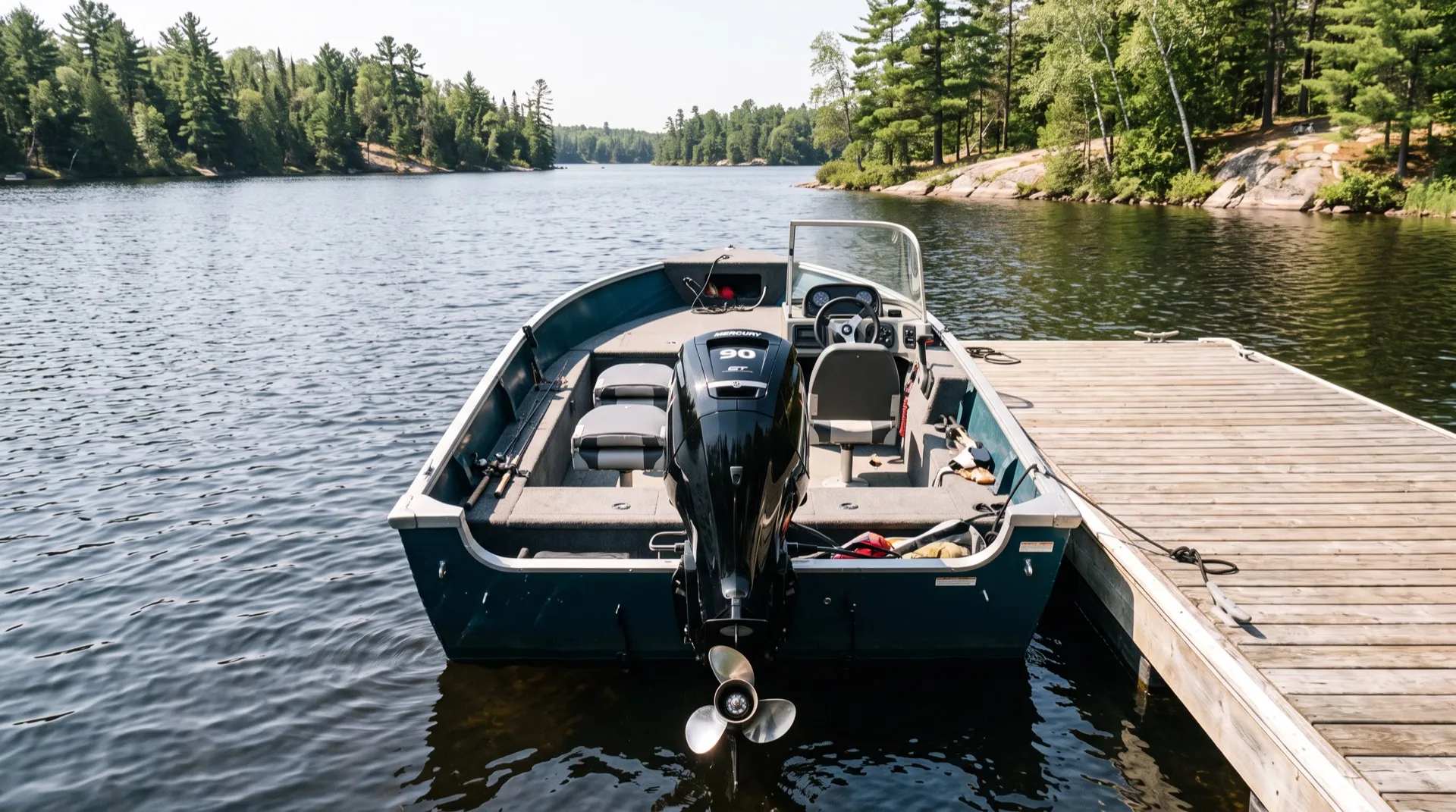
Most Ontario boats came factory-rigged with a Mercury FourStroke. That's not an accident, the major aluminum boat builders (Lund, Crestliner, Princecraft, Lowe) and many fibreglass runabout builders commonly package a Mercury FourStroke across their lineups. When you repower an Ontario boat, the question is usually "which FourStroke", not "Mercury FourStroke or something else."
The reasons are practical, not marketing:
- Fuel efficiency: modern 4-strokes burn 30-40% less fuel than the 2-strokes they replaced
- Quiet operation: important on the small lakes where Ontario does most of its boating
- Long service life: properly maintained, 15-25 years of useful service is realistic
- Mercury dealer and parts support: confirm the closest authorized shop and current parts availability for the motor you run, rather than treating any brand as automatically densest nationwide
- Resale support: Mercury-powered Ontario boats sell faster and to a wider buyer pool than equivalent setups with other brands
For an Ontario buyer, the FourStroke decision is rarely about whether to choose Mercury. It's about which HP class and which gearcase option.
The FourStroke lineup (2026)
| HP Range |
Configuration |
Typical Boats |
| 2.5 - 6 |
Portable, single-cylinder |
Dinghies, small tenders, very small fishing boats |
| 8 - 9.9 |
Portable or ProKicker |
Small fishing boats, kicker motors on larger rigs |
| 15 - 20 |
Portable or compact |
12-14 foot car-toppers, small aluminum |
| 25 - 30 |
Mid-weight |
14-16 foot aluminum, small pontoons |
| 40 - 60 |
Inline-3 |
14-17 foot aluminum, small pontoons |
| 75 - 115 |
2.1L inline-4 |
16-19 foot aluminum, mid-size pontoons (CT version) |
| 150 |
3.0L inline-4 |
18-22 foot aluminum + fibreglass, larger pontoons |
| 175 - 225 |
3.4L V6 |
19-22 foot runabouts, larger pontoons, ski boats |
| 250 - 300 |
4.6L V8 |
20+ foot cruisers, performance pontoons, larger fibreglass |
Within each HP class, there are configuration options that matter more than most buyers realize: shaft length, electric vs manual start, tiller vs remote, standard vs Command Thrust gearcase, and rigging family compatibility.
HP selection: how to actually decide
The first rule: start with the exact hull documentation. On an outboard-powered pleasure craft up to 6 metres, the Canadian compliance notice shows the manufacturer's maximum recommended safe power. Going beyond it can create real safety, insurance, warranty, liability, financing, and resale problems. HBW works from the documented rating and a boat-specific assessment.
Within the legal max, the right HP depends on:
Hull weight and intended use. A 16-foot aluminum running solo for bass fishing wants different power than the same hull running four adults and gear to a cottage. Lighter use = smaller HP works fine. Heavier loads = the larger HP earns its weight.
Cruise speed expectations. Most Ontario cruise targets are 25-32 MPH. A properly matched motor hits that range comfortably. Underpowered means you're holding the throttle wide-open just to plane; over-powered means you waste fuel hitting 38+ MPH unnecessarily.
Trim and load conditions you actually run. A pontoon with 8 people and coolers is a different load problem than a 2-person fishing trip. Match the motor to the heaviest realistic load you'll see, not the lightest.
For most Ontario use cases, these are the typical sweet spots we see at HBW:
| Boat Type |
Length |
Typical FourStroke HP |
| Aluminum fishing |
14-16 ft |
40-60 HP |
| Aluminum fishing |
16-18 ft |
75-115 HP |
| Aluminum fishing |
18-20 ft |
115-150 HP |
| Pontoon (small) |
20-22 ft |
60-90 HP |
| Pontoon (mid) |
20-22 ft |
90-115 HP CT |
| Pontoon (large/triple-tube) |
22-26 ft |
150-200 HP |
| Fibreglass runabout |
17-19 ft |
115-150 HP |
| Fibreglass runabout |
19-22 ft |
150-225 HP |
| Cottage cruiser |
18-22 ft |
90-150 HP |
The Command Thrust (CT) option on the 90 and 115 is worth understanding, see the gearcase section below.
The 75 / 90 / 115 question
The 75, 90, and 115 HP FourStroke share the same 2.1L inline-4 powerhead. Same block, same weight (163 kg (359 lb)), same physical footprint. The difference is software calibration, prop matching, and RPM limit.
For Ontario aluminum fishing boats (16-19 ft) and mid-size pontoons, this is the most common decision range, and the 90 is the sweet spot for most buyers. Here's why:
- 75 HP: RPM-limited to 5,500. Same motor as the 90, less performance. The price gap to the 90 is smaller than most buyers expect. We rarely recommend the 75 unless your capacity plate maxes at 75.
- 90 HP: RPM-limited to 6,000. Same physical motor as the 75 with more performance headroom. The default recommendation for most 16-19 ft Ontario boats.
- 115 HP: Full-throttle range 5,000–6,000 rpm, the same as the 90. The 5,300–6,300 rpm range belongs to the 115 Pro XS. Same motor with full performance turned on. Worth the upgrade when the boat is heavier or you want full planing margin.
This is why most factory-rigged Ontario 16-19 ft aluminum boats come with the 90 HP. It's the right answer most of the time.
Command Thrust (CT) on the 90 and 115
The Command Thrust gearcase is a larger-diameter lower unit with a different prop range. Command Thrust is offered on several FourStrokes: 9.9 (including ProKicker), 40, 50, 60, 90 and 115 HP. This section covers the 90 and 115. The benefit is more torque for moving heavy hulls, particularly pontoons.
The rule of thumb: if you're putting a 90 or 115 on a pontoon, you almost certainly want CT. The standard gearcase works on a planing hull; the CT is engineered for the displacement loads a pontoon presents. The price gap is usually $400-700 over the standard gearcase, and the performance difference on a loaded pontoon is meaningful.
For aluminum fishing boats, the standard gearcase is fine unless you're running heavy with multiple people and gear regularly.
Shaft length: 20" vs 25" (and the rare 30")
Match the shaft length to your transom height:
- 15" (short shaft, S): small portable motors, very few full-size boats
- 20" (long shaft, L): standard for most 14-18 ft aluminum and small fibreglass
- 25" (extra-long, XL): standard for most 18+ ft fibreglass, larger aluminum, pontoons
- 30" (XXL): rare; very large offshore or specialty boats
Measure your transom from the top of the boat-side bracket to the cavitation plate area. Most factory-rigged Ontario boats are already set up correctly, if you're repowering an existing boat, the new motor should match the old motor's shaft length unless the previous setup was wrong.
For more detail, see our Outboard Shaft Length Guide.
Tiller vs Remote (and ProKicker)
For motors 30 HP and under, tiller is common, you steer with the motor handle directly. For motors 40 HP and up, remote steering and throttle controls are the usual setup, though 40 to 60 HP tiller models are available.
The ProKicker is a special tiller configuration on the 9.9 HP (and recently 15/25) designed as a kicker motor, a secondary motor used for trolling on a primary-motored boat. ProKickers have:
- Higher gear ratio for low-speed trolling
- Alternator that keeps the battery charged while you troll
- Big-foot lower unit for better low-speed thrust
- Centering straps on tiller models that straighten and lock the kicker when it is tilted fully up
Most serious Ontario walleye, muskie, and bass setups run a 9.9 ProKicker on the transom alongside their primary motor. If you're shopping the 9.9 to 15 HP tiller class specifically, we have a dedicated Mercury 9.9 vs 15 HP comparison guide that walks through capacity plate, HP-restricted lakes, and kicker motor use.
What an installed FourStroke costs in Ontario (2026)
Installed pricing varies by HP, rigging complexity, and trade-in credit. Real CAD installed ranges for typical Ontario repowers:
| Motor |
Bare motor today (CAD, before HST) |
Add for rigging, controls, prop & install (estimate) |
| 9.9 ProKicker |
$5,000–$5,198 |
Quoted per boat |
| 25 |
$5,093–$6,265 |
Quoted per boat |
| 40 |
$9,438–$9,955 |
$1,500 to $2,500 |
| 60 |
$12,040–$13,057 |
$1,500 to $2,500 |
| 90 |
$14,960–$15,477 |
$2,000 to $3,000 |
| 115 |
$17,083–$17,892 |
$2,500 to $4,000 |
| 150 |
$22,242–$22,363 |
$3,500 to $5,500 |
| 200 V6 |
$27,858–$29,623 |
$4,500 to $6,500 |
| 250 V8 |
$36,080–$37,466 |
Quoted per boat |
These are general ranges based on 2026 pricing. Your actual installed price depends on existing rigging condition, prop spec, and any required upgrades (controls, gauges, harness, hydraulic steering). For Mercury outboard prices in Ontario on every FourStroke model in CAD, see our full price reference. Build a quote at mercuryrepower.ca for the exact installed total, HST extra.
What we see at HBW
The most common FourStroke decision mistake we see: buyers focusing on the motor HP number without thinking about the rigging context. A new 115 HP on a 15-year-old boat with original mechanical controls, single-cable steering, and worn-out gauges is going to feel like an underwhelming repower. The new motor is fine; the rigging context is what's holding it back.
Our standard repower includes a rigging assessment. If the controls are tired, we recommend replacement at the same time. The math: $1,500-$3,000 in fresh rigging makes the difference between a repower that feels new and one that just runs.
The other observation: customers consistently under-spec horsepower when they own their first boat, and over-spec on the second one. Match the motor to your actual use case, not the spec sheet aspirations.
How to get a quote
Build your real installed FourStroke quote at mercuryrepower.ca. Live CAD pricing, full configuration, three minutes. No phone call required.
For complex repowers (twin-engine setups, brand conversions, or unusual configurations), call 905-342-2153 after building the basic quote.