Quick answer Boat trim is the angle of your outboard relative to the transom, controlled by the trim button on your throttle. Trimming the motor IN (down) pushes the bow down and helps you get on plane quickly from a stop. Trimming OUT (up) lifts the bow once you're on plane,...
Quick answer
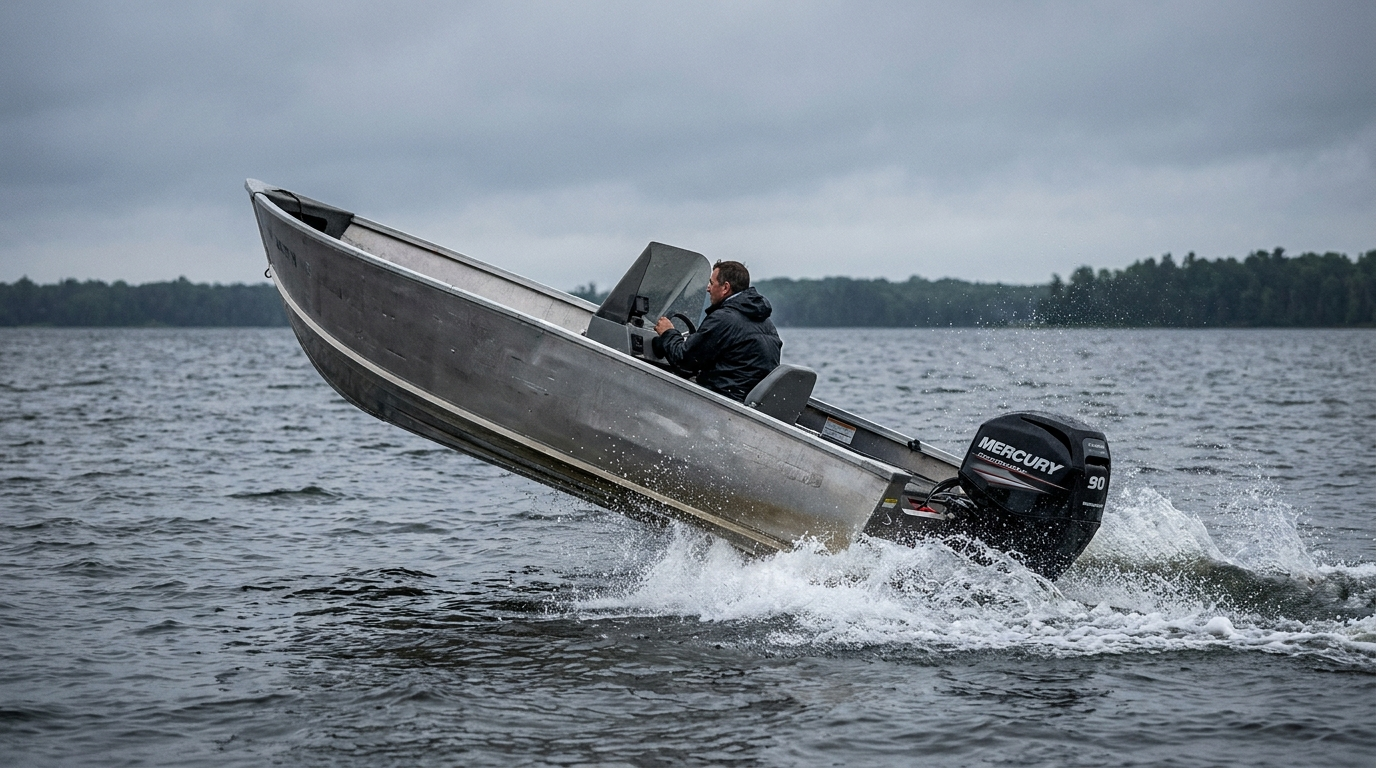
Boat trim is the angle of your outboard relative to the transom, controlled by the trim button on your throttle. Trimming the motor IN (down) pushes the bow down and helps you get on plane quickly from a stop. Trimming OUT (up) lifts the bow once you're on plane, which reduces drag, improves fuel economy, and gives you a smoother ride. The wrong trim setting wastes fuel, soaks your passengers with spray, makes the boat porpoise like a rocking horse, or buries the bow in chop. On Rice Lake at typical cruise speeds with a 14-19 foot aluminum boat and a Mercury outboard, the right trim setting is usually about 30-50 percent of the way out once you're up on plane. The rest of this guide explains how to feel that without overthinking it.
What trim actually does
Your outboard is mounted to the transom by a bracket that can pivot up and down. The trim button on your throttle control runs a hydraulic ram that changes this angle. When the motor angles in toward the transom, the propeller thrust pushes the bow down. When the motor angles out away from the transom, the thrust pushes the bow up.
That's it. Everything else is just the consequence of bow angle relative to the water.
The three trim positions you actually use
Trim full IN (down): for hole shot and getting on plane.
The bow stays down, the prop bites cleanly, the boat accelerates without "plowing" or burying the nose. Most boats need trim fully in for the first 3-5 seconds when you push the throttle from idle to cruise.
Trim partially OUT (mid-position): for cruise speed.
Once the boat is up on plane and running, trim out until the bow lifts and the boat feels smooth, fast, and quiet. You want to feel the boat "settle" onto the water rather than fight against it. On most Rice Lake aluminum fishing boats, this is about 30-50 percent of the trim range.
Trim full OUT (up): for shallow water, beaching, or driving on a trailer.
This is the position for getting the prop out of the way, not for running at speed. If you run at cruise speed with trim full out, the prop will lose grip and ventilate, and the bow will bounce uncontrollably.
The mistakes we see most often on Rice Lake
Mistake 1: leaving trim full IN at cruise
This is the most common one. People hit the throttle with trim in, the boat planes nicely, then they forget to trim out. The result: bow stays low, the hull pushes more water than it should, fuel burn is high, top speed is reduced, and the ride is wetter than it needs to be.
Fix: once you feel the boat on plane (usually 5-8 seconds after throttle-up), trim out gradually until the bow lifts and the boat feels smooth.
Mistake 2: porpoising from too much trim OUT
If you trim out too far at cruise, the bow lifts so much that the hull lifts off the water in front, then drops back, then lifts again. This rocking-horse motion is called porpoising. It's uncomfortable, it wastes fuel, and it scares passengers.
Fix: trim in slightly until the porpoising stops. The boat should feel level and smooth, not bouncing.
Mistake 3: ignoring trim in chop
Rice Lake gets 1-2 foot chop when the wind picks up from the southwest. In choppy water, the bow needs to be DOWN, not up. Lower bow cuts through chop. Higher bow slams into chop.
Fix: trim in 1-2 button presses when conditions get bumpy. You sacrifice a knot or two of speed but the ride and the boat both thank you.
Reading what your boat is telling you
You don't need a trim gauge to get trim right. The boat tells you everything you need to know:
- Bow too high (porpoising or bouncing in calm water): trim in.
- Bow too low (spray over the windshield, sluggish acceleration, plowing feel): trim out.
- Boat feels heavy on the wheel: trim in slightly, you're fighting the bow lift.
- Boat feels loose or wandering at speed: trim in slightly, you've gone too far out.
- Prop ventilating or losing grip in turns: trim in, the prop is angling too high to stay in clean water.
After a few weeks of running your boat, you'll trim without thinking about it. The motor will tell you what it wants.
Trim and fuel economy
You can build a live CAD quote for your repower online at Mercury Repower Centre.
The right trim setting at cruise can save 10-20 percent on fuel compared to running with trim full in. On a Mercury 90 HP burning 6-7 gallons per hour at cruise, that's worth real money over a season. The exact savings depend on hull design, load, and conditions, but the direction is consistent: proper trim equals lower fuel burn.
This is one of the reasons we tell new boat owners that the trim button is the cheapest performance upgrade their boat has. It costs nothing, and using it right makes the boat noticeably faster and quieter.
Trim on different boat types
Aluminum V-hull fishing boats (the most common Rice Lake setup): respond well to trim, need about 30-50 percent trim out at cruise.
Pontoons: less responsive to trim than V-hulls because the flat hull doesn't "ride" on the water the same way. Most pontoons need minimal trim, usually 10-25 percent out at cruise. Over-trimming a pontoon doesn't help speed and can cause the front to wander.
Bass boats and performance hulls: very trim-sensitive, need careful adjustment to extract top speed. These boats reward an operator who pays attention.
Bowriders and runabouts: similar to V-hulls but heavier, often need slightly more trim in for the family-load condition.
Trim and Mercury Pro XS
If you own a Mercury Pro XS or are considering one, the trim conversation gets more interesting. Pro XS motors are designed for higher-performance applications and respond differently to trim than a standard FourStroke. The optimum trim is usually further out, top speed is more trim-sensitive, and a good operator can find an extra 2-4 mph just by playing with the button. Our Mercury Pro XS Repower Guide for Rice Lake & Kawartha Anglers covers this in detail.
What we do at Harris Boat Works
When customers buy a new boat from us, we run through the trim basics on the launch day. It's a 5-minute conversation that saves people years of frustration. For owners coming in for service who mention "the boat feels slow" or "it bounces a lot," the trim conversation is usually the first diagnostic step. About half the time, trim is the issue. The other half, it's a propeller or a worn impeller, both of which we'll find on inspection.
If you'd like a structured run-through of trim on your specific boat, email info@harrisboatworks.ca and we can usually walk you through it in 5 minutes. For the broader boat handling conversation, our Docking in Wind on Rice Lake post covers another piece of the same skill set.
Sources
- Mercury Marine outboard operation guide (dealer technical reference, 2026)
- Transport Canada Pleasure Craft Safety Guide
- HBW dealer experience, 2018-2026 customer service records
About the author
Jay Harris helps run Harris Boat Works, a third-generation family marina in Gores Landing on Rice Lake, established in 1947. HBW is a Mercury Marine Premier Dealer and Legend Boats dealer serving Rice Lake, the Kawarthas, and Ontario boaters who want straight answers before spending real money. Read Jay's full bio.
Ready to price it out? Build a live CAD quote for your repower online at the Mercury Repower Centre.
