--- ## What "Pro XS" actually means Pro XS is Mercury's tournament and performance line. It's still a four-stroke, the days of the screaming Pro XS two-strokes are behind us, but the tuning is different from a standard FourStroke. The differences that matter on the water: -...
Quick answer: Mercury Pro XS is the angler-focused outboard family across 115–300 HP. For Rice Lake and Kawartha bass, walleye, and muskie boats, the sweet spot is usually 175 HP V6 or 200–225 HP V8 Pro XS, strong hole-shot, fuel-efficient cruise, and proven reliability. The 150 Pro XS is inline-4 (lighter); 200 and above are V8. The right choice depends on hull rating, fishing style, and budget. Quote: mercuryrepower.ca.
What "Pro XS" actually means
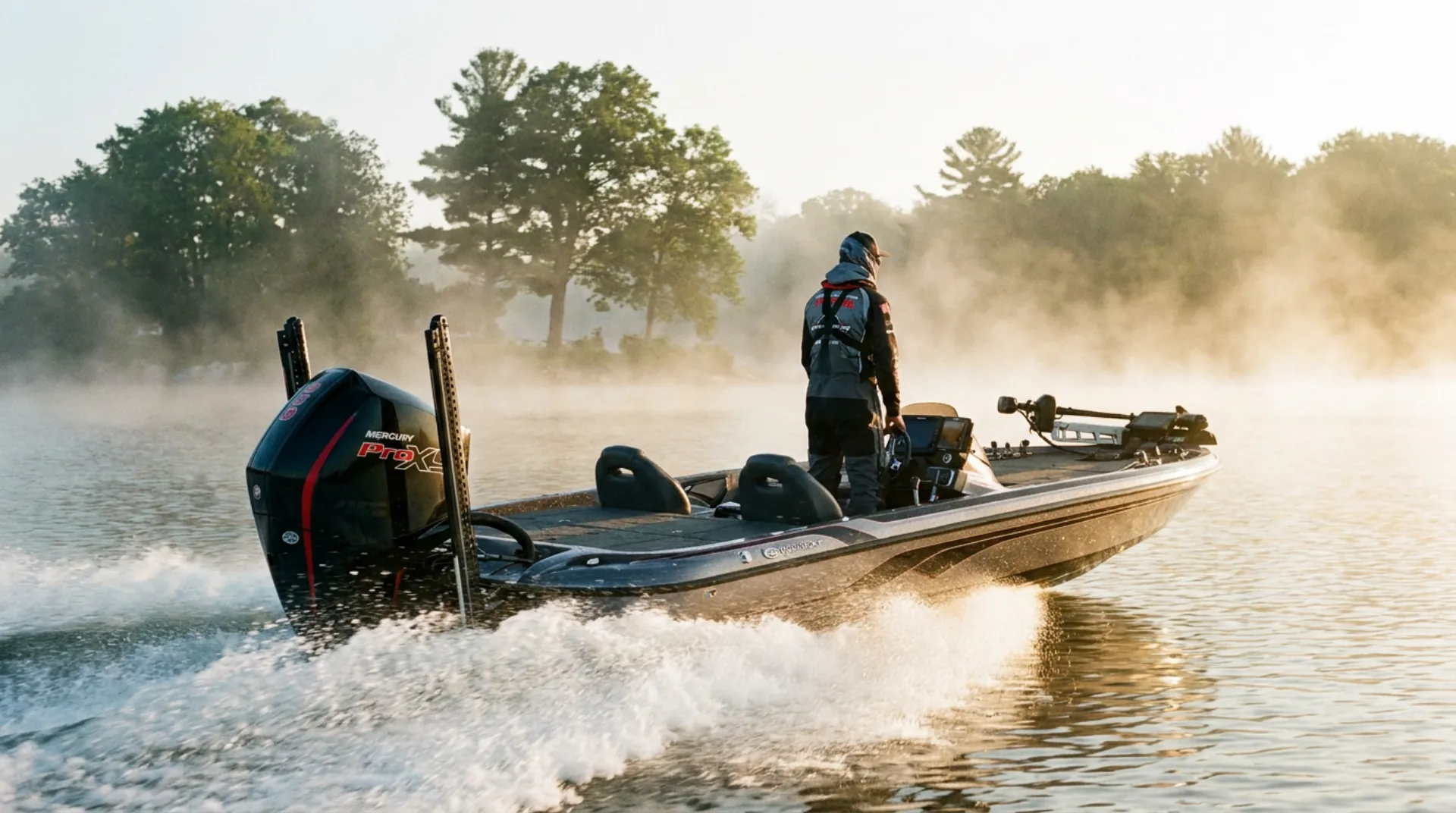
Pro XS is Mercury's tournament and performance line. It's still a four-stroke, the days of the screaming Pro XS two-strokes are behind us, but the tuning is different from a standard FourStroke.
The differences that matter on the water:
- Lower gear ratio for harder hole-shot and quicker plane.
- Higher max RPM ceiling so the motor pulls cleanly all the way through the throttle range.
- Tuned calibration that responds instantly to the throttle instead of easing in.
- Performance gearcase (Sport Master or similar on the bigger HPs) that handles high-RPM water and aggressive prop choices.
The 115 and 150 Pro XS are inline-four. The remaining V6 rating is the 175. The 200, 225, 250, and 300 Pro XS are 4.6 L V8. The 150 is meaningfully lighter than the V6 and V8 models, which is why it shows up on smaller aluminum bass boats.
The trade for that response: Pro XS isn't a fuel miser. The trade is fuel for response. Tournament anglers happily make that trade. Weekend cruisers usually shouldn't.
Why anglers repower to Pro XS
The anglers we see repowering to Pro XS are usually moving from one of three places:
Old two-stroke V6 (mid-90s to early 2000s Mercury, OMC, Yamaha). The two-stroke is loud, smoky, fuel-hungry, and getting harder to keep parts for. A modern Pro XS makes more usable power, burns less fuel, runs quieter, and starts every time.
FourStroke that doesn't have the punch they want. A FourStroke 200 will get a 19-foot bass boat on plane just fine. A 200 Pro XS will get the same boat on plane noticeably faster, with a sharper throttle response, and a higher top end. For tournament anglers who clear weed lines on Rice Lake and run between spots on Stoney or Buckhorn, that difference is real.
Tired older Pro XS. The Optimax-era Pro XS earned a strong reputation. Owners coming out of those motors usually want the modern Pro XS because the response and the sound profile they remember are still there, plus modern reliability and fuel efficiency.
The other reason matters less in marketing copy but a lot in real life: having a Mercury Premier Dealer on the lake means you've got a local shop that can actually fix things. That's why so many Kawartha anglers repower with us specifically.
Choosing your Pro XS HP
Which Pro XS for your fishing?
Hull rating is the hard limit. After that, fishing style decides.
115–150 Pro XS
- ✓Smaller bass boats (16–17 ft aluminum or fiberglass)
- ✓Single-angler or two-angler max
- ✓Tight-water lakes and weed-edge fishing
- ✓150 Pro XS = inline-4, lighter rigged package
Best for light, tight-water bass rigs
175–225 Pro XS
- ✓18–20 ft aluminum or fiberglass angler hulls
- ✓Multi-lake days across Rice, Pigeon, Stoney
- ✓Two- or three-up fishing, full livewells
- ✓Top end varies by hull, load, and setup; ask us for real-world numbers on your rig
Sweet spot for most Kawartha anglers
When in doubt:Most Rice Lake and Kawartha anglers land on a 200 or 225 Pro XS V8 with the standard gearcase.
The 250 and 300 Pro XS belong on 20–22 ft tournament rigs, multi-species tournament boats, or anglers who run the Trent-Severn at speed. The 300 is V8, heaviest, fastest, and most expensive to operate. If that's the boat you fish, you already know it. If you're not sure, you probably don't need it.
Command Thrust on Pro XS
Short version: Command Thrust is a hull, load, and propeller choice, not a universal V-hull ban. HBW's shop recommendation for most planing V-hull angler and bass boats we see, even loaded three-up with a full livewell, tackle, and electronics, is still the standard gearcase.
Other dealers commonly spec CT on those boats claiming "more torque." Ask for the actual boat, prop, and test result. Standard gearcase Pro XS is the usual HBW call for Rice Lake and Kawartha angler boats.
If you want more low-speed control for trolling, that's what a 9.9 or 15 HP ProKicker is for (the ProKicker CT gearcase is a legitimate trolling-motor configuration). Pro XS CT itself only makes sense on the narrow pontoon/workboat applications the CT gearcase was engineered for, and even there it's a niche pick.
Fuel economy reality check
Pro XS isn't a fuel miser. That has to be said honestly.
Fuel use depends on hull, load, propeller, RPM, and conditions. Compare on-boat fuel-flow readings at the same speed, or a dated Mercury performance report for a comparable hull, before treating one family as cheaper to run.
For a tournament angler running 60 km in a day, the response wins, you're not buying the motor for fuel economy, you're buying it for hole-shot and top-end. For a weekend fisherman who runs to one spot, anchors, and fishes for six hours, FourStroke makes more sense. Same hull, same HP, less fuel, more quiet, less money up front.
Honest framing matters. We sell both because they're both right for different people.
Hole-shot, top-end, and where they matter
Different Kawartha water rewards different things:
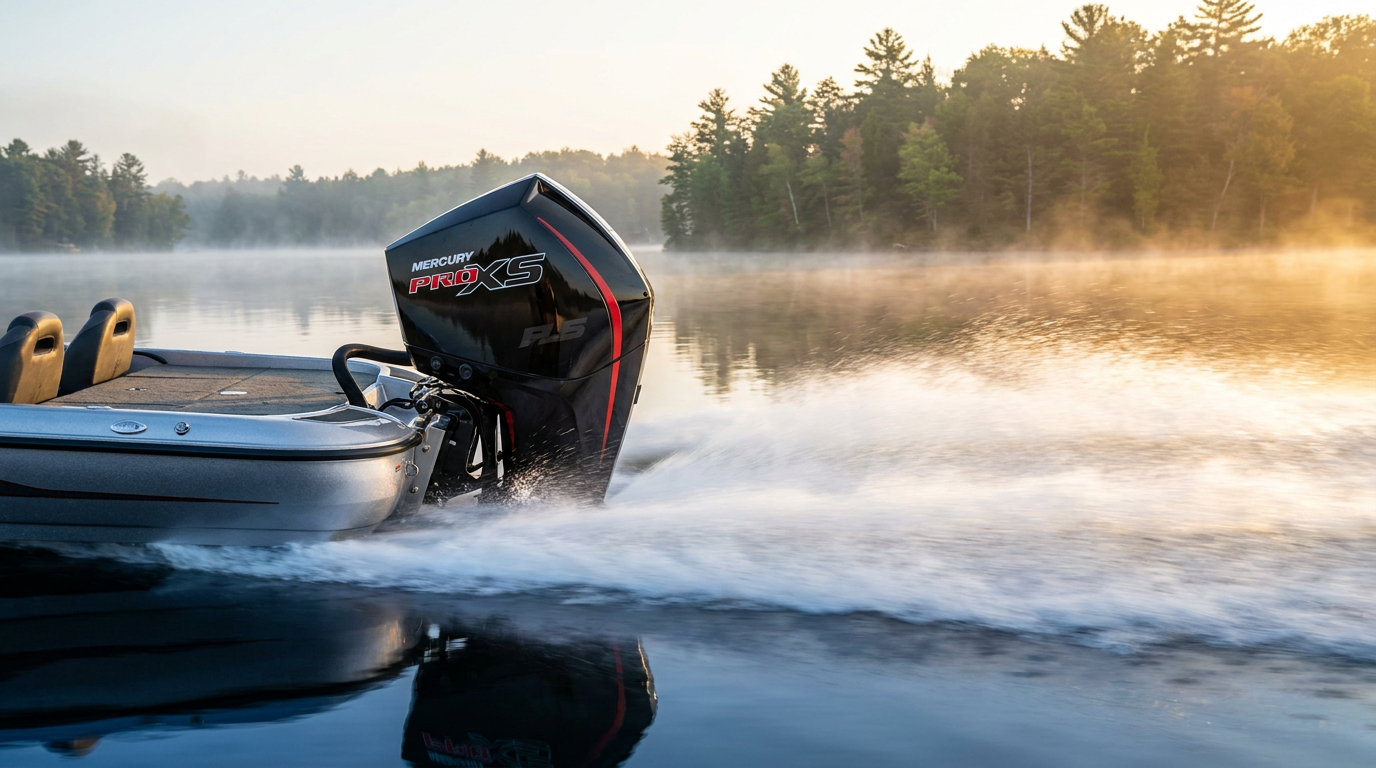
- Rice Lake: weed lines and shallow flats. Hole-shot dominates. You're up-and-over, not flat-out. Pro XS shines.
- Stoney, Buckhorn, Pigeon: bigger water, longer spot-to-spot runs. Top-end matters more. A 200 or 225 Pro XS V8 is the sweet spot.
- Trent-Severn cruising: lock-to-lock running with fuel range as a constraint. Top-end and fuel range both matter. A 200 or 225 Pro XS sized to your hull is hard to beat.
- Cold-water muskie water: heavier rigs, bigger props, harder to plane. Size to your hull's capacity plate, and the best fit is usually one model below the plate maximum.
Match the HP to the water you actually fish, not the water you fished once on a road trip.
Repower cost reality
A Pro XS repower isn't just the motor. The line items add up:
- Motor (the biggest line)
- Rigging kit (controls, harnesses, throttle/shift)
- Gauges (digital SmartCraft displays where applicable)
- Prop (stainless for performance hulls)
- Steering (hydraulic on most 175+ Pro XS installs; confirm the exact engine and helm)
- Install labour
- Lake test and tuning
- Taxes
Installed cost depends on HP, rigging, and what we can reuse from the existing setup. A 150 Pro XS inline-4 build sits lower. A 300 Pro XS V8 build sits higher.
Don't budget off this paragraph. Run a real quote at mercuryrepower.ca, the quote builder uses our actual pricing, accounts for what we can reuse from your existing setup, and shows financing options if applicable. Numbers in CAD, no surprises.
HBW process for a Pro XS repower
The practical walk-through:
- Assessment. You bring the boat in (or send photos and specs if you're trailering from far). We check the transom, stringers, fuel system, rigging tunnels, and hull rating. We confirm the HP you want fits the hull.
- Quote. We build a real CAD quote with motor, rigging, prop, steering, install, and taxes. Financing options laid out if you want them.
- Order. Motor goes on order with Mercury. Lead time depends on HP, shaft length, and current allocation.
- Install. Two to four working days in the shop once motor and parts are in hand. Rigging done clean, not over the top of the old harness.
- Lake test. We run the boat on Rice Lake, set throttle and shift, confirm WOT RPM is in spec, and prop accordingly.
- Handoff. Walk-through on the new motor, paperwork, warranty registration, and how to use SmartCraft features if you're new to them.
Most anglers plan repowers over the winter so the boat is ready for opening day. We take orders all winter (the shop itself is closed December 1 through April 1), lead times are shorter, and you're not losing fishing days.
When NOT to go Pro XS
Honest counter-positioning. Pro XS is the wrong answer if:
- You fish leisurely, never tournament. A FourStroke at the same HP costs less, burns less fuel, runs quieter, and does the job.
- Your hull is rated lower than the Pro XS HP you want. Hull rating is a hard limit. We won't repower over the rating, and you shouldn't either.
- The boat is 25+ years old with a questionable transom. A wet transom or rotted stringers means repower money is going into a hull that won't outlast the motor. In that case, the honest answer is to look at a new boat or a serious hull repair before the motor decision. See our boat hull replacement vs repower decision guide for how we walk through that call with customers.
About the author
Jay Harris helps run Harris Boat Works, a third-generation family marina in Gores Landing on Rice Lake, established in 1947. HBW is a Mercury Marine Premier Dealer and Legend Boats dealer serving Rice Lake, the Kawarthas, and Ontario boaters who want straight answers before spending real money. Read Jay's full bio.
Related guide: Boat trim basics for Rice Lake.
Related guide: DTS vs mechanical controls, what Pro XS buyers should know.
More from HBW on Mercury performance and repowers
For a real CAD quote on a Pro XS repower, use the quote builder at mercuryrepower.ca. For service bookings and shop appointments, hbwservice.ca.
Harris Boat Works
5369 Harris Boat Works Rd, Gores Landing, ON K0K 2E0
Mercury Marine Premier Dealer. Established 1947.