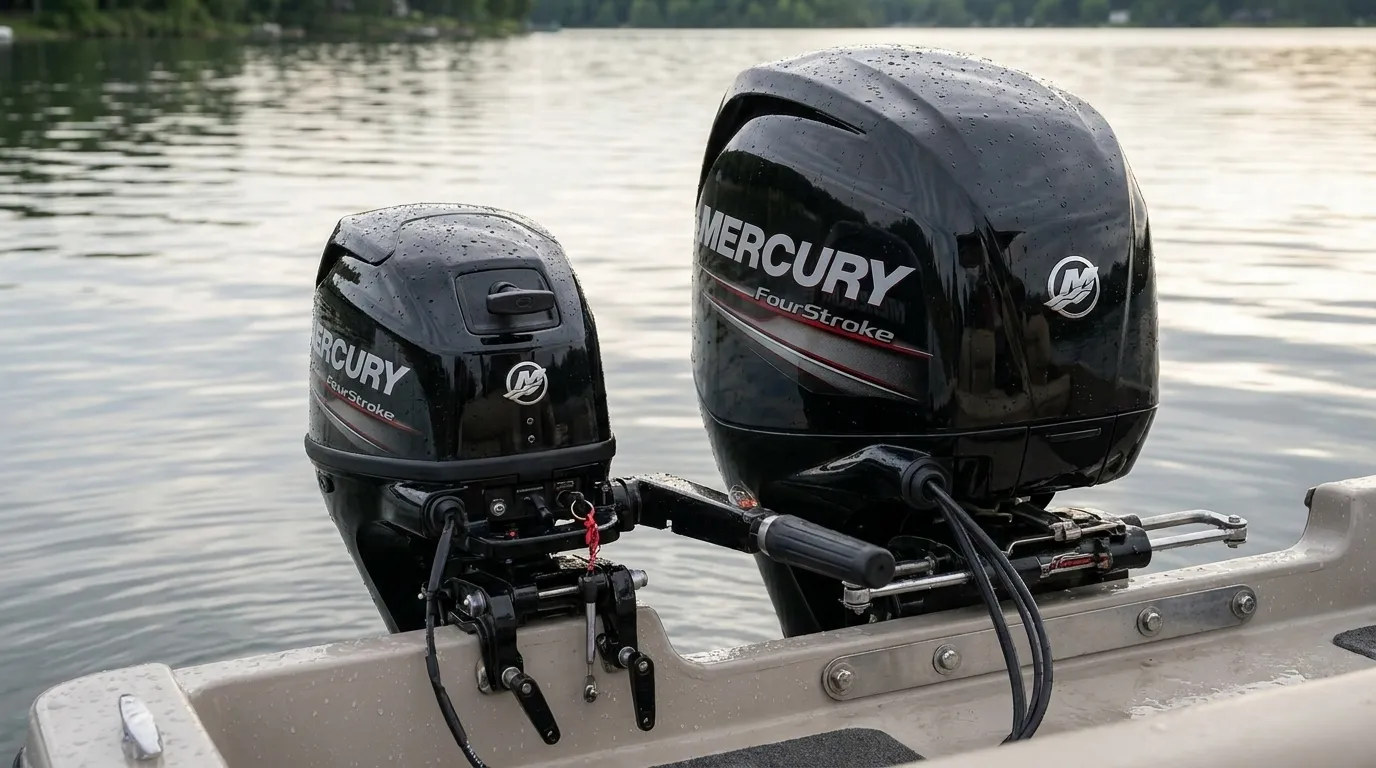
Quick answer On Rice Lake and the Kawarthas, a gas kicker, specifically the Mercury 9.9 ProKicker, wins for walleye trolling, big water, and all-day range. A bow-mount electric trolling motor wins for shallow-water stealth, spot-lock precision, and solo fishing. Most serious...
Quick answer
On Rice Lake and the Kawarthas, a gas kicker, specifically the Mercury 9.9 ProKicker, wins for walleye trolling, big water, and all-day range. A bow-mount electric trolling motor wins for shallow-water stealth, spot-lock precision, and solo fishing. Most serious anglers end up running both. They solve different problems. We rig either setup; get a quote at mercuryrepower.ca.
Honest auxiliary pick
Trolling motor or kicker motor for your boat?
Different waters, different answers. Boat positioning and sustained trolling need different tools.
Choose a trolling motor if
- ✓You fish predominantly in 8 to 15 ft of water
- ✓Spot-Lock and GPS-anchor are important
- ✓Stealth matters (no gas engine running while fishing)
- ✓Battery management is something you can handle
- ✓Primary use is boat positioning, drifting, or other controlled presentations
Pick a trolling motor (Minn Kota or Lowrance)
Choose a kicker motor if
- ✓You troll for salmon or lake trout in deep water (40 ft or more)
- ✓All-day trolling outlasts any practical battery
- ✓You don't want to babysit charging schedules
- ✓Boat is on bigger water (Lake Ontario, Simcoe deep zones)
- ✓You want refuelling at the tank instead of battery charging, plus all-day range
Pick a Mercury 9.9 EFI kicker
When in doubt:An electric trolling motor suits precise positioning; compare a kicker for sustained trolling. Match either setup to the weather, load, and available battery or fuel supply.
What each one actually does
An electric trolling motor is battery-powered, rated in pounds of thrust (not horsepower), and mounts at the bow or transom. Modern bow-mount units come with GPS spot-lock (the boat holds position against wind and current automatically), plus wireless foot pedal control and programmable navigation routes.
Brands you will see: Minn Kota, Garmin Force, MotorGuide.
A gas kicker is a small outboard mounted alongside your main motor. It runs on gasoline, gives you real propulsion at trolling speeds, and is rated in horsepower like any outboard. The Mercury 9.9 ProKicker is the king of this category, purpose-built for kicker duty with a low-RPM idle, sailboat-mode programming, and a gear ratio tuned for thrust at slow speed rather than top-end speed.
These are not competing tools. They are complementary. But they cost real money, so most boaters pick one first.
Compare how each system will be used. Evaluate steering and position control, desired trolling behaviour, battery or fuel capacity, charging arrangements and installation compatibility. Check the exact equipment specifications. Neither option provides unlimited range or guarantees emergency propulsion.
Head-to-head: when each one wins
| Factor |
Electric Trolling Motor |
Gas Kicker |
| Noise |
Silent |
Quiet but audible |
| Range |
Battery-limited (roughly 1 to 6 hours) |
Effectively unlimited |
| Stealth in shallow water |
Excellent |
Good, not silent |
| Top trolling speed |
~3 to 5 mph |
~5 to 7 mph |
| GPS spot-lock |
Yes (holds position without an anchor) |
No |
| Hands-free control |
Yes (foot pedal / wireless) |
No |
| Wind and wave handling |
Limited above 1 to 2 ft chop |
Excellent |
| Maintenance |
Minimal |
Standard outboard service |
| Upfront cost (CAD, approx.) |
$500 to $3,500 (before batteries) |
$4,000 to $7,500 installed |
| Emergency backup propulsion |
Limited (battery-dependent) |
Full backup |
Prices here are planning figures as of September 2026. For live Mercury motor pricing, see the Mercury pricing reference.
When an electric trolling motor wins
You fish shallow water for bass or panfish
Bass do not tolerate noise. A properly handled bow-mount electric is quiet enough to drift right over fish in 3 feet of water. Same for crappie in spawning bays, perch on weed flats, or pike working lily pads.
You fish solo and need hands-free control
The foot pedal or wireless spot-lock anchor changes how you fish. You can land a fish, re-bait, and reposition without ever touching a steering wheel or moving a tiller.
You work structure in 4 feet of water or less
A kicker gearcase still hangs down 18+ inches. A trolling motor runs comfortably in a foot of water.
You want spot-lock
Press a button and the boat holds GPS position against reasonable wind, so you can land a fish, re-bait, or work a spot without resetting an anchor. Range and hold still depend on battery capacity, wind, and current.
Honest limitation of electrics
Battery range is real. A 50 lb-thrust unit running at 70% draws a single deep-cycle battery down in roughly 4 to 5 hours. Lithium (LiFePO4) battery upgrades help significantly but add to the upfront investment.
When a gas kicker wins
You troll for walleye
This is what kickers were made for. Walleye trolling on Rice Lake demands sustained low-speed propulsion in open water, often in building chop. A gas kicker on a full tank handles an all-day walleye session without complaint.
You fish big water or serious chop
Lake Simcoe, the Trent-Severn main channel, the Kawarthas in October wind. A gas kicker has enough thrust to push through conditions that strand an electric motor.
Your main motor is a V6 or V8
Larger Mercury 4-strokes (175 HP and up) are not built to idle at 600 to 800 RPM for hours. Extended low-RPM operation glazes cylinders and burns oil. Trolling on a dedicated kicker instead of lugging your main motor at idle will extend your powerhead life measurably.
You want a backup motor
Main motor will not start at the far end of Rice Lake? The kicker gets you home.
The Mercury 9.9 ProKicker specifically
Mercury makes both a standard 9.9 FourStroke and a ProKicker version. For kicker duty, the ProKicker is the right choice:
- Idle drops to ~600 RPM vs ~750 on the standard
- Achieves slower, steadier trolling speeds
- "Sailboat mode" programming for hands-off running
- Gear ratio optimized for thrust at low speed, not top-end
- Available with electric start and power tilt
Approximate installed cost (CAD) varies with options. Confirm current pricing at mercuryrepower.ca.
Why most serious anglers end up running both
If you fish 30+ days a season and target more than one species, you will eventually want both. The setup that serious Rice Lake anglers run:
- Bow-mount electric with spot-lock for working specific structure (drop-offs, weed edges, the railway line)
- Transom-mount kicker for covering ground between spots, long trolling runs, and handling weather
The electric finds the fish. The kicker covers water.
Approximate combined investment for a quality setup on a 17 to 19 ft fishing boat (CAD):
| Item |
Approximate Cost |
| Bow-mount electric (e.g. Minn Kota Terrova 80 with spot-lock) |
$3,000 to $4,500 |
| Mercury 9.9 ProKicker, installed |
$5,500 to $7,500 |
| Lithium battery upgrade (optional but recommended) |
~$1,200 |
| Total |
$9,500 to $13,200 |
The decision framework for Rice Lake and Kawartha boaters
| Your situation |
Start with |
| Bass-only, weed beds, shallow bays |
Bow-mount electric with spot-lock |
| Walleye trolling is your main game |
Mercury 9.9 ProKicker |
| You fish 100+ hours a season, multiple species |
Both, the question is which one first |
| You have a big main motor (175 HP+) |
Kicker first, it protects your main motor |
| You fish exposed water and building chop |
Kicker first |
| Tight budget, casual angler |
A quality bow-mount electric without spot-lock is a reasonable start |
What we do at HBW
We rig both setups regularly:
- Mercury 9.9 ProKicker installations with proper transom bracket selection, fuel-line plumbing from the main tank, and tiller or remote linkage to your console
- Bow-mount trolling motor installs including wiring runs, battery placement, and spot-lock setup and pairing
- Lithium battery upgrades for boaters running heavy draw on the bow electric
- Annual kicker service (oil, impeller, plugs) and battery health checks on the electric side
For engine repairs, we only service Mercury and MerCruiser.
Request service at hbw.wiki/service or price a new ProKicker at mercuryrepower.ca.