Last reviewed: 2026-06-06 > Quick answer: BRP stopped producing Evinrude outboards in 2020 and Johnson outboards haven't been built under that name since the early 2000s. Parts and qualified service are shrinking every year. When keeping an orphan motor alive stops being...
Last reviewed: 2026-06-06
Quick answer: BRP stopped producing Evinrude outboards in 2020 and Johnson outboards haven't been built under that name since the early 2000s. Parts and qualified service are shrinking every year. When keeping an orphan motor alive stops being practical, a Mercury repower is the cleanest path back to reliable time on the water.
Your Evinrude isn't coming back. Here's what happens next.
BRP stopped producing Evinrude outboard motors in 2020. Johnson outboards haven't been manufactured under that name since the early 2000s. If you're still running one, you've been doing what a lot of Ontario boaters do: keeping it alive with used parts and goodwill.
That works until it doesn't.
As of mid-2026, BRP still supplies some Evinrude parts and the aftermarket fills gaps, but BRP has retired its dealer parts-locator service, and availability is patchy and shrinking. Common service items are findable. Model-specific parts increasingly are not.
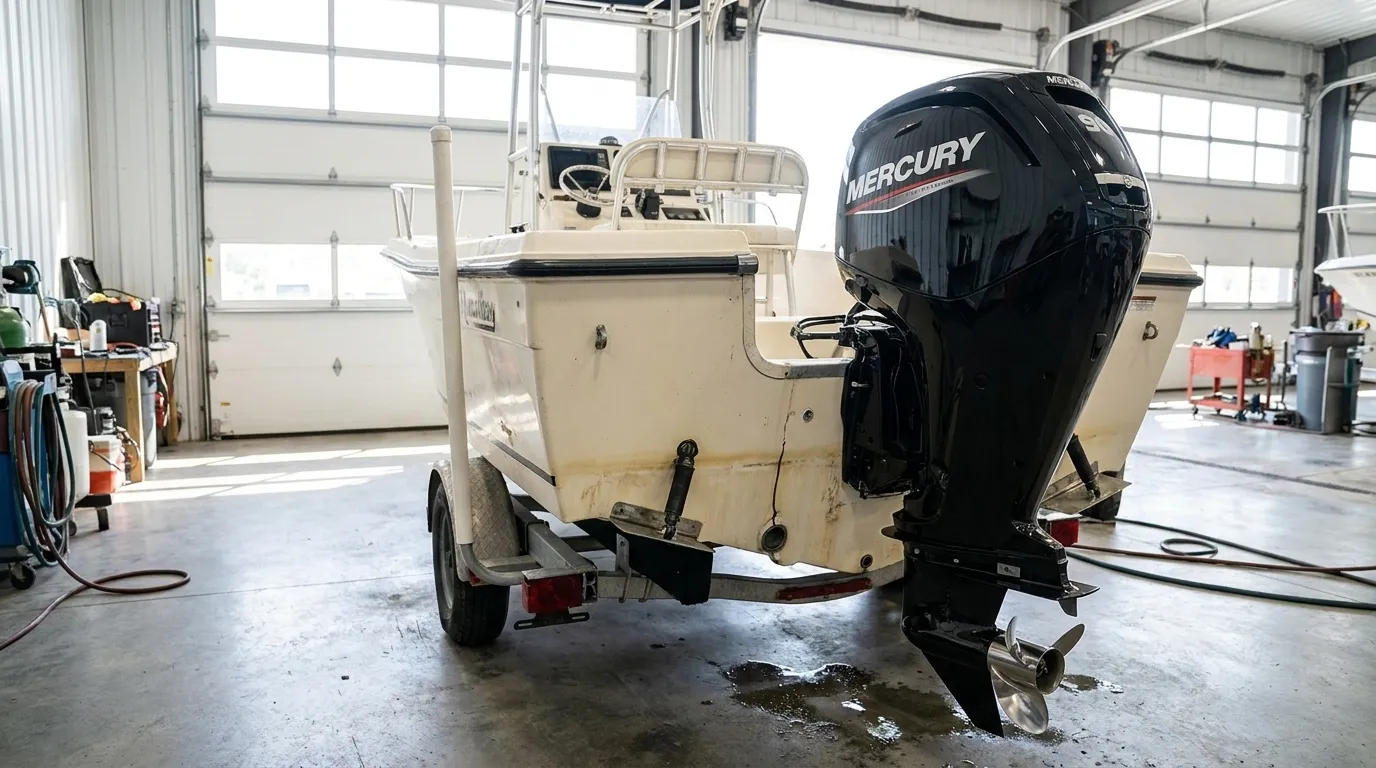
When it finally stops being practical to source parts or find qualified service for an orphan motor, a Mercury repower is the cleanest path back to reliable time on the water.
Before: what life with an orphan motor looks like
A well-maintained Evinrude or Johnson from the 1990s or early 2000s can run a long time. We're not going to tell you otherwise.
But at some point, the math changes:
- Parts that used to take a week to source now take a month, if they're available at all
- The service shops qualified to work on these motors are fewer every year
- For engine repairs, we only service Mercury and Mercruiser, so if your Evinrude needs work, we can't be your shop
- You're running a two-stroke in an era of four-stroke fuel efficiency, four-stroke emissions standards, and four-stroke resale expectations
"It ran fine last fall" is not a parts-supply strategy. At some point, you need a motor that has a full service network and a future.
After: what a Mercury four-stroke actually delivers
A modern Mercury four-stroke in the same horsepower class as your old Evinrude or Johnson will typically be:
- Quieter: four-stroke combustion cycle, no two-stroke exhaust note
- More fuel-efficient: direct injection and fuel management that didn't exist in 1997
- Cleaner-burning: current-generation emissions standards vs. a carbureted two-stroke
- Serviceable locally: by a Mercury Platinum dealer on Rice Lake. Family-owned since 1947, Mercury dealer since 1965
Mercury's FourStroke and Pro XS lineup covers 2.5hp to 300hp, with larger Verado options available by special order. Whether you're replacing a 40hp kicker on an aluminum fishing boat or a 150hp on a bowrider, there's a direct equivalent in the Mercury lineup that we can quote, install, and service.
The conversion: what actually changes
The motor itself is the main piece, but a full repower from an orphan two-stroke involves a few other things:
Controls and rigging: Throttle and shift cables, the control box, and sometimes the steering linkage may need to be updated. Older Evinrude/Johnson controls don't always mate directly with modern Mercury rigging standards. We quote the full installed job, not the motor alone.
Fuel system: If your current setup uses a remote fuel tank with an old primer bulb and two-stroke mix system, the new motor will need a clean single-line fuel feed. We handle this as part of the rigging.
Transom inspection: Every repower starts with a transom inspection. If the transom has issues, we find them before the new motor goes on, not after.
Gauges: Mercury SmartCraft gauges give you real-time engine data that your old analog gauges never offered. Not mandatory, but worth discussing when you're already wiring a new installation.
Is your old Evinrude/Johnson worth anything?
Maybe. Running condition matters, as does the vintage and the model. We inspect and assess every trade-in before we quote it. If it has value, we apply it to the repower. If it doesn't, we handle disposal properly.
The honest answer is that orphan motors in marginal condition have limited trade value, the market for them is thin and getting thinner. The real value exchange happens when you start calculating the fuel savings, maintenance simplicity, and reliability of the new motor over the next ten seasons.
Every repower gets tested before you see it again
Every repower gets an on-water test on Rice Lake before pickup. No exceptions.
When you pick up your boat, the motor has already run. Any rigging or setup issue gets caught here, not at your dock.
Running an orphan motor? Let's see what a Mercury repower looks like for your boat.
Build your quote at mercuryrepower.ca or call 905-342-2153.
Related guides