- Mercury Premier Dealer - Family-owned since 1947 - Mercury dealer since 1965 - Gores Landing, ON - Quote builder available Lake Ontario salmon fishing puts heavy, specific demands on a Mercury outboard setup. Long days at trolling speed. Heavy electrical load from electric...
Quick answer: Lake Ontario salmon setups match the main motor to hull length (150 to 200 HP for 19 to 20 ft V-hulls, 200 to 250 HP for 21 to 22 ft), add a Mercury 9.9 ProKicker for hours of slow trolling, and need a 40 to 60 amp alternator floor for a four-downrigger electrical load. Cobourg is about 25 minutes from HBW; Port Hope about 30.
- Mercury Premier Dealer
- Family-owned since 1947
- Mercury dealer since 1965
- Gores Landing, ON
- Quote builder available
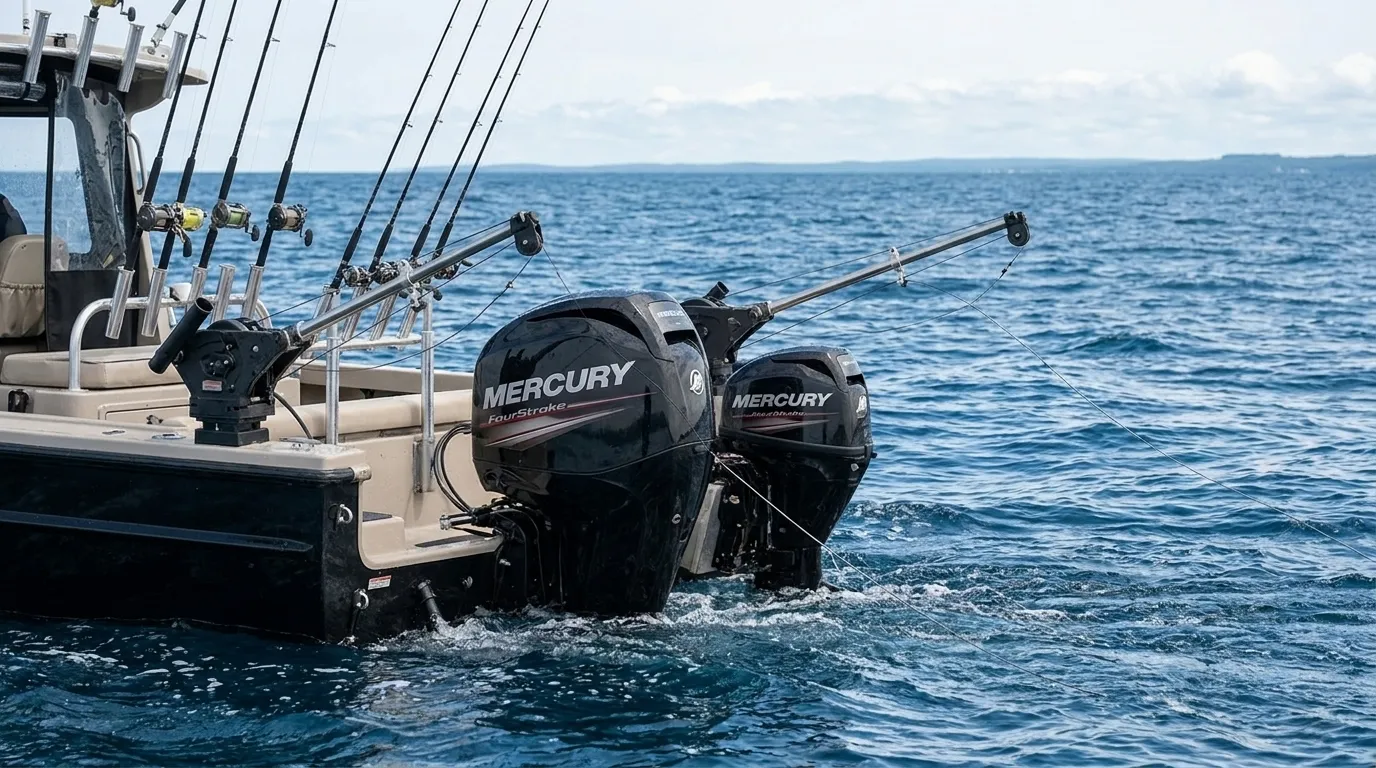
Lake Ontario salmon fishing puts heavy, specific demands on a Mercury outboard setup. Long days at trolling speed. Heavy electrical load from electric downriggers, sonar, chartplotter, and lights. Charging system has to hold voltage at idle. Kicker needs to run for hours at consistent low RPM. Dual-battery management matters.
This is the dealer-side perspective on rigging a Lake Ontario salmon boat for the work it actually does. Written from HBW's position on Rice Lake, 25 to 30 minutes from the Cobourg and Port Hope ports that most north-shore charter and recreational anglers launch from.
Drive time from HBW to Lake Ontario ports
A clarification because we hear this misread: Cobourg is approximately 25 minutes drive from HBW. Port Hope is approximately 30 minutes. Both ports are well within practical service-destination range for Lake Ontario north-shore salmon anglers. HBW services Lake Ontario boats regularly. We do not provide service calls away from Rice Lake; boats come to us.
For Port Hope and Cobourg boat owners specifically, HBW may be the closer Mercury Premier service option than GTA-area dealers, depending on where you launch and store the boat.
The main motor decision
For Lake Ontario salmon work, main motor sizing depends primarily on boat type and length.
19 to 20 ft aluminum V-hull (Princecraft, Lund, similar): Mercury 150 to 200 HP. The 150 is adequate for most cottage salmon use. The 200 gives better headroom for heavier loads and longer runs to deeper water.
21 to 22 ft aluminum V-hull or hardtop: Mercury 200 to 250 HP. The 200 is the practical sweet spot for most owners. The 250 V8 FourStroke or 250 Pro XS is the upgrade for boats that travel further offshore or run heavier.
Center console or deep-V offshore: typically 250+ HP. Mercury FourStroke or Pro XS for HBW-standard repowers, with Verado available by special-order for true offshore or large-twin builds. Twin engines for redundancy on longer offshore runs.
Charter captain perspective: Lake Ontario north-shore charter operators we work with typically run Mercury 200 to 250 HP main motors with a Mercury 9.9 ProKicker for trolling. Charter setups usually spec higher alternator output than recreational boats because they're running more electronics for longer days.
The kicker conversation: Mercury 9.9 ProKicker
For salmon trolling, the kicker is genuinely critical. Slow trolling for hours on the main motor is hard on the main motor and noisy. A 9.9 ProKicker handles the trolling work and serves as backup if the main fails.
Why Mercury ProKicker specifically:
- Engineered for sustained low-RPM trolling (not just a small outboard pressed into kicker duty)
- High-thrust gear ratio optimized for low-speed control
- Available with electric start and remote control for helm-mounted operation
- High-thrust four-blade prop designed for low-speed control
- Pairs cleanly with Mercury main-motor setups where SmartCraft Troll Control is already part of the rig
Kicker sizing: Current Mercury Canada ProKicker listings are 9.9, 15, and 25 HP. The 9.9 is the volume choice. A 15 can add thrust on a heavier boat when weight, shaft length, mounting clearance, and controls fit. There is no current 20 HP ProKicker tier; the ordinary 20 HP FourStroke is a different product. Do not treat a 25 as the automatic motor for every 22-foot boat. ProKicker 9.9-25.
Common boat brands we set up for Mercury kicker installs: Princecraft is the most common brand we rig. Lund, Lund Pro-V, MirroCraft, and Sylvan are also frequent. Older Alumacraft hulls come through with kicker upgrades regularly.
Mercury SmartCraft Troll Control
Mercury SmartCraft Troll Control locks engine RPM and lets you adjust it in 10 RPM steps through the main motor's SmartCraft network. For boats with the right engine family, it holds a steady trolling RPM, and you use GPS or a speed log to find the RPM that gives your target speed (e.g., 2.4 MPH for spoon trolling). Wind, waves, and current still affect speed over ground, no system overrides physics on the lake.
HBW has installed Mercury SmartCraft Troll Control for Lake Ontario salmon anglers. It's not the right choice for every setup. For boats where the kicker handles all the trolling work, SmartCraft Troll Control usually isn't necessary. For boats running only a main motor for trolling (uncommon but real), it can replace the kicker setup at significantly lower cost.
The right answer depends on use case, boat size, and what you're already running. We'll walk through it on a quote.
Alternator capacity for 4-downrigger setups
The electrical math matters. Electric downriggers draw significant current during retrieval cycles. Add a sonar, a chartplotter, navigation lights, courtesy lights, and a livewell, and total electrical load can exceed what a basic 30-40 amp alternator can sustain.
Per-downrigger draw: Electric downrigger current depends on the make, model, load, and whether retrieval is happening. Use the manufacturer's electrical specification and add it into a boat-specific load calculation. Do not treat one amp range as universal.
Add the other electronics: Sonar 1-3 A, chartplotter 0.5-2 A, nav lights 1-2 A, livewell pump 3-5 A, courtesy lights 0.5-2 A. Total ancillary draw 6-14 A.
Practical alternator minimum: A 40 to 60 amp alternator at 12V on the main motor is the realistic floor for a 4-downrigger Lake Ontario setup, assuming typical cycling patterns and a separate cranking battery.
Comfortable headroom: For boats that want "everything on, everything works" without voltage drop concerns, a 70 to 90 amp main alternator is the safer target. Many Verado V8 and V10 setups provide higher alternator capacity, but exact output should be confirmed by model and serial number. For Mercury FourStroke outboards, Mercury lists 60 A on the 150 and 85 A on the V6 175 and 200.
If you're running heavy electrical loads, factor alternator capacity into the main motor selection.
Dual-battery configuration
A separate house battery for the electronics, kept apart from the cranking battery for the main motor, is the standard Lake Ontario salmon configuration. Two main wiring approaches:
Battery isolator / VSR (Voltage Sensitive Relay): Automatically connects the batteries when the main motor is running (alternator outputs above ~13.3V), disconnects when the motor is off. Cranking battery is protected from house loads when the motor isn't running.
Manual battery switch (1 / 2 / Both / Off): Owner manually selects which battery is in use. Less automated but gives full control. Common on older setups.
For modern Lake Ontario salmon rigs we set up at HBW, we generally recommend the VSR / ACR (Automatic Charging Relay) approach. The Blue Sea Systems ACRs are a known-good option that we install routinely.
House battery sizing: Group 31 deep-cycle marine battery is the standard for a 4-downrigger setup. Two Group 31 deep-cycle batteries wired in parallel for extended trips.
Fuse sizing: Main feed from house battery to electronics distribution: 50 to 70 A fuse depending on total load. Individual circuits fused at appropriate device-specific levels.
This is rigging work we do regularly. Bring your boat, we'll spec and install.
Fishing regulations: zone awareness
Lake Ontario fishing falls under Fisheries Management Zone (FMZ) 20. Confirm current regulations on the Ontario Fishing Regulations Summary before each season, limits and seasons can change year to year.
A separate note for Rice Lake anglers: Rice Lake itself is in FMZ 17, which has its own rules. Don't carry FMZ 20 limits into FMZ 17 water, or vice versa.
The HBW on-water test
HBW's standard repower handoff includes an on-water test on Rice Lake before pickup when safe seasonal conditions allow.
Common mistakes (the things we push back on)
Myth: "I'll just use the main motor for trolling."
What we tell customers: Possible on some setups but hard on the main motor over a full season, noisy at trolling speed, and gives up trolling-speed precision. The kicker is the right answer for most Lake Ontario work.
Myth: "30 amp alternator is enough."
What we tell customers: For a single-rod boat with basic electronics, sometimes. For a 4-downrigger setup, you'll see voltage sag during long retrieval cycles. Plan for the larger alternator if you're running heavy.
Myth: "One battery is enough if it's big."
What we tell customers: A single battery shared between cranking and house loads will eventually fail to crank the main when you've drained it running electronics. Dual-battery is the standard.
Myth: "I'll install the kicker myself."
What we tell customers: Kicker installation involves transom integrity, tie-bar setup for steering integration, electrical connection to the main battery system, fuel routing, and (sometimes) remote-control integration. We see DIY installations come in for repair routinely. Worth doing right the first time.
Myth: "Verado is supercharged."
What we tell customers: Current Mercury Verado V8 250-300 HP, V10 350-425 HP, and V12 600 HP models are naturally aspirated. The older inline-6 Verado was supercharged but is no longer the current Verado platform.
Customer language we hear
| What you might say |
Our take |
| "I lost a fish because the rigger was slow" |
alternator capacity or battery voltage sag |
| "My boat won't start after a day of fishing" |
cranking battery drained by house loads, isolator issue |
| "I want quieter trolling" |
kicker upgrade conversation |
| "I have a 9.9 but I want auto-trolling speed" |
SmartCraft Troll Control candidate |
| "When can you get me in?" |
905-342-2153 |
Ready to talk Lake Ontario salmon setup?
If you launch from Port Hope, Cobourg, or anywhere on Lake Ontario's north shore, HBW is closer than you think. We service Lake Ontario boats regularly and we can spec a kicker install, dual-battery rigging, or full repower with the Lake Ontario use case in mind.
Phone: 905-342-2153
Email: info@harrisboatworks.ca
Main site: harrisboatworks.ca
Build a Mercury quote: mercuryrepower.ca
Service booking: hbwservice.ca
Harris Boat Works - 5369 Harris Boat Works Rd, Gores Landing, ON. Family-owned since 1947, Mercury dealer since 1965, current Premier Dealer. Confirm drive time, the exact part, and service capacity before travelling from Port Hope or Cobourg.
Pricing out a big-water setup? Build the main-and-kicker quote at mercuryrepower.ca/quote/motor-selection.