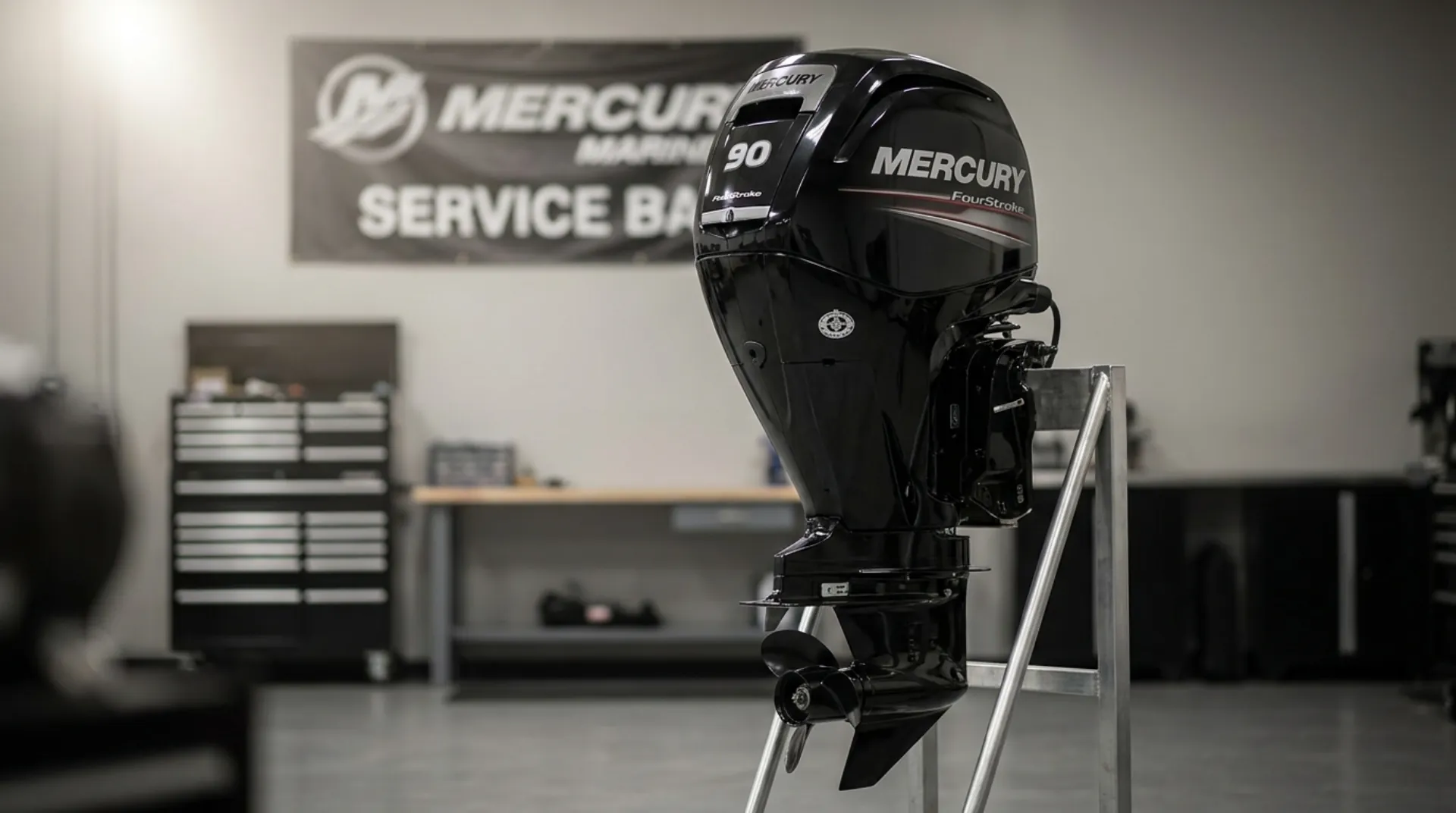
Choosing between a Mercury 90 hp and 115 hp FourStroke for your Ontario boat often comes down to a few hundred pounds of extra load capacity and about $1,500 to $2,500 in upfront cost. Both share the same 2.1-litre block and weigh nearly the same, but the 115 delivers...
Choosing between a Mercury 90 hp and 115 hp FourStroke for your Ontario boat often comes down to a few hundred pounds of extra load capacity and about $1,500 to $2,500 in upfront cost. Both share the same 2.1-litre block and weigh nearly the same, but the 115 delivers noticeably more mid-range torque and top-end punch. For most 17-to-19-foot aluminum fishing and cottage boats on Rice Lake or Kawartha waterways, the 115 is the safer long-term bet, yet the 90 can be perfectly adequate if you seldom run heavy. Understanding the real-world differences in performance, fuel economy, and resale value will help you make the right choice for your boat and how you use it.
Same Block, Different Tune: How Mercury Builds the 90 and 115
Mercury's 90 hp and 115 hp FourStroke models are built on the same 2.1L inline-four platform. The core architecture, including displacement, bore, and stroke, is identical. The difference comes from the engine control module (ECM) tuning, camshaft profiles, and throttle-body sizing that allow the 115 to produce roughly 25 more horsepower at the top end. This design means the 115 delivers added torque across a broader RPM range without a physical weight penalty, which is a big advantage on heavier boats.
Both engines are available in standard and Command Thrust gearcase variants, as well as multiple shaft lengths and tiller or remote configurations. The shared block gives both motors excellent reliability and a well-proven service history, so either choice benefits from Mercury's modern engineering and parts support across Canada.
Weight: Nearly Identical Across the Range
One of the most common surprises for boaters is how little weight separates the Mercury 90 hp FourStroke from the 115 hp FourStroke. Because both are built on the same 2.1L block, when you compare the same gearcase and shaft length the two motors weigh within a few pounds of each other. Mercury lists them in the same weight class, and the Command Thrust versions add only the modest weight of the larger gearcase, equally to both. For repower planning, treat the 90 and 115 as effectively the same weight, and confirm the exact figure for your specific model on Mercury's spec sheet or your Harris Boat Works quote.
There is no meaningful weight penalty for choosing more horsepower. This parity makes repowering decisions much simpler. If your boat is rated for 115 hp and its transom and handling can accept the power, stepping up from a 90 does not add weight you need to plan around. That frees you to focus on performance, fuel use, and budget rather than worrying about whether your boat will sit lower in the water or struggle with balance.
Performance on a Typical Ontario Aluminum Boat (17 to 19 ft)
Most of the fishing and cottage boats we see at Harris Boat Works fall into the 17-to-19-foot aluminum category. Think Legend, Lund, Princecraft, Alumacraft, or Crestliner. Loaded with three or four adults, fishing gear, a full livewell, and a cooler, the total on-water weight quickly climbs north of 2,000 pounds. The difference between a 90 and a 115 becomes very real when you need to plane quickly against a chop on Rice Lake or cruise comfortably into the wind.
With a 90 hp FourStroke, a 17.5-foot deep-V aluminum boat carrying three adults and gear will typically plane in the mid-teens (mph) and top out around 32 to 35 mph in ideal conditions. A well-propped 115 on the same hull can add 4 to 6 mph on the top end, but more importantly it gets on plane faster and maintains plane at lower RPM. That extra mid-range authority means you can stay comfortably on step at 20 mph without burying the throttle, which is a huge advantage when you want to cover water smoothly with a full crew and a chop building.
Fuel Economy: 90 vs 115 at Cruise and WOT
Because the two engines share the same displacement, their fuel consumption at typical cruising speeds (3,500 to 4,000 RPM) is remarkably close. Both will return fuel burn in the range of roughly 4 to 5 gallons per hour (15 to 19 litres per hour) when propped correctly and settled into an efficient cruise. The 115 will typically burn a little more fuel at wide-open throttle, perhaps 5 to 10 percent, simply because it is making more power and turning the propeller faster.
The real-world fuel cost difference over a season of weekend boating on Ontario lakes is modest. The 115's ability to plane at lower RPM can actually improve cruise economy when loaded heavily, because you are not forcing the engine to labour at high throttle openings just to stay on plane. That nuance is exactly why we encourage boaters to consider their typical load, not just the engine spec sheet, when comparing fuel use.
Command Thrust: Why It Matters for Heavy Loads
Both the 90 and 115 are available with Mercury's Command Thrust (CT) gearcase. A CT gearcase uses a larger-diameter gearcase housing and propeller, which bites more water and generates additional stern lift. For aluminum boats that run heavy, carry multiple passengers, or frequently operate at cottage-settlement loading, Command Thrust can dramatically improve hole shot, handling, and ability to stay on plane at lower speeds.
Choosing a CT model does not change the horsepower rating but can make a 90 feel closer to a standard 115 in terms of load handling, and a 115 CT feels even more authoritative. If your boat is near the maximum recommended weight for its horsepower, opting for the CT gearcase on either the 90 or 115 is a sensible upgrade that we routinely recommend for Ontario cottage and fishing boats.
Price Difference in Canada (CAD)
Pricing varies with shaft length, CT gearcase, and accessory choices, but in Canada you can generally expect to pay between $1,500 and $2,500 more for a Mercury 115 hp FourStroke compared with the equivalent 90 hp model. The spread is largely driven by the premium manufacturers place on the extra horsepower, even though the hardware differences are minimal.
At Harris Boat Works, we never fabricate inventory prices online. Instead, we invite you to use our Mercury repower configurator at www.mercuryrepower.ca to build exactly the engine you want and receive an accurate, transparent quote. That way you see the true differential between a 90 and a 115 for your hull and requirements, without any guesswork.
Resale Value: 115 HP Commands a Premium
When it comes time to sell your boat, the transom horsepower plate often shapes buyer interest. Boats hanging a 115 hp outboard generally attract more attention than those with a 90, particularly in the popular 17-to-19-foot family-fish segment. A 115 is seen as the "just right" size for many all-purpose aluminum boats, and the resale market reflects that.
A well-maintained 115 will typically fetch a higher resale value and sell more quickly than a comparable 90. If you plan to keep the boat for many years, the upfront savings on a 90 might outweigh the future resale difference. But for boaters who trade every five to seven years, the extra $1,500 to $2,500 spent today often comes back at resale time, and you enjoy the better performance in the meantime.
Which One Should You Choose? A Simple Boat Weight Framework
Instead of choosing solely by horsepower number, think about the total weight you regularly put on the water. A simple framework is:
- Light loads (under 2,200 lbs total on-plane weight): A 90 hp FourStroke, especially with Command Thrust, is almost certainly plenty. This covers a 17-foot aluminum tiller with two people and modest gear, or a smaller side-console boat used for solo fishing.
- Medium loads (2,200 to 2,800 lbs): A 115 hp will provide noticeably better acceleration, planing, and control in rough water. If you regularly carry three or four adults, a full livewell, and weekend gear, this is the sweet spot.
- Heavy loads (2,800 lbs and up): If your boat is rated for 115 hp and you push its capacity limits, the 115 is the clear choice. Pairing it with Command Thrust gives you a setup that handles like a larger engine and keeps you safely on plane in any reasonable Ontario chop.
Run through your typical crew, fuel, batteries, and tackle. Multiply by real weights, and you will quickly see whether the 90 or 115 deserves the nod.
Repowering at Harris Boat Works: On-Water Test Included
Every repower gets an on-water test on Rice Lake before pickup. No exceptions. This test verifies that the engine, propeller, and hull are perfectly matched for how you actually use the boat, not just a generic spec-sheet setup. We adjust engine height, propeller choice, and trim until we see the performance and RPM you need.
As a third-generation family marina on Rice Lake, our family has been serving Ontario boaters since 1947. We are a Mercury Premier Dealer and a Legend Boats dealer, and we understand the specific demands of Ontario cottage and fishing boat setups. For engine repairs, we only service Mercury and Mercruiser. Our service intake is always open at hbw.wiki/service. Whether you are still deciding between a 90 and a 115 or are ready to build your new engine, our team can walk you through the options and get you on the water with confidence.
Frequently Asked Questions
Can I put a 115 hp engine on a boat rated for 90 hp?
No. Never exceed the maximum horsepower rating on your boat's capacity plate. Doing so is illegal under Canadian regulations, voids your insurance, and creates a serious safety risk. If your boat is rated for a 90 hp maximum, you must choose a 90 hp outboard.
Is the Mercury 115 FourStroke just a tuned 90?
Essentially, yes. The 90 hp and 115 hp FourStroke share the same 2.1L block and many internal components. Differences in ECM tuning, camshaft design, and throttle-body size allow the 115 to deliver more power, but the core engine is nearly identical in weight and dimensions.
How much fuel will I save by choosing the 90 hp over the 115?
At typical cruising speeds the difference is minor, often within half a litre per hour. Both motors are efficient four-strokes. The 115 may use slightly more fuel at wide-open throttle, but its ability to plane at lower RPM with heavy loads can offset that in real-world use.
Do both engines come with Command Thrust?
Yes. Both the Mercury 90 hp and 115 hp FourStroke are available with the Command Thrust gearcase option. If you often carry heavy loads, pull watersports gear, or operate at higher elevations, the CT gearcase is worth considering on either engine.
Should I repower with a 90 or 115 if I plan to sell the boat in a few years?
For most 17-to-19-foot aluminum boats common in Ontario, a 115 hp outboard generally retains better resale value and appeals to a wider range of buyers. If the price difference fits your budget now, the 115 often pays off in quicker sales and higher offers down the road.
Related Guides