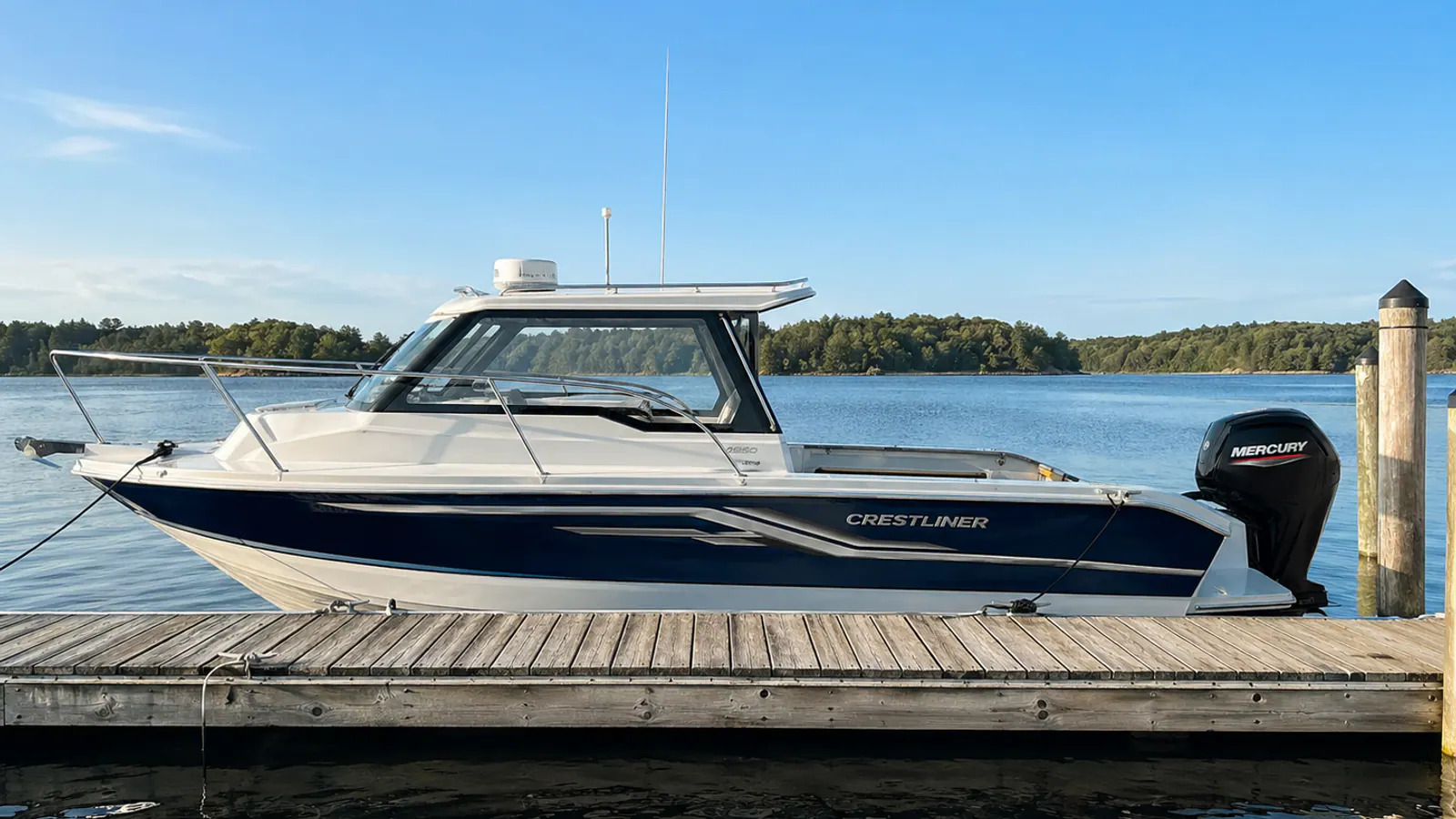
Quick Answer For many family runabouts in the 17-20 ft range, a Mercury FourStroke in the 90 - 150 HP range is the band to compare. Lighter cruise days sit nearer the 90-115 examples; a loaded tow day sits nearer 150. The capacity plate and manufacturer documentation set the...
Quick Answer
For many family runabouts in the 17-20 ft range, a Mercury FourStroke in the 90–150 HP range is the band to compare. Lighter cruise days sit nearer the 90-115 examples; a loaded tow day sits nearer 150. The capacity plate and manufacturer documentation set the real ceiling. Match hull, steering, usual and heaviest planned load, and use. Installed pricing in CAD at mercuryrepower.ca.
Runabout use-case decision
Calm cruising or active watersports?
Same boat length, two very different right answers on motor and gearcase.
Primary use is calm cruising and dinner runs
- ✓Mostly 2 to 4 people, light loading
- ✓Occasional tubing for the kids
- ✓Fuel economy and quiet matter most
- ✓You want lower upfront cost
Example: 90 to 115 HP FourStroke, standard gearcase
You tow watersports regularly
- ✓Skiing, wakeboarding, or wakesurfing most weekends
- ✓4 to 6 people aboard with full gear
- ✓Hole shot with the boat loaded matters
- ✓Boat is 19 ft or larger
Example: 150 to 200 HP where the tow load and the hull's limits support it
When in doubt:Check the capacity plate first. Then size for how you actually use the boat on a typical Saturday, not the once-a-year scenario.
Full Article
A "family runabout" covers a lot of ground. It might be a 16-foot bowrider tugging the kids around the bay, or a 22-foot deck boat pulling a wakeboarder behind a full crew. The right Mercury depends on three things: the boat's length and weight, what you actually do with it, and how much you want to spend on fuel.
We've rigged and repowered family runabouts on Rice Lake and the Kawarthas for a long time. What follows is the answer we'd give if you walked into the shop on a Saturday in April.
The Quick Recommendations by Boat Length
| Boat length |
Example Mercury |
When this comparison is in play |
| 16-17 ft |
90 HP FourStroke |
Light family cruise, where the hull's limits support it |
| 17-18 ft |
115 HP FourStroke |
Fuller crew and gear; still inside the 90-150 band |
| 18-19 ft |
150 HP FourStroke |
Loaded tow day |
| 19-21 ft |
175-200 HP |
Tow boat examples. FourStroke 175-225 are V6; 200 Pro XS is V8 |
| 21-22 ft |
200-250 HP |
Big crew / longer runs. 200-250 Pro XS are V8; FourStroke 250 is V8; FourStroke 200-225 are V6 |
Why FourStroke Beats Pro XS for Most Families
Mercury makes two flavours at most horsepower ratings: FourStroke (the standard) and Pro XS (the performance variant). For 90% of family runabouts, FourStroke is the right call.
FourStroke is quieter. Conversation-quiet at cruise. Pro XS has a sportier exhaust note that sounds great for five minutes and gets old over a six-hour day with kids in the boat.
FourStroke gets better fuel economy. Roughly 10 to 15% better at typical family cruise (3,500-4,200 RPM). On a long day pulling skiers and tubes, that's real money.
FourStroke is smoother at low speed. The Pro XS sport gearcase is tuned for hole shot and top end. The FourStroke gearcase is tuned for smoother transitions through the rev range. Family use lives in that middle zone.
Pro XS is the right call when:
- You water-ski seriously and the hole shot matters for getting the skier up
- You want absolute top speed
- You run a heavier hull with full ballast for wakesurfing
- The driver genuinely cares how the throttle feels
For everyone else, pulling tubes occasionally, cruising to dinner, hauling the kids to the swim spot, FourStroke is the answer.
Don't Under-Power. Don't Over-Power.
The most common mistake we see on family runabouts: the previous owner under-powered the boat to save money on the original purchase, and now it struggles whenever the boat is loaded.
A 17-foot bowrider rated for 115 HP, running with a 75 HP motor, four people, full fuel, a cooler, and tow toys, will plane sluggishly and struggle in chop. The motor runs at 80 to 90% throttle constantly just to maintain cruise, bad for motor life and miserable to drive.
The rule: Start with the boat's maximum HP rating on the capacity plate (usually near the helm) and never exceed it. The right choice below that ceiling depends on the hull, full operating load, use, and performance target; there is no universal requirement to stay within 25 HP of maximum.
Don't over-power either. A boat rated 150 HP max doesn't need a 200 HP motor. It adds fuel cost, changes handling in chop, and on some hulls causes porpoising.
Fuel Math at Family Cruise
Fuel use depends on hull, load, propeller, RPM, and conditions. Use SmartCraft or another on-boat fuel-flow reading at the speeds you actually run, then compare written quotes for the horsepower class that fits the hull and the heaviest planned day.
We sell ethanol-free 89 marine gas at the dock in Gores Landing. Pick the HP that fits how often you'll use the boat, not just what looks good at the transom.
Features Worth Paying For on a Family Runabout
- Power steering, On anything over 115 HP, get hydraulic or electric power steering. Manual steering on bigger motors is tiring after an hour of driving.
- Power trim, Standard on every Mercury 25 HP and up. You'll use it constantly as load and conditions change.
- SmartCraft / Mercury Marine App, Real-time fuel flow lets you find the efficient cruise RPM for your boat. Saves real money over a season.
- Active Trim, Available on V8 Verados and select V6s. Worth it if your driver is still learning; the engine trims itself for conditions.
What you don't need: Mercury's premium Verado V8/V10 lineup on a family runabout under 22 feet. They're excellent motors built for performance boats and big cruisers, overkill on a 19-foot bowrider that mostly goes to the swim spot.
Pricing, What to Expect in CAD
These are planning-level ranges for a motor with rigging, prop, and installation on a typical family runabout. Build a quote at mercuryrepower.ca for your specific configuration and current pricing.
| Motor |
Bare motor today (CAD, before HST) |
Add for rigging, controls, prop & install (estimate) |
| 90 HP FourStroke |
$14,960–$15,477 |
$2,000 to $3,000 |
| 115 HP FourStroke |
$17,083–$17,892 |
$2,500 to $4,000 |
| 150 HP FourStroke |
$22,242–$22,363 |
$3,500 to $5,500 |
| 175 HP V6 FourStroke |
$27,544–$27,676 |
$4,500 to $6,500 |
| 200 HP V6 FourStroke |
$27,858–$29,623 |
$4,500 to $6,500 |
Prices here are planning figures as of September 2026. For live Mercury motor pricing, see the Mercury pricing reference.
Your all-in cost is the two columns added together: motor plus rigging, prop, and installation. Every model and shaft variant is on our Live motor price page. If you're repowering, the trade-in value on your existing motor, typically $1,500 to $5,000 depending on age and condition, applies against the total.
What We Do
We rig family runabouts every spring in Gores Landing. Specifically:
- Boat-to-motor matching, Bring the boat in or send photos with the capacity plate spec, and we'll spec the right HP for how you'll actually use it.
- Repower quotes through the live configurator, Real CAD pricing in about three minutes at mercuryrepower.ca.
- Trade-in valuation, We give fair-market value on your old motor or boat. No lowballing.
- Annual service, Mercury Premier dealer, factory-trained techs, ethanol-free 89 marine gas at the dock.
Ready to find the right Mercury for your family runabout? Build a quote at mercuryrepower.ca, real CAD pricing, no phone tag, no "call for price."