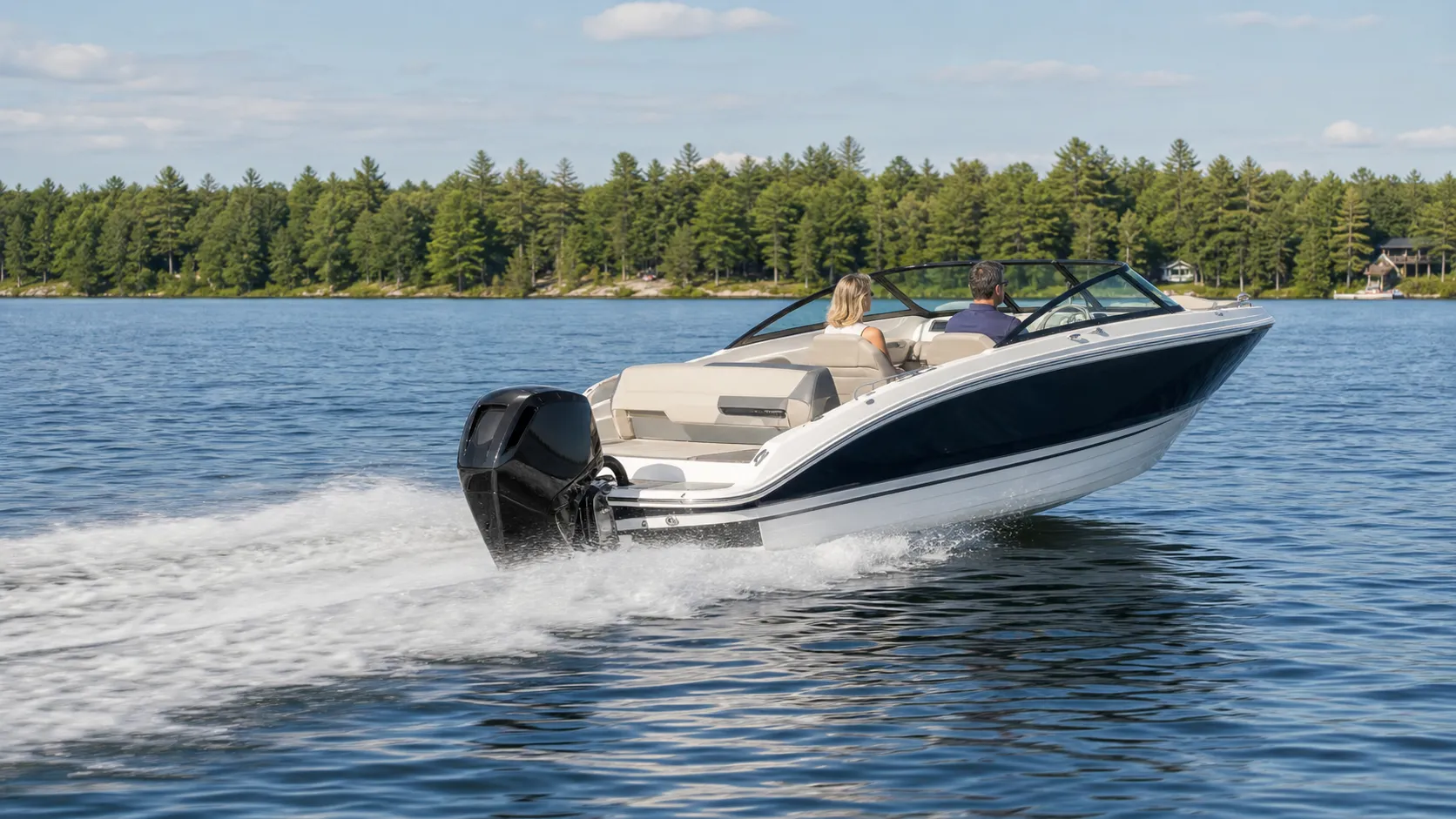
You bring the boat onto plane, leave the throttle alone and tap the trim switch. The bow lifts a little. Steering gets lighter. Speed rises. It feels like somebody quietly removed a load from the boat. Nothing about the throttle setting changed. The running attitude did. That...
Quick answer: Tuck the outboard in before accelerating onto plane. Once the boat settles, trim out in short taps while holding steady throttle. Stop when speed quits improving, RPM rises without matching speed, steering gets loose, the bow starts bouncing, or the prop ventilates. Load, speed and water conditions change the right setting, so read the boat rather than memorizing a gauge number.
You bring the boat onto plane, leave the throttle alone and tap the trim switch. The bow lifts a little. Steering gets lighter. Speed rises. It feels like somebody quietly removed a load from the boat.
Nothing about the throttle setting changed. The running attitude did. That small change altered the thrust angle and how much hull was pushing through the water.
That is the useful way to understand trim. It is not a number you set once. It is an adjustment you make as speed, load and conditions change.
What Trim Changes Under the Boat
The trim switch changes the angle of the outboard relative to the transom. Mercury describes three basic states:
- Trimmed in or down: The gearcase moves closer to the transom. Propeller thrust helps lift the stern and push the bow down.
- Neutral trim: The propeller shaft is roughly parallel to the water surface while the boat is on plane. Thrust is directed mainly forward.
- Trimmed out or up: The gearcase moves away from the transom. Some thrust pushes the stern down and lifts the bow.
Before accelerating onto plane, tuck the motor in. This gives the propeller clean water and helps control bow rise. Once the boat is on plane, trimming out can lift more of the hull clear of the water. Less wetted hull usually means less drag, so the boat may gain speed and improve fuel economy without more throttle.
Keep going and the benefit disappears. The bow may begin to rise and fall in a cycle called porpoising. The propeller may draw air from the surface, called ventilation, which lets RPM rise without a matching increase in boat speed. Steering can also feel too light or loose.
The right position sits between plowing and losing grip. It varies with hull, motor height, propeller, passenger placement, fuel, gear, speed and water.
 From left: tuck the motor in for acceleration; ease it out to find a clean, efficient cruise; back in when the bow starts to porpoise; and trim in immediately if rising RPM and broken thrust signal ventilation.
A Repeatable Way to Find the Right Trim
Learn on open water with good visibility, light traffic and enough depth. Use the boat's normal load. A solo test with little fuel will not tell you how the boat behaves with a family, a full tank and weekend gear aboard.
- Start trimmed in. Bring the motor fully into its normal trim range before accelerating. Do not confuse the trim range with the higher trailer range used to lift the motor clear of the water.
- Accelerate smoothly onto plane. Keep the wheel straight and let the hull settle before chasing a perfect gauge reading.
- Hold a steady cruising throttle. Changing throttle and trim at the same time makes the result harder to read.
- Trim out in short taps. Pause after each tap. Give the hull time to respond.
- Watch speed and RPM together. A useful adjustment may bring more speed at the same throttle. If RPM flares but speed does not follow, trim back in.
- Feel the steering and ride. The wheel often gets lighter as drag falls. If the boat begins wandering, bouncing or feeling loose, you went too far.
- Trim back in slightly. Once you find the first sign of excessive trim, a small correction in usually puts the boat in a stable cruising attitude.
A SmartCraft or VesselView display can make the test easier by showing RPM, speed, trim position and, on compatible setups, fuel data. The instruments confirm what happened. They do not replace the feel of the boat. Our VesselView and SmartCraft guide explains the data side without turning it into a computer course.
Read These Signals Instead of Guessing
| What you notice |
Likely cause |
First response |
| Bow stays high and the boat is slow to plane |
Too much trim out during acceleration |
Trim in before accelerating |
| Bow feels buried, steering is heavy or spray breaks forward |
Too much trim in at cruise |
Trim out in short taps |
| Speed rises at steady throttle and steering gets lighter |
The hull is approaching an efficient attitude |
Continue carefully, one short tap at a time |
| RPM rises sharply without matching speed |
Propeller ventilation |
Trim in and ease the throttle if needed |
| Bow repeatedly rises and falls |
Too much trim out, load placement or setup issue |
Trim in until stable |
| Prop loses grip in a turn |
Motor is trimmed too far out for the turn, or setup needs attention |
Trim in before or during the turn |
| Ride becomes hard in rough water |
Speed or trim does not suit the conditions |
Reduce speed first, then adjust trim |
There is no universal "40 percent trim" answer. Gauge scales differ. Hulls respond differently. Even the same boat changes when people move seats or the livewell fills.
The useful comparison is what changed after one trim input. Did speed increase? Did the wheel lighten? Did spray move aft? Did RPM jump without more speed? Those signals tell you more than a memorized bar on the gauge.
Common Mistakes
Leaving the motor tucked in at cruise. Full-in trim helps the boat climb onto plane, but keeping it there can hold too much hull in the water. The boat may feel heavy and use more throttle to maintain speed.
Trimming out before the hull settles. If you start the holeshot with the motor already out, bow rise can increase and the propeller may ventilate. Start in, get on plane, then work outward.
Chasing top speed in passenger conditions. A trim position that feels manageable with one experienced operator may feel loose with children, guests or a tube aboard. Stable control comes first.
Treating a bounce as normal. Porpoising is feedback. Trim in. If the bounce remains through a sensible range of speed and trim, stop trying to cure it with the switch. Load placement, motor height, propeller choice or hull setup may need attention.
Using trim as a depth sounder. Raising the motor can help protect the gearcase at low speed in shallow water, but steering authority can decrease. Mercury also states that Active Trim cannot detect depth or automatically avoid underwater obstacles. Slow down, keep watch and use the manual trim control.
Trying to fix every rough ride with trim. Trim can change how the bow meets the water. It cannot make an unsafe speed safe. Reduce speed before fine-tuning the attitude.
Rough Water, Turns and Shallow Water
Trim advice gets unreliable when it becomes a slogan. "Trim down in chop" is a useful starting point when heading into waves because lowering the bow can help the forward hull meet the water more cleanly. It is not permission to keep the throttle pinned. Wave direction, hull design and load still matter.
Use this order:
- Reduce speed until the boat is under control.
- Make a small trim change.
- Check steering, spray and impact.
- Keep the setting that improves control without burying the bow.
Before a tighter turn, trim in enough to keep the propeller in solid water and the boat predictable. Mercury recommends trimming in for propeller bite and handling, then trimming out again after the boat straightens.
In shallow water, operate slowly. Trim up only as much as needed, knowing that steering may weaken as the gearcase rises. Do not run at planing speed with the motor in the trailer range. The owner's manual for your serial number remains the source of truth for the permitted trim and tilt range.
On Rice Lake, the practical lesson is not a local magic setting. It is that one trip can include open-water cruise, a turn into a bay, a loaded run home and a shallow approach. Each change deserves a fresh read of the boat.
Mercury Active Trim: Helpful, Not Psychic
Mercury Active Trim is a GPS speed-based system that automatically adjusts engine trim. During acceleration it tucks the engine in to control bow rise. At planing speed it follows a selected trim profile. It can trim in as speed drops or as the boat enters a turn.
The system has five profiles, allowing more or less trim at a given speed. You can override it with the manual trim switch. Compatibility depends on the engine, controls, SmartCraft capability and rigging, so confirm the exact setup rather than assuming a current Mercury automatically has it.
Active Trim cannot see shoals, logs or the lake bottom. It also cannot know that three passengers just moved to one side or that the wind changed your approach. Use it as a consistent default, not a substitute for watching the water and feeling the hull.
For a compatible boat, the appeal is simple. It handles routine trim changes while the operator keeps attention outside the boat. Understanding manual trim still matters because the conditions that call for an override are usually the conditions that need the most judgment.
What HBW Checks Before Blaming the Trim Switch
If careful trim inputs do not produce a stable, predictable result, the switch may not be the problem.
A propeller that is damaged or poorly matched can ventilate, miss the engine's specified wide-open-throttle RPM range or make the boat slow to plane. Motor mounting height changes how cleanly the propeller stays fed with water. Weight concentrated too far forward or aft changes the hull's response. Hull damage or water trapped where it should not be can add drag. A trim sender can also give a bad gauge reading even while the hydraulic system moves the motor normally.
Start with observations the shop can use:
- motor model and serial number
- boat make, model and length
- propeller part number or stamped size
- normal passenger, fuel and gear load
- speed and RPM before and after the symptom
- whether the issue appears in a straight line, a turn or both
- a short video of the wake, bow attitude or RPM flare, recorded by a passenger
Do not record video while operating the boat alone. That should not need saying, yet here we are.
Our Mercury propeller selection guide explains how prop choice and the specified WOT RPM range fit into the diagnosis. If the boat still porpoises, ventilates or handles poorly after sensible trim changes, send the details through the service form. Guessing with replacement parts is an expensive hobby.
Ready to Get the Boat Running Properly?
If sensible trim changes do not stop porpoising, ventilation or poor handling, have the boat inspected by a qualified marine technician before further operation.
Request service: hbwservice.ca
Family-owned since 1947, Mercury dealer since 1965, Mercury Premier Dealer.
Phone: 905-342-2153
Address: 5369 Harris Boat Works Rd, Gores Landing, ON
Configurator: mercuryrepower.ca