Stand 20 feet back and the decision looks easy. Both motors are black Mercury V8s. Both say 250 on the cowl. Both have 4.6 litres of displacement, an 85-amp alternator and the same rated horsepower.
Quick answer: The current Mercury 250 FourStroke and 250 Pro XS are both 4.6-litre V8s rated at 250 HP, but they are aimed at different jobs. The FourStroke is the natural fit for most family tritoons, deep-Vs and runabouts. Pro XS makes sense when a performance hull can use its higher rpm range, exhaust character and available TorqueMaster gearcase.
Stand 20 feet back and the decision looks easy.
Both motors are black Mercury V8s. Both say 250 on the cowl. Both have 4.6 litres of displacement, an 85-amp alternator and the same rated horsepower.
Then you put one on a 25-foot family tritoon and the other on a 21-foot bass boat, and the idea that they are interchangeable starts to fall apart.
The useful difference is not which decal looks faster. It is what the hull, gearcase, propeller and owner are asking the motor to do.
That is the review.
What the Current Mercury 250s Actually Are
Mercury introduced its current naturally aspirated 4.6-litre V8 family in 2018. The architecture is established, not a first-season redesign being tested on customers.
For the current Canadian product range checked in July 2026:
- both 250s are 4.6 L, 32-valve DOHC V8 outboards
- both are rated at 250 HP
- the FourStroke operates from 5,200 to 6,000 rpm at wide-open throttle
- the Pro XS operates from 5,600 to 6,200 rpm at wide-open throttle
- both use 87 AKI minimum gasoline and allow up to 10% ethanol
- both have an 85-amp alternator with Idle Charge battery management
- SmartCraft compatibility is standard, while controls and steering depend on the exact model
- shaft length, gearcase, rotation and control type must be checked from the model code
Mercury's current linked brochures list the lightest 250 FourStroke at about 239 kg (527 lb) and the lightest 250 Pro XS at about 232 kg (511 lb). That is one of the stranger facts in this comparison: the performance model is not automatically the heavier one.
Those are lightest-version figures, not installed weights. A 20-inch mechanical Pro XS, a 25-inch DTS FourStroke and a 30-inch counter-rotation model are not the same package.
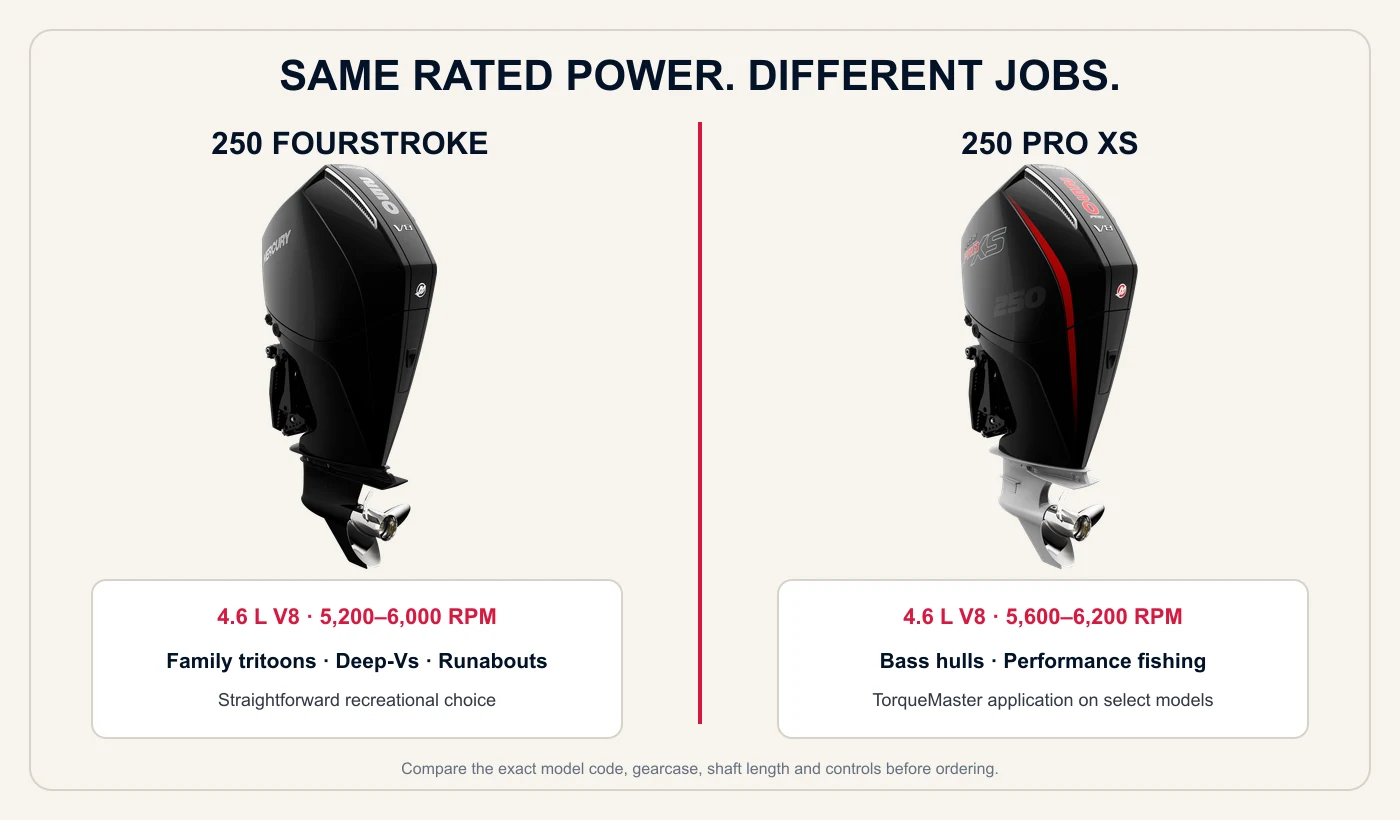
Official Mercury Marine product photography of the current 250 FourStroke and 250 Pro XS. The side-by-side design is an HBW comparison graphic. Exact gearcase, shaft length, finish, controls and propeller depend on the ordered model and boat.
FourStroke vs Pro XS: The Differences That Matter
On a phone, swipe the table sideways to see every column.
| Feature |
250 FourStroke |
250 Pro XS |
What it means on the boat |
| Rated power |
250 HP |
250 HP |
Pro XS is not advertised as hidden extra horsepower |
| Powerhead |
4.6 L V8 |
4.6 L V8 |
They share the same core architecture and displacement |
| Full-throttle range |
5,200–6,000 rpm |
5,600–6,200 rpm |
Pro XS gives a performance setup a higher operating window |
| Published lightest weight |
About 239 kg (527 lb) |
About 232 kg (511 lb) |
Exact shaft, gearcase, controls and steering can change the package |
| Gearcase focus |
Recreational and load-carrying configurations |
TorqueMaster on select V8 applications |
TorqueMaster is built for semi-surfacing, high-speed use |
| Exhaust character |
Large muffler and refinement-focused design |
Performance-tuned exhaust |
Pro XS intentionally has more startup and acceleration character |
| Charging |
85 amp with Idle Charge |
85 amp with Idle Charge |
Both suit electronics-heavy modern boats |
| Natural fit |
Family tritoons, deep-Vs and runabouts |
Bass boats and performance fishing hulls |
The job matters more than the badge |
Choose the 250 FourStroke when
- the boat is a family or cruising tritoon
- the boat is a recreational deep-V, deck boat or runabout
- normal use means people, fuel, canvas, gear and long cruising days
- the owner wants the straightforward recreational V8
- there is no real plan to run a semi-surfacing performance gearcase
The standard FourStroke is not the slow version a buyer settles for. On a properly matched family boat, it is often the more honest use of the money.
Choose the 250 Pro XS when
- the boat is a properly rated bass or performance fishing hull
- acceleration, engine height and high-speed control matter
- a 20-inch TorqueMaster application belongs on the transom
- the owner is willing to finish the setup with the right propeller and water test
- the startup bark and V8 character are part of the appeal rather than an annoyance
The Pro XS hardware is real. It is also specific. A performance gearcase and higher operating range do not rescue a heavy hull, a poor mounting height or the wrong propeller.
What They Feel Like on the Water
The FourStroke's personality is easy to understand. Mercury gave the current V8 a large muffler, vibration-damped cowl and Adaptive Speed Control. The design is meant to disappear into a family boating day rather than turn every start into an event.
That matters more than brochure language suggests. On a 24- or 25-foot tritoon, people talk over the motor, move around the cockpit and spend much more time at idle and cruise than at full throttle.
The Pro XS announces itself differently. Mercury deliberately performance-tuned the exhaust, and owners repeatedly talk about the brief V8 bark at startup. Once running, it is still a modern four-stroke, not an old open-exhaust race motor. The character is simply more present.
Some owners love that moment. Others hear it at a quiet launch before sunrise and immediately know they ordered the wrong personality.
Neither motor can be reviewed apart from the boat. The same 250 can feel athletic on one hull, overloaded on another and completely ordinary on a third.
Official Freshwater Tests: What a 250 FourStroke Actually Does
Mercury's Boat House performance database is useful because it keeps the boat, load, propeller, gearcase and conditions attached to every number.
It is also incomplete for this exact comparison. When we filtered the current database for 250 HP FourStroke and Pro XS tests, we found several exact 250 FourStroke records and no exact 250 Pro XS record. The table below proves what the FourStroke did on five boats. It does not prove a same-hull speed advantage for either cowl.
| Boat |
Published dry weight |
Propeller |
Top speed |
0–30 mph |
| Barletta Cabrio 24UE tritoon |
1,449 kg (3,194 lb) |
Enertia 15p |
41.6 mph at 5,776 rpm |
7.06 sec |
| Harris Grand Mariner 250 tritoon |
1,794 kg (3,954 lb) |
Enertia 15p |
44.7 mph at 6,016 rpm |
8.7 sec |
| Evotti 721S tritoon |
1,548 kg (3,413 lb) |
Enertia 15p |
44.1 mph at 5,905 rpm |
5.83 sec |
| Lund 2075 Tyee Magnum deep-V |
871 kg (1,920 lb) |
Tempest Plus 19p |
54.1 mph at 5,755 rpm |
5.5 sec |
| Glastron GTD 220 deck boat |
1,633 kg (3,600 lb) |
Revolution 4 18p |
52.7 mph at 5,977 rpm |
5.4 sec |
Every test was on fresh water. Every result belongs to that exact installation.
The interesting part is not that the lighter Lund went faster. It is how different the answers are with the same rated horsepower.
The three 15-pitch Enertia tritoon setups ran in the low-to-mid 40s. The Lund used a 19-pitch Tempest Plus and reached 54.1 mph. The Glastron used a four-blade Revolution 4 and still reached 52.7 mph while carrying a much higher published dry weight than the Lund.
That is why a detached internet claim such as “a Mercury 250 goes 54” is nearly useless. The boat is most of the sentence.
What Owners Actually Say Online
We screened current-generation 4.6 L V8 discussions, owner videos and propeller tests. Older two-strokes, unrelated horsepower models and modified engines were excluded when judging this 250.
This material is anecdotal. It is not a warranty database, and people with a spectacular result or a frustrating problem are more likely to post than an owner whose motor simply starts every weekend.
The recurring themes are still useful.
Owners spend more time discussing props than decals
The most convincing 250 Pro XS owner content is rarely a speech about horsepower. It is a test with two or three propellers, a normal fishing load and an rpm number.
Ken Smith's Fury 23-versus-24 comparison is a good example. The point is not that one pitch is the universal winner. The point is that a one-inch change can alter rpm, load carrying and how the boat feels through the middle. Other discussions compare three-blade top-end speed with four-blade grip and loaded handling.
The funny part is how quickly a confident recommendation falls apart when someone asks:
- How high is the motor mounted?
- How many batteries are aboard?
- Is that speed with one person or tournament load?
- What was the full-throttle rpm?
- Was the livewell full?
By the fifth question, “run a 24 Fury” has become “we need to water test your boat.”
The startup bark is a feature until it is not
Owners who bought the Pro XS for character usually love the cold-start sound. One current-outboard discussion praised the brief V8 rasp while admitting that full throttle is not where fuel economy lives.
Other owners prefer the quieter personality of a standard FourStroke or the additional isolation of a Verado. Nobody is wrong. Sound is one of the few features a spec table cannot choose for you.
If you launch early beside cottages, think about the first five seconds as well as the next five hours.
Speed videos are entertaining and terrible forecasts
One current 250 Pro XS owner review showed roughly 66 hours of use and discussed a tournament-loaded bass-boat setup reaching the low 70s. That is interesting evidence about one hull, propeller, engine height and load.
It is not a promise for another boat.
The same video's fuel-total discussion was challenged in the comments because engine hours do not reveal how much time was spent idling, cruising or at full throttle. That criticism is fair. A seasonal fuel total without duty cycle is a boating story, not a controlled economy test.
Heavy tritoons do not become bass boats when the cowl says Pro XS
A 2026 tritoon owner discussion described a mid-40-mph result with a 250 Pro XS and normal passengers. The useful replies focused on hull strakes, load, engine height and propeller rather than blaming or praising the motor.
That is the right instinct. On a heavy tritoon, the hull may hide most of the difference a Pro XS could show on a pad-bottom performance boat. The motor can still be an excellent 250. The badge just is not a hydrodynamic upgrade.
Reliability reports are generally positive, with normal internet exceptions
The screened V8 reliability discussions contain many satisfied owners and a small number of individual complaints involving seals, lower units, trim hardware or other faults.
We did not find evidence that turns those posts into one documented recurring defect. We also would not dismiss a specific owner's real problem because the broader pattern looks positive.
The responsible conclusion is narrower: the current V8 family has been in service since 2018, owner sentiment is broadly favourable, and individual anecdotes are not failure-rate statistics.
The TorqueMaster Question
Mercury describes the TorqueMaster gearcase on select V8 Pro XS models as a 1.75:1 unit with a heavy-duty 1.25-inch prop shaft for semi-surfacing, high-speed applications.
That sentence contains the buying decision.
“Semi-surfacing, high-speed applications” does not describe most family tritoons. It does describe the kind of bass hull that runs high engine mounting, substantial steering loads and a propeller chosen around performance.
The correct order is:
- Confirm the capacity plate and transom.
- Confirm shaft length, model code and steering requirements.
- Decide whether the hull actually calls for the selected gearcase.
- Choose a starting propeller for the normal load.
- Water test the installed boat.
Skipping directly to step four because somebody online runs the same pitch is how expensive propellers become garage decorations.
The Propeller Can Change the Whole Review
The five official FourStroke tests used:
- a 15-pitch Enertia on three different tritoons
- a 19-pitch Tempest Plus on the Lund deep-V
- an 18-pitch Revolution 4 on the Glastron deck boat
Those are not conflicting recommendations. They are different answers to different hulls.
Three blades can favour a different part of the performance envelope than four blades. Pitch changes engine rpm. Diameter and blade area affect grip and load carrying. Engine height changes what the gearcase and propeller are doing in the water.
Motors 25 HP and up do not include a propeller in the base motor price. HBW includes a propeller allowance in the quote so the installed price has a realistic plan. If an existing propeller may be reusable, the quote can account for that. We still verify fit and performance during water testing.
Read the Mercury propeller-selection guide for the terms. The installed boat gives the final answer.
What This Means on Ontario Water
Family tritoons on the Kawarthas and Rice Lake, Ontario
A properly rated 24- or 25-foot tritoon carrying family, fuel, canvas and gear is the obvious 250 FourStroke case. Load carrying, clean acceleration and low-speed manners matter more than winning one lightly loaded top-speed run.
Pro XS can still belong on a performance tritoon. The hull needs lifting strakes, steering and setup that can use it. If those pieces are missing, buying the badge first is backwards.
Deep-V multi-species boats
A 20- or 21-foot deep-V can make a strong case for either version.
The standard FourStroke suits the owner who trolls, cruises, carries people and wants a powerful recreational package. Pro XS becomes more relevant when the exact boat, fishing style and mounting can use its higher operating range.
The Lund test shows how capable the standard 250 can be. It does not prove a Pro XS would be slower on the same hull because Mercury did not publish that controlled comparison.
Bass and performance fishing hulls
This is where Pro XS earns the shortest explanation.
A properly rated bass hull designed around a 20-inch performance outboard, high engine mounting and a TorqueMaster application is the job Mercury built the 250 Pro XS to do.
Even here, the performance package is not finished when the motor is bolted on. Steering, mounting height, propeller, battery placement and tournament load all remain part of the review.
Bigger runabouts and deck boats
The Glastron result is a useful reminder that a recreational 250 FourStroke can move a substantial family boat well. A deck boat does not need a performance identity to benefit from V8 torque and a correct four-blade propeller.
Controls, Charging, Battery and Fuel
Mechanical vs Digital Throttle & Shift
The current 250 range includes different control, steering, shaft and rotation configurations. A repower is not automatically a motor-only swap because the old control box says Mercury.
The quote has to answer:
- Is the selected motor mechanical or DTS?
- Can the controls, harnesses and SmartCraft components be reused?
- Does the boat need hydraulic or power-steering work?
- Is the battery cable, rigging tube and mounting hardware suitable?
- Does the exact gearcase and shaft length match the hull?
Reusing sound rigging can save money. Reusing incompatible or worn rigging is not a saving.
Charging and starting battery
Mercury publishes an 85-amp alternator with Idle Charge battery management for both 250 families. The Pro XS product page specifies 20 amps of net charging output at idle and 85 amps at wide-open throttle.
That is useful on boats running large displays, pumps, stereos, lighting and charging equipment. It does not remove the need for the correct starting battery, clean terminals, good switches and sound grounds.
Low voltage can create starting and electronic symptoms that look like an engine problem. Battery condition is part of a serious repower inspection, not a detail to check after delivery.
Fuel
Mercury specifies 87 AKI minimum gasoline and permits up to 10% ethanol. Premium fuel is not a required upgrade for either 250.
Fresh fuel is the issue that matters. Ontario boats that sit for long periods need sound storage habits, correct filtration and a fuel system that is not feeding the new motor last season's problem.
HBW sells ethanol-free 89-octane gasoline at our Rice Lake dock. The engine does not require the extra octane, but avoiding ethanol can make seasonal storage simpler.
Mercury Boost on the 250
Mercury Boost is relevant to eligible current and compatible earlier 250 FourStroke and Pro XS models, but it is often described badly.
Boost is a dealer-installed software calibration. Mercury reports 5% to 21% quicker acceleration from zero to top speed in its tested boat-and-engine applications with Boost. That is an acceleration comparison, not a 5% to 21% increase in top speed, and it is not a guaranteed result for this 250 HP installation. Mercury says Boost does not change top speed or time to plane; boat configuration and operating conditions affect the result.
Boost does not:
- raise the engine's rated horsepower
- change peak horsepower
- increase top speed
- reduce time to plane
It changes how strongly the boat accelerates through the middle of the run.
As checked September 5, 2026, Mercury's Canadian page lists factory-installed Boost on 2026 Pro XS 175, 200, 225, 250 and 300, Verado 250 and 300, and Racing 150R starting at serial 3B612473, and Verado 350 starting at 3B576449. The same dated page lists dealer upgrades for FourStroke 175, 200, 250 and 300, Pro XS 175, 200, 225, 250 and 300, and Verado 250 and 300 starting at 2B529482; Verado 350 from 3B266064 through 3B578266; and Racing 150R starting at 3B547096. Have a Mercury dealer confirm the exact serial number, control system and installed calibration rather than using a serial cutoff alone. A general “250 HP” label is not enough.
Is the Mercury 250 Reliable?
There is no honest motor review that can promise a buyer will never have a problem.
There is also no responsible reason to turn scattered complaints into a made-up systemic defect.
Mercury's current 4.6-litre V8 family entered the market in 2018. Across the official material, complete performance records and screened owner discussions used for this review, we did not find a documented recurring current-generation failure pattern strong enough to warn buyers away from either 250.
That is not a reliability guarantee.
The ownership basics still matter:
- use the battery capacity Mercury specifies
- keep fuel fresh and water out of the system
- prop the boat into the correct full-throttle range
- maintain cooling-water flow and service the water pump
- use the specified oil, filters and service intervals
- winterize for Ontario storage
- investigate repeatable symptoms by serial number instead of guessing from a forum
One isolated bad seal or loosened trim screw is worth fixing on that motor. It is not automatically a family-wide engineering verdict.
What We See at HBW
The 250 conversation usually does not begin with the cowl. It begins with the capacity plate, transom, steering, controls and what the boat carries on a normal July weekend. From there, we decide whether the hull can actually use the Pro XS hardware or whether the standard FourStroke is the better match.
Installation is not the finish line. Propeller selection and water testing have to put the motor in its correct full-throttle range with the boat loaded the way its owner will use it. A prop recommendation copied from somebody else's boat cannot replace that test.
When We Would Tell You Not to Buy the 250
The capacity plate stops below 250 HP
Then the answer is below 250. Pro XS is not a loophole.
A healthy, correctly propped 200 already does the job
If the current 200 planes the normal load cleanly, cruises comfortably and reaches the correct rpm, another 50 HP may be money spent for a result the owner rarely uses.
Read the Mercury 200 FourStroke and Pro XS review before assuming bigger is the only fix.
The hull cannot use the Pro XS hardware
A heavy family tritoon may be rated for 250 and still have no meaningful use for a semi-surfacing performance gearcase. In that case, the standard FourStroke is not a compromise. It is the better match.
The owner really wants Verado refinement
If the priority is premium isolation, advanced steering integration and the most refined large-outboard experience, a Verado may be the more honest conversation. HBW handles Verado as a special-order option rather than pretending Pro XS is the quiet luxury version.
The transom, steering or fuel system needs the budget first
A new V8 should not be used to hide an unsafe installation. We would rather repair the foundation or decline the job than put a 250 on a transom, steering system or fuel system that is not ready for it.
What Does a Mercury 250 Cost in Canada?
The useful price is not one frozen number in a review.
The 250 range includes different shaft lengths, controls, steering, gearcases, rotation and model codes. The complete installed cost can also include harnesses, gauges, propeller allowance, installation, battery work, trade-in and current Mercury programs.
Use the live Canadian Mercury pricing reference for current motor prices. Then use the quote builder to put the exact motor into an installation.
That prevents an old article price from following a customer into a new model year.
Warranty and Product Protection
Mercury's standard limited warranty and corrosion warranty are important, but they run concurrently rather than stacking into six years of coverage.
Eligible buyers can add Mercury Product Protection. HBW normally quotes the Platinum plan because it is the coverage customers usually mean when they ask for extended protection.
See the Mercury Product Protection guide and current Canadian Platinum pricing. If coverage is added to an eligible financed quote, the quote can show the estimated payment difference rather than only one larger amount due today.
Coverage terms, eligibility, exclusions and the contract control. The page and quote are explanations, not replacements for the agreement.
Our Verdict
The Mercury 250 FourStroke is the version we expect to fit more Ontario family repowers. It has the full 4.6-litre V8, strong official freshwater results and the straightforward recreational personality most tritoons, deep-Vs and runabouts actually need.
The 250 Pro XS earns its place on a performance hull. The higher operating range, exhaust character and available TorqueMaster application are meaningful when the boat can use them.
The honest answer is not that one is universally better.
It is this:
- buy the FourStroke for family and load-carrying work
- buy the Pro XS when the hull calls for performance hardware
- buy neither until the capacity plate, transom, shaft length, steering, controls and normal load have been checked
- do not copy an internet propeller or speed number without copying the entire boat
At 250 HP, setup is part of the product.
Build the 250 Around Your Boat
The quote builder shows current Canadian motor pricing and lets you account for installation, controls, steering, propeller needs, trade-in and available programs.
Browse current pricing: Canadian Mercury pricing reference
Build a complete quote: Mercury motor selection
Address: 5369 Harris Boat Works Rd, Gores Landing, ON K0K 2E0
Harris Boat Works sells, installs and services Mercury outboards in Gores Landing, Ontario. Completed boats are picked up at HBW after installation and water testing.
Sources and Review Notes
This review was last checked July 27, 2026. Specifications come from Mercury's current Canadian product pages and the brochures linked from those pages. Performance figures remain attached to the boat, propeller, load and conditions that produced them.
Official article imagery was downloaded from Mercury Marine's dealer-approved Canadian asset library. Both motor images are identified as current 250 HP V8 product photography approved for Canadian dealer use.
Online owner material is treated as anecdotal buyer context, not as a warranty statistic or proof of a recurring failure. All speed, acceleration and fuel-use results vary by boat, propeller, load, mounting and conditions. Current prices come from the live HBW pricing reference, not this article.
