If a review tells you that the Mercury 200 FourStroke and 200 Pro XS are basically the same motor with different tuning, stop there. That is not the current lineup. The 200 FourStroke is Mercury's 3.4-litre V6 recreational outboard.
Quick answer: The Mercury 200 FourStroke is a 3.4-litre V6; the 200 Pro XS is a 4.6-litre V8. Both are rated at 200 HP. The lighter V6 is usually the cleaner family-boat choice. The V8 Pro XS earns a serious look when a responsive fishing or performance hull can use its higher operating range and gearcase options.
If a review tells you that the Mercury 200 FourStroke and 200 Pro XS are basically the same motor with different tuning, stop there.
That is not the current lineup.
The 200 FourStroke is Mercury's 3.4-litre V6 recreational outboard. The 200 Pro XS is a 4.6-litre V8 performance outboard. The Pro XS has two more cylinders, 1.2 litres more displacement and roughly 17 kg (36 lb) more published lightest weight.
That difference matters. It also does not mean every boat should get the V8.
The useful question is not which cowl looks faster. It is which 200 matches the boat you actually own.
What the Current Mercury 200s Actually Are
Mercury introduced its current naturally aspirated 3.4-litre V6 and 4.6-litre V8 families in 2018. These are established platforms, not first-season engines being tested on customers.
For the current Canadian range checked in July 2026:
- the 200 FourStroke is a 3.4 L V6
- the 200 Pro XS is a 4.6 L V8
- both are Mercury-rated at 200 HP
- the FourStroke's full-throttle range is 5,000–5,800 rpm
- the Pro XS full-throttle range is 5,600–6,200 rpm
- both have an 85-amp alternator with idle charge battery management
- both use electronic fuel injection
- mechanical or Digital Throttle & Shift configurations are available, depending on the exact model
- shaft length, gearcase, rotation and control type must be verified from the model code
Mercury publishes the lightest 200 FourStroke around 215 kg (475 lb) and the lightest 200 Pro XS around 232 kg (511 lb). Those are useful class comparisons, not a promise that every model weighs exactly the same. A 20-inch mechanical motor and a 25-inch DTS motor are not identical packages.
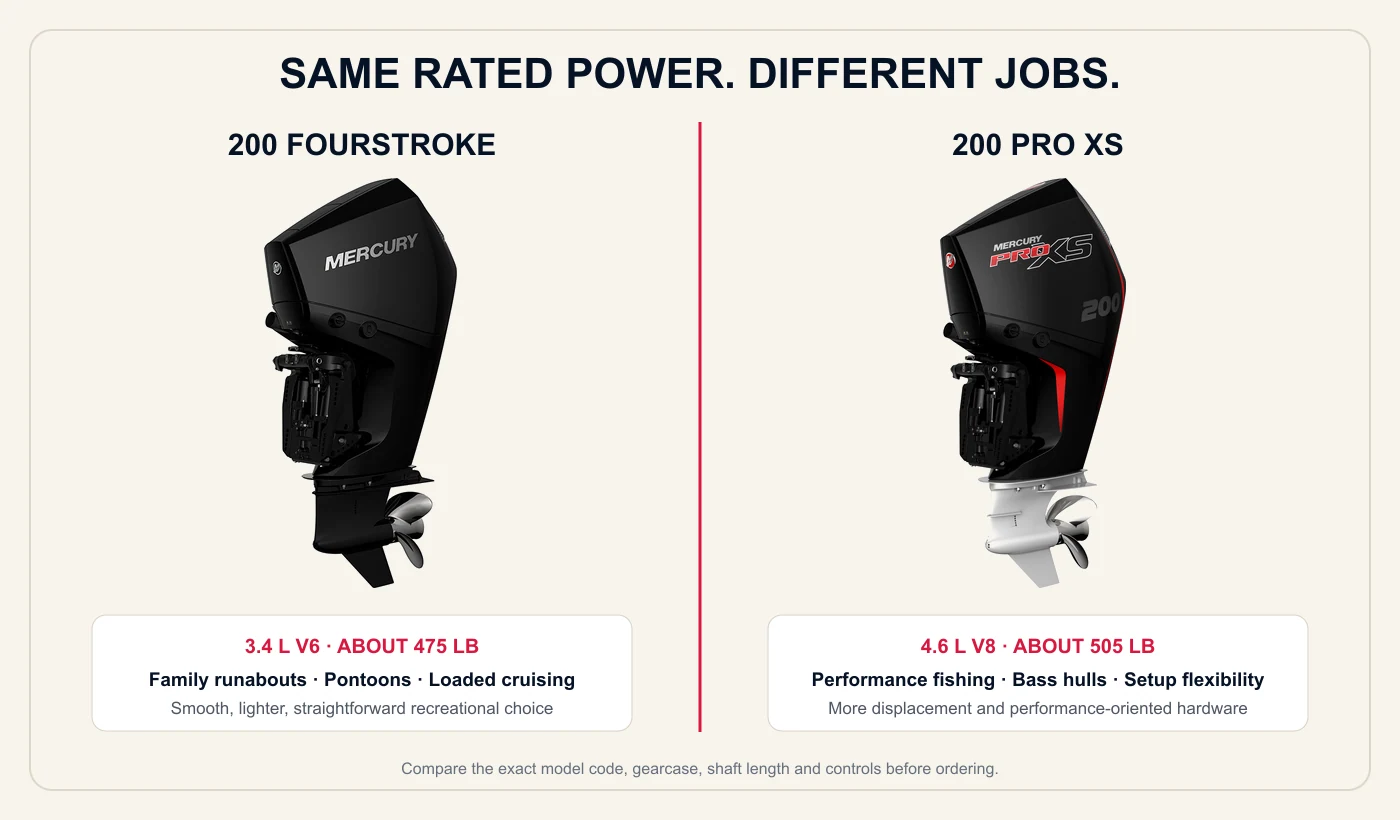
Official Mercury product photographs in an HBW comparison layout. The website crops the older weight labels from view. If your reader displays the full archived image, use the configuration-qualified table below: the Pro XS brochure lists 232 kg (511 lb), not the older 505 lb label.
FourStroke vs Pro XS: The Differences That Matter
On a phone, swipe the table sideways to see every column.
| Feature |
200 FourStroke |
200 Pro XS |
What it means on the boat |
| Rated power |
200 HP |
200 HP |
The Pro XS is not advertised as hidden extra horsepower |
| Powerhead |
3.4 L V6 |
4.6 L V8 |
Pro XS has more displacement and two more cylinders |
| Full-throttle range |
5,000–5,800 rpm |
5,600–6,200 rpm |
Pro XS supports a more performance-oriented propeller and setup window |
| Published lightest weight |
About 215 kg (475 lb) |
About 232 kg (511 lb) |
FourStroke saves roughly 17 kg (36 lb) before exact configuration differences |
| Gearcase |
Standard recreational configurations |
Standard and performance-oriented choices vary by model |
Exact ratio and gearcase must be checked, not guessed from the family name |
| Charging |
85 amp with idle charge management |
85 amp with idle charge management |
Both are well suited to electronics-heavy modern boats |
| Best fit |
Family, cruising and load-carrying use |
Performance fishing and responsive hulls |
Application matters more than the badge |
Weight-source note: Mercury FourStroke brochure 8M0189529 (May 2022), PDF page 10, lists 215 kg (475 lb) for the lightest 175/200 model. This is a manufacturer reference figure, not a promise for every current configuration. Confirm the exact ordered motor. Read the manufacturer brochure.
Choose the 200 FourStroke when
- the boat is a family runabout, deck boat or recreational deep-V
- the pontoon needs strong 200 HP load carrying without a performance setup project
- lower transom weight helps the boat's balance
- smooth low-speed operation and relaxed cruising are the priorities
- the owner wants the most straightforward route to a properly matched 200
The standard FourStroke is not the motor you settle for when you cannot justify Pro XS. On many boats, it is the better motor.
Choose the 200 Pro XS when
- the boat is a responsive aluminum or fibreglass fishing hull
- acceleration and high-speed control matter
- the hull can use a 4.6-litre V8 without creating a weight or balance problem
- a performance gearcase, jack plate or higher mounting is part of a qualified setup
- the owner is willing to finish the propeller and engine-height work with a real water test
The Pro XS is more than decals. The V8 displacement, operating range and available gearcase hardware are real differences. They still cannot rescue the wrong propeller, an overloaded boat or a hull that was never designed for a performance setup.
What They Feel Like on the Water
The V6 FourStroke's appeal is how naturally it fits a recreational boat.
It has strong displacement for a 200, a broad usable midrange and enough charging output for the electronics, pumps and accessories found on a modern family boat. On a pontoon, clean acceleration with people, canvas, fuel and gear aboard usually matters more than the last mile per hour with two people and an empty cooler.
The V8 Pro XS has a different personality. Its extra displacement and higher operating range give a properly set up performance boat more room to accelerate and carry speed. The exhaust note is more present. The motor also asks more of the setup. Propeller choice, mounting height, steering condition and weight distribution become part of the review.
Neither description is a substitute for driving the boat. A quiet motor on a poor hull match is still a poor repower. A V8 on the right bass or multi-species boat can feel completely at home.
What Owners Actually Say Online
We searched public boating forums, Reddit discussions and owner videos for the current 3.4-litre V6 FourStroke and 4.6-litre V8 Pro XS. We excluded older Optimax two-strokes, unrelated horsepower models and modified engines when judging performance or reliability.
This is not survey data. People with a problem or a fast boat are more likely to post than an owner whose motor simply starts every Saturday. The value is in the themes that keep repeating.
The Pro XS startup sound is either a feature or a warning to leave the dock quietly
The V8's brief startup bark may be the most consistently discussed non-technical feature. Some owners clearly love it. One 200 Pro XS owner described the start as a growl that settles into a purr. A Lund owner said the initial sound was enough to wake people at an early boat launch, then reported that the engine became unobtrusive at idle and normal running speeds.
That is the honest split. The Pro XS is not loud all day, but it makes an entrance. For some buyers, Mercury has effectively attached a soundtrack to the outboard. For someone who slips out for walleye before sunrise or wants the quietest possible family cockpit, the V6 FourStroke has the better personality.
The internet humour follows the sound. Under one heavily modified 200 Pro XS video, people joked that it needed 115 decals and that it sounded angry at the world. That clip is entertaining, but it is not evidence of what a stock, warrantied 200 will do.
V6 owners talk about the trip; V8 owners talk about the motor
In the Lund owner discussion, buyers repeatedly framed the decision as quiet relaxation and lower transom weight versus stronger hole shot and the V8 experience. In a V6-versus-V8 pontoon thread, the comments split between people who wanted the V8's torque and sound and people who saw Pro XS as unnecessary on a normal recreational pontoon.
Both camps can be right because “pontoon” no longer describes one kind of boat. A family cruising pontoon and a properly rated performance tritoon do not want the same setup.
The funny part is that the V6 earns less online theatre partly because it is doing exactly what its buyer wanted. Quiet, smooth and uneventful does not create as many videos. It does create good afternoons.
The propeller rabbit hole starts almost immediately
Owner discussions stop being about decals very quickly and turn into pitch, engine height, loaded rpm and whether the boat should prioritize hole shot, midrange or a top-speed number.
A 200 FourStroke owner with a 22-foot Pathfinder posted a detailed rpm, speed and fuel-use log after only 25 hours. He was already comparing props and said hole shot and midrange mattered more than top speed, while still admitting that joining the “60 club” would be fun.
That is a much more realistic owner review than “this motor is fast.” Buyers want the boat to jump cleanly on plane, carry its normal load and feel right at the speeds they actually use. Then, because boat owners are boat owners, they still wonder what one more propeller might do.
Wide-open throttle changes the fuel conversation
Owners generally describe both current 200s as reasonable at sensible cruise. The V8's reputation changes when it is held near the top of its operating range. A 4.6-litre engine moving a high-drag boat quickly will use fuel.
That is not a defect and it is not unique to Mercury. It is why we publish the useful cruise rows beside the top-speed results. If fuel range matters, compare the boat at the speed you will run for an hour, not the speed you will show a friend for 20 seconds.
Service access matters more than internet brand wars admit
In repower discussions, owners often choose the brand supported by the dealer they trust and the technicians available near their water. That is not surrendering the engineering comparison. It is recognizing that a perfect specification is not useful if competent service is hours away during boating season.
The same social threads also show why failure stories need context. One current 200 Pro XS owner reporting lost power was dealing with low voltage, a battery connection problem and an intermittent ground code. Another triggered Guardian mode after the engine ingested sand while backing off a sandbar. Those are real owner problems. They are not proof of a defective 200 powerhead.
The useful lesson is diagnostic: when a current 200 alarms or loses power, record the exact symptoms, voltage and fault history. Check the battery, grounds, fuel and cooling flow before guessing. A serial-number-specific scan and an on-water data log are worth more than 40 confident forum replies.
What the online buzz gets right
Across owner videos and discussions, the strongest recurring picture is:
- the V6 FourStroke is liked for quiet, smooth recreational use and lower weight
- the V8 Pro XS is liked for sound, hole shot, midrange response and the feeling of a performance motor
- either engine can disappoint when the propeller or installation is wrong
- full-throttle fuel use matters more than the badge
- owners value a local dealer who can diagnose the installed boat, not just sell the motor
- isolated complaints need an exact engine generation, serial number and cause before they become a reliability conclusion
That is more useful than pretending every owner agrees. They do not. They are often buying different experiences.
Real Freshwater Results, With the Boat Attached
These are complete Mercury performance records. They are examples, not speed promises and not controlled same-hull comparisons.
On a phone, swipe the table sideways to see every column.
| Boat |
Motor and setup |
Published result |
Useful cruise point |
| Barletta C22U pontoon, 23.2 ft, 1,286 kg (2,834 lb) dry |
200 FourStroke V6, standard 1.85, 14-pitch Enertia stainless |
38.4 mph at 5,824 rpm; 0–20 mph in 3.98 s; 0–30 mph in 7.4 s |
24.4 mph at 4,000 rpm, 29.5 L/h (7.8 US gal/h) |
| Crestliner 2200 Bay, 22.25 ft aluminum, 867 kg (1,912 lb) dry |
200 FourStroke V6, standard 1.85, 17-pitch Tempest Plus stainless |
49.1 mph at 5,800 rpm; 0–20 mph in 3.8 s; 0–30 mph in 5.0 s |
32.9 mph at 4,000 rpm, 32.6 L/h (8.6 US gal/h) |
| Crestliner 1850 Fish Hawk, 18.5 ft aluminum deep-V, 766 kg (1,689 lb) dry |
200 Pro XS V8, standard 1.85, 19-pitch Tempest Plus stainless |
53.5 mph at 5,987 rpm in Mercury's summary; 0–20 mph in 3.17 s; 0–30 mph in 4.65 s |
35.8 mph at 4,000 rpm, 33.3 L/h (8.8 US gal/h) |
| Lund 1875 Tyee, 18.8 ft aluminum deep-V, 798 kg (1,760 lb) dry |
200 Pro XS V8, HD Straight 1.75, 17-pitch Enertia stainless |
53.3 mph at 6,131 rpm; 0–20 mph in 3.0 s; 0–30 mph in 4.6 s |
33.7 mph at 4,000 rpm, 31.0 L/h (8.2 US gal/h) |
All four records are freshwater tests. The boat weights are published dry weights, not complete as-tested weights. Fuel, batteries, people, safety gear and options add to them.
The Barletta bulletin's 5,824 rpm is a published test-day reading, slightly above the 200 FourStroke's recommended 5,000–5,800 rpm full-throttle range. It is not a propping target; use the operating range in the exact engine's manual.
The Crestliner Fish Hawk table reaches 55.2 mph at 6,200 rpm, while Mercury's own performance summary reports 53.5 mph at 5,987 rpm. We use Mercury's summary number in the comparison and preserve that difference here instead of silently choosing the larger figure.
What Those Tests Do and Do Not Prove
The Barletta and Crestliner 2200 both use the V6 FourStroke. One runs 38.4 mph and the other 49.1 mph.
That 10.7 mph spread is not an engine mystery. It is the boat.
The pontoon is a larger, higher-drag platform carrying a 14-pitch propeller. The bay boat is a lighter, more efficient hull using a 17-pitch Tempest Plus. Both results can be excellent for their jobs.
The two Pro XS tests finish around 53 mph, but they use different gear ratios and propellers. That is exactly why a buyer should not ask only for a “200 Pro XS.” The exact model and setup determine what arrives on the transom.
These records support three practical conclusions:
- A 200 FourStroke can be an excellent pontoon and recreational motor.
- A 200 Pro XS can be an excellent match for a responsive fishing hull.
- A detached internet speed number is not a forecast for another boat.
The Gearcase Question Is Not Fine Print
Online comparison charts often give the 200 Pro XS one fixed gear ratio. Mercury's own test records show why that can mislead.
The Crestliner Fish Hawk used a standard 1.85 gearcase. The Lund Tyee used an HD Straight 1.75. Current model availability varies with shaft length, control configuration and application.
The correct ordering sequence is:
- Confirm the boat's capacity plate and transom condition.
- Confirm shaft length and steering requirements.
- Match the exact FourStroke or Pro XS model code to the hull.
- Select a starting propeller for that gearcase and normal load.
- Water test the installed boat.
The last step is not ceremonial. It confirms full-throttle rpm, acceleration, grip in turns, steering feel and cooling-water performance.
The Propeller Can Change the Whole Review
The four Mercury tests use three different pitch numbers:
- 14-pitch Enertia on the Barletta pontoon
- 17-pitch Tempest Plus on the Crestliner bay boat
- 19-pitch Tempest Plus on the Fish Hawk
- 17-pitch Enertia on the Lund Tyee
Those are not competing propeller opinions. They are different answers to different hulls, loads and gearcases.
Copying the Fish Hawk's 19-pitch propeller to the Barletta would not create a 53 mph pontoon. It could pull the motor below its intended operating range and make acceleration worse.
Motors 25 HP and up do not include a propeller in the base motor price. HBW carries a propeller allowance in the quote because a complete installed price needs a realistic prop plan. If a customer's existing propeller might be reusable, the quote can account for that. We still verify fit and performance on the water.
Read the Mercury propeller-selection guide for the terms. The installed boat gives the final answer.
What This Means on Ontario Water
A 200 on Rice Lake, Ontario may be carrying a family pontoon with canvas and coolers, a deep-V fishing boat in open-water chop or a lighter hull whose owner cares about acceleration and handling. Those jobs share a horsepower number, not a setup.
At HBW, the decision starts with the capacity plate, transom, steering, normal load and the way the boat is used. We carry a realistic propeller allowance in the quote, then finish the installation with a water test instead of treating a catalogue prop as the final answer.
Controls, Charging, Battery and Fuel
Mechanical vs Digital Throttle & Shift
Both 200 families appear in multiple configurations. A repower is not automatically a simple engine swap because the old control box says Mercury.
The quote has to answer:
- Is the selected motor mechanical or DTS?
- Can the existing controls and harnesses be reused?
- Does the boat need new hydraulic or power steering work?
- What instruments or SmartCraft components are staying?
- Is the rigging tube, battery cable and mounting hardware in suitable condition?
Reusing sound rigging can save money. Reusing incompatible or tired rigging is not a saving.
Charging and starting battery
Mercury publishes an 85-amp alternator and idle charge management for these V6 and V8 families. That is useful on boats running large displays, livewell pumps, stereos, lighting and charging equipment.
It does not remove the need for the correct battery. The operation manual calls for an AGM starting battery with substantial marine cranking and reserve capacity. We verify the exact requirement for the chosen motor and the boat's accessory load rather than copying the smallest number from a forum.
Weak battery voltage can create starting and electronic symptoms that look like a motor problem. Battery age, connections, switches and grounds are part of a serious repower inspection.
Fuel
Mercury specifies 87 AKI minimum gasoline and permits up to 10% ethanol. Premium fuel is not a required upgrade for either 200.
Fresh fuel is the issue that matters. Ontario boats that sit for long periods need good storage habits, a sound fuel system and the right filtration. Paying for extra octane does not repair stale or water-contaminated gasoline.
HBW sells ethanol-free 89-octane gasoline at our Rice Lake dock. The engine does not require the extra octane, but avoiding ethanol can make seasonal storage simpler.
Mercury Boost on the 200
Mercury Boost is relevant to eligible current and compatible earlier 200 FourStroke and Pro XS models, but it is easy to describe badly.
Boost is a dealer-installed software calibration. It improves midrange acceleration. Mercury says the measured zero-to-top-speed improvement varies by boat and setup, with published gains from 5% to 21%.
Boost does not:
- raise the engine's rated horsepower
- change peak horsepower
- increase top speed
- reduce time to plane
It changes how strongly the boat accelerates through the middle of the run.
Eligibility depends on engine family and serial number. Mercury currently lists factory availability on eligible 2026 Pro XS 175–300 HP engines beginning at serial 3B612473. Dealer-installed availability covers eligible FourStroke 175/200/250/300 and Pro XS 175/200/225/250/300 engines beginning at serial 2B529482.
We verify the actual serial number before presenting Boost as an option. A general “200 HP” label is not enough.
Is the Mercury 200 Reliable?
There is no honest motor review that can promise a buyer will never have a problem.
There is also no responsible reason to turn scattered online complaints into a made-up systemic defect.
Mercury's current 3.4-litre V6 and 4.6-litre V8 families entered the market in 2018. In the current manufacturer material, complete performance records and owner discussions reviewed for this article, we did not find a documented recurring current-generation failure pattern strong enough to warn buyers away from either 200.
The ownership issues worth taking seriously are ordinary and preventable:
- start with the battery capacity Mercury specifies
- keep fuel fresh and water out of the system
- use the correct propeller so the engine reaches its intended operating range
- maintain cooling-water flow and service the water pump on schedule
- use the specified oil, filters and service intervals
- do not treat winterization as optional on an Ontario boat
One online quirk is worth understanding without dramatizing it: some owners describe a brief extra crank or a second start attempt in certain conditions. That is not evidence of one universal defect. If a specific engine develops a repeatable starting issue, the right response is battery and voltage testing, fault-history review, fuel-system checks and diagnosis by serial number.
When We Would Tell You Not to Buy the 200
The capacity plate stops below 200 HP
Then the answer is below 200. The plate is not a suggestion and Pro XS is not a loophole.
A healthy 150 already does the job
The step from the 150's 3.0-litre inline-four to the 200 FourStroke's 3.4-litre V6 adds weight, cost and rigging considerations. If a properly propped 150 already planes the boat cleanly with the normal load, the 200 may be money spent for a result the owner rarely uses.
Read the Mercury 150 FourStroke and Pro XS review for the smaller platform.
The loaded boat really wants a 225 or 250
A large tritoon or heavy deep-V can be rated for more power and regularly carry a demanding load. If the current healthy 200 already struggles after propeller and setup have been corrected, replacing it with another 200 may repeat the complaint.
That does not mean automatically buying the maximum rating. It means sizing the motor from the loaded job, not the old decal.
The owner wants Pro XS only for the badge
If the boat will never use the V8's performance application, extra setup range or available gearcase hardware, the V6 FourStroke can be the better purchase. It is lighter, simpler to justify and still a strong 200 HP outboard.
The transom, steering or fuel system needs the budget first
A new motor should not be used to hide an unsafe installation. We would rather repair the foundation or decline the job than put a 200 on a transom or steering system that is not ready for it.
What Does a Mercury 200 Cost in Canada?
The useful price is not one frozen number in a review.
The 200 range includes different shaft lengths, controls, gearcases and model codes. The complete installed cost can also include controls, harnesses, steering, gauges, propeller allowance, installation, battery work, trade-in and current Mercury programs.
Use the live Canadian Mercury pricing reference for the current motor prices. Then use the quote builder to put the exact motor into an installation.
That approach is less convenient for a headline writer and more useful for a buyer. It also prevents an old article price from following a customer into a new model year.
Warranty and Product Protection
Mercury's standard limited warranty and corrosion warranty are both important, but they run concurrently rather than stacking into six years of total coverage.
Eligible buyers can also add Mercury Product Protection. HBW normally quotes the Platinum plan because it is the coverage customers usually expect when they ask for extended protection.
See the Mercury Product Protection guide and current Canadian Platinum pricing. If coverage is added to an eligible financed quote, the quote can show the estimated payment difference instead of presenting only one larger amount due today.
Coverage terms, eligibility, exclusions and the contract control. The page and quote are explanations, not replacements for the agreement.
Our Verdict
The Mercury 200 FourStroke is the choice we expect to fit more family and cruising repowers. The 3.4-litre V6 is lighter than the V8, has strong recreational manners and does not ask the owner to pretend the boat is a performance hull.
The 200 Pro XS is the more interesting motor when the boat can use it. On a responsive fishing hull, the 4.6-litre V8, higher operating range and performance-oriented configurations are meaningful. It deserves proper steering, propeller and engine-height work.
The honest answer is not that one is universally better.
It is this:
- buy the FourStroke for the recreational job it does naturally
- buy the Pro XS when the hull and owner will use the V8 performance package
- buy neither until the capacity plate, transom, shaft length, controls and normal load have been checked
That is how a 200 HP review turns into a good repower instead of a faster-looking mistake.
Build the 200 Around Your Boat
The quote builder shows current Canadian motor pricing and lets you account for installation, controls, propeller needs, trade-in and available programs.
Browse current pricing: Canadian Mercury pricing reference
Build a complete quote: Mercury motor selection
Phone: 905-342-2153
Address: 5369 Harris Boat Works Rd, Gores Landing, ON K0K 2E0
Harris Boat Works sells, installs and services Mercury outboards in Gores Landing, Ontario. Completed boats are picked up at HBW after installation and water testing.
Sources and Review Notes
This review uses current-family evidence and complete Mercury freshwater test records. Performance numbers remain attached to the boat, propeller and test setup that produced them.
All speed, acceleration and fuel-use results vary by boat, propeller, load, mounting and conditions. Current prices come from the live HBW pricing reference, not this article.
