Here is the quickest way to get a Mercury 150 review wrong. Take the 60.2 mph result from a Nitro bass boat, detach it from the boat and propeller, then promise every 18-foot boat will do the same thing. It won't.
Quick answer: The Mercury 150 FourStroke and 150 Pro XS use the same 3.0-litre inline-four platform and are both rated at 150 HP. For most family runabouts and cruising pontoons, the standard FourStroke is the straightforward choice. Pro XS earns its place on a responsive fishing or performance hull whose setup can use its wider operating range. It's not a secret higher-horsepower motor.
Here is the quickest way to get a Mercury 150 review wrong.
Take the 60.2 mph result from a Nitro bass boat, detach it from the boat and propeller, then promise every 18-foot boat will do the same thing.
It won't.
A 23.2-foot Barletta pontoon with a standard 150 FourStroke ran 34.6 mph in Mercury's freshwater test. A Crestliner 1850 Fish Hawk with a 150 Pro XS ran 47.6 mph. The Nitro Z18 reached 60.2 mph. All three are real results. None is a prediction for your boat.
The useful review starts when the motor stays attached to the hull, load and propeller.
What the Current Mercury 150 Actually Is
The recreational Mercury 150 isn't a new V6 or a first-year engine being tested on customers.
Mercury released the 3.0-litre 150 FourStroke in North America in 2012. The 150 Pro XS version arrived in 2018 on the same proven platform. Mercury's current operation manual still identifies both as 3.0-litre four-cylinder outboards.
For the current Canadian lineup checked in July 2026:
- both motors are Mercury-rated at 150 HP
- both use a 3.0-litre inline-four powerhead
- both use electronic fuel injection
- both have a 60-amp charging system with idle charge battery management
- the standard FourStroke uses a 5,000–5,800 rpm full-throttle range
- the Pro XS uses a 5,200–6,000 rpm full-throttle range
- the standard gear ratio is 1.92:1
- the Pro XS gear ratio is 2.08:1
Mercury lists the lightest standard 150 around 206 kg (455 lb) and introduced the Pro XS at 207 kg (456 lb). Exact model, shaft length and rotation can change the number, so we still check the model code rather than treating one catalogue weight as every 150.
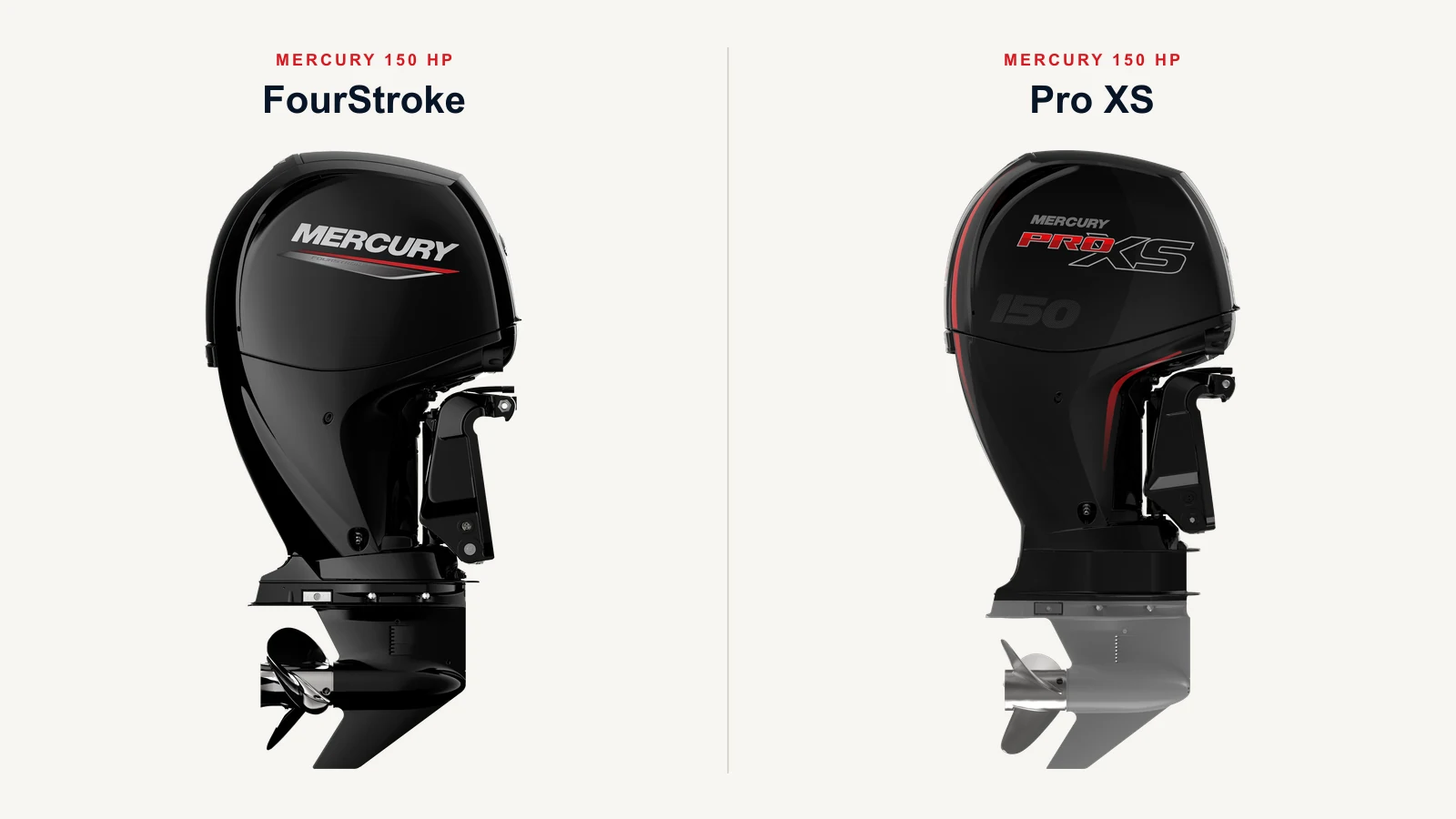
Official Mercury Marine studio assets of the current 150 FourStroke and 150 Pro XS. The side-by-side layout is an HBW comparison graphic. The display props and finishes shown are not a fitment recommendation for your boat.
FourStroke vs Pro XS: The Differences That Matter
On a phone, swipe the table sideways to see every column.
| Feature |
150 FourStroke |
150 Pro XS |
What it means on the boat |
| Rated power |
150 HP |
150 HP |
Pro XS is not advertised as hidden extra horsepower |
| Powerhead |
3.0 L inline-four |
3.0 L inline-four |
Same mature engine platform |
| Full-throttle range |
5,000–5,800 rpm |
5,200–6,000 rpm |
Pro XS gives a performance setup more propeller and rpm flexibility |
| Gear ratio |
1.92:1 |
2.08:1 |
Pro XS turns the prop shaft with more gear reduction for acceleration |
| Gearcase details |
Standard recreational gearcase |
Extra water pickups on the nose |
Pro XS supports higher mounting and jack-plate applications when set up correctly |
| Engine mounts and calibration |
Recreational tune |
Performance-tuned mounts and Transient Spark Technology |
Pro XS is aimed at sharper acceleration and high-speed control |
| Published lightest weight |
About 206 kg (455 lb) |
About 207 kg (456 lb) |
Weight is effectively a tie; the choice is about application |
| Charging |
60 amp with idle charge management |
60 amp with idle charge management |
Both support electronics better than a small-output legacy charging system |
Choose the standard 150 FourStroke when
- the boat is a family bowrider, deck boat or normal recreational V-hull
- the pontoon needs honest 150 HP load carrying, not a performance identity
- the owner wants a simple, mature repower without chasing the last bit of acceleration
- the boat will not use a jack plate or aggressive engine height
- predictable cruising matters more than proving a number at wide-open throttle
The standard 150 isn't the economy version of a better motor. On the right family boat, it is the right motor.
Choose the 150 Pro XS when
- the boat is a responsive aluminum or fibreglass fishing hull
- acceleration and high-speed handling matter
- the owner will finish the propeller, engine-height and load setup
- a jack plate or higher mounting is part of a qualified performance application
- the hull can use the wider rpm range without sacrificing normal loaded operation
The Pro XS changes useful hardware and calibration. It is more than decals. It still can't make a heavy, high-drag boat behave like a bass boat.
What They Feel Like on the Water
The standard 150's appeal is how little drama it needs.
It has enough displacement to move a properly rated family boat without feeling strained, and the 60-amp alternator is useful on modern boats carrying chartplotters, stereos, pumps and charging demands. On a pontoon, the important result is usually clean planing and loaded midrange rather than one more mile per hour with two people aboard.
The Pro XS feels more urgent when the boat can respond to it. The lower 2.08:1 ratio, wider operating range and Transient Spark Technology are aimed at acceleration. The extra nose water pickups give a qualified installer more freedom with mounting height.
That freedom isn't permission to guess. An engine mounted too high can still lose cooling-water pressure or propeller grip. A jack plate doesn't replace a water test.
What Owners Actually Say Online
We screened public owner forums, Reddit discussions and owner videos for the current 3.0-litre 150 FourStroke and 150 Pro XS. Older Optimax two-strokes, the separate Mercury Racing 150R and other horsepower families were excluded.
Social posts are not failure-rate data or controlled tests. They are useful for finding the questions, surprises and annoyances that brochures leave out.
Standard 150 owners are often happier than the internet expects
Performance forums naturally spend more time on Pro XS. Owners of the standard 150 tend to describe a less dramatic experience: strong planing, good midrange, reasonable cruise fuel use and a motor that is easy to enjoy.
In one current-generation owner discussion, a standard 150 owner on a Ranger Z518 described the motor as quick onto plane, consistent in the mid-50 mph range on that boat, easy on fuel and simply fun to drive.
That is not a transferable speed promise. It is a good reminder that the standard FourStroke is not waiting to be rescued by a Pro XS badge.
A Pro XS can be slower when the setup is wrong
This may be the most useful 150 owner story online.
A Vexus owner compared his 150 Pro XS with a friend's standard 150 on the same boat model. Both had been supplied with the same 23-pitch propeller. The standard boat was faster, and the Pro XS owner understandably wondered whether he had paid more to go slower.
The 2.08:1 Pro XS gear ratio and 1.92:1 standard ratio do not use an identical pitch in an identical way. Add a jack plate, mounting height, load and manufacturing variation, and “same boat, same prop” is not a controlled comparison.
The lesson is not that the standard 150 is always faster. It is that Pro XS creates a different setup window. If the dealer sends both boats out with the same prop and calls the work finished, the standard motor can absolutely produce the better result.
That is why we water test.
The premium question is really a personality question
In a public 150 FourStroke-versus-Pro XS discussion, owners divided almost exactly as expected. Tournament and performance users valued the gearing, extra rpm and water pickups. Recreational buyers asked why they should pay for hardware they would rarely use.
Neither group missed the point. Pro XS earns its premium when the hull and owner will finish and use the performance setup. The standard 150 wins when the goal is a strong family or fishing motor without turning every Saturday into a propeller test.
New owners worry about break-in more than they admit at the dealership
A 2026 owner took a new 150 Pro XS out on a cold, windy day, briefly ran above the rpm he had planned and then asked the internet whether he had damaged the engine.
The human part of the break-in discussion was not abuse. It was an owner trying so hard to protect a new purchase that a few minutes outside his personal plan created days of anxiety.
Follow Mercury's current manual for the exact engine. Use rpm, not a guessed throttle percentage. Vary the load as directed, avoid extended operation the manual prohibits and do not substitute a forum's “run it like you stole it” theory for the manufacturer's procedure.
There are real failure stories, not a proven epidemic
A candid review should not pretend every current 150 has been flawless.
We found a 2026 report of a very low-hour 2022 150 Pro XS that suffered a serious internal failure; Mercury replaced the powerhead under the remaining factory warranty. We also found an early-production 2018 Pro XS report involving an oil-pump failure and a warranty long-block replacement.
Those are serious individual cases. They matter to the owners. They do not establish a failure rate, identify one shared cause or prove a systemic defect across a 3.0-litre family that has been sold for years.
The online phrase “post-COVID motors” appears in some discussions, but a model-wide claim needs more than a date range and a shop-floor remark. For a used 150, the useful response is to verify the serial number, warranty history, service records, engine hours and fault history, then inspect and test the actual motor.
What the online buzz gets right
- the standard 150 can be an excellent and fun motor on the right boat
- Pro XS performance is earned through propeller and mounting work, not guaranteed by the decal
- using the same propeller on standard and Pro XS versions can produce a misleading comparison
- buyers need a clear break-in explanation at delivery, not only a manual in a bag
- serious individual failures should be acknowledged without inventing a fleet-wide defect
- warranty status and local dealer support matter on a used or new 150
The most human 150 review is not “Pro XS is faster.” It is “which setup will still feel right when the boat has its real people and gear aboard?”
What This Means on Ontario Water
Around Rice Lake, Ontario and the Kawarthas, a Mercury 150 can end up doing three very different jobs: pushing a family pontoon with people, canvas and gear; carrying a deep-V fishing boat through open-water chop; or powering a lighter performance hull. Those boats don't want the same gearcase, propeller or setup just because the cowl says 150.
At HBW, the recommendation starts with the boat's capacity plate, transom, normal passenger load and how the owner actually uses local water. We carry a realistic propeller allowance in the quote, finish the setup with a water test on Rice Lake and make the installed boat available for pickup at Gores Landing. That process matters more than repeating the fastest number we found online.
Real Freshwater Results, With the Boat Attached
These are documented examples, not speed promises.
On a phone, swipe the table sideways to see every column.
| Boat and test load |
Motor and propeller |
Reported result |
Useful cruise point |
| 2020 Barletta C22QC pontoon, 23.2 ft, 1,286 kg (2,834 lb) dry |
150 FourStroke, 1.92:1, 14-pitch Spitfire aluminum |
34.6 mph at 5,743 rpm; 0–20 mph in 4.89 s; 0–30 mph in 9.59 s |
22.0 mph at 4,000 rpm, 26.1 L/h (6.9 US gal/h) |
| 2023 Crestliner 1850 Fish Hawk, 18.5 ft aluminum deep-V, 693 kg (1,527 lb) dry |
150 Pro XS, 2.08:1, 19-pitch Tempest Plus stainless |
47.6 mph at 5,875 rpm; 0–20 mph in 3.99 s; 0–30 mph in 6.06 s |
21.3 mph at 3,000 rpm, 13.6 L/h (3.6 US gal/h) |
| 2019 Nitro Z18, 18 ft 8 in fibreglass bass boat, 1,254 kg (2,765 lb) as tested including two people and full 151 L (40 US gal) fuel |
150 Pro XS, 25-pitch Fury 4 |
60.2 mph at 5,770 rpm; planed in 4.1 s; 0–30 mph in 6.4 s |
25.7 mph at 3,000 rpm, 15.1 L/h (4.0 US gal/h) |
The Barletta and Crestliner rows use published dry boat weights. The Nitro figure is an as-tested weight with people and fuel, so the three weights are not directly comparable. What is comparable is the warning: the Barletta and Nitro use the same horsepower and differ by 25.6 mph at the top end. That isn't an argument that one test is wrong. It is the clearest possible argument against shopping by a detached speed number.
BoatTEST's Nitro article calls the 150 Pro XS a V6 in one line. Mercury's operation manual identifies it as a 3.0-litre inline-four, which is the specification used in this review. The Nitro performance table remains useful because the boat, tested weight, propeller, rpm and conditions are documented.
The Propeller Can Change the Whole Review
Look at the three props in the test table:
- 14-pitch Spitfire aluminum on the pontoon
- 19-pitch Tempest Plus stainless on the deep-V
- 25-pitch Fury 4 on the bass boat
These aren't three opinions about the same propeller. They're three different answers to three different boats.
Copy the Nitro's 25-pitch prop to the Barletta and the motor would not suddenly produce a 60 mph pontoon. It would likely hold the engine far below its intended operating range and make the boat worse.
The correct sequence is:
- Confirm the capacity plate, transom, shaft length and steering.
- Match the motor and gearcase to the hull and normal load.
- Start with a propeller chosen for that application.
- Water test with a realistic passenger, fuel and gear load.
- Check full-throttle rpm, acceleration, grip in turns, steering and cooling-water pressure.
- Change the propeller or mounting only when the test says it is needed.
At HBW, motors 25 HP and up do not include a propeller in the base motor price. Our quote builder carries a propeller allowance because a complete price needs a realistic prop plan. If an existing propeller may be reusable, we can account for that, but “it fits the shaft” is not the same as “it fits the boat.”
Our propeller-selection guide explains the terms. The water test gives the final answer.
115 vs 150: More Than 35 HP
Moving from a 115 to a 150 is not just changing the badge.
The current Mercury 115 family is a 2.1-litre platform in roughly the 163 kg (360 lb) class. The 150 is a 3.0-litre platform around 206 kg (455 lb). That roughly 90-plus-pound step matters to an older transom, boat balance, trailer tongue weight and how the hull sits at rest.
Choose the 115 when the boat is properly rated, normally loaded and does not need the size or weight of the 150 class.
Choose the 150 when the capacity plate allows it and the boat's real load, hull and intended use justify the larger platform.
Don't decide from boat length alone. Two 18-foot boats can differ by hundreds of pounds before batteries, trolling motors, fuel, canvas, gear and people go aboard.
Read the Mercury 115 FourStroke and Pro XS review for the smaller platform. The capacity plate and transom inspection still get the last word.
When We Would Tell You Not to Buy the 150
The capacity plate stops below 150 HP
Then the answer is below 150. The plate is not a suggestion and Pro XS is not a loophole.
The boat really needs the 175 class
If the hull is rated for more power, carries a heavy regular load and already struggles with a healthy 150-class setup, buying another 150 may repeat the same complaint. The current 175 is a different 3.4-litre V6 engine family, so the physical fit, rigging and complete cost need a fresh comparison.
The owner wants a 60 mph result from the wrong hull
The Nitro test is not transferable. A family pontoon, broad deep-V and bass boat use 150 HP differently.
The repower budget ignores rigging
A motor-only price can look attractive until steering, controls, gauges, harnesses, battery capacity, propeller and installation are added. Compare complete working boats, not two bare engine numbers.
Real Ownership Details Buyers Miss
The idle may rise when the battery is low
Mercury's current manual says the 150 can automatically increase idle speed up to 800 rpm when battery voltage is low. That raises charging output. Optional troll control overrides the feature.
An idle increase is therefore not automatically a fault. It is still worth checking the battery and charging system if it happens often.
The battery requirement is not small-motor territory
The current manual lists 1,000 MCA, 800 CCA or 180 Ah for a lead-acid cranking battery. Battery chemistry and installation requirements matter, and an old battery that started the previous motor is not automatically suitable.
Existing Mercury rigging is not automatically reusable
Mechanical controls, harnesses, key switches, SmartCraft gauges and steering may be reusable after inspection. Brand matching is not enough. Generation, condition, connectors and the complete setup still decide.
Pro XS setup flexibility creates more ways to get it wrong
The nose water pickups and performance gearcase support higher mounting and jack-plate applications. They do not guarantee the engine height, water pressure or propeller is correct. The more adjustable the setup becomes, the more important the final water test becomes.
Does Mercury Boost Work on the 150?
No.
Mercury's current Boost compatibility begins at 175 HP in the recreational FourStroke and Pro XS ranges. The list includes Mercury Racing's 150R separately, but that is a different racing motor. It is not evidence that Boost can be installed on a recreational 150 FourStroke or 150 Pro XS.
Boost also doesn't increase the eligible engines' peak horsepower or top speed. It changes midrange acceleration. Don't buy a 150 expecting a later software upgrade to turn it into a 175.
Reliability: The Honest Answer
The standard 3.0-litre 150 platform has been in the North American market since 2012. The Pro XS version has been in market since 2018. This is a mature engine family.
Public owner material includes serious individual current-generation failures, including warranty powerhead replacements, as well as many trouble-free ownership reports. We did not find documented evidence that establishes one recurring defect or a failure rate strong enough to warn buyers away from either current 150.
That is not the same as saying every complaint is minor. It means an individual failure, even a major one, cannot responsibly be turned into a model-wide conclusion without a shared cause and broader evidence.
The things that repeatedly matter are less exciting:
- correct battery capacity and clean connections
- clean fuel and the right fuel-system care
- correct engine height and propeller
- cooling-system condition
- scheduled oil, filter, gear-lube and anode service
- proper winterization before HBW's December 1 to April 1 closure
A mature powerhead cannot compensate for water in the fuel, a tired battery or a propeller that keeps the engine below its operating range.
Warranty, Product Protection and Current Pricing
For a new Mercury outboard registered for pleasure use in Canada, the standard factory package includes a 3-year limited warranty and a separate 3-year corrosion warranty. Those periods run concurrently. They do not add up to six years.
Mercury Product Protection Platinum is an optional extended service contract that can continue eligible covered-component protection after the applicable factory limited warranty. Plan term, eligibility, exclusions and current Canadian pricing need to be confirmed for the exact motor.
We don't freeze the motor price into this review. Shaft length, model, rigging and Canadian programs can change, and an old search result shouldn't overrule a current quote.
The Pro XS generally carries a premium over the standard FourStroke. The useful question isn't whether the badge costs more. It is whether your hull and setup can use the wider rpm range, performance gearcase and acceleration hardware you are paying for. The live pricing reference shows the current Canadian relationship without locking this article to an old dollar figure.
See current Canadian pricing: HBW Mercury pricing reference
Build a complete quote: Choose your Mercury motor
The HBW Verdict
The standard Mercury 150 FourStroke is the right answer more often than internet discussions make it sound.
For a family runabout or normal cruising pontoon, it delivers the same rated 150 HP, the same 3.0-litre displacement and the same 60-amp charging system without asking the owner to build a performance setup around the motor.
The 150 Pro XS is the right answer when the boat and owner will use what makes it different. On a responsive fishing hull with a properly chosen propeller and finished engine height, its gearing, operating range and performance hardware are meaningful.
The wrong answer is buying Pro XS because someone said it is secretly more horsepower, or buying the standard motor while expecting a Nitro bass-boat speed from a pontoon.
Bring the actual boat into the decision.
Address: 5369 Harris Boat Works Rd, Gores Landing, ON K0K 2E0
Harris Boat Works is a Mercury Marine Premier Dealer on Rice Lake. We have been a Mercury dealer since 1965 and a family marina since 1947.
Sources and Review Notes
This review was last checked July 26, 2026. Specifications come from Mercury's current 150/150 Pro XS operation manual and current product literature. Performance figures remain attached to the boat, propeller, test load and conditions that produced them.
Official article imagery was downloaded from Mercury Marine's dealer-approved Canadian asset library. The hero is identified by Mercury as freshwater lifestyle photography of a 150 Pro XS on a Ranger 1782.
All performance results vary by boat, propeller, load, mounting and conditions. Current prices come from the live HBW pricing reference, not this article.
