Short answer
Squeezing the bulb is doing a job the motor should be doing for itself, which is pulling fuel from the tank. A bulb that is sucked flat points to the tank side. A bulb that still has fuel in it, where squeezing brings the motor back, points to the engine side, and on a 40, 50 or 60 hp FourStroke the part we replace most often there is the fuel pump bolted to the engine. We have done 39 as paid repairs, typically $450 to $700 before tax. Rule out the cheaper causes first.
This page is about the fuel-injected (EFI) 40, 50 and 60 FourStrokes, which is most of what we see. A primer bulb belongs on these motors. Mercury's rule is that 60 hp and below prime with a bulb, and 75 hp and up prime themselves.
What the bulb is telling you
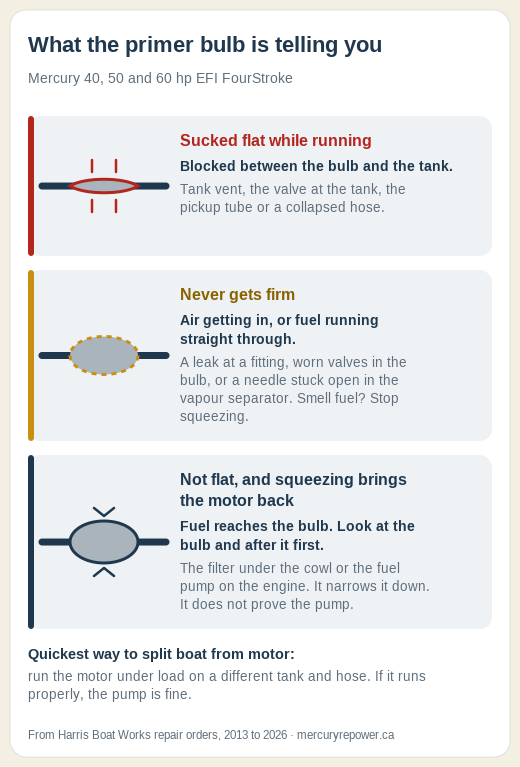
Pumping the bulb proves one thing: the motor wants more fuel than it is getting. The bulb also gives you a clue about where, and you already have your hand on it.
The bulb is sucked flat while you are running. Something between the bulb and the tank is blocked. The motor is pulling and nothing is coming. Think tank vent, the valve at the tank, the pickup tube or a collapsed hose. A bulb that is only a little soft once the motor is running is normal.
The bulb never gets firm, no matter how much you squeeze. Air is getting in somewhere, the little valves inside the bulb have failed, or fuel is running straight through past a needle in the vapour separator that is stuck open. If you see or smell fuel at the motor, stop squeezing.
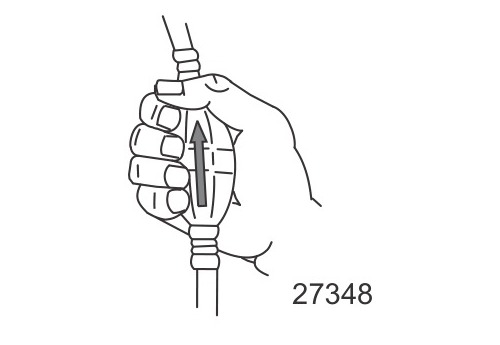
When priming, hold the bulb with its arrow pointing up and squeeze until it feels firm. Mercury Marine 30/40/50/60 FourStroke owner’s manual 8M0231124, p. 65, fig. 27348.
The bulb is not sucked flat, the motor still starves, and squeezing brings it back. Fuel is reaching the bulb, so the fault is at the bulb or after it: the filter under the cowl or the fuel pump on the engine. It narrows things down. It does not prove the pump.
Which fuel pump are we talking about?
These motors have two.
The low-pressure pump is a mechanical one bolted to the engine and driven off the camshaft. It pulls fuel from the tank. It is the one this page is about and the one we replace most.
The high-pressure pump is electric and sits inside the vapour separator, a small fuel reservoir on the engine. It feeds the injectors.
A lot of owners replace both because one might be bad, and are still stuck afterwards.
Six cheaper things to rule out before the pump
Every one of these has fooled an owner into buying a pump.
A tank vent or cap that is not letting air in. As fuel leaves, air has to replace it. If it cannot, the tank pulls a vacuum and the motor starves. On a portable tank, check that the vent is open. On any tank, when the motor starts to starve, shut it off and crack the cap. A hiss of air going in is your answer. Do not run the boat with the cap loose.
A stuck valve at the tank. Many built-in tanks have an anti-siphon valve where the fuel line attaches. When it sticks, it chokes off the flow. It is a safety part, so it gets replaced, not removed.
A loose or damaged pickup tube inside the tank. We have found about ten of these. One was lying on the bottom of the tank.
A fuel line that is breaking down on the inside. We have replaced 39. The hose looks fine from the outside. Inside, the liner peels and folds over.
The bulb or the connectors. The check valves in a bulb wear out, and a tired O-ring in a quick-connect fitting lets in air.
A plugged fuel filter. There is a small filter under the cowl, and many boats also have a spin-on water-separating filter back near the tank. Either one can choke the flow.
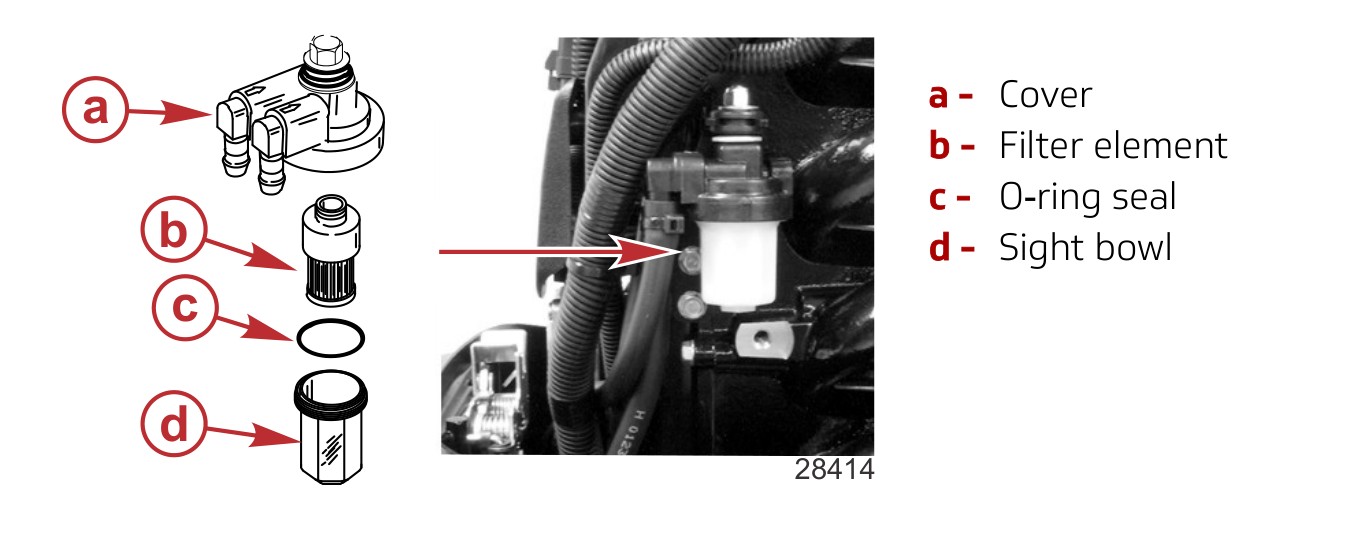
On the 30–60 FourStroke shown, the sight bowl (d) sits below the filter element (b). Look through the bowl for water or sediment. Mercury Marine owner’s manual 8M0231124, p. 86, fig. 28414.
The quickest way to sort the boat from the motor is to run the motor on a different tank and hose. Our techs do this with a shop tank before they touch anything else. If the motor runs properly on our tank, the problem is in your boat and the pump is fine.
When it is the pump
The mechanical pump has small valves and a plunger inside, and they wear.
What our customers told us on those jobs:
- It starves for fuel under load and is fine at idle
- It runs well for twenty minutes and then bogs
- It stalls above about 4,000 RPM
- Squeezing the bulb keeps it going (16 of 39 jobs)
- The pump is knocking or ticking
We have replaced 39 of these as paid repairs since 2018, on motors from model year 2003 to 2022, and more of them lately than when we started counting. That number does not include another 18 we replaced under warranty, which are covered in the questions below.
Do not run it all season on the bulb
Use the bulb to get home. On seven of our 39 jobs the pump had come apart inside by the time we saw it. The pieces went down the fuel line and into the vapour separator, and the repair became a pump plus a clean-out.
A failing pump can also leak, and where it leaks to is the engine oil. The diaphragm inside tears and fuel goes through the pump's mounting hole into the crankcase. On one job this year the pump was knocking and leaking, and the tech checked the oil for gas and changed it as part of the repair.
Mercury's own check is simple: squeeze the bulb until it is firm and look for fuel weeping around the edge of the pump and at its vent opening, where it meets the engine. That finds a leak to the outside. A leak into the oil does not always show there, so if your pump is ticking, or you have been limping along on the bulb, pull the dipstick too. An oil level that is climbing quickly and smells of gas means stop running the motor and have it looked at. A lot of cold running and idling can also thin the oil with fuel, more slowly. Either way, oil with gas in it needs changing.
What it costs
These are the totals our customers paid, parts and labour, before tax, on jobs from 2024 to 2026.
Mechanical fuel pump replaced: typically $450 to $700. Labour is usually about an hour and a half.
Pump replaced and the vapour separator cleaned out on the same visit: $440 to $865 on the five we did from 2024 to 2026.
If it turns out to be the fuel line: typically $275 to $600.
If we find nothing wrong: you pay for the time spent looking, which has been about $125 to $210.
Prices change, so treat these as a guide and not a quote.
What to tell us when you book
The model year or serial number, the RPM where it falls off, what the bulb does when it happens, and whether squeezing it helps. That last detail saves real time.
We are Harris Boat Works, on Rice Lake in Gores Landing, Ontario. Service requests are at hbwservice.ca.
The counts on this page are from our own repair orders, December 2013 to November 2026.
Sources
- Mercury Marine Canada: Quicksilver 8M0141827 fuel pump for select 30 to 60 hp outboards, accessed November 25, 2026.
- Mercury Marine: Quick Tip, Priming Your Fuel System, accessed November 25, 2026.
- Mercury Marine Service Bulletin 2018-01, 30 to 60 hp FourStroke fuel pump replacement (dealer bulletin). Confirm your serial number with a Mercury dealer.
- HBW service records review, November 2026: technician notes on 959 fuel-system repair jobs, December 2013 to November 2026, classified by what was found and fixed. Costs are from 2024 to 2026 jobs, parts and labour before tax (no customer data used)
About the author
Jay Harris runs Harris Boat Works, a family marina and Mercury dealer on Rice Lake in Gores Landing, Ontario. The repair counts and costs on this page come from the shop's own work orders.
