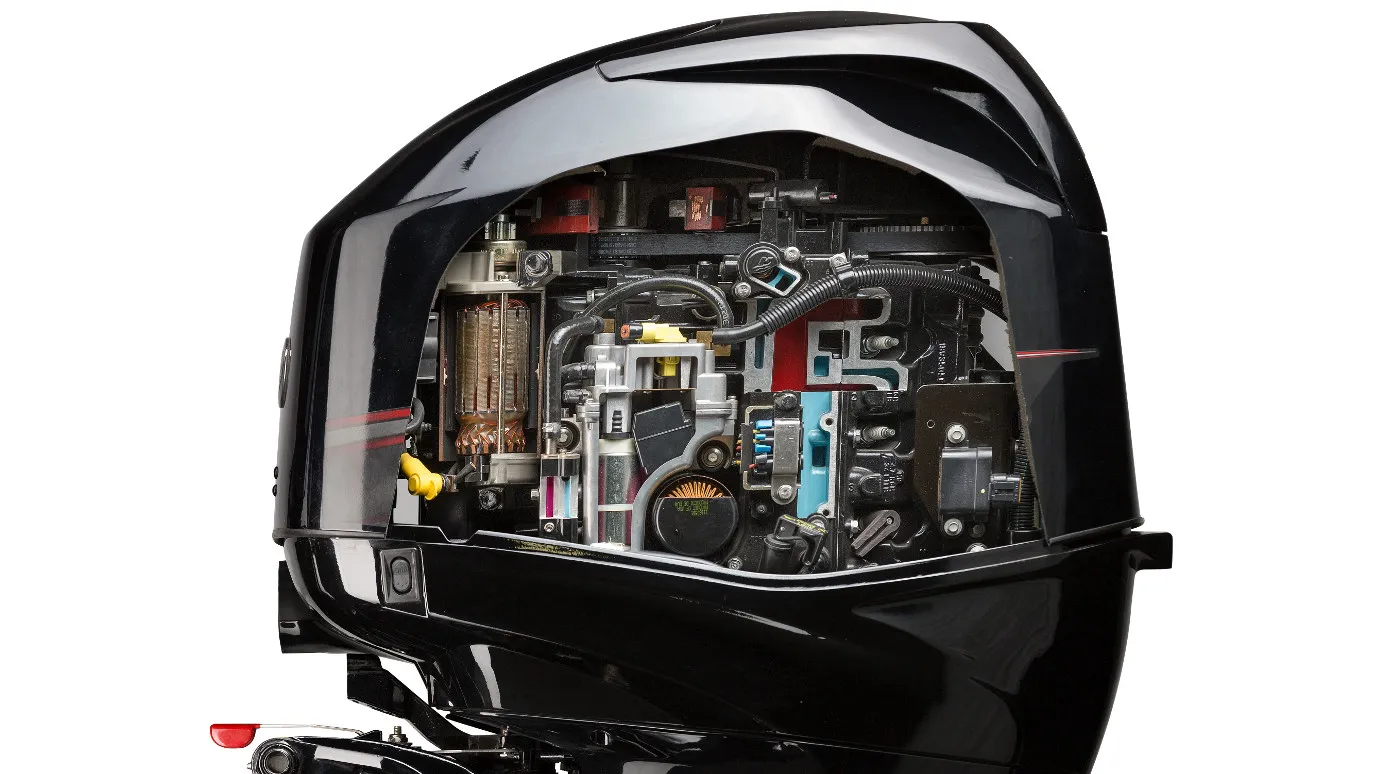
Mercury’s cutaway shows the powerhead beneath the cowl of a 60 hp FourStroke Command Thrust. Image courtesy of the Mercury Marine Creative Dept.
Short answer
On a Mercury 25 to 60 hp EFI FourStroke, a vapour separator that leaks, floods the motor or will not build pressure almost never needs replacing. On the 79 jobs where we had one apart, what we usually found was dirt under a needle, a plugged screen or a failed rubber seal. A cleaning and small-parts job has typically cost $350 to $700 before tax. The real work is finding where the dirt came from, because if nobody does, it comes back.
If fuel is leaking right now: shut the motor off and do not crank it again to check. Unplug the fuel line at the motor if it has a quick-connect, otherwise close the valve at the tank, keep sparks and flame away, and air out the area. Call before you trailer it in with fuel sitting under the cowl.
If your motor is a 75, 90 or 115, this is not your page. Those motors use a fuel supply module, and the common fault on the 2007 to 2014 ones is a float switch. That is covered in our guide to a 75, 90 or 115 that quits after 20 minutes.
What it costs
These are the totals our customers paid, parts and labour, before tax, on jobs from 2024 to 2026.
Cleaned out, with a needle, screen or seal as needed: typically $350 to $700. About two hours of labour.
The same job where the electric pump had to be replaced: typically $700 to $1,450. The pump is most of the difference.
Prices change, so treat these as a guide and not a quote.
What the vapour separator does
It is a small fuel tank bolted to the side of the engine. Mercury's short name for it is the VST, which is what you will see in a parts lookup. It holds a ready supply of fuel for the electric high-pressure pump that sits inside it, and that pump feeds the injectors.
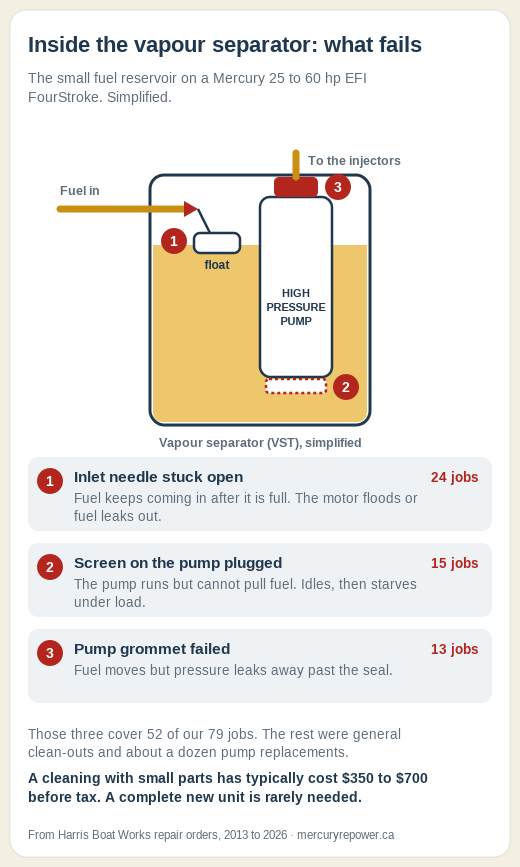
Three small things inside it do most of the failing:
- an inlet needle and float, which let fuel in and shut it off when the tank is full
- a fine screen on the pump's intake
- a rubber grommet that seals the pump so it can build pressure
We have found the same three faults on motors from model year 2002 to 2023.
Why is it leaking fuel or flooding?
Most often the inlet needle is stuck open or has a speck of debris sitting under it. Fuel keeps coming in after the tank is full. It ends up in the engine, which floods it, or outside the motor. We found this on 24 jobs.
Twice in 2026 the cause was different: the rubber insulator around the electric pump had swollen and was holding the float down, so the needle could not close. One of those motors was a 2023. Owners elsewhere have found the same thing, usually after fitting a new needle that changed nothing.
Why will it not start, or why does it lose power?
Two findings cover most of these.
The screen on the pump is plugged (15 jobs). The pump is running but it cannot pull fuel through. What plugs it is rust, dirt, or pieces from the inside of an old fuel line. A screen that is only partly blocked lets the motor idle and then starves it when it is working.
The pump's grommet has failed (13 jobs). The pump runs and fuel moves, but pressure leaks away past the seal. This is a small, inexpensive part, and it is the reason we look inside before anyone quotes a pump.
One more thing to rule out before anyone quotes a pump: the wiring connector on top of the vapour separator. A poor connection there stops the pump and looks exactly like a dead one. We have not logged one here, but it takes a minute to check.
Those needle, screen and grommet findings account for 52 of the 79 jobs. The rest were clean-outs where the notes did not single out one part, plus about a dozen where the electric pump had to be replaced.
When is a pump really needed?
Mostly on motors that sat for years. The pump seizes or rusts and no amount of cleaning brings it back.
Why does it get dirty again?
Cleaning the vapour separator fixes today's problem. These are the sources we have traced the dirt back to.
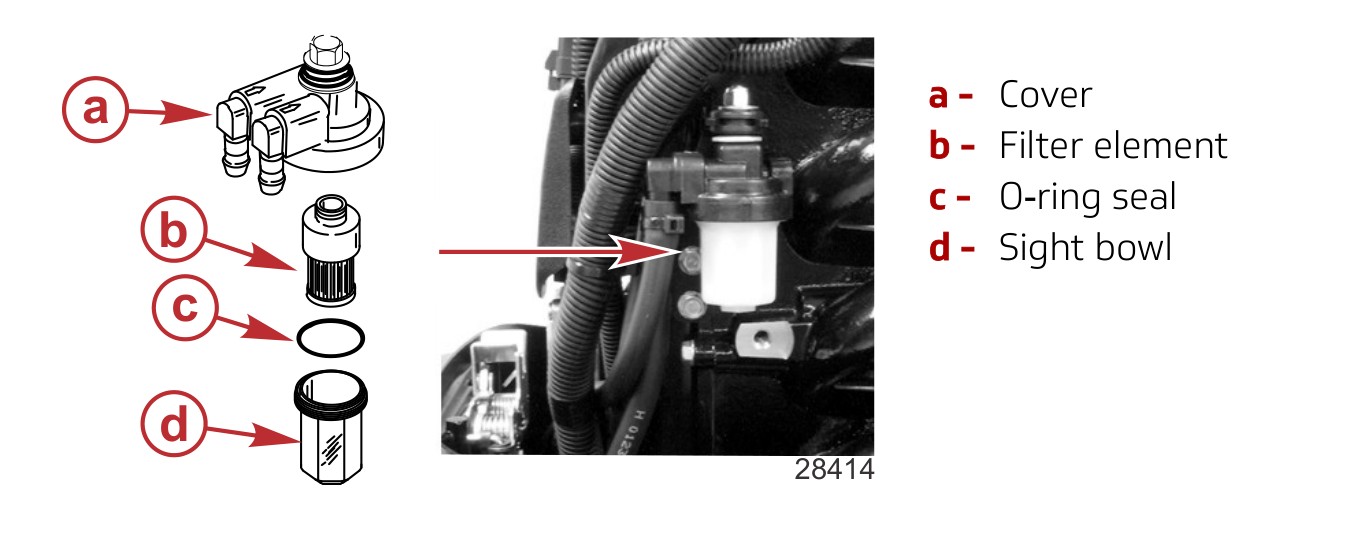
Before fuel reaches the vapour separator, it passes through this filter on the 30–60 FourStroke shown. The arrow points to the installed filter. Water or sediment can collect in its sight bowl (d). Mercury Marine owner’s manual 8M0231124, p. 86, fig. 28414.
The fuel line from the boat. The liner inside old hose breaks down and sheds. We have replaced 39 lines for this, across all sizes of motor. The hose looks fine from the outside.
Water and old fuel. The biggest single cause of fuel trouble we see on any motor. Rust inside the vapour separator is the sign that water has been sitting in it.
A mechanical fuel pump that came apart. On seven 40, 50 and 60 hp motors, the mechanical pump on the engine had failed internally and sent its pieces downstream.
The tank. Rarely, something in the boat's fuel tank or vent system is feeding dirt into the line.
If a vapour separator is dirty again a month after it was cleaned, one of these is feeding it, and cleaning it again will not fix that.
What not to do
Do not buy a complete vapour separator as a first move. It is the least likely fix.
Do not replace the high-pressure pump because there is no pressure. Check the screen and the grommet first.
Do not keep running a motor that is leaking fuel, and do not squeeze the primer bulb on one. That pushes more fuel past a needle that is already stuck open.
What to tell us when you book
The horsepower and the serial number if you have it, or the year if you do not, whether fuel is leaking or the motor simply will not run, and how long it sat. If fuel is leaking, say so first.
We are Harris Boat Works, on Rice Lake in Gores Landing, Ontario. Service requests are at hbwservice.ca.
The counts on this page are from our own repair orders on 25 to 60 hp motors, September 2014 to November 2026, unless a line says otherwise.
Sources
- Mercury Marine: Quick Tip, Priming Your Fuel System, accessed November 25, 2026.
- Mercury Marine Canada: Service and Support FAQs, accessed November 25, 2026.
- HBW service records review, November 2026: technician notes on 959 fuel-system repair jobs, December 2013 to November 2026, including 79 vapour separator jobs on 25 to 60 hp motors, classified by what was found and fixed. Costs are from 2024 to 2026 jobs, parts and labour before tax (no customer data used)
About the author
Jay Harris runs Harris Boat Works, a family marina and Mercury dealer on Rice Lake in Gores Landing, Ontario. The repair counts and costs on this page come from the shop's own work orders.