Short answer
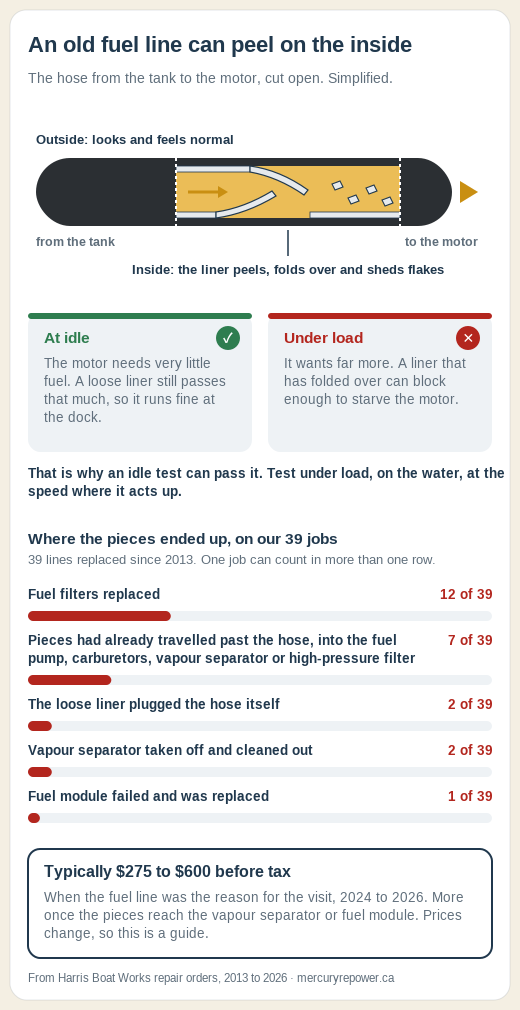
An old fuel hose can come apart on the inside while the outside still looks fine, and the loose liner starves the motor when it is working hardest. It often passes a test at idle, which is why it gets missed. We have replaced 39 boat-to-motor fuel lines for this since 2013, on motors from 25 to 150 hp. When the fuel line was the reason for the visit, the bill has typically been $275 to $600 before tax, and more once the pieces reach the vapour separator or fuel module.
What it looks like from the driver's seat
The most common complaint on these jobs was a motor that idles and runs at low speed, then bogs, surges or loses power when you ask it to get on plane or hold speed. Some quit and would not restart. A few were the other way round: surging while trolling, or sputtering at low revs and fine at full throttle. So do not rule the hose out because your symptom is different.
Other signs our techs found:
- Flakes in a fuel filter, or a clear plastic film that has crinkled and folded over inside a hose fitting. The liner will not always show up as dark flecks.
- On a motor that uses a primer bulb, a bulb that goes flat while the motor is running. Something is restricting flow between the bulb and the tank, and a collapsing hose is one candidate. A firm bulb does not clear the hose: on one of ours the bulb was fine and the liner was plugging the line anyway.
- A bulb that is damaged inside. On one job this year the tech noted the bulb was squished inside as well as the hose.
- On a few larger fuel-injected motors, the notes also record a warning horn or a fuel pump fault on the gauge. Those alarms have other causes: on one the fuel module had also failed, and another just had a nearly empty tank. Check the gauge before you book.
Most of ours came in June to September, when boats are run hardest. On several jobs the motor was in for something else entirely and the tech found the hose while checking it over.
Why an idle test misses it
At idle the motor needs very little fuel. A hose with a loose liner can still pass that much, so it runs fine on the muffs in the driveway and at the dock. Under load the motor wants far more, and a liner that has peeled and folded over can block enough of it to starve the motor.
That is also why it has to be tested under load, on the water, at the speed where it acts up.
Where the pieces end up
Pieces do not stay in the hose. On our 39 jobs:
- Fuel filters were replaced on 12.
- On seven, the notes record pieces of liner that had already travelled past the hose: into the fuel pump, the carburetors, the vapour separator or the high-pressure filter.
- On two more, the liner had come loose and plugged the hose itself.
- Two needed the vapour separator taken off and cleaned out. More on that part in our guide to vapour separator problems.
- On one, pieces were in the high-pressure filter and the fuel module had failed and was replaced. That boat later turned out to have a second source of dirt as well, a soaked charcoal canister on the tank vent.
Cleaning liner out of a vapour separator costs more than the hose did.
Grey hose
Two of our techs' notes name grey fuel hose by name, and older grey hose is the one owners online complain about most. That is a reason to look hard at an old grey line. It is not proof that every grey hose is bad, and a black one is not safe because of its colour. What matters is what the inside looks like.
How to check it yourself, safely
You can do two useful checks without opening anything on the motor. Before either one, work outside, away from anything that sparks, with no smoking, and keep rags handy. Fuel and fuel-soaked rags go to household hazardous waste, never overboard or in the garbage.
Look in the filter and the bulb. If your boat has a spin-on water-separating filter near the tank, pour what is in the old one into a clean glass jar when you change it and look for flakes or film. If your motor has a primer bulb, check it while the motor is running. A bulb that sucks flat means something is restricting flow between the bulb and the tank.
Run it on a different tank and hose. Our techs do this before they take anything apart. It needs a connector on the outside of the motor. If your hose disappears under the cowl with none, this test is shop work. Borrow a portable tank and a hose you know is good, strap the tank down, connect it to the motor and run it under load where it usually acts up. Have a fire extinguisher aboard and a second person driving so you can watch the motor. If it runs properly, the problem is in your boat: the hose, the tank vent, a stuck valve at the tank or the pickup. If it still starves, the problem is on the motor's own fuel system. The order we check them in is in our guide to a Mercury that bogs down under load.
If you take the old hose off, turn the battery switch off first, then work outside with the same no-spark, no-smoking rules. Have rags and a container ready, because fuel will run out. A sealed portable tank can build up pressure sitting in the sun, so open its cap slowly to let it off, and wear eye protection, since a connector under pressure can spray fuel. With a built-in tank, keep the loose end of the hose raised above the tank and plugged, so fuel cannot siphon out into the boat. Stop at the connector on the motor. Everything under the cowl is shop work, and never open a fuel-injection line yourself. Those lines hold pressure.
If you are replacing the hose anyway, cut the old one open lengthwise and look. If the liner is peeling, ask where the missing pieces went, and have the filters checked.
After any work, prime the system: squeeze the bulb firm, or on a motor without one, prime it the way the owner's manual says. Look at every connection for a drip or a smell of fuel before you start it, then test it under load.
What to replace it with
We replace it with Mercury fuel line, either a complete line with fittings (and a bulb, on motors that use one) or hose cut to length with new clamps. Ask for marine fuel hose made for outboard fuel lines. Clear tubing and hose meant for something else are not fuel lines, and the clear hose a tech uses for testing goes back to proper fuel hose before the boat leaves. If your tank is built in, the hose that runs under the floor is a different job from a portable tank line. It has to be the right rated hose for that spot, so match what is printed on the old hose or have us supply it.
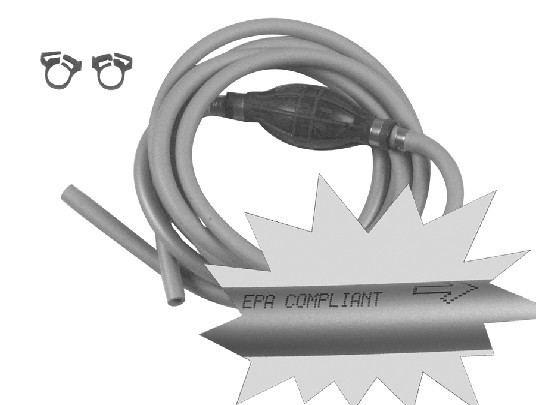
The close-up shows the flow arrow and “EPA COMPLIANT” marking on one Mercury replacement hose. A grey jacket alone tells you little about the liner inside. Match the hose rating, inside diameter and fittings to your installation. Mercury Marine, 2026 Canada Accessories Guide, p. 72.
Whether a motor should have a bulb depends on the engine family, not horsepower alone. Mercury's current fuel-injected FourStrokes of 60 hp and under use one; those of 75 hp and up prime themselves, and a bulb should not be added. Two-strokes, OptiMax and carburetor motors of 75 hp and up do use one. If your motor has a bulb and it is old, do it at the same time. The bulb was replaced on 9 of our 39 jobs. While the hose is off, the O-rings in the quick connectors are worth a look, since a tired one lets air in.
How old is too old?
We cannot give you a number of years, and we would be wary of anyone who does. Where the work order recorded the motor's model year, the motor was 3 to 25 years old, most of them 8 to 18. We do not know how old each hose was, and some were certainly not the original.
The practical rule: if you do not know how old the hose is, or the motor starves under load, have the inside looked at. Old grey hose deserves a look on its own. A replacement line costs far less than cleaning its pieces out of the vapour separator.
What it costs
These are the totals our customers paid, parts and labour, before tax, on jobs from 2024 to 2026 where the fuel complaint was the reason for the visit.
Fuel line replaced: typically $275 to $600. On its own, with small items like a bulb, plugs, a plug wire or fuel, it has been about $280 to $430.
Fuel line plus a float switch on a 2007 to 2014 75, 90 or 115 FourStroke: about $500 to $590 on the two we did. Six of our 39 also needed a float switch. That part is covered in our guide to a 75, 90 or 115 that quits after 20 minutes.
Fuel line plus a complete fuel module: about $1,730 on the one we did.
Three other jobs found a bad hose while doing bigger, unrelated repairs, and those bills say nothing about the hose, so they are left out. Most of our fuel line jobs billed 1 to 3 hours of labour, including the time to find it.
Prices change, so treat these as a guide and not a quote.
What else it could be
A failing hose is only one reason a motor starves under load, though it is one of the cheapest to fix. Water or old fuel, a blocked tank vent, a stuck valve at the tank, a plugged filter, a tired fuel pump and dirt in the vapour separator can all feel the same from the seat. Seven of our 39 had water in the fuel as well. If a new hose does not fix it, the order to check the rest is in the bog-down guide.
What to tell us when you book
What the motor does and at what speed, whether the primer bulb (if it has one) goes flat when it happens, how old you think the fuel line is, and whether you have found anything in a filter. If you have the old hose or a filter with flakes in it, bring it.
We are Harris Boat Works, on Rice Lake in Gores Landing, Ontario. Service requests are at hbwservice.ca.
The counts on this page are from our own repair orders, December 2013 to November 2026.
Sources
- Mercury Marine: Quick Tip, Priming Your Fuel System, accessed November 25, 2026.
- HBW service records review, November 2026: technician notes on 959 fuel-system repair jobs, December 2013 to November 2026, classified by what was found and fixed. Costs are from 2024 to 2026 jobs, parts and labour before tax (no customer data used)
About the author
Jay Harris runs Harris Boat Works, a family marina and Mercury dealer on Rice Lake in Gores Landing, Ontario. The repair counts and costs on this page come from the shop's own work orders.
