Short answer
If your motor is a 2007 to 2014 Mercury 75, 90 or 115 FourStroke and it runs well for 15 to 30 minutes before it bogs or stalls, the likely cause is a small float switch inside the fuel module. We have replaced that switch 58 times, 49 of them on these three motors. It usually takes about two hours, and the bill has typically been $480 to $620 before tax.
What it feels like
The motor starts and runs the way it always has. You get out past the point, open it up, and somewhere between fifteen minutes and half an hour in, it starts to lose power. It may surge. It may stall. Shut it off, wait a few minutes, and it will often start again, then do the same thing on the next run.
That pattern is what our customers described, nearly word for word. Most had already changed the plugs and the fuel filters and filled up with premium. None of that touches the cause. On eight of the 58 jobs a warning horn or beep was part of the complaint as well.
Why it takes 20 minutes
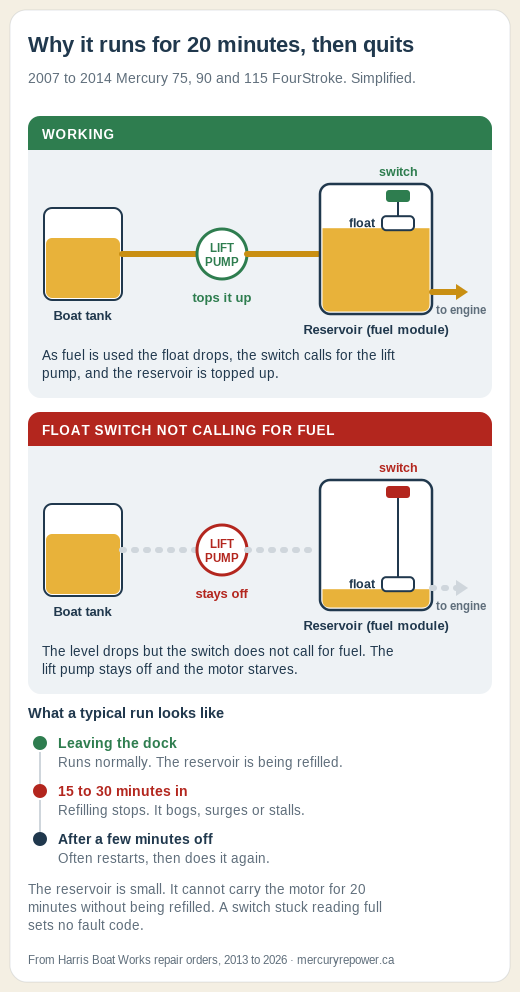
Your motor has a small fuel reservoir under the cowl called the fuel supply module. An electric lift pump keeps it full. A float switch inside tells that pump when to run.
When the switch stops doing its job, the lift pump stops topping up the reservoir. The level falls and the motor starves.
The reservoir is small. It could not carry the motor for twenty minutes without being refilled, so the lift pump is clearly keeping up when you leave the dock. Somewhere in the run the refilling stops. On our jobs that was most often fifteen to thirty minutes in. Shut the motor off for a few minutes and it will often run again for a while.
The lift pump itself is usually fine. We have had pumps test good on the bench while the switch that controls them had failed.
It also leaves no trace for a scan tool. Mercury's service bulletin on these modules says a float switch stuck in the "full" position keeps the lift pump off and sets no fault code. A clean scan does not clear the switch.
The switch can fail the other way too and leave the lift pump running. Then the module overfills, fuel reaches the vent, and the motor sets a fault and shuts the lift pump off. That is where the horn on some of our jobs came from.
Is your motor one of these?
Go by the serial number, not only the model year. It is on the label on the transom bracket. Our guide to reading a Mercury serial number shows where to look.
Serial 1B366823 to 2B094995. These are the 2007 to 2014 75, 90 and 115 FourStrokes. The module comes apart and the float switch can be replaced by itself. Every float switch job where we recorded the serial number falls in this range.
Serial 2B094996 and up. These are the 2015 and newer 75, 90 and 115 FourStrokes. The module is a different design with no float switch in it. When one has failed here, we have replaced the whole module.
Of our 58 float switch jobs, 49 were on these motors: 24 were 90s, 19 were 115s and six were 75s. Four were on larger Mercury motors from the same years that use the same switch (two 175s, a 150 and a 300), and five were on boats where the work order did not record the engine model. This page is about the 75, 90 and 115.
How we confirm it before replacing anything
The tech runs the motor long enough to draw the module down and checks whether the lift pump is being switched on to refill it. If it is not, the module comes out, both pumps are tested and the switch is checked. That is how we know it is the switch and not the pump.
If it turns out to be something else, you pay for the time it took to find that out. On fuel complaints since 2024 where no parts were needed, that has been about $125 to $210.
What it costs
These are the totals our customers paid, parts and labour, before tax, on jobs from 2024 to 2026.
Float switch repair (2007 to 2014): typically $480 to $620. The lowest was about $440. The highest was about $990, on a job where the tech also found water in the fuel and a rotted fuel line.
Complete module (2015 and newer): we have replaced nine since 2020, on 90, 115 and 150 hp motors. Five were covered by warranty. Of the four that were not, the three with a complete bill on file came to $1,700 to $2,450.
Prices change, so treat these as a guide and not a quote.
What else might be on the bill?
Once the module is open, the tech can see what else is worn. On our 58 float repairs these also came up. One job can be in more than one line.
- A small hose inside the module that had gone soft: 22 jobs
- Spark plugs: 16
- Fuel filters: 14
- An air filter that was falling apart: 12
- Water or old fuel sitting in the module: 10
- The fuel line from the boat breaking down on the inside: 6
The last two matter most. A module does not fill with water or flakes of hose liner by itself. If the cause is upstream and nobody fixes it, a new float switch is a temporary repair.
If it happens on the water
Ease back to idle or a slow cruise and head for the nearest safe spot. If the switch is cutting in and out, the motor may keep going at low speed long enough to get you home. If the lift pump has stopped completely, it will stall once the reservoir is empty no matter how gently you drive.
- If the warning horn sounds, find out why before you keep going. A horn can mean overheating or low oil pressure, and running through either can ruin the engine. You cannot tell which it is from the driver's seat.
- If you smell fuel or see it, shut the motor off and do not restart it. Twice we have seen the lift pump stick on, overfill the module and push fuel out where it should never be. Have the oil checked afterwards, because fuel from an overfilled module can end up in the engine oil.
- If it will not restart, stop cranking. Anchor if you are drifting somewhere you should not be, and call for a tow.
What not to do
Do not buy a complete module for a 2007 to 2014 motor before someone tests the float switch. That is the expensive way to fix a small part.
Do not order a float switch for a motor with a serial number of 2B094996 or higher. It will not fit anything.
Do not add a primer bulb to get around it. Mercury's guidance is that its 75 hp and larger motors prime themselves and do not use a bulb, and the bulletin on this module names a primer bulb as one way fuel gets forced into the vent. Our techs have taken three off during float switch repairs. A bulb does not fix a dead switch.
Do not judge it at the dock. At idle the motor sips fuel, so one with this fault can run on the hose long enough to look fine. It has to be run under load, on the water, long enough for the fault to show.
What if it is not the float switch?
A float switch is the most common fix we see for this exact pattern on these exact motors. It is not the only possibility. Water in the tank, a fuel line that is collapsing inside, a stuck valve at the tank or worn plugs can all look similar, and each is cheaper to rule out than to guess at. The order our techs check them in is in our guide to a Mercury that bogs down under load.
What to tell us when you book
The model year or serial number, how many minutes into a run it happens, and whether the horn sounds. That is enough for the tech to know where to start before the cowl comes off.
We are Harris Boat Works, on Rice Lake in Gores Landing, Ontario. Service requests are at hbwservice.ca.
The counts on this page are from our own repair orders, December 2013 to November 2026.
Sources
- Mercury Marine Canada: 8M6000359 float switch for select 75 to 300 hp outboards, accessed November 25, 2026.
- Mercury Marine Service Bulletin 2009-09, fuel supply module troubleshooting (dealer bulletin). Confirm anything serial-specific with a Mercury dealer.
- Mercury Marine Service Bulletin 2014-01, new model information for the 2.1 L 75 to 115 FourStroke (dealer bulletin).
- Mercury Marine: Quick Tip, Priming Your Fuel System, accessed November 25, 2026.
- HBW service records review, November 2026: technician notes on 959 fuel-system repair jobs, December 2013 to November 2026, classified by what was found and fixed. Costs are from 2024 to 2026 jobs, parts and labour before tax (no customer data used)
About the author
Jay Harris runs Harris Boat Works, a family marina and Mercury dealer on Rice Lake in Gores Landing, Ontario. The repair counts and costs on this page come from the shop's own work orders.
