Short answer
A Mercury that idles fine and falls flat when you ask it to work is most often short of fuel, and the cause tends to be cheaper and closer to the tank than the part you are about to order. It can also be spark, or the motor protecting itself from heat or low oil pressure, so that gets ruled out first. This is the order our techs check things in, what each fix has typically cost, and where it usually ends up for your size of motor. It comes from 959 fuel-system jobs at Harris Boat Works since 2013.
Why the order matters
The cheap causes are common. The expensive ones are rare. Most of the money wasted on these problems is spent replacing something from the bottom of this list before anyone has looked at the top.
A motor that is fine at idle and bogs under load also has to be tested under load, at the speed where it fails. Idling on the hose in the driveway proves nothing either way.
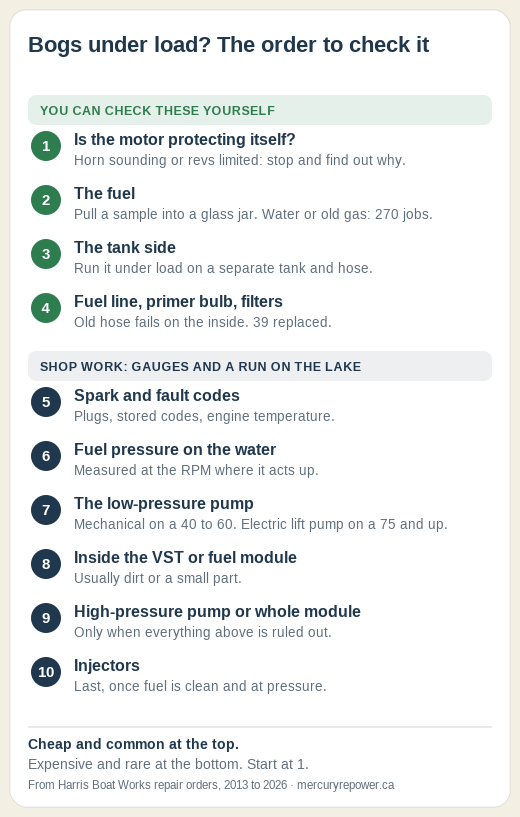
The order our techs check it
The first four you can check yourself. From step 5 down it is shop work with gauges and a run on the lake.
1. Is the motor protecting itself? If a warning horn is sounding, or the motor will only rev so far and no further, stop and find out why. A horn can mean overheating or low oil pressure. Neither is a fuel problem and both can wreck an engine. A motor that has cut its own power also feels exactly like fuel starvation from the driver's seat.
2. The fuel. Pull a sample into a glass jar and look at it. Water or old gas is the most common thing we find: 270 jobs.
3. The tank side. Run the motor under load, where it bogs, on a separate tank and hose. If it runs properly, the problem is in the boat: a blocked vent, a stuck valve at the tank, or a loose pickup tube.
4. The fuel line, primer bulb and filters. Old hose breaks down on the inside where you cannot see it. We have replaced 39 for that reason. Many boats have two filters: a small one under the cowl and a spin-on water-separating filter back near the tank.
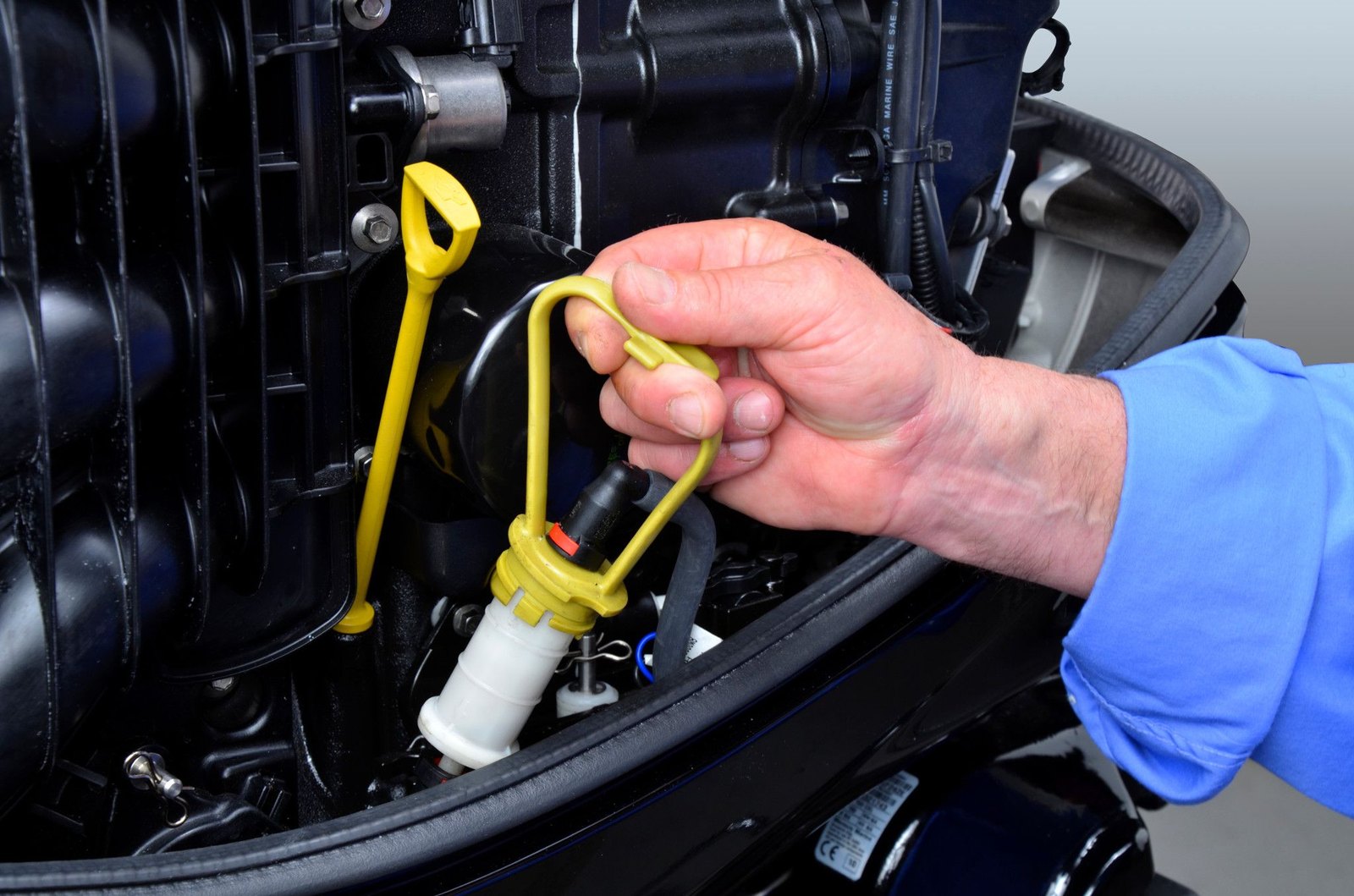
The engine fuel filter is the white cartridge below the yellow loop in the technician’s hand. The other yellow handle, on the left, is the oil dipstick. This is a Mercury 150 FourStroke. Photo courtesy of Mercury Marine.
5. Spark and fault codes. Plugs, stored codes, engine temperature. About one in eight of our fuel jobs needed plugs as well as the fuel repair.
6. Fuel pressure on the water. Measured at the RPM where the motor acts up. Do not tee a gauge into a fuel-injection line yourself. Those lines hold pressure.
7. The low-pressure pump. On a 40, 50 or 60 that is the mechanical pump on the engine. On a 75 and up it is an electric lift pump inside the fuel module.
8. Inside the vapour separator or fuel module. Usually dirt or a small part.
9. The high-pressure pump or a complete module. Only when everything above has been ruled out.
10. Injectors. Last, once the fuel reaching them is known to be clean and at pressure.
Where it usually ends up, by motor
All costs are what our customers paid in total, parts and labour, before tax, on jobs from 2024 to 2026. Prices change, so treat them as a guide and not a quote.
Portable motors up to 20 hp with a carburetor
Old fuel gumming up the carburetor. It gets taken off and cleaned.
Typical cost: $285 to $525.
40, 50 or 60 hp: only runs while you squeeze the bulb
Often the mechanical fuel pump on the engine. We have replaced 39 as paid repairs since 2018. Squeezing the bulb proves the motor is short of supply, not that the pump is bad, so the tank side and the hose get checked first. More in our guide to a 40, 50 or 60 that only runs on the primer bulb.
Typical cost: $450 to $700.
25 to 60 hp EFI: leaking fuel, flooding, or will not start
Inside the vapour separator: a stuck needle, a plugged screen or a failed seal. We have had 79 apart. A whole new unit is rarely needed. More in our guide to a leaking VST.
Typical cost: $350 to $700. With an electric pump, $700 to $1,450.
75, 90 or 115 hp, 2007 to 2014: fine for 20 minutes, then bogs
A float switch inside the fuel module. We have replaced 58. More in our guide to a 75, 90 or 115 that quits after 20 minutes.
Typical cost: $480 to $620.
75, 90 or 115 hp, 2015 and newer, and the 150: starts then quits, or no fuel pressure
These have a different fuel module with no float switch in it. On the ones that failed here, the whole module was replaced. Nine since 2020, five under warranty. On a 75, 90 or 115 the serial number tells you which module you have: 1B366823 to 2B094995 is the float switch module, 2B094996 and up is the later one.
Typical cost when not under warranty: $1,700 to $2,450.
Any motor, especially at first launch: sputters, stumbles, will not restart
Water or old fuel. More in our guide to water in outboard gas.
Typical cost: $300 to $700.
OptiMax two-strokes and the big V6 and V8 motors have their own fuel systems and are not covered here. On the OptiMax jobs we have done, bad fuel and a dirty vapour separator were the usual findings.
Things that came in as fuel problems and were not
- Worn spark plugs or a failing coil
- A thermostat stuck open, so the engine never warmed up
- A bad temperature sensor
- A worn timing belt
- A weak battery or dirty battery terminals, on boats that came in as "not getting fuel" and would not start
- A loose bracket that stopped the throttle from opening all the way
Why the bogging sometimes comes right back
The hardest jobs are the ones where the repair was right and the boat came back anyway.
We had one return four times in a year. Each visit found and fixed a real fault: a fuel module, a dirty injector, then a set of injectors. On the fourth visit the tech traced the tank vent line from end to end and found a charcoal canister that had soaked through with fuel. Many boats built since about 2012 with a built-in tank have one on the vent to meet emissions rules. The charcoal inside had turned to dust and was washing into the tank a little at a time. Each repair had been fouled again by that dust.
If you ever find fine black dust in a fuel filter, tell your tech, so the vent line gets traced. And stop filling at the first click. Topping off is how liquid fuel reaches the canister.
What not to buy first
- A complete fuel module or vapour separator. The least likely fix and the most expensive.
- Both fuel pumps at once. Owners do this regularly and are often still stuck afterwards.
- A primer bulb for a 75 hp or larger FourStroke. Mercury's guidance is that those motors prime themselves and do not use a bulb. Our techs have removed several.
- Cheap injectors online. We had a motor come in over-fuelling on a set of them. A used set of original injectors fixed it.
What to tell us when you book
The model year or serial number, what the motor does, how many minutes into a run it starts, the RPM, and whether squeezing the primer bulb changes anything.
We are Harris Boat Works, on Rice Lake in Gores Landing, Ontario. Service requests are at hbwservice.ca.
The counts on this page are from our own repair orders, December 2013 to November 2026. Where a count starts later, the line says so.
Sources
- Mercury Marine: Quick Tip, Priming Your Fuel System, accessed November 25, 2026.
- Mercury Marine Canada: Service and Support FAQs, accessed November 25, 2026.
- Mercury Marine Service Bulletin 2009-09, fuel supply module troubleshooting (dealer bulletin). Confirm anything serial-specific with a Mercury dealer.
- HBW service records review, November 2026: technician notes on 959 fuel-system repair jobs, December 2013 to November 2026, classified by what was found and fixed. Costs are from 2024 to 2026 jobs, parts and labour before tax (no customer data used)
About the author
Jay Harris runs Harris Boat Works, a family marina and Mercury dealer on Rice Lake in Gores Landing, Ontario. The repair counts and costs on this page come from the shop's own work orders.
